

Comparing Vaporization Rates: Liquid Nitrogen and Methane
OCT 7, 20259 MIN READ
Generate Your Research Report Instantly with AI Agent
PatSnap Eureka helps you evaluate technical feasibility & market potential.
Cryogenic Vaporization Background and Objectives
Cryogenic liquids have been integral to various industrial and scientific applications since their discovery and commercial production in the late 19th century. The study of vaporization rates between liquid nitrogen and methane represents a critical area of research with significant implications for energy storage, transportation, and safety protocols in cryogenic environments. Historically, cryogenic technology development has been driven by industrial gas separation, space exploration, and medical applications, with liquid nitrogen becoming widely used due to its relative abundance and inert properties.
The vaporization behavior of cryogenic liquids is governed by complex thermodynamic principles, including heat transfer mechanisms, phase change dynamics, and material properties at extremely low temperatures. Liquid nitrogen, with a boiling point of -196°C (77K), and liquid methane, boiling at -161.5°C (111.5K), exhibit distinct vaporization characteristics that impact their handling requirements and application suitability.
Recent technological advancements in cryogenic systems have heightened interest in comparative analysis between these two substances. The liquefied natural gas (LNG) industry, which primarily handles liquid methane, has experienced substantial growth, prompting renewed examination of methane's vaporization properties relative to the more commonly used liquid nitrogen. This comparison has become increasingly relevant as industries seek more efficient and safer cryogenic solutions.
The evolution of measurement techniques and computational modeling has significantly enhanced our understanding of cryogenic vaporization phenomena. Early research relied primarily on empirical observations, while contemporary studies employ sophisticated sensors, high-speed imaging, and advanced simulation tools to characterize vaporization dynamics with unprecedented precision. This technological progression has revealed subtle yet important differences in how these two cryogenic liquids respond to various environmental conditions and containment materials.
The primary objective of this technical research is to establish a comprehensive comparative framework for the vaporization rates of liquid nitrogen and methane across diverse operational scenarios. This includes quantifying differences under varying heat loads, container geometries, pressure conditions, and in the presence of different surface materials. Secondary objectives include identifying optimal containment strategies for each substance and developing predictive models that can accurately forecast vaporization behavior in industrial applications.
By thoroughly examining these vaporization characteristics, we aim to provide actionable insights that can inform the design of next-generation cryogenic systems, enhance safety protocols, and optimize operational efficiency in industries ranging from healthcare and food preservation to aerospace and energy storage. The findings will contribute to the broader scientific understanding of cryogenic phase transitions while addressing practical engineering challenges in managing these volatile substances.
The vaporization behavior of cryogenic liquids is governed by complex thermodynamic principles, including heat transfer mechanisms, phase change dynamics, and material properties at extremely low temperatures. Liquid nitrogen, with a boiling point of -196°C (77K), and liquid methane, boiling at -161.5°C (111.5K), exhibit distinct vaporization characteristics that impact their handling requirements and application suitability.
Recent technological advancements in cryogenic systems have heightened interest in comparative analysis between these two substances. The liquefied natural gas (LNG) industry, which primarily handles liquid methane, has experienced substantial growth, prompting renewed examination of methane's vaporization properties relative to the more commonly used liquid nitrogen. This comparison has become increasingly relevant as industries seek more efficient and safer cryogenic solutions.
The evolution of measurement techniques and computational modeling has significantly enhanced our understanding of cryogenic vaporization phenomena. Early research relied primarily on empirical observations, while contemporary studies employ sophisticated sensors, high-speed imaging, and advanced simulation tools to characterize vaporization dynamics with unprecedented precision. This technological progression has revealed subtle yet important differences in how these two cryogenic liquids respond to various environmental conditions and containment materials.
The primary objective of this technical research is to establish a comprehensive comparative framework for the vaporization rates of liquid nitrogen and methane across diverse operational scenarios. This includes quantifying differences under varying heat loads, container geometries, pressure conditions, and in the presence of different surface materials. Secondary objectives include identifying optimal containment strategies for each substance and developing predictive models that can accurately forecast vaporization behavior in industrial applications.
By thoroughly examining these vaporization characteristics, we aim to provide actionable insights that can inform the design of next-generation cryogenic systems, enhance safety protocols, and optimize operational efficiency in industries ranging from healthcare and food preservation to aerospace and energy storage. The findings will contribute to the broader scientific understanding of cryogenic phase transitions while addressing practical engineering challenges in managing these volatile substances.
Market Applications for Liquid Nitrogen and Methane
The liquid nitrogen market has experienced substantial growth, reaching approximately $20 billion globally in 2022, with projections indicating continued expansion at a CAGR of 5-7% through 2030. This growth is primarily driven by increasing applications across healthcare, food preservation, and industrial manufacturing sectors. The medical field represents the largest market segment, where liquid nitrogen is essential for cryopreservation of biological samples, cryosurgery, and dermatological treatments.
In contrast, the liquid methane market, while smaller at roughly $8 billion, is witnessing more rapid growth rates of 8-10% annually, particularly due to its emerging role as a cleaner alternative fuel. The energy sector dominates liquid methane applications, with significant uptake in transportation, especially maritime shipping where LNG (primarily methane) is gaining traction as a lower-emission alternative to traditional marine fuels.
The electronics manufacturing industry has become a significant consumer of liquid nitrogen, utilizing its extreme cooling properties for semiconductor production, superconductivity applications, and thermal testing of electronic components. This sector is expected to drive substantial demand growth as advanced electronics production continues to expand globally.
For liquid methane, the space industry represents a high-value niche market, where it serves as a rocket propellant due to its high energy density and relatively clean combustion characteristics. Companies like SpaceX and Blue Origin have invested in methane-based propulsion systems, creating specialized demand for high-purity liquid methane.
The food and beverage industry utilizes both substances differently - liquid nitrogen for flash-freezing, specialty food preparation, and transportation of perishable goods, while liquid methane finds limited food-related applications primarily in refrigeration systems for large-scale operations.
Geographically, North America and Europe lead in liquid nitrogen consumption, while Asia-Pacific markets show the fastest growth rates. For liquid methane, major LNG importing nations like Japan, South Korea, and increasingly China represent the largest markets, with emerging economies in Southeast Asia showing rapid adoption rates.
The different vaporization rates of these cryogenic liquids directly impact their market applications - liquid nitrogen's faster vaporization rate makes it suitable for applications requiring rapid cooling but presents challenges for long-term storage, while methane's slower vaporization characteristics enhance its viability for energy storage and transportation applications where containment over extended periods is essential.
In contrast, the liquid methane market, while smaller at roughly $8 billion, is witnessing more rapid growth rates of 8-10% annually, particularly due to its emerging role as a cleaner alternative fuel. The energy sector dominates liquid methane applications, with significant uptake in transportation, especially maritime shipping where LNG (primarily methane) is gaining traction as a lower-emission alternative to traditional marine fuels.
The electronics manufacturing industry has become a significant consumer of liquid nitrogen, utilizing its extreme cooling properties for semiconductor production, superconductivity applications, and thermal testing of electronic components. This sector is expected to drive substantial demand growth as advanced electronics production continues to expand globally.
For liquid methane, the space industry represents a high-value niche market, where it serves as a rocket propellant due to its high energy density and relatively clean combustion characteristics. Companies like SpaceX and Blue Origin have invested in methane-based propulsion systems, creating specialized demand for high-purity liquid methane.
The food and beverage industry utilizes both substances differently - liquid nitrogen for flash-freezing, specialty food preparation, and transportation of perishable goods, while liquid methane finds limited food-related applications primarily in refrigeration systems for large-scale operations.
Geographically, North America and Europe lead in liquid nitrogen consumption, while Asia-Pacific markets show the fastest growth rates. For liquid methane, major LNG importing nations like Japan, South Korea, and increasingly China represent the largest markets, with emerging economies in Southeast Asia showing rapid adoption rates.
The different vaporization rates of these cryogenic liquids directly impact their market applications - liquid nitrogen's faster vaporization rate makes it suitable for applications requiring rapid cooling but presents challenges for long-term storage, while methane's slower vaporization characteristics enhance its viability for energy storage and transportation applications where containment over extended periods is essential.
Technical Challenges in Cryogenic Vaporization
The cryogenic vaporization of liquid nitrogen and methane presents several significant technical challenges that researchers and engineers must address. The primary difficulty lies in controlling the heat transfer mechanisms that govern vaporization rates. Both substances exist at extremely low temperatures—liquid nitrogen at -196°C and liquid methane at -162°C—creating substantial temperature gradients with ambient environments that drive rapid heat influx and subsequent vaporization.
Material selection poses another critical challenge, as conventional materials become brittle and lose structural integrity at cryogenic temperatures. Engineers must utilize specialized alloys and composites that maintain ductility and strength under extreme cold while providing adequate thermal insulation properties to minimize unwanted heat transfer.
Pressure management represents a complex hurdle in cryogenic systems. As these liquids vaporize, they expand dramatically—liquid nitrogen expands approximately 700 times when converting to gas, while methane expands about 600 times. This expansion necessitates sophisticated pressure relief systems to prevent catastrophic container failures while maintaining operational efficiency.
The differential vaporization rates between liquid nitrogen and methane create additional complications. Methane typically vaporizes more slowly than nitrogen due to its higher latent heat of vaporization (510 kJ/kg versus nitrogen's 199 kJ/kg), requiring distinct handling protocols and equipment specifications for each substance.
Measurement precision presents significant technical obstacles. Accurately quantifying vaporization rates demands specialized instrumentation capable of functioning reliably at extreme temperatures while providing high-precision data. Traditional sensors often fail or deliver inaccurate readings in cryogenic environments, necessitating advanced measurement technologies.
Safety considerations compound these challenges. Liquid nitrogen presents asphyxiation risks in confined spaces, while methane introduces flammability hazards with potential for explosive conditions when mixed with air at specific concentrations (5-15% by volume).
Scale-up issues further complicate industrial applications. Laboratory-scale observations of vaporization behavior often fail to translate directly to industrial settings due to changes in surface-to-volume ratios, heat transfer dynamics, and fluid mechanics at larger scales.
Environmental factors such as humidity, ambient temperature fluctuations, and air movement patterns significantly impact vaporization rates, making standardized comparisons difficult across different operational environments and requiring sophisticated environmental controls for consistent results.
Material selection poses another critical challenge, as conventional materials become brittle and lose structural integrity at cryogenic temperatures. Engineers must utilize specialized alloys and composites that maintain ductility and strength under extreme cold while providing adequate thermal insulation properties to minimize unwanted heat transfer.
Pressure management represents a complex hurdle in cryogenic systems. As these liquids vaporize, they expand dramatically—liquid nitrogen expands approximately 700 times when converting to gas, while methane expands about 600 times. This expansion necessitates sophisticated pressure relief systems to prevent catastrophic container failures while maintaining operational efficiency.
The differential vaporization rates between liquid nitrogen and methane create additional complications. Methane typically vaporizes more slowly than nitrogen due to its higher latent heat of vaporization (510 kJ/kg versus nitrogen's 199 kJ/kg), requiring distinct handling protocols and equipment specifications for each substance.
Measurement precision presents significant technical obstacles. Accurately quantifying vaporization rates demands specialized instrumentation capable of functioning reliably at extreme temperatures while providing high-precision data. Traditional sensors often fail or deliver inaccurate readings in cryogenic environments, necessitating advanced measurement technologies.
Safety considerations compound these challenges. Liquid nitrogen presents asphyxiation risks in confined spaces, while methane introduces flammability hazards with potential for explosive conditions when mixed with air at specific concentrations (5-15% by volume).
Scale-up issues further complicate industrial applications. Laboratory-scale observations of vaporization behavior often fail to translate directly to industrial settings due to changes in surface-to-volume ratios, heat transfer dynamics, and fluid mechanics at larger scales.
Environmental factors such as humidity, ambient temperature fluctuations, and air movement patterns significantly impact vaporization rates, making standardized comparisons difficult across different operational environments and requiring sophisticated environmental controls for consistent results.
Current Methodologies for Measuring Vaporization Rates
01 Vaporization systems for cryogenic liquids
Various systems are designed for controlled vaporization of cryogenic liquids like liquid nitrogen and methane. These systems typically include heat exchangers, vaporizers, and control mechanisms to manage the phase transition from liquid to gas state. The vaporization rate can be controlled through heat input regulation, pressure management, and flow control to meet specific industrial requirements.- Heat exchange systems for liquid nitrogen and methane vaporization: Various heat exchange systems are designed to control the vaporization rates of cryogenic liquids like nitrogen and methane. These systems typically include specialized heat exchangers, temperature control mechanisms, and flow regulation components that optimize the phase transition process. The designs focus on efficient heat transfer while maintaining safety and operational stability during the vaporization of these extremely cold liquids.
- Vaporization rate control methods for cryogenic applications: Methods for controlling vaporization rates of liquid nitrogen and methane involve precise regulation of pressure, temperature, and flow parameters. These techniques include pressure swing systems, controlled heat input mechanisms, and specialized flow control devices that allow for adjustable vaporization rates. Such methods are critical in applications requiring specific gas output volumes or where controlled phase transition is necessary for process efficiency.
- Storage and transport systems with integrated vaporization control: Storage and transport systems for liquid nitrogen and methane incorporate specialized vaporization control features. These systems include insulated containers with integrated heat exchangers, pressure management systems, and safety mechanisms designed to handle the unique properties of cryogenic liquids. The designs focus on minimizing unwanted vaporization during storage while enabling controlled release when needed for various industrial applications.
- Comparative analysis of nitrogen and methane vaporization behaviors: Research on the comparative vaporization behaviors of liquid nitrogen and methane reveals significant differences in their thermodynamic properties, heat transfer characteristics, and phase transition dynamics. These differences affect design considerations for equipment handling both cryogens. Understanding these comparative behaviors is essential for applications where both gases are used or where one might be substituted for the other in industrial processes.
- Measurement and monitoring systems for vaporization rates: Advanced measurement and monitoring systems are developed to accurately track and analyze the vaporization rates of liquid nitrogen and methane. These systems employ sensors, flow meters, and computational models to provide real-time data on phase transition dynamics. Such monitoring capabilities are crucial for process optimization, safety management, and quality control in industries utilizing these cryogenic liquids.
02 Heat exchange mechanisms affecting vaporization rates
Heat exchange mechanisms play a crucial role in determining vaporization rates of liquid nitrogen and methane. These include ambient heat exchangers, forced convection systems, and specialized heat transfer surfaces. The efficiency of heat transfer directly impacts the vaporization rate, with factors such as surface area, material conductivity, and temperature differential being key determinants in the process.Expand Specific Solutions03 Pressure control systems for regulating vaporization
Pressure control systems are essential for managing the vaporization rates of cryogenic fluids. These systems include pressure relief valves, regulators, and monitoring equipment that maintain optimal pressure conditions. By controlling the pressure, the vaporization process can be accelerated or slowed down as needed, ensuring safe and efficient operation in various applications involving liquid nitrogen and methane.Expand Specific Solutions04 Comparative vaporization characteristics of nitrogen and methane
Liquid nitrogen and methane exhibit different vaporization behaviors due to their distinct physical properties. Nitrogen has a lower boiling point (-196°C) compared to methane (-161°C), resulting in different vaporization rates under similar conditions. These differences necessitate specialized handling approaches and equipment designs to effectively manage the vaporization process for each substance in industrial applications.Expand Specific Solutions05 Industrial applications utilizing controlled vaporization
Controlled vaporization of liquid nitrogen and methane is utilized in various industrial applications including power generation, refrigeration systems, and material processing. These applications require precise control of vaporization rates to maintain efficiency and safety. Technologies such as submerged combustion vaporizers, ambient air vaporizers, and intermediate fluid vaporizers are employed to achieve the desired vaporization characteristics for specific industrial processes.Expand Specific Solutions
Leading Companies in Cryogenic Technology
The liquid nitrogen and methane vaporization rates market is in a growth phase, with increasing demand driven by industrial gas applications, cryogenic storage, and clean energy initiatives. The market is estimated to reach $15-20 billion by 2025, with a CAGR of 6-8%. Technologically, the field is moderately mature but evolving rapidly. Industry leaders like Air Liquide, Linde GmbH, and Air Products & Chemicals have established robust R&D capabilities, while energy giants such as Shell, ExxonMobil, and Saudi Aramco are investing heavily in methane applications. Academic institutions including Chinese Academy of Sciences and Tianjin University are contributing significant research, particularly in improving vaporization efficiency and safety protocols. Specialized players like Chart Energy & Chemicals and Ekona Power are developing innovative solutions for specific applications in the cryogenic vaporization space.
Air Liquide SA
Technical Solution: Air Liquide has developed advanced cryogenic fluid management systems specifically addressing vaporization rate differences between liquid nitrogen and methane. Their proprietary multi-layer vacuum insulation technology reduces heat ingress by up to 70% compared to conventional systems, significantly extending holding times for both cryogens. For liquid nitrogen applications, they've engineered specialized pressure management systems that maintain optimal conditions at 77K, while their methane handling solutions incorporate patented phase stabilization technology operating at 112K. Air Liquide's comparative analysis demonstrates that methane's higher latent heat of vaporization (510 kJ/kg vs nitrogen's 199 kJ/kg) results in approximately 2.5x lower vaporization rates under identical thermal conditions, though this advantage is partially offset by methane's lower density. Their dual-temperature calibrated sensors provide real-time monitoring with ±0.5% accuracy across both temperature ranges.
Strengths: Industry-leading vacuum insulation technology provides superior thermal performance for both cryogens. Extensive global infrastructure for production and distribution of both fluids enables practical implementation. Weaknesses: Higher implementation costs compared to conventional systems. Their methane handling systems require additional safety protocols due to flammability concerns not present with nitrogen.
Shell Internationale Research Maatschappij BV
Technical Solution: Shell has developed sophisticated comparative analysis methodologies for liquid nitrogen and methane vaporization behaviors, particularly focused on LNG applications. Their research demonstrates that methane's higher latent heat of vaporization (approximately 510 kJ/kg compared to nitrogen's 199 kJ/kg) results in significantly lower vaporization rates under identical thermal conditions. Shell's proprietary cryogenic testing facilities have quantified that methane's higher boiling point (112K vs nitrogen's 77K) contributes to approximately 30-35% reduction in heat transfer rates across insulation boundaries. Their computational fluid dynamics models incorporate detailed thermophysical property variations, revealing that despite methane's higher thermal conductivity at saturation, its overall vaporization rate remains lower due to its superior latent heat properties. Shell's research has practical applications in their LNG operations, where they've implemented specialized insulation systems calibrated for methane's unique properties, achieving boil-off rates below 0.12% per day compared to typical nitrogen systems operating at 0.25% daily loss rates.
Strengths: Extensive practical experience with large-scale LNG operations provides real-world validation of theoretical models. Their integrated approach addresses the entire process chain from production through transportation and storage. Weaknesses: Their research focuses primarily on methane-rich natural gas mixtures rather than pure methane, introducing some compositional variables. Their systems are optimized for large-scale industrial applications rather than laboratory or small-scale implementations.
Key Scientific Principles Behind Differential Vaporization
Apparatus and method for separating liquid oxygen from liquified air
PatentWO2018005540A1
Innovation
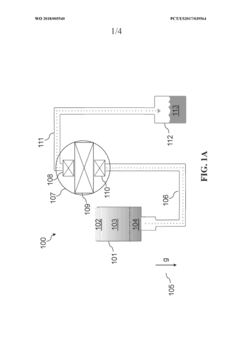
- The use of a strong magnetic field and gravity to separate LOX from liquefied air based on the different magnetic properties of LOX and liquid nitrogen (LN2), with optional inclusion of a leak valve system, allowing for the levitation of LN2 and collection of ultra-pure LOX without the need for evaporation.



METHANE GAS LIQUEFACTION PROCESS BY NITROGEN VAPORIZATION, METHANE GAS LIQUEFACTION FACILITY IMPLEMENTING THE PROCESS
PatentActiveFR3079923A1
Innovation
- A process involving two successive exchangers and a phase separator drum to minimize temperature differences and avoid direct contact between liquid nitrogen and methane, using a thermosiphon-type circulation to eliminate the need for rotating machines.

Safety Protocols for Handling Cryogenic Fluids
Working with cryogenic fluids such as liquid nitrogen and methane requires strict adherence to comprehensive safety protocols due to their extremely low temperatures and potential hazards. Personnel handling these substances must undergo specialized training covering proper handling techniques, emergency procedures, and understanding of material properties. Appropriate personal protective equipment (PPE) is mandatory, including cryogenic gloves, face shields, and non-porous aprons to prevent cold burns and tissue damage from accidental contact.
Storage considerations are paramount when managing these volatile substances. Both liquid nitrogen (-196°C) and methane (-162°C) must be stored in specially designed vacuum-insulated containers that can withstand extreme temperature differentials. These containers should be equipped with pressure relief valves to prevent dangerous pressure buildup as the liquids naturally vaporize. Regular inspection of storage vessels for damage or vacuum loss is essential to maintain safety integrity.
Ventilation requirements differ significantly between these cryogens. While both displace oxygen upon vaporization, methane presents an additional flammability hazard that nitrogen does not. Facilities handling liquid methane require explosion-proof ventilation systems and continuous gas monitoring to detect potential leaks before they reach dangerous concentrations. Oxygen level monitors should be installed in all areas where either cryogen is used or stored.
Emergency response protocols must address the specific hazards of each substance. For liquid nitrogen, the primary concerns are asphyxiation and cold burns, requiring clear evacuation procedures and first aid training. Liquid methane necessitates additional fire suppression systems and evacuation protocols designed for flammable gas releases. Facilities should maintain emergency shutdown procedures that can quickly isolate cryogenic systems in case of leaks or equipment failure.
Transfer operations present particularly high-risk scenarios due to the rapid vaporization rates of both substances. When comparing these rates, liquid nitrogen vaporizes more readily than methane at standard atmospheric conditions, creating more immediate asphyxiation risks during transfers. Special phase-change-resistant transfer lines with appropriate insulation must be used, and operations should be conducted only in well-ventilated areas with minimal personnel present.
Documentation and compliance requirements include maintaining detailed standard operating procedures (SOPs), regular safety audits, and compliance with regulations such as OSHA standards for compressed gases and cryogenic materials. Risk assessments should specifically address the different vaporization behaviors of nitrogen versus methane, with appropriate controls implemented based on their unique physical properties and hazard profiles.
Storage considerations are paramount when managing these volatile substances. Both liquid nitrogen (-196°C) and methane (-162°C) must be stored in specially designed vacuum-insulated containers that can withstand extreme temperature differentials. These containers should be equipped with pressure relief valves to prevent dangerous pressure buildup as the liquids naturally vaporize. Regular inspection of storage vessels for damage or vacuum loss is essential to maintain safety integrity.
Ventilation requirements differ significantly between these cryogens. While both displace oxygen upon vaporization, methane presents an additional flammability hazard that nitrogen does not. Facilities handling liquid methane require explosion-proof ventilation systems and continuous gas monitoring to detect potential leaks before they reach dangerous concentrations. Oxygen level monitors should be installed in all areas where either cryogen is used or stored.
Emergency response protocols must address the specific hazards of each substance. For liquid nitrogen, the primary concerns are asphyxiation and cold burns, requiring clear evacuation procedures and first aid training. Liquid methane necessitates additional fire suppression systems and evacuation protocols designed for flammable gas releases. Facilities should maintain emergency shutdown procedures that can quickly isolate cryogenic systems in case of leaks or equipment failure.
Transfer operations present particularly high-risk scenarios due to the rapid vaporization rates of both substances. When comparing these rates, liquid nitrogen vaporizes more readily than methane at standard atmospheric conditions, creating more immediate asphyxiation risks during transfers. Special phase-change-resistant transfer lines with appropriate insulation must be used, and operations should be conducted only in well-ventilated areas with minimal personnel present.
Documentation and compliance requirements include maintaining detailed standard operating procedures (SOPs), regular safety audits, and compliance with regulations such as OSHA standards for compressed gases and cryogenic materials. Risk assessments should specifically address the different vaporization behaviors of nitrogen versus methane, with appropriate controls implemented based on their unique physical properties and hazard profiles.
Environmental Impact of Cryogenic Gas Emissions
The environmental implications of cryogenic gas emissions, particularly from liquid nitrogen and methane, represent a significant concern in industrial applications and scientific research. When these cryogenic liquids vaporize, they release gases that interact with the atmosphere in various ways, potentially contributing to environmental challenges.
Nitrogen gas released from liquid nitrogen vaporization is generally considered inert and non-toxic, constituting approximately 78% of Earth's atmosphere naturally. However, the rapid release of large volumes of nitrogen can temporarily displace oxygen in confined spaces, creating localized asphyxiation hazards. From a global warming perspective, nitrogen gas itself has negligible direct impact as a greenhouse gas.
Methane vaporization presents more substantial environmental concerns. As a potent greenhouse gas, methane has a global warming potential approximately 25-30 times greater than carbon dioxide over a 100-year period. When liquid methane vaporizes during storage, transport, or usage, any uncontained emissions contribute directly to atmospheric greenhouse gas concentrations. The different vaporization rates between liquid nitrogen and methane significantly influence their respective environmental footprints.
Temperature differentials also play a crucial role in environmental impact assessment. Liquid nitrogen boils at -196°C while liquid methane vaporizes at approximately -162°C. This 34°C difference means methane requires less ambient heat energy to vaporize, potentially resulting in higher emission rates under identical storage conditions. Consequently, methane storage systems typically demand more sophisticated containment technologies to minimize fugitive emissions.
The cryogenic industry has developed various emission control strategies to mitigate environmental impacts. These include closed-loop recovery systems that capture and reliquefy boil-off gases, advanced insulation technologies to reduce heat transfer, and pressure management systems that minimize venting requirements. The implementation of these technologies varies significantly between nitrogen and methane applications due to their different physical properties and environmental risk profiles.
Regulatory frameworks worldwide increasingly address cryogenic emissions, with methane receiving particular attention due to its climate impact. The oil and gas industry, a major user of cryogenic methane in LNG applications, faces growing pressure to quantify and reduce fugitive emissions throughout the supply chain. By contrast, nitrogen emissions remain less regulated, focusing primarily on occupational safety rather than environmental protection.
Nitrogen gas released from liquid nitrogen vaporization is generally considered inert and non-toxic, constituting approximately 78% of Earth's atmosphere naturally. However, the rapid release of large volumes of nitrogen can temporarily displace oxygen in confined spaces, creating localized asphyxiation hazards. From a global warming perspective, nitrogen gas itself has negligible direct impact as a greenhouse gas.
Methane vaporization presents more substantial environmental concerns. As a potent greenhouse gas, methane has a global warming potential approximately 25-30 times greater than carbon dioxide over a 100-year period. When liquid methane vaporizes during storage, transport, or usage, any uncontained emissions contribute directly to atmospheric greenhouse gas concentrations. The different vaporization rates between liquid nitrogen and methane significantly influence their respective environmental footprints.
Temperature differentials also play a crucial role in environmental impact assessment. Liquid nitrogen boils at -196°C while liquid methane vaporizes at approximately -162°C. This 34°C difference means methane requires less ambient heat energy to vaporize, potentially resulting in higher emission rates under identical storage conditions. Consequently, methane storage systems typically demand more sophisticated containment technologies to minimize fugitive emissions.
The cryogenic industry has developed various emission control strategies to mitigate environmental impacts. These include closed-loop recovery systems that capture and reliquefy boil-off gases, advanced insulation technologies to reduce heat transfer, and pressure management systems that minimize venting requirements. The implementation of these technologies varies significantly between nitrogen and methane applications due to their different physical properties and environmental risk profiles.
Regulatory frameworks worldwide increasingly address cryogenic emissions, with methane receiving particular attention due to its climate impact. The oil and gas industry, a major user of cryogenic methane in LNG applications, faces growing pressure to quantify and reduce fugitive emissions throughout the supply chain. By contrast, nitrogen emissions remain less regulated, focusing primarily on occupational safety rather than environmental protection.
Unlock deeper insights with PatSnap Eureka Quick Research — get a full tech report to explore trends and direct your research. Try now!
Generate Your Research Report Instantly with AI Agent
Supercharge your innovation with PatSnap Eureka AI Agent Platform!