

Electrochemical Compression vs. Mechanical Compression: Efficiency
APR 24, 20269 MIN READ
Generate Your Research Report Instantly with AI Agent
PatSnap Eureka helps you evaluate technical feasibility & market potential.
Electrochemical vs Mechanical Compression Background and Objectives
Gas compression technology has undergone significant evolution since the industrial revolution, with mechanical compression systems dominating the landscape for over a century. Traditional mechanical compressors, including reciprocating, rotary, and centrifugal designs, have been the cornerstone of industrial gas processing, refrigeration, and energy storage applications. However, the increasing demand for higher efficiency, reduced environmental impact, and enhanced operational flexibility has driven the exploration of alternative compression methodologies.
Electrochemical compression represents a paradigm shift in gas compression technology, emerging from advances in electrochemical cell design and materials science. This technology leverages electrochemical reactions to achieve gas compression without moving mechanical parts, offering potential advantages in terms of efficiency, noise reduction, and maintenance requirements. The development of electrochemical compression has been particularly accelerated by the growing hydrogen economy and the need for efficient hydrogen handling systems.
The fundamental distinction between these two approaches lies in their energy conversion mechanisms. Mechanical compression relies on the physical displacement of gas molecules through mechanical work, typically involving multiple stages and intercooling to manage temperature rise. Conversely, electrochemical compression utilizes ionic transport and electrochemical reactions to achieve pressure differentials, potentially offering isothermal or near-isothermal compression processes.
Current market drivers for compression technology advancement include stringent energy efficiency regulations, carbon emission reduction targets, and the rapid expansion of renewable energy systems requiring efficient energy storage solutions. The hydrogen fuel cell industry, in particular, demands compression systems capable of handling high-purity gases with minimal contamination and maximum energy efficiency.
The primary objective of comparing electrochemical and mechanical compression efficiency centers on identifying optimal applications for each technology. Key performance metrics include energy consumption per unit of compressed gas, compression ratio capabilities, operational temperature ranges, and system durability. Understanding these efficiency parameters is crucial for determining the economic viability and environmental benefits of each approach.
Secondary objectives encompass evaluating the scalability potential of electrochemical compression systems, assessing their integration capabilities with renewable energy sources, and determining their suitability for specific industrial applications. The analysis aims to establish clear guidelines for technology selection based on operational requirements, economic constraints, and performance expectations.
Electrochemical compression represents a paradigm shift in gas compression technology, emerging from advances in electrochemical cell design and materials science. This technology leverages electrochemical reactions to achieve gas compression without moving mechanical parts, offering potential advantages in terms of efficiency, noise reduction, and maintenance requirements. The development of electrochemical compression has been particularly accelerated by the growing hydrogen economy and the need for efficient hydrogen handling systems.
The fundamental distinction between these two approaches lies in their energy conversion mechanisms. Mechanical compression relies on the physical displacement of gas molecules through mechanical work, typically involving multiple stages and intercooling to manage temperature rise. Conversely, electrochemical compression utilizes ionic transport and electrochemical reactions to achieve pressure differentials, potentially offering isothermal or near-isothermal compression processes.
Current market drivers for compression technology advancement include stringent energy efficiency regulations, carbon emission reduction targets, and the rapid expansion of renewable energy systems requiring efficient energy storage solutions. The hydrogen fuel cell industry, in particular, demands compression systems capable of handling high-purity gases with minimal contamination and maximum energy efficiency.
The primary objective of comparing electrochemical and mechanical compression efficiency centers on identifying optimal applications for each technology. Key performance metrics include energy consumption per unit of compressed gas, compression ratio capabilities, operational temperature ranges, and system durability. Understanding these efficiency parameters is crucial for determining the economic viability and environmental benefits of each approach.
Secondary objectives encompass evaluating the scalability potential of electrochemical compression systems, assessing their integration capabilities with renewable energy sources, and determining their suitability for specific industrial applications. The analysis aims to establish clear guidelines for technology selection based on operational requirements, economic constraints, and performance expectations.
Market Demand for Advanced Compression Technologies
The global compression technology market is experiencing unprecedented growth driven by increasing demands for energy efficiency and environmental sustainability across multiple industrial sectors. Traditional mechanical compression systems, while well-established, face mounting pressure to improve efficiency and reduce carbon footprints, creating substantial market opportunities for advanced compression technologies.
Industrial gas processing represents the largest market segment for advanced compression technologies, with applications spanning hydrogen production, carbon capture and storage, and specialty gas manufacturing. The hydrogen economy's rapid expansion particularly drives demand for more efficient compression solutions, as hydrogen requires significant compression for storage and transportation. Electrochemical compression technologies are gaining traction in this sector due to their potential for higher efficiency and reduced maintenance requirements compared to conventional mechanical systems.
Energy storage applications constitute another critical market driver, especially with the proliferation of renewable energy systems requiring efficient gas compression for grid-scale storage solutions. Compressed air energy storage systems and power-to-gas technologies demand compression solutions that can operate efficiently across variable load conditions, presenting opportunities for hybrid compression approaches that combine electrochemical and mechanical principles.
The semiconductor and electronics manufacturing industries represent high-value niche markets for advanced compression technologies. These sectors require ultra-pure gas compression with minimal contamination risk, where electrochemical compression's sealed operation and absence of moving parts provide significant advantages over traditional mechanical compressors.
Automotive and transportation sectors are emerging as substantial growth markets, particularly with the expansion of fuel cell vehicle infrastructure. Hydrogen refueling stations require reliable, efficient compression systems capable of achieving high pressures while maintaining operational flexibility. The market increasingly favors compression technologies that can deliver superior energy efficiency and reduced operational costs.
Geographic market distribution shows strong demand concentration in developed economies with aggressive decarbonization targets. North American and European markets lead adoption of advanced compression technologies, driven by stringent environmental regulations and substantial investments in clean energy infrastructure. Asian markets, particularly in industrial manufacturing hubs, represent rapidly growing segments with increasing focus on energy efficiency improvements.
Market capacity projections indicate sustained growth potential, with industrial decarbonization initiatives and clean energy transitions creating long-term demand for more efficient compression solutions. The market increasingly values technologies that can demonstrate measurable efficiency improvements over conventional mechanical compression while maintaining operational reliability and cost-effectiveness.
Industrial gas processing represents the largest market segment for advanced compression technologies, with applications spanning hydrogen production, carbon capture and storage, and specialty gas manufacturing. The hydrogen economy's rapid expansion particularly drives demand for more efficient compression solutions, as hydrogen requires significant compression for storage and transportation. Electrochemical compression technologies are gaining traction in this sector due to their potential for higher efficiency and reduced maintenance requirements compared to conventional mechanical systems.
Energy storage applications constitute another critical market driver, especially with the proliferation of renewable energy systems requiring efficient gas compression for grid-scale storage solutions. Compressed air energy storage systems and power-to-gas technologies demand compression solutions that can operate efficiently across variable load conditions, presenting opportunities for hybrid compression approaches that combine electrochemical and mechanical principles.
The semiconductor and electronics manufacturing industries represent high-value niche markets for advanced compression technologies. These sectors require ultra-pure gas compression with minimal contamination risk, where electrochemical compression's sealed operation and absence of moving parts provide significant advantages over traditional mechanical compressors.
Automotive and transportation sectors are emerging as substantial growth markets, particularly with the expansion of fuel cell vehicle infrastructure. Hydrogen refueling stations require reliable, efficient compression systems capable of achieving high pressures while maintaining operational flexibility. The market increasingly favors compression technologies that can deliver superior energy efficiency and reduced operational costs.
Geographic market distribution shows strong demand concentration in developed economies with aggressive decarbonization targets. North American and European markets lead adoption of advanced compression technologies, driven by stringent environmental regulations and substantial investments in clean energy infrastructure. Asian markets, particularly in industrial manufacturing hubs, represent rapidly growing segments with increasing focus on energy efficiency improvements.
Market capacity projections indicate sustained growth potential, with industrial decarbonization initiatives and clean energy transitions creating long-term demand for more efficient compression solutions. The market increasingly values technologies that can demonstrate measurable efficiency improvements over conventional mechanical compression while maintaining operational reliability and cost-effectiveness.
Current Efficiency Challenges in Compression Systems
Mechanical compression systems face significant efficiency challenges primarily due to thermodynamic losses during multi-stage compression processes. Traditional reciprocating and centrifugal compressors typically achieve overall efficiencies ranging from 70-85%, with substantial energy losses occurring through heat generation, friction, and pressure drops across valves and piping systems. The isothermal compression ideal is difficult to achieve in practice, leading to higher energy consumption as gas temperatures rise during compression cycles.
Electrochemical compression systems encounter distinct efficiency barriers related to electrochemical reaction kinetics and mass transport phenomena. Current densities in electrochemical compressors are often limited by proton conductivity through polymer electrolyte membranes, typically operating at 0.1-1.0 A/cm² to maintain acceptable voltage efficiencies. Membrane degradation under high differential pressures further constrains operational parameters, reducing long-term system efficiency and requiring frequent maintenance interventions.
Both compression approaches suffer from parasitic energy losses that significantly impact overall system performance. Mechanical systems require substantial auxiliary power for cooling systems, lubrication pumps, and control mechanisms, often consuming 10-15% of total system energy. Electrochemical systems face similar challenges with balance-of-plant components, including power conditioning equipment, thermal management systems, and gas purification units that collectively reduce net system efficiency.
Scale-up challenges present additional efficiency constraints for both technologies. Mechanical compressors experience reduced efficiency at smaller scales due to increased surface-to-volume ratios and manufacturing tolerances, while electrochemical systems face current distribution non-uniformities in larger membrane electrode assemblies. These scaling effects create optimization trade-offs between system capacity and energy efficiency.
Temperature management represents a critical efficiency challenge across both compression methodologies. Mechanical systems generate significant waste heat that must be removed to maintain optimal performance, while electrochemical systems require precise temperature control to optimize membrane conductivity and prevent thermal degradation. Inadequate thermal management in either system leads to cascading efficiency losses and reduced operational reliability.
Integration challenges with renewable energy sources further complicate efficiency optimization. Mechanical compressors typically require steady-state operation for peak efficiency, making them poorly suited for variable renewable inputs. Electrochemical systems, while potentially more responsive to power fluctuations, suffer efficiency penalties during transient operations due to electrochemical overpotentials and membrane hydration dynamics.
Electrochemical compression systems encounter distinct efficiency barriers related to electrochemical reaction kinetics and mass transport phenomena. Current densities in electrochemical compressors are often limited by proton conductivity through polymer electrolyte membranes, typically operating at 0.1-1.0 A/cm² to maintain acceptable voltage efficiencies. Membrane degradation under high differential pressures further constrains operational parameters, reducing long-term system efficiency and requiring frequent maintenance interventions.
Both compression approaches suffer from parasitic energy losses that significantly impact overall system performance. Mechanical systems require substantial auxiliary power for cooling systems, lubrication pumps, and control mechanisms, often consuming 10-15% of total system energy. Electrochemical systems face similar challenges with balance-of-plant components, including power conditioning equipment, thermal management systems, and gas purification units that collectively reduce net system efficiency.
Scale-up challenges present additional efficiency constraints for both technologies. Mechanical compressors experience reduced efficiency at smaller scales due to increased surface-to-volume ratios and manufacturing tolerances, while electrochemical systems face current distribution non-uniformities in larger membrane electrode assemblies. These scaling effects create optimization trade-offs between system capacity and energy efficiency.
Temperature management represents a critical efficiency challenge across both compression methodologies. Mechanical systems generate significant waste heat that must be removed to maintain optimal performance, while electrochemical systems require precise temperature control to optimize membrane conductivity and prevent thermal degradation. Inadequate thermal management in either system leads to cascading efficiency losses and reduced operational reliability.
Integration challenges with renewable energy sources further complicate efficiency optimization. Mechanical compressors typically require steady-state operation for peak efficiency, making them poorly suited for variable renewable inputs. Electrochemical systems, while potentially more responsive to power fluctuations, suffer efficiency penalties during transient operations due to electrochemical overpotentials and membrane hydration dynamics.
Existing Electrochemical and Mechanical Compression Solutions
01 Data compression algorithms and methods
Various compression algorithms and methods are employed to reduce data size while maintaining quality. These techniques include lossless and lossy compression approaches that optimize data storage and transmission efficiency. Advanced mathematical models and encoding schemes are utilized to achieve higher compression ratios with minimal quality degradation.- Data compression algorithms and methods: Various compression algorithms and methods are developed to reduce data size while maintaining quality. These techniques include lossless and lossy compression approaches that optimize storage space and transmission efficiency. Advanced mathematical models and encoding schemes are employed to achieve higher compression ratios with minimal quality degradation.
- Hardware-based compression acceleration: Specialized hardware components and processors are designed to accelerate compression operations. These systems utilize dedicated compression engines, parallel processing architectures, and optimized instruction sets to improve compression speed and efficiency. Hardware acceleration reduces computational overhead and enables real-time compression applications.
- Adaptive compression techniques: Adaptive compression systems dynamically adjust compression parameters based on data characteristics and system conditions. These methods analyze input data patterns and automatically select optimal compression strategies to maximize efficiency. The adaptive approach ensures consistent performance across different data types and varying system loads.
- Multi-stage compression optimization: Multi-stage compression processes combine different compression techniques in sequential or parallel configurations to achieve superior efficiency. These systems employ preprocessing, primary compression, and post-processing stages to optimize overall performance. The multi-layered approach allows for fine-tuning of compression parameters at each stage.
- Real-time compression monitoring and control: Advanced monitoring and control systems track compression performance metrics in real-time and make dynamic adjustments to maintain optimal efficiency. These systems implement feedback mechanisms, performance analytics, and automated tuning capabilities. The monitoring approach ensures consistent compression quality and identifies opportunities for further optimization.
02 Hardware-based compression acceleration
Specialized hardware components and processors are designed to accelerate compression operations. These systems utilize dedicated compression engines, parallel processing architectures, and optimized instruction sets to improve compression speed and efficiency. Hardware acceleration reduces computational overhead and enables real-time compression applications.Expand Specific Solutions03 Adaptive compression optimization techniques
Dynamic compression methods that adapt to different data types and characteristics to maximize efficiency. These techniques analyze input data patterns and automatically select optimal compression parameters and algorithms. Adaptive systems can switch between different compression modes based on content analysis and performance requirements.Expand Specific Solutions04 Multi-stage and hybrid compression systems
Complex compression frameworks that combine multiple compression stages or hybrid approaches to achieve superior efficiency. These systems may integrate different compression algorithms in sequence or parallel configurations. Multi-stage processing allows for specialized handling of different data components and optimization at various compression levels.Expand Specific Solutions05 Real-time compression for streaming applications
Compression technologies specifically designed for real-time data streaming and live transmission scenarios. These solutions prioritize low latency while maintaining acceptable compression ratios. Streaming compression systems handle continuous data flows and support various multimedia formats with minimal processing delays.Expand Specific Solutions
Leading Companies in Compression Technology Development
The electrochemical versus mechanical compression efficiency landscape represents an emerging technology sector in early commercialization stages, with significant market potential driven by hydrogen economy growth and clean energy transitions. The market demonstrates substantial scale opportunities across industrial applications, with established players like Siemens Energy, ABB, and Mitsubishi Heavy Industries leveraging their traditional mechanical compression expertise while newer entrants such as Electric Hydrogen and Skyre pioneer electrochemical solutions. Technology maturity varies considerably, where mechanical compression represents well-established, commercially proven technology deployed by companies like Daikin Industries and Robert Bosch, while electrochemical compression remains in advanced development phases, with specialized firms like H2gremm and research institutions including Xi'an Jiaotong University driving innovation. The competitive landscape shows convergence between traditional industrial equipment manufacturers and clean technology startups, indicating technology transition dynamics where efficiency improvements and cost optimization determine market leadership positions.
DAIKIN INDUSTRIES Ltd.
Technical Solution: Daikin has leveraged their expertise in refrigeration and gas compression to develop efficient mechanical hydrogen compression systems with advanced heat management capabilities. Their compression technology utilizes multi-stage centrifugal designs that achieve high efficiency through optimized thermodynamic cycles and advanced materials. The systems feature integrated cooling systems that recover waste heat for other processes, improving overall system efficiency by 20%. Daikin's mechanical compressors are designed for continuous industrial operation with compression ratios reaching 500:1, incorporating variable speed drives and smart monitoring systems to optimize performance across varying load conditions and minimize energy consumption.
Advantages: Heat recovery integration, continuous operation capability, established industrial presence, energy optimization features. Disadvantages: Complex thermal management requirements, higher initial costs, mechanical complexity.
Robert Bosch GmbH
Technical Solution: Bosch has developed mechanical compression systems optimized for automotive and industrial hydrogen applications, featuring advanced reciprocating and centrifugal compressor designs. Their mechanical compression technology achieves compression ratios up to 875:1 with robust performance in mobile applications. The systems incorporate intelligent control algorithms that optimize compression cycles based on real-time demand, reducing energy consumption by up to 15% compared to conventional mechanical compressors. Bosch's solutions are designed for high-reliability applications including hydrogen refueling infrastructure and industrial gas processing, with proven durability in automotive environments and standardized maintenance protocols.
Advantages: Automotive-grade reliability, established manufacturing scale, proven technology, comprehensive service network. Disadvantages: Higher noise levels, mechanical wear components, energy intensity at lower pressures.
Core Patents in High-Efficiency Compression Technologies
Method for producing hydrogen with adjustment of the power of a compressor
PatentWO2023242385A1
Innovation
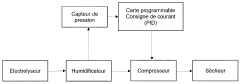
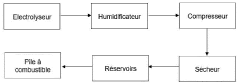
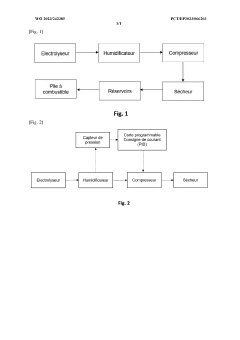
- The implementation of electrochemical compression technology using PEM membranes, which allows for silent, vibration-free operation, fine and continuous flow regulation, and isothermal conditions, enabling the adjustment of compressor power based on electrolyzer production flow rates through dynamic current management and integrated humidity control.

Solid-State Electro-Chemical Compressor
PatentInactiveUS20220002885A1
Innovation
- A solid-state electrochemical compressor design featuring multiple cell packages connected in parallel, with each cell having a common electric power supply and fluid inlet/outlet system, allowing for independent operation and optimization of each cell, including separate power supplies and check valves to prevent backflow, and monitoring systems for optimal performance and reconditioning.

Energy Efficiency Standards and Environmental Regulations
Energy efficiency standards and environmental regulations are increasingly shaping the competitive landscape between electrochemical and mechanical compression technologies. The European Union's Energy Efficiency Directive mandates minimum efficiency thresholds for industrial compression systems, with electrochemical compressors often exceeding these requirements due to their inherently higher thermodynamic efficiency. These regulations typically favor technologies that demonstrate lower energy consumption per unit of compressed gas output.
Environmental regulations focusing on carbon footprint reduction create additional advantages for electrochemical compression systems. The technology's ability to achieve compression ratios with significantly lower electricity consumption directly translates to reduced greenhouse gas emissions, particularly in regions where grid electricity originates from fossil fuel sources. Current regulatory frameworks in North America and Europe increasingly incorporate lifecycle carbon assessments, where electrochemical systems demonstrate superior performance metrics.
Emerging efficiency standards specifically target the industrial gas sector, establishing benchmarks that mechanical compression systems struggle to meet without substantial auxiliary equipment. The International Energy Agency's industrial efficiency protocols now include specific provisions for electrochemical compression technologies, recognizing their potential for meeting stringent energy performance criteria. These standards often incorporate real-time efficiency monitoring requirements, where electrochemical systems' consistent performance profiles provide compliance advantages.
Regulatory incentives and tax credits are increasingly aligned with high-efficiency compression technologies. Several jurisdictions offer accelerated depreciation schedules for compression systems exceeding baseline efficiency standards by predetermined margins. Electrochemical compression systems frequently qualify for these incentives due to their superior energy conversion ratios, creating favorable economic conditions for adoption despite higher initial capital investments.
Future regulatory trends indicate stricter efficiency mandates and expanded environmental compliance requirements. Proposed legislation in major industrial markets suggests efficiency standards will tighten by approximately fifteen to twenty percent over the next decade, potentially making electrochemical compression the preferred solution for meeting regulatory compliance while maintaining operational competitiveness in energy-intensive applications.
Environmental regulations focusing on carbon footprint reduction create additional advantages for electrochemical compression systems. The technology's ability to achieve compression ratios with significantly lower electricity consumption directly translates to reduced greenhouse gas emissions, particularly in regions where grid electricity originates from fossil fuel sources. Current regulatory frameworks in North America and Europe increasingly incorporate lifecycle carbon assessments, where electrochemical systems demonstrate superior performance metrics.
Emerging efficiency standards specifically target the industrial gas sector, establishing benchmarks that mechanical compression systems struggle to meet without substantial auxiliary equipment. The International Energy Agency's industrial efficiency protocols now include specific provisions for electrochemical compression technologies, recognizing their potential for meeting stringent energy performance criteria. These standards often incorporate real-time efficiency monitoring requirements, where electrochemical systems' consistent performance profiles provide compliance advantages.
Regulatory incentives and tax credits are increasingly aligned with high-efficiency compression technologies. Several jurisdictions offer accelerated depreciation schedules for compression systems exceeding baseline efficiency standards by predetermined margins. Electrochemical compression systems frequently qualify for these incentives due to their superior energy conversion ratios, creating favorable economic conditions for adoption despite higher initial capital investments.
Future regulatory trends indicate stricter efficiency mandates and expanded environmental compliance requirements. Proposed legislation in major industrial markets suggests efficiency standards will tighten by approximately fifteen to twenty percent over the next decade, potentially making electrochemical compression the preferred solution for meeting regulatory compliance while maintaining operational competitiveness in energy-intensive applications.
Cost-Benefit Analysis of Compression Technology Implementation
The economic evaluation of electrochemical versus mechanical compression technologies requires a comprehensive assessment of capital expenditures, operational costs, and long-term financial returns. Initial capital investment for electrochemical compression systems typically ranges from $2,000 to $4,000 per kilowatt of capacity, while mechanical compression systems generally require $1,500 to $3,000 per kilowatt. However, this upfront cost differential must be weighed against operational efficiency gains and maintenance requirements over the system lifecycle.
Operational expenditure analysis reveals significant variations in energy consumption patterns between the two technologies. Electrochemical compression systems demonstrate superior efficiency at partial loads, consuming 15-25% less energy than mechanical systems during variable demand scenarios. This translates to annual energy cost savings of $200-400 per kilowatt installed capacity, depending on local electricity rates and operational profiles. Additionally, electrochemical systems require minimal mechanical maintenance, reducing annual maintenance costs by approximately 40-60% compared to traditional mechanical compressors.
The total cost of ownership calculation over a 15-year operational period shows electrochemical compression achieving cost parity with mechanical systems within 4-6 years of deployment. Beyond this breakeven point, electrochemical systems generate cumulative savings of $1,000-2,500 per kilowatt through reduced energy consumption and maintenance requirements. These savings are particularly pronounced in applications requiring frequent start-stop cycles or variable compression ratios.
Return on investment analysis indicates that electrochemical compression implementations typically achieve 18-25% internal rates of return in industrial applications, compared to 12-18% for mechanical systems. The superior financial performance stems from higher operational efficiency, extended equipment lifespan, and reduced downtime requirements. However, implementation success depends heavily on proper system sizing, integration complexity, and local energy pricing structures, making site-specific economic modeling essential for accurate investment decisions.
Operational expenditure analysis reveals significant variations in energy consumption patterns between the two technologies. Electrochemical compression systems demonstrate superior efficiency at partial loads, consuming 15-25% less energy than mechanical systems during variable demand scenarios. This translates to annual energy cost savings of $200-400 per kilowatt installed capacity, depending on local electricity rates and operational profiles. Additionally, electrochemical systems require minimal mechanical maintenance, reducing annual maintenance costs by approximately 40-60% compared to traditional mechanical compressors.
The total cost of ownership calculation over a 15-year operational period shows electrochemical compression achieving cost parity with mechanical systems within 4-6 years of deployment. Beyond this breakeven point, electrochemical systems generate cumulative savings of $1,000-2,500 per kilowatt through reduced energy consumption and maintenance requirements. These savings are particularly pronounced in applications requiring frequent start-stop cycles or variable compression ratios.
Return on investment analysis indicates that electrochemical compression implementations typically achieve 18-25% internal rates of return in industrial applications, compared to 12-18% for mechanical systems. The superior financial performance stems from higher operational efficiency, extended equipment lifespan, and reduced downtime requirements. However, implementation success depends heavily on proper system sizing, integration complexity, and local energy pricing structures, making site-specific economic modeling essential for accurate investment decisions.
Unlock deeper insights with PatSnap Eureka Quick Research — get a full tech report to explore trends and direct your research. Try now!
Generate Your Research Report Instantly with AI Agent
Supercharge your innovation with PatSnap Eureka AI Agent Platform!