

Enhancing Collaborative Research on Magnetocaloric Technologies
APR 24, 202610 MIN READ
Generate Your Research Report Instantly with AI Agent
PatSnap Eureka helps you evaluate technical feasibility & market potential.
Magnetocaloric Technology Background and Research Objectives
Magnetocaloric technology represents a revolutionary approach to solid-state refrigeration based on the magnetocaloric effect (MCE), where certain materials exhibit temperature changes when subjected to varying magnetic fields. This phenomenon, first discovered by Warburg in 1881, has evolved from a scientific curiosity into a promising alternative to conventional vapor-compression cooling systems. The technology leverages the entropy change associated with magnetic ordering in materials, offering potential solutions for energy-efficient cooling applications across multiple scales.
The historical development of magnetocaloric technology can be traced through several pivotal phases. Initial theoretical foundations were established in the early 20th century, followed by significant advances in the 1970s with the discovery of giant magnetocaloric effects in rare-earth materials. The 1990s marked a turning point with the identification of room-temperature magnetocaloric materials, particularly Gd-based compounds, which opened pathways for practical applications. Recent decades have witnessed exponential growth in research activities, driven by environmental concerns and energy efficiency demands.
Current technological evolution trends indicate a shift toward developing materials with enhanced magnetocaloric properties, including larger entropy changes, broader operating temperature ranges, and reduced hysteresis losses. Advanced material engineering approaches focus on optimizing crystal structures, exploring new compound families, and developing composite materials that combine multiple magnetocaloric phases. Simultaneously, system-level innovations emphasize improved heat transfer mechanisms, magnetic field generation efficiency, and integration with existing cooling infrastructures.
The primary research objectives encompass multiple interconnected goals that address both fundamental scientific challenges and practical implementation requirements. Material development objectives focus on discovering and synthesizing magnetocaloric compounds with superior performance metrics, including higher adiabatic temperature changes, enhanced refrigeration capacity, and improved cyclability under operational conditions. These efforts particularly target materials operating near room temperature while maintaining cost-effectiveness for commercial viability.
System optimization objectives aim to develop efficient magnetocaloric refrigeration prototypes that demonstrate competitive performance compared to conventional cooling technologies. This includes advancing magnetic field generation systems, optimizing heat exchanger designs, and developing control algorithms that maximize cooling efficiency while minimizing energy consumption. Integration challenges involve creating scalable manufacturing processes and establishing standardized performance evaluation protocols.
Collaborative research objectives emphasize establishing interdisciplinary partnerships that combine expertise in materials science, thermodynamics, magnetic systems engineering, and industrial design. These collaborations seek to accelerate technology transfer from laboratory demonstrations to commercial applications, while fostering knowledge sharing across research institutions, industry partners, and international scientific communities to overcome technical barriers and reduce development timelines.
The historical development of magnetocaloric technology can be traced through several pivotal phases. Initial theoretical foundations were established in the early 20th century, followed by significant advances in the 1970s with the discovery of giant magnetocaloric effects in rare-earth materials. The 1990s marked a turning point with the identification of room-temperature magnetocaloric materials, particularly Gd-based compounds, which opened pathways for practical applications. Recent decades have witnessed exponential growth in research activities, driven by environmental concerns and energy efficiency demands.
Current technological evolution trends indicate a shift toward developing materials with enhanced magnetocaloric properties, including larger entropy changes, broader operating temperature ranges, and reduced hysteresis losses. Advanced material engineering approaches focus on optimizing crystal structures, exploring new compound families, and developing composite materials that combine multiple magnetocaloric phases. Simultaneously, system-level innovations emphasize improved heat transfer mechanisms, magnetic field generation efficiency, and integration with existing cooling infrastructures.
The primary research objectives encompass multiple interconnected goals that address both fundamental scientific challenges and practical implementation requirements. Material development objectives focus on discovering and synthesizing magnetocaloric compounds with superior performance metrics, including higher adiabatic temperature changes, enhanced refrigeration capacity, and improved cyclability under operational conditions. These efforts particularly target materials operating near room temperature while maintaining cost-effectiveness for commercial viability.
System optimization objectives aim to develop efficient magnetocaloric refrigeration prototypes that demonstrate competitive performance compared to conventional cooling technologies. This includes advancing magnetic field generation systems, optimizing heat exchanger designs, and developing control algorithms that maximize cooling efficiency while minimizing energy consumption. Integration challenges involve creating scalable manufacturing processes and establishing standardized performance evaluation protocols.
Collaborative research objectives emphasize establishing interdisciplinary partnerships that combine expertise in materials science, thermodynamics, magnetic systems engineering, and industrial design. These collaborations seek to accelerate technology transfer from laboratory demonstrations to commercial applications, while fostering knowledge sharing across research institutions, industry partners, and international scientific communities to overcome technical barriers and reduce development timelines.
Market Demand for Magnetocaloric Cooling Applications
The global cooling and refrigeration market is experiencing unprecedented growth driven by urbanization, rising living standards, and increasing demand for energy-efficient solutions. Traditional vapor-compression refrigeration systems, while dominant, face mounting pressure due to environmental regulations targeting hydrofluorocarbon refrigerants and growing energy consumption concerns. This regulatory landscape creates substantial opportunities for alternative cooling technologies, particularly magnetocaloric cooling systems that operate without harmful refrigerants and demonstrate superior energy efficiency potential.
Commercial refrigeration represents the largest addressable market segment for magnetocaloric cooling applications. Supermarkets, convenience stores, and food service establishments require continuous cooling operations, making energy efficiency a critical cost factor. The commercial sector's willingness to invest in premium technologies that deliver long-term operational savings positions magnetocaloric cooling as an attractive solution for display cases, walk-in coolers, and specialized food storage applications.
Residential air conditioning and refrigeration markets present significant volume opportunities, though cost sensitivity remains a primary adoption barrier. Consumer awareness of environmental impact and energy costs continues to grow, particularly in developed markets where premium appliance segments show strong growth. The integration of magnetocaloric technology into high-end residential cooling systems could establish market presence before broader cost reduction enables mass market penetration.
Industrial cooling applications demonstrate strong alignment with magnetocaloric technology capabilities. Process cooling, data center thermal management, and specialized industrial refrigeration often require precise temperature control and high reliability. These applications typically justify higher initial investments for technologies offering improved efficiency, reduced maintenance requirements, and enhanced environmental compliance.
The automotive sector presents emerging opportunities as electric vehicle adoption accelerates. Magnetocaloric cooling systems could address cabin climate control while minimizing battery drain, a critical performance factor for electric vehicles. Additionally, thermal management of battery systems and power electronics represents specialized applications where magnetocaloric technology's precise temperature control capabilities offer distinct advantages.
Healthcare and pharmaceutical applications require stringent temperature control for medical equipment, vaccine storage, and laboratory environments. These markets prioritize reliability and precision over cost considerations, making them attractive early adoption segments for magnetocaloric cooling technology. The growing global healthcare infrastructure and increasing pharmaceutical cold chain requirements support sustained demand growth in these specialized applications.
Commercial refrigeration represents the largest addressable market segment for magnetocaloric cooling applications. Supermarkets, convenience stores, and food service establishments require continuous cooling operations, making energy efficiency a critical cost factor. The commercial sector's willingness to invest in premium technologies that deliver long-term operational savings positions magnetocaloric cooling as an attractive solution for display cases, walk-in coolers, and specialized food storage applications.
Residential air conditioning and refrigeration markets present significant volume opportunities, though cost sensitivity remains a primary adoption barrier. Consumer awareness of environmental impact and energy costs continues to grow, particularly in developed markets where premium appliance segments show strong growth. The integration of magnetocaloric technology into high-end residential cooling systems could establish market presence before broader cost reduction enables mass market penetration.
Industrial cooling applications demonstrate strong alignment with magnetocaloric technology capabilities. Process cooling, data center thermal management, and specialized industrial refrigeration often require precise temperature control and high reliability. These applications typically justify higher initial investments for technologies offering improved efficiency, reduced maintenance requirements, and enhanced environmental compliance.
The automotive sector presents emerging opportunities as electric vehicle adoption accelerates. Magnetocaloric cooling systems could address cabin climate control while minimizing battery drain, a critical performance factor for electric vehicles. Additionally, thermal management of battery systems and power electronics represents specialized applications where magnetocaloric technology's precise temperature control capabilities offer distinct advantages.
Healthcare and pharmaceutical applications require stringent temperature control for medical equipment, vaccine storage, and laboratory environments. These markets prioritize reliability and precision over cost considerations, making them attractive early adoption segments for magnetocaloric cooling technology. The growing global healthcare infrastructure and increasing pharmaceutical cold chain requirements support sustained demand growth in these specialized applications.
Current Status and Challenges in Magnetocaloric Research
Magnetocaloric technology has emerged as a promising alternative to conventional vapor-compression refrigeration systems, offering potential advantages in energy efficiency and environmental sustainability. The field has witnessed significant progress since the discovery of the giant magnetocaloric effect in Gd5Si2Ge2 compounds in 1997, which sparked renewed interest in magnetic refrigeration applications. Current research spans from fundamental materials science to system-level engineering, with investigations focusing on both near-room-temperature and cryogenic applications.
The global magnetocaloric research landscape is characterized by substantial geographical concentration, with leading research activities primarily centered in Europe, North America, and East Asia. European institutions have maintained strong momentum through coordinated research programs, while Asian countries, particularly China and Japan, have significantly increased their research investments and patent filings in recent years. The United States continues to contribute through both academic institutions and government laboratories, though industrial engagement remains limited compared to other regions.
Contemporary magnetocaloric research faces several critical technical challenges that impede widespread commercialization. The most significant obstacle remains the limited adiabatic temperature change and refrigerant capacity of existing materials, particularly for room-temperature applications. Most promising magnetocaloric materials exhibit peak performance within narrow temperature ranges, necessitating complex multi-material systems or active magnetic regenerator designs that increase system complexity and cost.
Material stability presents another fundamental challenge, as many high-performance magnetocaloric compounds suffer from structural degradation, corrosion, or magnetic property deterioration under cyclic operating conditions. The hysteresis losses associated with first-order magnetic transitions, while often correlating with large magnetocaloric effects, create efficiency penalties and contribute to material fatigue over extended operation periods.
Manufacturing scalability represents a critical bottleneck for practical implementation. Many advanced magnetocaloric materials require sophisticated synthesis processes, precise compositional control, or specialized heat treatments that are difficult to scale economically. The cost-performance ratio remains unfavorable compared to conventional refrigeration technologies, particularly when considering the additional complexity of magnetic field generation and heat transfer systems.
System-level integration challenges further complicate the development pathway. Effective heat transfer between magnetocaloric materials and heat transfer fluids requires innovative heat exchanger designs that minimize thermal resistance while maintaining acceptable pressure drops. The magnetic field generation systems, whether permanent magnet-based or electromagnetic, must balance field strength, uniformity, and energy consumption considerations.
Research fragmentation across different application domains has also hindered progress, with insufficient coordination between groups focusing on materials discovery, system design, and application-specific optimization. This fragmentation limits the efficient translation of materials advances into practical systems and slows the development of standardized testing protocols and performance metrics.
The global magnetocaloric research landscape is characterized by substantial geographical concentration, with leading research activities primarily centered in Europe, North America, and East Asia. European institutions have maintained strong momentum through coordinated research programs, while Asian countries, particularly China and Japan, have significantly increased their research investments and patent filings in recent years. The United States continues to contribute through both academic institutions and government laboratories, though industrial engagement remains limited compared to other regions.
Contemporary magnetocaloric research faces several critical technical challenges that impede widespread commercialization. The most significant obstacle remains the limited adiabatic temperature change and refrigerant capacity of existing materials, particularly for room-temperature applications. Most promising magnetocaloric materials exhibit peak performance within narrow temperature ranges, necessitating complex multi-material systems or active magnetic regenerator designs that increase system complexity and cost.
Material stability presents another fundamental challenge, as many high-performance magnetocaloric compounds suffer from structural degradation, corrosion, or magnetic property deterioration under cyclic operating conditions. The hysteresis losses associated with first-order magnetic transitions, while often correlating with large magnetocaloric effects, create efficiency penalties and contribute to material fatigue over extended operation periods.
Manufacturing scalability represents a critical bottleneck for practical implementation. Many advanced magnetocaloric materials require sophisticated synthesis processes, precise compositional control, or specialized heat treatments that are difficult to scale economically. The cost-performance ratio remains unfavorable compared to conventional refrigeration technologies, particularly when considering the additional complexity of magnetic field generation and heat transfer systems.
System-level integration challenges further complicate the development pathway. Effective heat transfer between magnetocaloric materials and heat transfer fluids requires innovative heat exchanger designs that minimize thermal resistance while maintaining acceptable pressure drops. The magnetic field generation systems, whether permanent magnet-based or electromagnetic, must balance field strength, uniformity, and energy consumption considerations.
Research fragmentation across different application domains has also hindered progress, with insufficient coordination between groups focusing on materials discovery, system design, and application-specific optimization. This fragmentation limits the efficient translation of materials advances into practical systems and slows the development of standardized testing protocols and performance metrics.
Current Magnetocaloric Material Solutions
01 Magnetocaloric materials and alloy compositions
Development of specialized magnetocaloric materials including rare earth-based alloys, transition metal compounds, and novel composite materials that exhibit significant magnetocaloric effects. These materials undergo temperature changes when subjected to magnetic field variations, enabling efficient cooling applications through optimized crystal structures and chemical compositions.- Magnetocaloric materials and alloy compositions: Development of specialized magnetocaloric materials including rare earth-based alloys, transition metal compounds, and novel composite materials that exhibit significant magnetocaloric effects. These materials undergo temperature changes when subjected to magnetic field variations, enabling efficient cooling applications through optimized crystal structures and chemical compositions.
- Magnetocaloric refrigeration systems and devices: Complete refrigeration systems utilizing magnetocaloric technology for cooling applications, including system architecture, heat exchangers, magnetic field generation components, and control mechanisms. These systems provide environmentally friendly alternatives to conventional refrigeration by eliminating harmful refrigerants and improving energy efficiency.
- Magnetic field generation and control methods: Techniques for generating and controlling magnetic fields in magnetocaloric applications, including permanent magnet assemblies, electromagnetic systems, and field modulation methods. These approaches optimize the magnetic field strength, uniformity, and cycling patterns to maximize the magnetocaloric effect and system performance.
- Heat transfer and thermal management systems: Advanced heat transfer mechanisms and thermal management solutions for magnetocaloric devices, including heat exchangers, thermal interfaces, and fluid circulation systems. These technologies enhance heat transfer efficiency between the magnetocaloric material and the working environment to improve overall cooling performance.
- Manufacturing processes and device fabrication: Manufacturing techniques and fabrication methods for producing magnetocaloric materials and devices, including powder metallurgy, thin film deposition, bulk material processing, and device assembly methods. These processes ensure optimal material properties and device performance while enabling cost-effective production.
02 Magnetocaloric refrigeration systems and devices
Complete refrigeration systems utilizing magnetocaloric technology for cooling applications, including system architecture, heat exchangers, magnetic field generation components, and control mechanisms. These systems provide environmentally friendly alternatives to conventional refrigeration by eliminating harmful refrigerants and improving energy efficiency.Expand Specific Solutions03 Magnetic field generation and control methods
Techniques for generating and controlling magnetic fields in magnetocaloric applications, including permanent magnet assemblies, electromagnetic systems, and field modulation methods. These approaches optimize the magnetic field strength, uniformity, and cycling patterns to maximize the magnetocaloric effect and system performance.Expand Specific Solutions04 Heat transfer and thermal management systems
Advanced heat transfer mechanisms and thermal management solutions for magnetocaloric devices, including heat exchangers, thermal interfaces, and fluid circulation systems. These technologies enhance heat transfer efficiency between the magnetocaloric material and the working environment to improve overall cooling performance.Expand Specific Solutions05 Manufacturing processes and device fabrication
Manufacturing techniques and fabrication methods for producing magnetocaloric materials and devices, including powder metallurgy, thin film deposition, bulk material processing, and device assembly procedures. These processes ensure optimal material properties and device performance while enabling scalable production.Expand Specific Solutions
Key Players in Magnetocaloric Research Ecosystem
The magnetocaloric technology sector is experiencing rapid evolution as it transitions from research-intensive development to early commercialization stages. The market demonstrates significant growth potential driven by increasing demand for environmentally sustainable cooling solutions and stringent regulations on traditional refrigerants. Technology maturity varies considerably across the competitive landscape, with specialized companies like Cooltech Applications SAS and Magneto BV leading commercial applications through advanced magnetocaloric heat pump systems, while VACUUMSCHMELZE focuses on advanced magnetic materials development. Industrial giants including Samsung Electronics, Philips, and BASF Corp. are leveraging their manufacturing capabilities and market reach to accelerate technology adoption. Research institutions such as Zhejiang University, Xi'an Jiaotong University, and the Chinese Academy of Sciences institutes are driving fundamental breakthroughs in magnetocaloric materials and system optimization, creating a robust innovation ecosystem that supports both academic advancement and industrial implementation across global markets.
VACUUMSCHMELZE GmbH & Co. KG
Technical Solution: VACUUMSCHMELZE specializes in developing high-performance magnetocaloric materials, particularly rare-earth-based alloys and Heusler compounds. Their research focuses on optimizing magnetic entropy change and adiabatic temperature change through precise compositional control and advanced metallurgical processes. The company has developed proprietary powder metallurgy techniques for producing magnetocaloric materials with enhanced mechanical properties and corrosion resistance. Their collaborative efforts include partnerships with research institutions for fundamental materials science research and application development in automotive and industrial cooling systems.
Strengths: Advanced materials expertise, strong R&D capabilities, established supply chain for rare earth materials. Weaknesses: Dependence on rare earth elements, high production costs, limited system integration experience.
Cooltech Applications SAS
Technical Solution: Cooltech Applications has developed innovative magnetocaloric cooling systems based on proprietary gadolinium-based alloys and advanced heat exchanger designs. Their technology utilizes rotating permanent magnet assemblies to create magnetic field variations of up to 1.4 Tesla, enabling temperature spans of 25-30K in single-stage operations. The company has successfully commercialized magnetocaloric wine coolers and refrigeration units, demonstrating energy efficiency improvements of 20-30% compared to conventional vapor compression systems. Their collaborative research focuses on material optimization, system integration, and scaling manufacturing processes for broader market applications.
Strengths: Proven commercial products, strong IP portfolio, established manufacturing capabilities. Weaknesses: Limited temperature range, high material costs, market penetration challenges.
Core Patents in Magnetocaloric Effect Technologies
Enhanced magnetocaloric effect material
PatentInactiveUS20040261420A1
Innovation
- A magnetocaloric effect heterostructure is created by applying a conformal thin layer of an elastically stiff material, such as iron, cobalt, or nickel, to the surface of giant magnetocaloric materials like Gd5(Si1-xGe4, which restricts volume changes during magnetic field application, effectively amplifying the magnetic field and reducing the critical field required for a large magnetocaloric effect.


Magnetocaloric generator
PatentActiveUS20240337419A1
Innovation
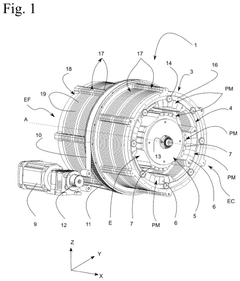
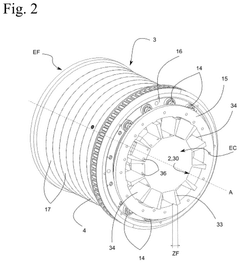
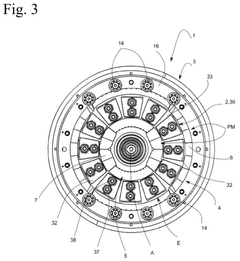
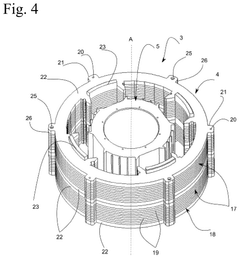
- A magnetocaloric generator design featuring concentric external and internal magnetic rotors with a mechanical and magnetic coupling, allowing synchronous rotation and maximizing magnetic field intensity, combined with a modular construction and optimized heat-transfer fluid circulation to reduce friction and eddy currents.
International Collaboration Frameworks for Advanced Materials
The development of effective international collaboration frameworks for advanced materials research, particularly in magnetocaloric technologies, requires structured approaches that transcend traditional academic and industrial boundaries. Current frameworks primarily operate through multilateral research agreements, joint funding mechanisms, and shared infrastructure initiatives that enable cross-border knowledge exchange and resource optimization.
Established frameworks such as the International Energy Agency's Technology Collaboration Programmes and the European Union's Horizon Europe initiative have demonstrated successful models for coordinating magnetocaloric research efforts across multiple nations. These frameworks typically incorporate standardized research protocols, intellectual property sharing agreements, and coordinated funding streams that reduce duplication of efforts while maximizing research impact.
The Materials Genome Initiative represents another significant framework model, emphasizing data sharing and computational approaches that accelerate materials discovery. This framework has proven particularly relevant for magnetocaloric materials research, where computational screening and experimental validation require substantial resource coordination across international research teams.
Emerging bilateral and multilateral partnerships between research institutions in the United States, European Union, Japan, and China have established specialized working groups focused on magnetocaloric technology development. These collaborations typically feature joint laboratory facilities, researcher exchange programs, and synchronized research roadmaps that align national priorities with global technological advancement goals.
Industry-academia partnership frameworks have evolved to include major materials companies, equipment manufacturers, and research institutions working collectively on magnetocaloric technology commercialization. These frameworks often incorporate technology transfer mechanisms, joint intellectual property development agreements, and shared risk investment structures that bridge the gap between fundamental research and market applications.
Digital collaboration platforms and virtual research environments have become integral components of modern international frameworks, enabling real-time data sharing, remote experimentation coordination, and distributed computational resources. These technological infrastructure elements support continuous collaboration despite geographical constraints and facilitate rapid knowledge dissemination across international research networks.
Future framework development trends indicate increasing emphasis on sustainability metrics, standardized performance benchmarking, and coordinated regulatory approaches that will shape the global magnetocaloric technology landscape.
Established frameworks such as the International Energy Agency's Technology Collaboration Programmes and the European Union's Horizon Europe initiative have demonstrated successful models for coordinating magnetocaloric research efforts across multiple nations. These frameworks typically incorporate standardized research protocols, intellectual property sharing agreements, and coordinated funding streams that reduce duplication of efforts while maximizing research impact.
The Materials Genome Initiative represents another significant framework model, emphasizing data sharing and computational approaches that accelerate materials discovery. This framework has proven particularly relevant for magnetocaloric materials research, where computational screening and experimental validation require substantial resource coordination across international research teams.
Emerging bilateral and multilateral partnerships between research institutions in the United States, European Union, Japan, and China have established specialized working groups focused on magnetocaloric technology development. These collaborations typically feature joint laboratory facilities, researcher exchange programs, and synchronized research roadmaps that align national priorities with global technological advancement goals.
Industry-academia partnership frameworks have evolved to include major materials companies, equipment manufacturers, and research institutions working collectively on magnetocaloric technology commercialization. These frameworks often incorporate technology transfer mechanisms, joint intellectual property development agreements, and shared risk investment structures that bridge the gap between fundamental research and market applications.
Digital collaboration platforms and virtual research environments have become integral components of modern international frameworks, enabling real-time data sharing, remote experimentation coordination, and distributed computational resources. These technological infrastructure elements support continuous collaboration despite geographical constraints and facilitate rapid knowledge dissemination across international research networks.
Future framework development trends indicate increasing emphasis on sustainability metrics, standardized performance benchmarking, and coordinated regulatory approaches that will shape the global magnetocaloric technology landscape.
Knowledge Sharing Platforms for Magnetocaloric Research
The development of effective knowledge sharing platforms represents a critical infrastructure component for advancing magnetocaloric research collaboration. These digital ecosystems serve as centralized repositories where researchers can access, contribute, and exchange vital information including experimental data, theoretical models, material properties databases, and computational resources. The complexity of magnetocaloric phenomena, spanning multiple disciplines from materials science to thermodynamics, necessitates sophisticated platforms that can accommodate diverse data formats and research methodologies.
Current knowledge sharing initiatives in magnetocaloric research primarily rely on traditional academic publishing channels and conference proceedings, which often create information silos and delay knowledge dissemination. Emerging platforms are beginning to address these limitations by incorporating real-time data sharing capabilities, collaborative annotation systems, and standardized metadata frameworks. These platforms enable researchers to upload raw experimental data, share computational models, and provide peer commentary on findings before formal publication.
The most promising platforms integrate multiple functionalities including version-controlled data repositories, collaborative workspace environments, and automated literature discovery tools. Advanced platforms incorporate machine learning algorithms to identify research patterns, suggest potential collaborations based on complementary expertise, and recommend relevant datasets or publications. Some platforms also feature virtual laboratory environments where researchers can simulate magnetocaloric experiments and share computational resources.
Standardization remains a fundamental challenge for knowledge sharing platforms in magnetocaloric research. The lack of unified data formats, measurement protocols, and terminology creates barriers to effective information exchange. Successful platforms must implement robust data standardization frameworks while maintaining flexibility to accommodate evolving research methodologies and emerging measurement techniques.
Security and intellectual property protection constitute additional critical considerations for platform development. Researchers require assurance that proprietary data and preliminary findings remain protected while still enabling meaningful collaboration. Advanced platforms implement tiered access controls, secure data encryption, and clear intellectual property agreements to balance openness with protection of sensitive research information.
The integration of artificial intelligence and natural language processing capabilities represents the next frontier for magnetocaloric knowledge sharing platforms. These technologies can automatically extract key information from research papers, identify research gaps, and facilitate cross-language collaboration among international research teams, ultimately accelerating the pace of discovery in magnetocaloric technologies.
Current knowledge sharing initiatives in magnetocaloric research primarily rely on traditional academic publishing channels and conference proceedings, which often create information silos and delay knowledge dissemination. Emerging platforms are beginning to address these limitations by incorporating real-time data sharing capabilities, collaborative annotation systems, and standardized metadata frameworks. These platforms enable researchers to upload raw experimental data, share computational models, and provide peer commentary on findings before formal publication.
The most promising platforms integrate multiple functionalities including version-controlled data repositories, collaborative workspace environments, and automated literature discovery tools. Advanced platforms incorporate machine learning algorithms to identify research patterns, suggest potential collaborations based on complementary expertise, and recommend relevant datasets or publications. Some platforms also feature virtual laboratory environments where researchers can simulate magnetocaloric experiments and share computational resources.
Standardization remains a fundamental challenge for knowledge sharing platforms in magnetocaloric research. The lack of unified data formats, measurement protocols, and terminology creates barriers to effective information exchange. Successful platforms must implement robust data standardization frameworks while maintaining flexibility to accommodate evolving research methodologies and emerging measurement techniques.
Security and intellectual property protection constitute additional critical considerations for platform development. Researchers require assurance that proprietary data and preliminary findings remain protected while still enabling meaningful collaboration. Advanced platforms implement tiered access controls, secure data encryption, and clear intellectual property agreements to balance openness with protection of sensitive research information.
The integration of artificial intelligence and natural language processing capabilities represents the next frontier for magnetocaloric knowledge sharing platforms. These technologies can automatically extract key information from research papers, identify research gaps, and facilitate cross-language collaboration among international research teams, ultimately accelerating the pace of discovery in magnetocaloric technologies.
Unlock deeper insights with PatSnap Eureka Quick Research — get a full tech report to explore trends and direct your research. Try now!
Generate Your Research Report Instantly with AI Agent
Supercharge your innovation with PatSnap Eureka AI Agent Platform!