

Recognizing Limitations in Magnetocaloric Cooling Applications
APR 24, 20269 MIN READ
Generate Your Research Report Instantly with AI Agent
PatSnap Eureka helps you evaluate technical feasibility & market potential.
Magnetocaloric Cooling Technology Background and Objectives
Magnetocaloric cooling technology represents a revolutionary approach to refrigeration that leverages the magnetocaloric effect, a phenomenon where certain materials experience temperature changes when subjected to varying magnetic fields. This solid-state cooling technology emerged from fundamental physics research in the early 20th century, with Pierre Weiss and Auguste Piccard first observing the effect in nickel in 1917. The technology gained renewed attention during the 1970s energy crisis as researchers sought more efficient and environmentally friendly alternatives to conventional vapor-compression refrigeration systems.
The historical development of magnetocaloric cooling has been marked by several key milestones. Initial research focused on understanding the thermodynamic principles underlying the magnetocaloric effect in ferromagnetic materials. The 1990s witnessed significant breakthroughs with the discovery of giant magnetocaloric effects in materials like Gd5Si2Ge2, which demonstrated substantially larger temperature changes than previously observed. This discovery catalyzed intensive research into new magnetocaloric materials and practical cooling device designs.
The evolution of this technology has progressed through distinct phases, beginning with fundamental materials research, advancing to proof-of-concept demonstrations, and currently focusing on addressing practical implementation challenges. Early prototypes successfully demonstrated the feasibility of magnetocaloric cooling but revealed significant limitations in terms of cooling capacity, temperature span, and operational efficiency compared to conventional systems.
Current technological objectives center on overcoming these fundamental limitations to achieve commercial viability. Primary goals include developing magnetocaloric materials with enhanced properties across broader temperature ranges, improving magnetic field generation efficiency, and optimizing heat transfer mechanisms within cooling devices. Researchers are particularly focused on achieving higher cooling power densities, extending operational temperature spans beyond current 10-20K limitations, and reducing the magnetic field requirements for effective operation.
The technology aims to address critical environmental concerns by eliminating harmful refrigerants while achieving superior energy efficiency. Target applications span from residential and commercial refrigeration to specialized cooling applications in electronics, medical devices, and space systems. However, recognizing and addressing the inherent limitations in magnetocaloric cooling applications remains crucial for realistic technology development roadmaps and successful market penetration strategies.
The historical development of magnetocaloric cooling has been marked by several key milestones. Initial research focused on understanding the thermodynamic principles underlying the magnetocaloric effect in ferromagnetic materials. The 1990s witnessed significant breakthroughs with the discovery of giant magnetocaloric effects in materials like Gd5Si2Ge2, which demonstrated substantially larger temperature changes than previously observed. This discovery catalyzed intensive research into new magnetocaloric materials and practical cooling device designs.
The evolution of this technology has progressed through distinct phases, beginning with fundamental materials research, advancing to proof-of-concept demonstrations, and currently focusing on addressing practical implementation challenges. Early prototypes successfully demonstrated the feasibility of magnetocaloric cooling but revealed significant limitations in terms of cooling capacity, temperature span, and operational efficiency compared to conventional systems.
Current technological objectives center on overcoming these fundamental limitations to achieve commercial viability. Primary goals include developing magnetocaloric materials with enhanced properties across broader temperature ranges, improving magnetic field generation efficiency, and optimizing heat transfer mechanisms within cooling devices. Researchers are particularly focused on achieving higher cooling power densities, extending operational temperature spans beyond current 10-20K limitations, and reducing the magnetic field requirements for effective operation.
The technology aims to address critical environmental concerns by eliminating harmful refrigerants while achieving superior energy efficiency. Target applications span from residential and commercial refrigeration to specialized cooling applications in electronics, medical devices, and space systems. However, recognizing and addressing the inherent limitations in magnetocaloric cooling applications remains crucial for realistic technology development roadmaps and successful market penetration strategies.
Market Demand Analysis for Magnetocaloric Cooling Systems
The global cooling market presents significant opportunities for magnetocaloric cooling systems, driven by increasing environmental regulations and energy efficiency demands. Traditional vapor-compression refrigeration systems face mounting pressure due to their reliance on hydrofluorocarbon refrigerants, which contribute to global warming potential. This regulatory landscape creates a substantial market pull for alternative cooling technologies that offer environmental benefits.
Industrial refrigeration represents the most promising near-term market segment for magnetocaloric cooling applications. Food processing facilities, pharmaceutical manufacturing, and chemical plants require precise temperature control with high energy efficiency standards. These sectors demonstrate willingness to invest in premium cooling solutions that deliver operational cost savings through reduced energy consumption, despite higher initial capital expenditure.
Residential and commercial HVAC markets show growing interest in sustainable cooling alternatives, particularly in regions with stringent energy efficiency mandates. European markets lead this trend, with building codes increasingly favoring low-carbon cooling technologies. The commercial sector, including data centers and office buildings, exhibits strong demand for cooling systems that can reduce operational expenses while meeting corporate sustainability commitments.
The automotive industry presents an emerging application area, where magnetocaloric cooling could address thermal management challenges in electric vehicles. Battery thermal management systems require efficient cooling solutions that minimize energy drain on vehicle range, creating specific performance requirements that align with magnetocaloric technology capabilities.
Market adoption faces significant barriers related to cost competitiveness and performance limitations. Current magnetocaloric systems struggle to match the coefficient of performance achieved by mature vapor-compression technologies across all operating conditions. Temperature span limitations restrict applications to specific cooling ranges, limiting market penetration in applications requiring wide temperature differentials.
Geographic demand patterns favor developed markets with established environmental regulations and higher energy costs. North American and European markets demonstrate stronger pull for alternative cooling technologies, while emerging markets prioritize cost-effectiveness over environmental benefits. This geographic distribution influences the total addressable market size and commercialization strategies for magnetocaloric cooling systems.
Market timing considerations suggest that widespread adoption depends on achieving cost parity with conventional systems while delivering superior environmental performance. Current market readiness varies significantly across application segments, with niche industrial applications showing higher acceptance of premium pricing for specialized performance benefits.
Industrial refrigeration represents the most promising near-term market segment for magnetocaloric cooling applications. Food processing facilities, pharmaceutical manufacturing, and chemical plants require precise temperature control with high energy efficiency standards. These sectors demonstrate willingness to invest in premium cooling solutions that deliver operational cost savings through reduced energy consumption, despite higher initial capital expenditure.
Residential and commercial HVAC markets show growing interest in sustainable cooling alternatives, particularly in regions with stringent energy efficiency mandates. European markets lead this trend, with building codes increasingly favoring low-carbon cooling technologies. The commercial sector, including data centers and office buildings, exhibits strong demand for cooling systems that can reduce operational expenses while meeting corporate sustainability commitments.
The automotive industry presents an emerging application area, where magnetocaloric cooling could address thermal management challenges in electric vehicles. Battery thermal management systems require efficient cooling solutions that minimize energy drain on vehicle range, creating specific performance requirements that align with magnetocaloric technology capabilities.
Market adoption faces significant barriers related to cost competitiveness and performance limitations. Current magnetocaloric systems struggle to match the coefficient of performance achieved by mature vapor-compression technologies across all operating conditions. Temperature span limitations restrict applications to specific cooling ranges, limiting market penetration in applications requiring wide temperature differentials.
Geographic demand patterns favor developed markets with established environmental regulations and higher energy costs. North American and European markets demonstrate stronger pull for alternative cooling technologies, while emerging markets prioritize cost-effectiveness over environmental benefits. This geographic distribution influences the total addressable market size and commercialization strategies for magnetocaloric cooling systems.
Market timing considerations suggest that widespread adoption depends on achieving cost parity with conventional systems while delivering superior environmental performance. Current market readiness varies significantly across application segments, with niche industrial applications showing higher acceptance of premium pricing for specialized performance benefits.
Current Status and Challenges in Magnetocaloric Applications
Magnetocaloric cooling technology has reached a critical juncture where its theoretical promise encounters practical implementation barriers. Despite decades of research demonstrating the potential for energy-efficient solid-state cooling, commercial adoption remains limited to niche applications. Current magnetocaloric systems operate primarily in laboratory environments or specialized industrial settings, with only a handful of prototype refrigeration units reaching market testing phases.
The technology faces significant material science constraints that impede widespread deployment. Most high-performance magnetocaloric materials exhibit optimal properties only within narrow temperature ranges, typically 10-20K windows around their Curie temperatures. This limitation necessitates complex multi-material systems or cascaded arrangements to achieve broader operating ranges comparable to conventional vapor-compression systems. Additionally, many promising materials contain rare earth elements, creating supply chain vulnerabilities and cost escalation concerns.
Manufacturing scalability presents another fundamental challenge. Current production methods for magnetocaloric materials often involve powder metallurgy or specialized heat treatments that are difficult to scale economically. The precise microstructural control required to maintain optimal magnetocaloric properties becomes increasingly challenging in large-scale manufacturing, leading to performance degradation and yield issues.
System integration complexities further constrain practical applications. Magnetocaloric cooling systems require sophisticated magnetic field generation and heat transfer mechanisms that add substantial complexity compared to conventional cooling technologies. The magnetic field sources, whether permanent magnets or electromagnets, contribute significantly to system weight, cost, and energy consumption, often offsetting theoretical efficiency gains.
Performance limitations become apparent when comparing magnetocaloric systems to mature cooling technologies. Current prototypes typically achieve temperature spans of 20-40K, significantly less than the 60-80K spans common in household refrigeration applications. Cooling power densities remain relatively low, requiring larger system volumes to match conventional refrigerator capacities.
Economic viability represents perhaps the most significant barrier to commercialization. Manufacturing costs for magnetocaloric materials and magnetic field generation systems currently exceed those of conventional cooling components by factors of 3-5. The specialized manufacturing infrastructure required for magnetocaloric systems lacks the economies of scale enjoyed by established cooling technologies, perpetuating cost disadvantages.
Reliability and durability concerns also limit practical deployment. Magnetocaloric materials can suffer from mechanical fatigue due to repeated thermal cycling and magnetic field exposure. Corrosion resistance varies significantly among different material compositions, particularly in humid operating environments typical of cooling applications.
The technology faces significant material science constraints that impede widespread deployment. Most high-performance magnetocaloric materials exhibit optimal properties only within narrow temperature ranges, typically 10-20K windows around their Curie temperatures. This limitation necessitates complex multi-material systems or cascaded arrangements to achieve broader operating ranges comparable to conventional vapor-compression systems. Additionally, many promising materials contain rare earth elements, creating supply chain vulnerabilities and cost escalation concerns.
Manufacturing scalability presents another fundamental challenge. Current production methods for magnetocaloric materials often involve powder metallurgy or specialized heat treatments that are difficult to scale economically. The precise microstructural control required to maintain optimal magnetocaloric properties becomes increasingly challenging in large-scale manufacturing, leading to performance degradation and yield issues.
System integration complexities further constrain practical applications. Magnetocaloric cooling systems require sophisticated magnetic field generation and heat transfer mechanisms that add substantial complexity compared to conventional cooling technologies. The magnetic field sources, whether permanent magnets or electromagnets, contribute significantly to system weight, cost, and energy consumption, often offsetting theoretical efficiency gains.
Performance limitations become apparent when comparing magnetocaloric systems to mature cooling technologies. Current prototypes typically achieve temperature spans of 20-40K, significantly less than the 60-80K spans common in household refrigeration applications. Cooling power densities remain relatively low, requiring larger system volumes to match conventional refrigerator capacities.
Economic viability represents perhaps the most significant barrier to commercialization. Manufacturing costs for magnetocaloric materials and magnetic field generation systems currently exceed those of conventional cooling components by factors of 3-5. The specialized manufacturing infrastructure required for magnetocaloric systems lacks the economies of scale enjoyed by established cooling technologies, perpetuating cost disadvantages.
Reliability and durability concerns also limit practical deployment. Magnetocaloric materials can suffer from mechanical fatigue due to repeated thermal cycling and magnetic field exposure. Corrosion resistance varies significantly among different material compositions, particularly in humid operating environments typical of cooling applications.
Current Technical Solutions for Magnetocaloric Systems
01 Material composition and magnetocaloric effect optimization
Limitations in magnetocaloric cooling arise from the inherent properties of magnetocaloric materials, including their operating temperature ranges, magnetic entropy changes, and thermal hysteresis. The effectiveness of cooling is constrained by the material's ability to undergo reversible magnetic phase transitions and the magnitude of the magnetocaloric effect. Optimization of alloy compositions and crystal structures is crucial for enhancing cooling performance while addressing material stability issues.- Material composition and magnetocaloric properties optimization: Magnetocaloric cooling systems face limitations related to the selection and optimization of magnetocaloric materials. The efficiency of these systems depends heavily on the magnetic entropy change and adiabatic temperature change of the working materials. Challenges include achieving optimal magnetic phase transitions, managing hysteresis effects, and developing materials with suitable Curie temperatures for specific operating ranges. Material degradation over repeated magnetic cycles also affects long-term performance.
- Heat transfer and thermal management challenges: Effective heat transfer represents a significant limitation in magnetocaloric cooling systems. The thermal conductivity of magnetocaloric materials and the design of heat exchangers directly impact cooling efficiency. Challenges include minimizing thermal losses, optimizing heat transfer fluid flow, managing temperature gradients across the magnetic material bed, and ensuring adequate thermal contact between components. Poor thermal management leads to reduced cooling capacity and system inefficiency.
- Magnetic field generation and uniformity issues: The generation of strong, uniform magnetic fields presents substantial limitations for magnetocaloric cooling systems. Permanent magnet assemblies and electromagnets must provide sufficient field strength while maintaining spatial uniformity across the magnetocaloric material. Challenges include field strength limitations, non-uniform field distribution, magnetic field leakage, and the energy consumption required for electromagnet operation. These factors directly affect the magnetocaloric effect magnitude and system performance.
- System design and mechanical limitations: Mechanical design constraints significantly limit magnetocaloric cooling system performance. These include the complexity of moving magnetocaloric materials in and out of magnetic fields, mechanical wear of rotating or reciprocating components, vibration and noise generation, and the need for precise timing and positioning. Sealing challenges in systems using liquid heat transfer media and the overall system size and weight also present practical limitations for various applications.
- Operational efficiency and control system limitations: Magnetocaloric cooling systems face limitations in achieving optimal operational efficiency and control. These include difficulties in maintaining precise temperature control, managing variable cooling loads, optimizing cycle timing and frequency, and integrating with existing HVAC systems. Power consumption for magnetic field generation and auxiliary components, along with the complexity of control algorithms required for efficient operation, present additional challenges. System response time and the ability to modulate cooling capacity also limit practical applications.
02 Heat transfer and thermal management challenges
Effective heat transfer between the magnetocaloric material and the heat exchangers presents significant limitations in system efficiency. Poor thermal conductivity of magnetocaloric materials and inadequate heat exchange mechanisms result in reduced cooling capacity and slower response times. The design of heat transfer systems must address thermal resistance, contact resistance, and the need for efficient fluid flow to maximize heat removal from the cooling load.Expand Specific Solutions03 Magnetic field generation and cycling limitations
The requirement for strong and variable magnetic fields creates substantial limitations in magnetocaloric cooling systems. Permanent magnet assemblies and electromagnetic systems face constraints in field strength, uniformity, and cycling frequency. Energy consumption for field generation, mechanical wear from moving components, and the need for precise field control limit the practical implementation and efficiency of magnetocaloric cooling devices.Expand Specific Solutions04 System integration and mechanical design constraints
Mechanical limitations in magnetocaloric cooling systems include challenges in material handling, regenerator design, and system compactness. The need for precise positioning of magnetocaloric materials within magnetic fields, mechanical durability under repeated cycling, and integration with conventional cooling systems present significant engineering challenges. Vibration, noise, and maintenance requirements further limit practical applications.Expand Specific Solutions05 Performance efficiency and operational limitations
Magnetocaloric cooling systems face limitations in achieving competitive coefficient of performance compared to conventional refrigeration technologies. Factors including parasitic heat loads, incomplete magnetic cycles, temperature span limitations, and power consumption for auxiliary components reduce overall system efficiency. The technology struggles with scalability issues and cost-effectiveness for commercial applications, particularly in achieving the performance levels required for widespread adoption.Expand Specific Solutions
Major Players in Magnetocaloric Cooling Industry
The magnetocaloric cooling technology is in its early commercialization stage, representing a nascent but promising market with significant growth potential driven by environmental regulations and energy efficiency demands. The market remains relatively small compared to conventional cooling systems, but shows strong expansion prospects as sustainability concerns intensify. Technology maturity varies considerably across players, with established industrial giants like BASF Corp., Siemens AG, and General Electric Company leveraging their materials science and engineering capabilities alongside specialized innovators like Camfridge Ltd. Research institutions including University of Maryland, Technical University of Denmark, and Centre National de la Recherche Scientifique are advancing fundamental materials research, while appliance manufacturers such as Liebherr-Hausgeräte and Gree Electric are exploring practical applications, creating a diverse ecosystem spanning materials development to end-user implementation.
BASF Corp.
Technical Solution: BASF has developed advanced magnetocaloric materials based on rare-earth compounds and transition metal alloys for cooling applications. Their approach focuses on optimizing the magnetocaloric effect through precise control of material composition and microstructure. However, they recognize significant limitations including the narrow operating temperature range of most magnetocaloric materials, which typically work efficiently only within 10-20K temperature spans. The company acknowledges challenges with material degradation under repeated magnetic cycling, leading to reduced cooling capacity over time. Additionally, BASF identifies the high cost of rare-earth elements as a major barrier to commercial viability, along with the need for strong permanent magnets that add system complexity and weight.
Strengths: Strong materials science expertise and industrial manufacturing capabilities. Weaknesses: High material costs, limited temperature range, and material degradation issues under cycling conditions.
Siemens AG
Technical Solution: Siemens has developed magnetocaloric cooling systems for industrial applications, focusing on magnetic refrigeration technology that eliminates traditional refrigerants. Their systems utilize layered magnetocaloric materials with different Curie temperatures to extend the operating range. However, Siemens recognizes critical limitations including the requirement for powerful electromagnets or permanent magnet assemblies that consume significant energy, potentially offsetting efficiency gains. The company identifies challenges with heat transfer limitations due to the solid-state nature of magnetocaloric materials, requiring complex heat exchanger designs. They also acknowledge issues with magnetic field uniformity across large cooling volumes and the difficulty in achieving rapid magnetic field cycling necessary for practical cooling rates.
Strengths: Industrial system integration expertise and magnetic field generation technology. Weaknesses: High energy consumption for magnetic field generation, complex heat transfer requirements, and scaling challenges for large cooling volumes.
Key Technical Innovations in Magnetocaloric Materials
Polycrystalline magnetocaloric materials
PatentInactiveEP2467858A1
Innovation
- Polycrystalline magnetocaloric materials with a specific formula MnaCobGecAx, where A, B, or C can be boron or carbon, and up to 30 mol% of Mn or Co can be replaced by Fe, Ni, Cr, V, or Cu, exhibiting both orthorhombic TiNiSi and hexagonal Ni2In structure types below -40°C, with a two-phase composition that enhances the magnetocaloric effect.
Magnetocaloric Refrigerant
PatentInactiveUS20090158749A1
Innovation
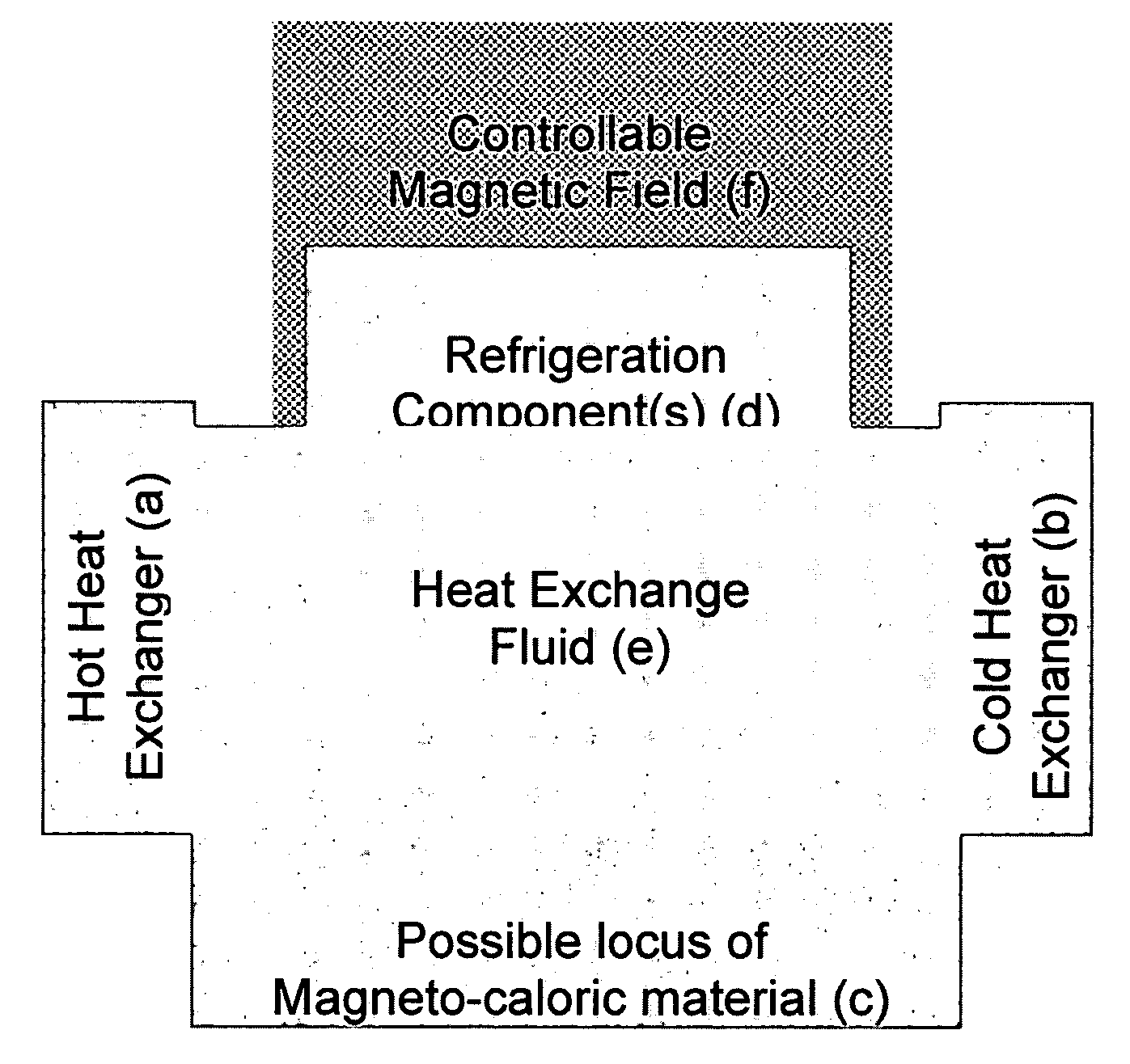
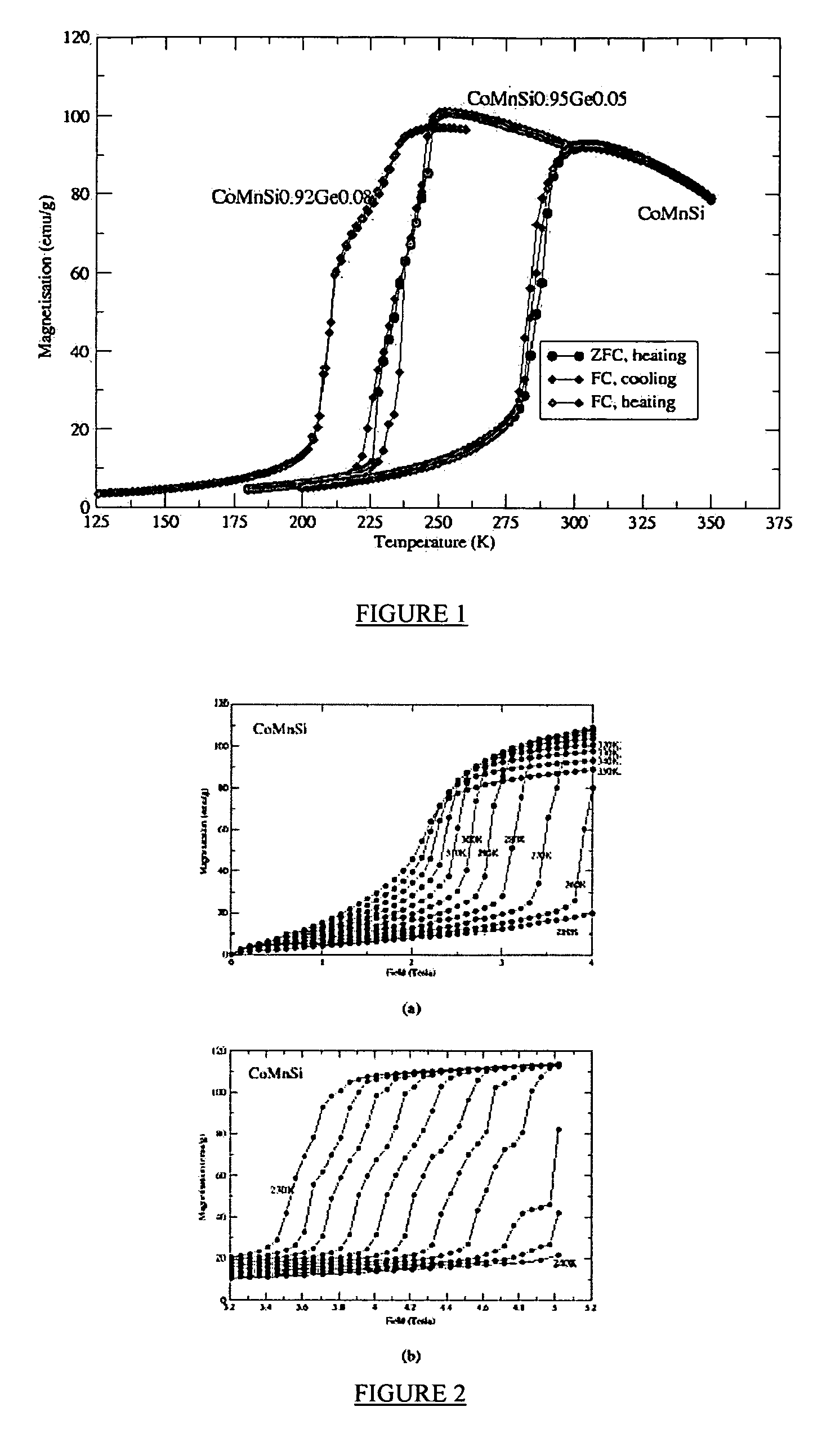
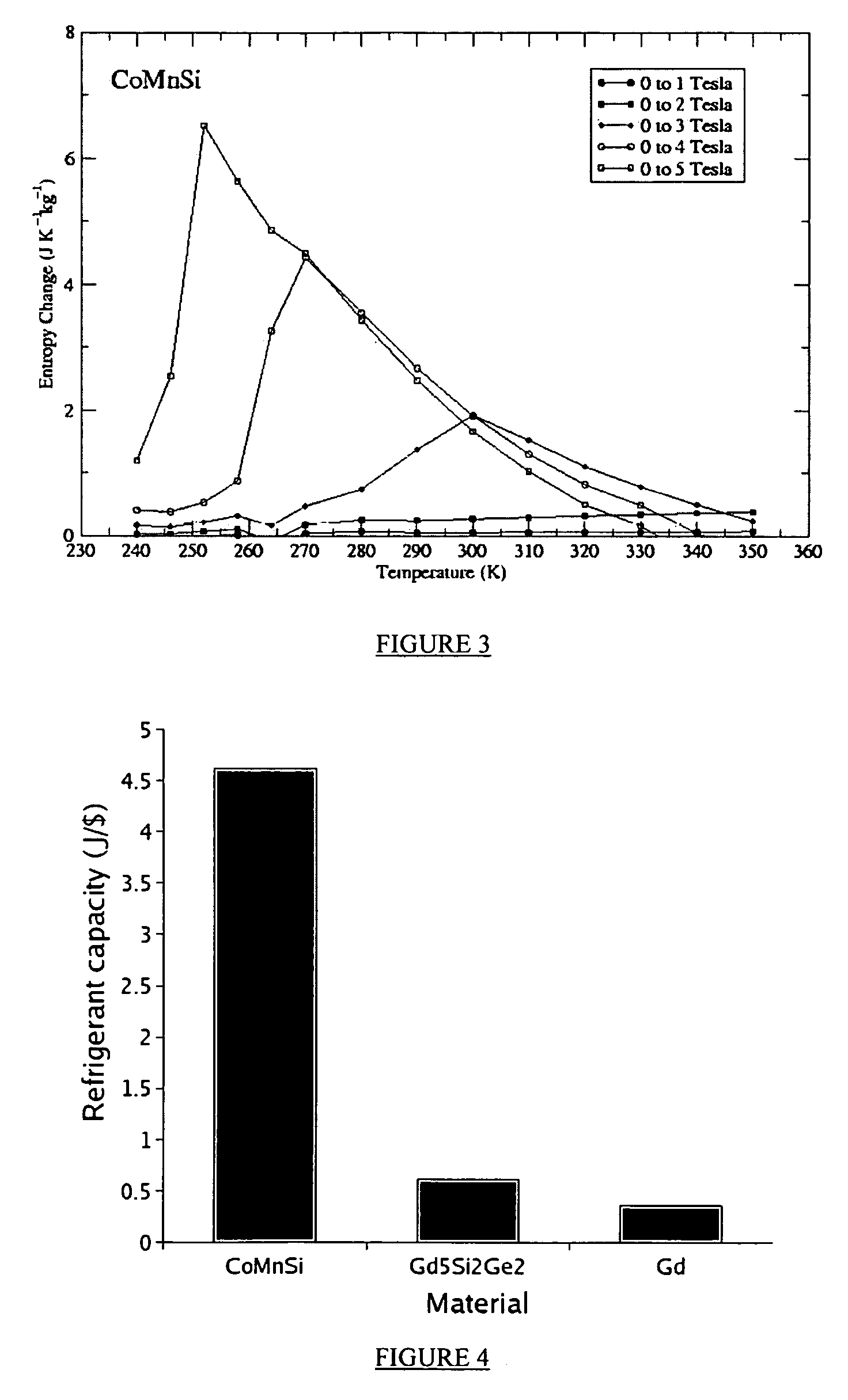
- Development of a metallic material with the general formula (AyCo1-y)(Mn1-zCz)(Si1-xBx) that is orthorhombic in structure, where A, B, and C are dopants that replace Co, Mn, and Si atoms, allowing for tuning of metamagnetic transitions, and are produced through co-melting and annealing under an inert atmosphere to achieve a large magnetocaloric effect with low hysteresis over a wide temperature range.

Energy Efficiency Standards and Environmental Regulations
The regulatory landscape for magnetocaloric cooling technology is increasingly shaped by stringent energy efficiency standards and environmental regulations that both drive innovation and present implementation challenges. Current energy efficiency mandates, such as the EU's F-Gas Regulation and similar frameworks in North America and Asia, are creating favorable conditions for magnetocaloric systems by restricting the use of high global warming potential refrigerants in traditional vapor-compression systems.
Energy efficiency standards like ENERGY STAR, MEPS (Minimum Energy Performance Standards), and the EU's Ecodesign Directive establish baseline performance requirements that magnetocaloric cooling systems must meet to gain market acceptance. These standards typically focus on coefficient of performance (COP) metrics, seasonal energy efficiency ratios, and annual energy consumption benchmarks. While magnetocaloric technology demonstrates theoretical advantages in efficiency, current prototypes often struggle to consistently meet these established thresholds across varying operational conditions.
Environmental regulations present a dual impact on magnetocaloric cooling development. The Montreal Protocol's phase-down of hydrofluorocarbons and national regulations like the American Innovation and Manufacturing Act create market opportunities by restricting conventional refrigerants. However, these same regulations impose strict lifecycle assessment requirements, demanding comprehensive evaluation of rare earth element extraction, processing, and disposal associated with magnetocaloric materials.
Compliance challenges emerge from the nascent state of magnetocaloric-specific testing standards. Existing efficiency measurement protocols were designed for vapor-compression systems and may not accurately capture the performance characteristics of magnetic refrigeration cycles. This regulatory gap creates uncertainty for manufacturers seeking certification and market entry, potentially delaying commercial deployment despite technological readiness.
The regulatory framework also influences material selection and system design choices. Environmental regulations governing rare earth mining and processing in key producing regions affect supply chain stability and cost structures for magnetocaloric materials. Additionally, emerging regulations on electromagnetic field exposure and noise emissions require careful consideration in residential and commercial applications, potentially limiting system configurations and operational parameters.
Future regulatory developments, including anticipated updates to refrigerant regulations and energy efficiency standards, will likely favor magnetocaloric technology adoption. However, the technology must demonstrate consistent performance under standardized testing conditions and address environmental concerns related to material sourcing to fully capitalize on these regulatory advantages.
Energy efficiency standards like ENERGY STAR, MEPS (Minimum Energy Performance Standards), and the EU's Ecodesign Directive establish baseline performance requirements that magnetocaloric cooling systems must meet to gain market acceptance. These standards typically focus on coefficient of performance (COP) metrics, seasonal energy efficiency ratios, and annual energy consumption benchmarks. While magnetocaloric technology demonstrates theoretical advantages in efficiency, current prototypes often struggle to consistently meet these established thresholds across varying operational conditions.
Environmental regulations present a dual impact on magnetocaloric cooling development. The Montreal Protocol's phase-down of hydrofluorocarbons and national regulations like the American Innovation and Manufacturing Act create market opportunities by restricting conventional refrigerants. However, these same regulations impose strict lifecycle assessment requirements, demanding comprehensive evaluation of rare earth element extraction, processing, and disposal associated with magnetocaloric materials.
Compliance challenges emerge from the nascent state of magnetocaloric-specific testing standards. Existing efficiency measurement protocols were designed for vapor-compression systems and may not accurately capture the performance characteristics of magnetic refrigeration cycles. This regulatory gap creates uncertainty for manufacturers seeking certification and market entry, potentially delaying commercial deployment despite technological readiness.
The regulatory framework also influences material selection and system design choices. Environmental regulations governing rare earth mining and processing in key producing regions affect supply chain stability and cost structures for magnetocaloric materials. Additionally, emerging regulations on electromagnetic field exposure and noise emissions require careful consideration in residential and commercial applications, potentially limiting system configurations and operational parameters.
Future regulatory developments, including anticipated updates to refrigerant regulations and energy efficiency standards, will likely favor magnetocaloric technology adoption. However, the technology must demonstrate consistent performance under standardized testing conditions and address environmental concerns related to material sourcing to fully capitalize on these regulatory advantages.
Cost-Performance Analysis of Magnetocaloric Systems
The economic viability of magnetocaloric cooling systems remains a critical barrier to widespread commercial adoption, despite their environmental advantages over conventional vapor-compression refrigeration. Current magnetocaloric systems exhibit significantly higher capital costs, primarily driven by expensive rare earth materials such as gadolinium and its alloys, which can cost 10-50 times more than traditional refrigerants per unit of cooling capacity.
Manufacturing complexity further escalates system costs, as magnetocaloric materials require precise composition control and specialized processing techniques. The magnetic field generation components, typically permanent magnets or electromagnets, contribute substantially to overall system expenses. High-performance permanent magnet assemblies can account for 30-40% of total system costs, while electromagnet-based systems incur ongoing operational expenses due to power consumption.
Performance analysis reveals that current magnetocaloric systems achieve coefficient of performance (COP) values ranging from 2-8, comparable to conventional systems under optimal conditions. However, this performance is highly dependent on operating temperature spans and magnetic field strengths. Most practical implementations demonstrate temperature spans of 10-20K per stage, necessitating multi-stage configurations for larger temperature differences, which proportionally increases system complexity and costs.
The cost-performance ratio becomes particularly challenging when considering cooling capacity per unit investment. Current magnetocaloric prototypes typically cost $500-2000 per watt of cooling capacity, compared to $50-200 for conventional systems. This 5-10x cost premium significantly limits market penetration, especially in price-sensitive applications.
Operational efficiency presents mixed results in cost-performance analysis. While magnetocaloric systems eliminate refrigerant-related maintenance costs and offer potentially longer operational lifespans, their energy efficiency advantages are often offset by higher parasitic losses from magnetic field generation and heat transfer fluid circulation. The total cost of ownership calculations indicate break-even periods of 15-25 years for most applications, assuming current material costs and performance levels.
Scalability analysis suggests that cost reductions are achievable through material optimization and manufacturing process improvements. Alternative magnetocaloric materials, including manganese-based compounds and composite structures, show promise for reducing material costs by 60-80% while maintaining acceptable performance levels, potentially improving the overall cost-performance proposition for future commercial implementations.
Manufacturing complexity further escalates system costs, as magnetocaloric materials require precise composition control and specialized processing techniques. The magnetic field generation components, typically permanent magnets or electromagnets, contribute substantially to overall system expenses. High-performance permanent magnet assemblies can account for 30-40% of total system costs, while electromagnet-based systems incur ongoing operational expenses due to power consumption.
Performance analysis reveals that current magnetocaloric systems achieve coefficient of performance (COP) values ranging from 2-8, comparable to conventional systems under optimal conditions. However, this performance is highly dependent on operating temperature spans and magnetic field strengths. Most practical implementations demonstrate temperature spans of 10-20K per stage, necessitating multi-stage configurations for larger temperature differences, which proportionally increases system complexity and costs.
The cost-performance ratio becomes particularly challenging when considering cooling capacity per unit investment. Current magnetocaloric prototypes typically cost $500-2000 per watt of cooling capacity, compared to $50-200 for conventional systems. This 5-10x cost premium significantly limits market penetration, especially in price-sensitive applications.
Operational efficiency presents mixed results in cost-performance analysis. While magnetocaloric systems eliminate refrigerant-related maintenance costs and offer potentially longer operational lifespans, their energy efficiency advantages are often offset by higher parasitic losses from magnetic field generation and heat transfer fluid circulation. The total cost of ownership calculations indicate break-even periods of 15-25 years for most applications, assuming current material costs and performance levels.
Scalability analysis suggests that cost reductions are achievable through material optimization and manufacturing process improvements. Alternative magnetocaloric materials, including manganese-based compounds and composite structures, show promise for reducing material costs by 60-80% while maintaining acceptable performance levels, potentially improving the overall cost-performance proposition for future commercial implementations.
Unlock deeper insights with PatSnap Eureka Quick Research — get a full tech report to explore trends and direct your research. Try now!
Generate Your Research Report Instantly with AI Agent
Supercharge your innovation with PatSnap Eureka AI Agent Platform!