Fixed Satellite Vs MEO: Orbits and Performance Metrics
MAR 18, 20269 MIN READ
Generate Your Research Report Instantly with AI Agent
PatSnap Eureka helps you evaluate technical feasibility & market potential.
Satellite Orbit Technology Background and Objectives
Satellite orbit technology has evolved significantly since the launch of Sputnik 1 in 1957, fundamentally transforming global communications, navigation, and Earth observation capabilities. The development trajectory has progressed from experimental single-satellite missions to sophisticated constellation architectures that provide seamless global coverage. This evolution has been driven by advancing rocket propulsion systems, miniaturization of satellite components, and increasingly sophisticated ground control systems.
The distinction between Fixed Satellite Service (FSS) operating in Geostationary Earth Orbit (GEO) and Medium Earth Orbit (MEO) constellations represents a pivotal technological paradigm shift in satellite communications. GEO satellites, positioned at approximately 35,786 kilometers above the equator, have dominated commercial communications for decades due to their stationary position relative to Earth's surface. However, the emergence of MEO constellations operating between 2,000 to 20,000 kilometers altitude has introduced new possibilities for reduced latency and enhanced coverage.
Current technological trends indicate a growing emphasis on Low Earth Orbit (LEO) and MEO systems, driven by demands for lower latency communications, reduced signal path loss, and improved coverage at higher latitudes. The proliferation of mega-constellations comprising hundreds or thousands of satellites represents a fundamental shift from traditional single-satellite GEO architectures to distributed network approaches.
The primary technical objectives driving this orbital technology comparison center on optimizing key performance metrics including latency, coverage area, signal strength, and system reliability. GEO systems aim to maximize coverage efficiency with minimal satellite count, while MEO constellations target reduced propagation delay and enhanced signal quality through shorter transmission distances.
Emerging objectives include developing hybrid orbital architectures that combine the benefits of different orbital regimes, implementing advanced inter-satellite link technologies, and achieving cost-effective global broadband coverage. The integration of artificial intelligence for dynamic beam steering and network optimization represents another critical technological goal.
The convergence of these orbital technologies seeks to address growing bandwidth demands, support Internet of Things applications, and enable next-generation services requiring ultra-low latency communications. Performance optimization across orbital regimes continues to drive innovation in satellite design, propulsion systems, and ground infrastructure development.
The distinction between Fixed Satellite Service (FSS) operating in Geostationary Earth Orbit (GEO) and Medium Earth Orbit (MEO) constellations represents a pivotal technological paradigm shift in satellite communications. GEO satellites, positioned at approximately 35,786 kilometers above the equator, have dominated commercial communications for decades due to their stationary position relative to Earth's surface. However, the emergence of MEO constellations operating between 2,000 to 20,000 kilometers altitude has introduced new possibilities for reduced latency and enhanced coverage.
Current technological trends indicate a growing emphasis on Low Earth Orbit (LEO) and MEO systems, driven by demands for lower latency communications, reduced signal path loss, and improved coverage at higher latitudes. The proliferation of mega-constellations comprising hundreds or thousands of satellites represents a fundamental shift from traditional single-satellite GEO architectures to distributed network approaches.
The primary technical objectives driving this orbital technology comparison center on optimizing key performance metrics including latency, coverage area, signal strength, and system reliability. GEO systems aim to maximize coverage efficiency with minimal satellite count, while MEO constellations target reduced propagation delay and enhanced signal quality through shorter transmission distances.
Emerging objectives include developing hybrid orbital architectures that combine the benefits of different orbital regimes, implementing advanced inter-satellite link technologies, and achieving cost-effective global broadband coverage. The integration of artificial intelligence for dynamic beam steering and network optimization represents another critical technological goal.
The convergence of these orbital technologies seeks to address growing bandwidth demands, support Internet of Things applications, and enable next-generation services requiring ultra-low latency communications. Performance optimization across orbital regimes continues to drive innovation in satellite design, propulsion systems, and ground infrastructure development.
Market Demand Analysis for Satellite Communication Services
The satellite communication services market is experiencing unprecedented growth driven by the convergence of multiple technological and societal factors. Digital transformation initiatives across industries have created substantial demand for reliable, high-bandwidth connectivity solutions that can reach remote locations where terrestrial infrastructure remains inadequate or economically unfeasible.
Enterprise applications represent a significant demand driver, particularly in sectors such as maritime shipping, aviation, oil and gas exploration, and mining operations. These industries require continuous connectivity for operational efficiency, safety monitoring, and regulatory compliance. The growing adoption of Internet of Things devices in remote industrial applications has further amplified the need for satellite-based communication solutions that can support both low-latency control systems and high-throughput data transmission.
Consumer market demand has surged dramatically, fueled by the global shift toward remote work and digital lifestyle adoption. Rural and underserved communities increasingly require broadband internet access comparable to urban standards, creating a substantial addressable market for satellite internet services. The entertainment industry's transition to streaming services has intensified bandwidth requirements, while emergency communication needs have highlighted the critical importance of resilient satellite networks.
Government and defense sectors continue to represent stable, high-value market segments with specific requirements for secure, reliable communication capabilities. Military operations, disaster response coordination, and national security applications demand robust satellite communication infrastructure that can operate independently of terrestrial networks.
The market exhibits distinct performance requirements that vary significantly across applications. Low Earth Orbit and Medium Earth Orbit satellite constellations are increasingly favored for applications requiring reduced latency, such as financial trading, real-time industrial control, and interactive communications. Conversely, traditional geostationary satellite systems maintain strong demand for broadcast applications, wide-area coverage scenarios, and cost-sensitive deployments where latency tolerance is higher.
Emerging applications in autonomous vehicle coordination, smart city infrastructure, and precision agriculture are creating new market segments with specific performance criteria. These applications often require hybrid solutions that leverage both fixed satellite and MEO constellation capabilities to optimize coverage, latency, and cost parameters according to specific operational requirements.
Enterprise applications represent a significant demand driver, particularly in sectors such as maritime shipping, aviation, oil and gas exploration, and mining operations. These industries require continuous connectivity for operational efficiency, safety monitoring, and regulatory compliance. The growing adoption of Internet of Things devices in remote industrial applications has further amplified the need for satellite-based communication solutions that can support both low-latency control systems and high-throughput data transmission.
Consumer market demand has surged dramatically, fueled by the global shift toward remote work and digital lifestyle adoption. Rural and underserved communities increasingly require broadband internet access comparable to urban standards, creating a substantial addressable market for satellite internet services. The entertainment industry's transition to streaming services has intensified bandwidth requirements, while emergency communication needs have highlighted the critical importance of resilient satellite networks.
Government and defense sectors continue to represent stable, high-value market segments with specific requirements for secure, reliable communication capabilities. Military operations, disaster response coordination, and national security applications demand robust satellite communication infrastructure that can operate independently of terrestrial networks.
The market exhibits distinct performance requirements that vary significantly across applications. Low Earth Orbit and Medium Earth Orbit satellite constellations are increasingly favored for applications requiring reduced latency, such as financial trading, real-time industrial control, and interactive communications. Conversely, traditional geostationary satellite systems maintain strong demand for broadcast applications, wide-area coverage scenarios, and cost-sensitive deployments where latency tolerance is higher.
Emerging applications in autonomous vehicle coordination, smart city infrastructure, and precision agriculture are creating new market segments with specific performance criteria. These applications often require hybrid solutions that leverage both fixed satellite and MEO constellation capabilities to optimize coverage, latency, and cost parameters according to specific operational requirements.
Current Status and Challenges of GEO vs MEO Systems
Geostationary Earth Orbit (GEO) satellites currently dominate the commercial satellite communications market, operating at approximately 35,786 kilometers above Earth's equator. These systems provide continuous coverage over fixed geographic regions, making them ideal for broadcasting, telecommunications, and weather monitoring applications. Major GEO operators include Intelsat, SES, and Eutelsat, who collectively manage hundreds of satellites serving global communications infrastructure.
Medium Earth Orbit (MEO) systems have gained significant momentum in recent years, operating between 2,000 to 35,786 kilometers altitude. Notable MEO constellations include O3b Networks (now part of SES) at 8,062 kilometers and emerging systems like Amazon's Project Kuiper planned for MEO deployment. These systems offer reduced latency compared to GEO while requiring fewer satellites than Low Earth Orbit (LEO) constellations for global coverage.
The primary technical challenge facing GEO systems is inherent signal latency, with round-trip times exceeding 500 milliseconds due to the vast distance signals must travel. This latency significantly impacts real-time applications such as voice communications, video conferencing, and interactive internet services. Additionally, GEO satellites require substantial ground-based infrastructure and high-power transmitters to overcome path loss, resulting in increased operational costs and complexity.
MEO systems face distinct challenges related to constellation management and orbital mechanics. Unlike GEO satellites that remain stationary relative to Earth, MEO satellites require sophisticated handover mechanisms as they move across the sky. This necessitates complex ground segment infrastructure capable of tracking multiple satellites simultaneously and seamless beam switching technologies. The orbital period of MEO satellites, typically ranging from 2 to 12 hours, creates coverage gaps that must be addressed through careful constellation design.
Both systems encounter spectrum allocation challenges as the radio frequency spectrum becomes increasingly congested. Interference mitigation between GEO and MEO systems operating in similar frequency bands requires advanced coordination mechanisms and regulatory frameworks. The International Telecommunication Union continues to develop guidelines for spectrum sharing, but implementation remains complex as constellation sizes increase.
Power management represents another critical challenge, particularly for MEO systems that experience more frequent eclipse periods compared to GEO satellites. MEO satellites must incorporate robust battery systems and efficient solar panel designs to maintain operations during Earth's shadow transits. GEO satellites, while experiencing predictable eclipse patterns, require substantial power generation capabilities to support high-throughput payloads and maintain signal strength across vast coverage areas.
The manufacturing and deployment costs for both systems present ongoing challenges. GEO satellites typically require larger, more complex spacecraft with extended operational lifespans of 15-20 years, while MEO constellations demand multiple satellites with shorter replacement cycles, creating different economic models and risk profiles for operators.
Medium Earth Orbit (MEO) systems have gained significant momentum in recent years, operating between 2,000 to 35,786 kilometers altitude. Notable MEO constellations include O3b Networks (now part of SES) at 8,062 kilometers and emerging systems like Amazon's Project Kuiper planned for MEO deployment. These systems offer reduced latency compared to GEO while requiring fewer satellites than Low Earth Orbit (LEO) constellations for global coverage.
The primary technical challenge facing GEO systems is inherent signal latency, with round-trip times exceeding 500 milliseconds due to the vast distance signals must travel. This latency significantly impacts real-time applications such as voice communications, video conferencing, and interactive internet services. Additionally, GEO satellites require substantial ground-based infrastructure and high-power transmitters to overcome path loss, resulting in increased operational costs and complexity.
MEO systems face distinct challenges related to constellation management and orbital mechanics. Unlike GEO satellites that remain stationary relative to Earth, MEO satellites require sophisticated handover mechanisms as they move across the sky. This necessitates complex ground segment infrastructure capable of tracking multiple satellites simultaneously and seamless beam switching technologies. The orbital period of MEO satellites, typically ranging from 2 to 12 hours, creates coverage gaps that must be addressed through careful constellation design.
Both systems encounter spectrum allocation challenges as the radio frequency spectrum becomes increasingly congested. Interference mitigation between GEO and MEO systems operating in similar frequency bands requires advanced coordination mechanisms and regulatory frameworks. The International Telecommunication Union continues to develop guidelines for spectrum sharing, but implementation remains complex as constellation sizes increase.
Power management represents another critical challenge, particularly for MEO systems that experience more frequent eclipse periods compared to GEO satellites. MEO satellites must incorporate robust battery systems and efficient solar panel designs to maintain operations during Earth's shadow transits. GEO satellites, while experiencing predictable eclipse patterns, require substantial power generation capabilities to support high-throughput payloads and maintain signal strength across vast coverage areas.
The manufacturing and deployment costs for both systems present ongoing challenges. GEO satellites typically require larger, more complex spacecraft with extended operational lifespans of 15-20 years, while MEO constellations demand multiple satellites with shorter replacement cycles, creating different economic models and risk profiles for operators.
Current Technical Solutions for Orbit-Based Communications
01 Signal quality and link performance metrics
Performance metrics for satellite systems include measurements of signal quality, link budget analysis, signal-to-noise ratio (SNR), bit error rate (BER), and carrier-to-noise ratio (C/N). These metrics evaluate the quality of communication links between satellites and ground stations or user terminals. Advanced techniques for measuring and optimizing signal strength, interference levels, and transmission quality are employed to ensure reliable satellite communications. Real-time monitoring and adaptive systems help maintain optimal performance under varying atmospheric and operational conditions.- Quality of Service (QoS) metrics and management in satellite systems: Performance metrics related to Quality of Service are essential for evaluating satellite communication systems. These metrics include parameters such as latency, throughput, packet loss rate, and jitter. QoS management techniques ensure that satellite systems meet specified service level agreements and maintain reliable communication links. Monitoring and optimization of these metrics enable efficient resource allocation and improved user experience in satellite networks.
- Link budget and signal quality metrics: Link budget analysis is a fundamental performance metric for satellite systems, encompassing signal-to-noise ratio, carrier-to-noise ratio, bit error rate, and received signal strength. These metrics determine the reliability and quality of satellite communication links. Performance evaluation includes assessment of uplink and downlink characteristics, atmospheric attenuation effects, and antenna gain parameters. Accurate measurement and optimization of these metrics ensure robust satellite connectivity under various environmental conditions.
- Throughput and bandwidth efficiency metrics: Throughput and bandwidth utilization are critical performance indicators for satellite systems. These metrics measure the effective data transmission rate, spectral efficiency, and capacity utilization of satellite channels. Performance optimization involves techniques such as adaptive coding and modulation, bandwidth allocation strategies, and interference mitigation. Evaluation of these metrics helps maximize the data-carrying capacity of satellite networks and improve overall system efficiency.
- Availability and reliability metrics: Availability and reliability are key performance metrics that measure the operational uptime and dependability of satellite systems. These metrics include mean time between failures, system availability percentage, outage duration, and service continuity measures. Performance assessment considers factors such as satellite constellation configuration, redundancy mechanisms, and fault tolerance capabilities. High availability and reliability metrics are essential for mission-critical satellite applications and ensure consistent service delivery.
- Latency and delay performance metrics: Latency metrics are crucial for evaluating the time-sensitive performance of satellite communication systems. These metrics include round-trip delay, propagation delay, processing delay, and end-to-end latency. Performance characterization is particularly important for applications requiring real-time communication, such as voice services, video conferencing, and interactive data transmission. Optimization techniques focus on minimizing delays through advanced routing protocols, efficient signal processing, and constellation design strategies.
02 Throughput and data rate performance
Satellite system performance is measured through data throughput capabilities, bandwidth utilization efficiency, and transmission rates. Metrics include maximum achievable data rates, average throughput under various conditions, and spectral efficiency. Performance evaluation considers factors such as modulation schemes, coding techniques, and multiple access methods. Systems are designed to optimize data delivery while managing limited satellite resources and ensuring quality of service for different types of traffic including voice, video, and data services.Expand Specific Solutions03 Coverage and availability metrics
Performance metrics related to satellite coverage include geographic service area, elevation angles, availability percentages, and service continuity. These metrics assess the reliability and accessibility of satellite services across different regions and time periods. Evaluation includes analysis of satellite constellation geometry, orbital parameters, and handover performance between satellites. Metrics also encompass outage probability, service interruption duration, and the ability to maintain connectivity during adverse weather conditions or system failures.Expand Specific Solutions04 Latency and delay performance
Critical performance metrics for satellite systems include end-to-end latency, propagation delay, processing delay, and round-trip time. These measurements are particularly important for real-time applications and interactive services. Performance evaluation considers the impact of satellite altitude, number of hops, ground segment processing, and protocol overhead. Advanced systems implement techniques to minimize delay and jitter, including optimized routing, predictive algorithms, and efficient protocol designs suitable for high-latency environments.Expand Specific Solutions05 Resource utilization and efficiency metrics
Performance metrics assess how effectively satellite systems utilize available resources including power, bandwidth, and orbital slots. Key measurements include power efficiency, spectrum utilization, transponder loading, and capacity allocation effectiveness. Metrics evaluate the ability to dynamically allocate resources based on demand, optimize frequency reuse patterns, and manage interference. Performance indicators also include cost per bit transmitted, energy consumption per data unit, and overall system capacity utilization under various traffic scenarios.Expand Specific Solutions
Major Players in GEO and MEO Satellite Industry
The satellite communication industry is experiencing a transformative phase as it transitions from traditional geostationary fixed satellite services to more dynamic MEO constellation architectures. The market demonstrates significant growth potential, driven by increasing demand for global broadband connectivity and low-latency applications. Technology maturity varies considerably across players, with established aerospace giants like Lockheed Martin and ViaSat leading in traditional fixed satellite systems, while companies such as Phantom Space Corp represent emerging commercial space ventures focusing on agile constellation deployment. Chinese entities including China Academy of Space Technology, Huawei, and leading universities like Beihang University are rapidly advancing MEO satellite capabilities, particularly in manufacturing and ground systems integration. Telecommunications infrastructure providers like Ericsson and ZTE are adapting their terrestrial expertise to satellite networks, while research institutions such as DLR contribute to orbital mechanics optimization and performance standardization across both satellite paradigms.
Telefonaktiebolaget LM Ericsson
Technical Solution: Ericsson provides ground infrastructure and network solutions supporting both GEO and MEO satellite constellations. Their technology enables seamless integration between terrestrial 5G networks and satellite systems operating at different orbital altitudes. For GEO satellites at 35,786 km altitude, Ericsson's solutions manage the inherent 600ms latency through advanced buffering and protocol optimization techniques. For MEO constellations operating at 8,000-20,000 km altitude with 150-300ms latency, their systems provide dynamic beam steering and handover management as satellites move across the sky with 2-12 hour orbital periods. The company's satellite-terrestrial convergence platform supports bandwidth scaling from hundreds of Mbps to multi-Gbps per beam, enabling operators to optimize performance metrics based on orbital characteristics and service requirements.
Strengths: Leading 5G and network infrastructure expertise, strong satellite-terrestrial integration capabilities, global operator relationships. Weaknesses: Limited direct satellite manufacturing experience, dependence on satellite operator partnerships for complete solutions.
China Academy of Space Technology
Technical Solution: CAST develops satellite platforms optimized for both GEO and MEO orbital deployments, focusing on performance optimization across different altitude regimes. Their GEO satellites operate at the standard 35,786 km geostationary altitude with 24-hour orbital periods, providing continuous coverage over fixed geographic regions but with inherent 600ms round-trip latency. For MEO applications, CAST designs satellites for altitudes between 2,000-35,786 km, typically deployed at 8,000-20,000 km altitude ranges, achieving reduced latency of 80-250ms with orbital periods of 2-12 hours. Their satellite platforms incorporate advanced propulsion systems for station-keeping in GEO and constellation maintenance in MEO, with power systems scaled from 5-15 kW depending on orbital requirements. CAST's approach emphasizes mission-specific optimization of coverage patterns, link budgets, and operational lifespans exceeding 15 years for both orbital configurations.
Strengths: Extensive satellite manufacturing experience, strong government support, proven track record in both GEO and MEO satellite development. Weaknesses: Limited international market presence, technology transfer restrictions affecting global competitiveness.
Key Innovations in MEO Constellation Performance
Ephemeris data signaling with extensions indicating cell coverage
PatentWO2022149037A1
Innovation
- Providing UE with cell coverage information associated with ephemeris data, using parameters like area shape descriptions and time dependence information, to predict cell coverage areas over time, facilitating better antenna pointing and mobility decisions.


Satellite constellation system
PatentInactiveUS6868316B1
Innovation
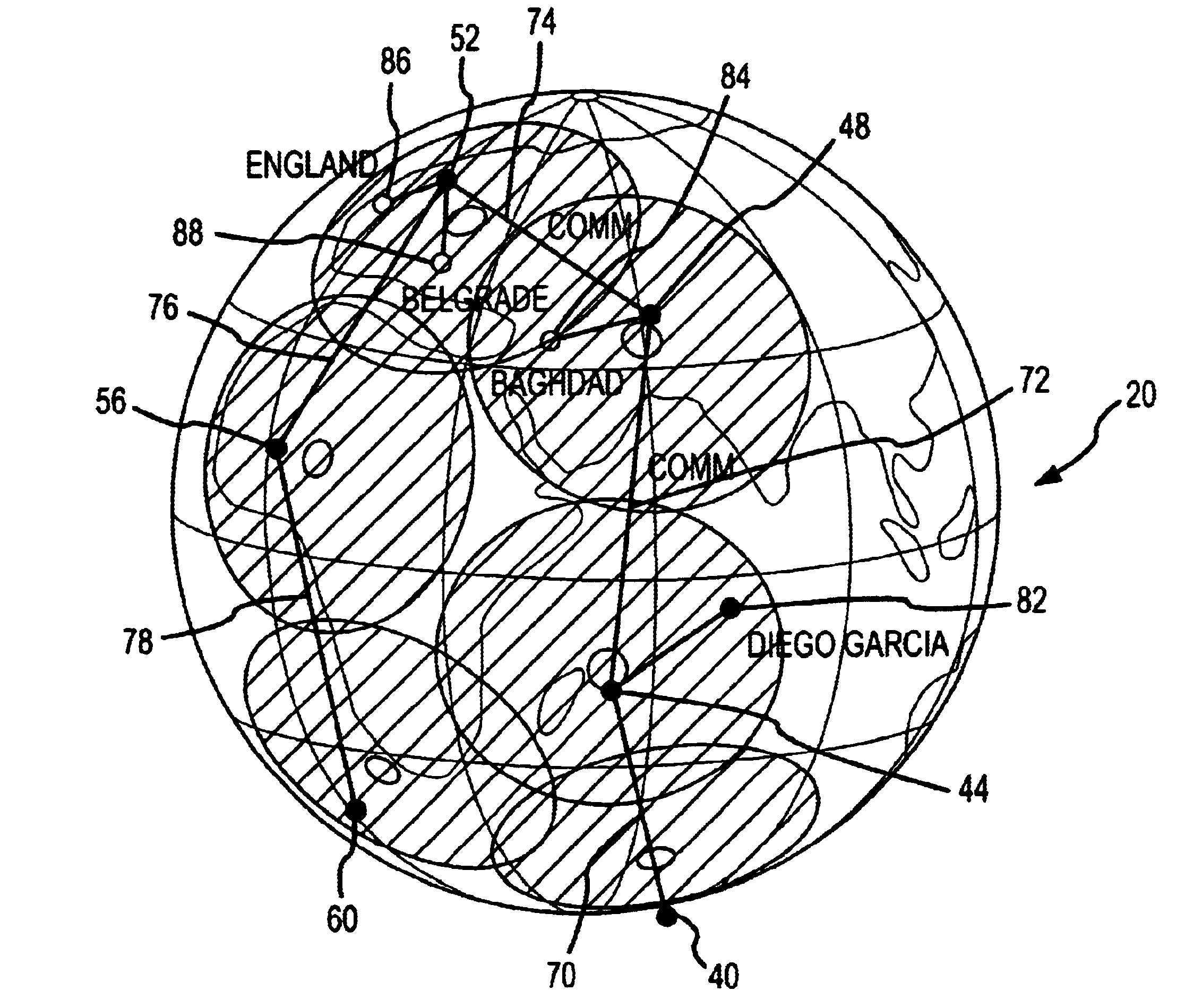
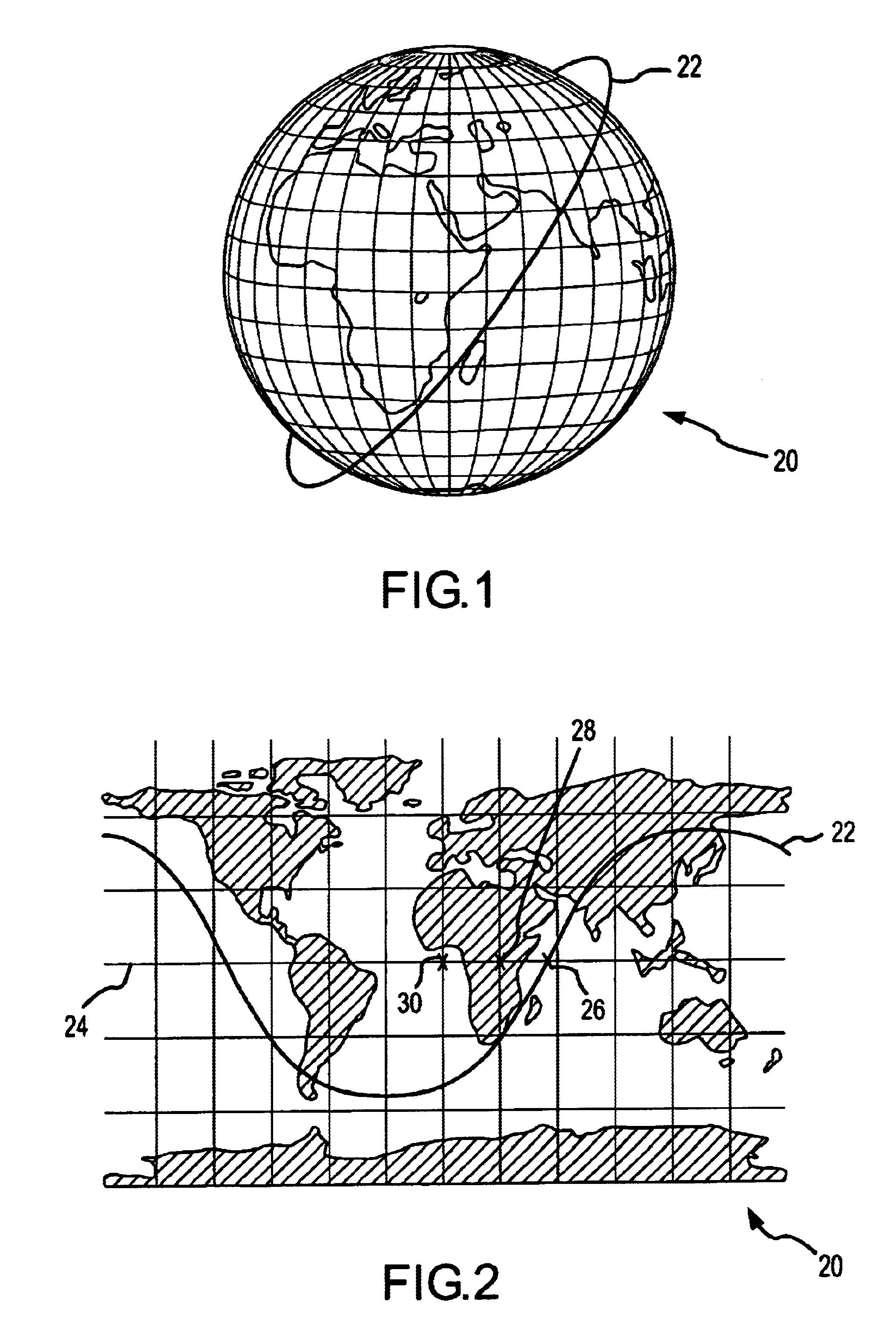
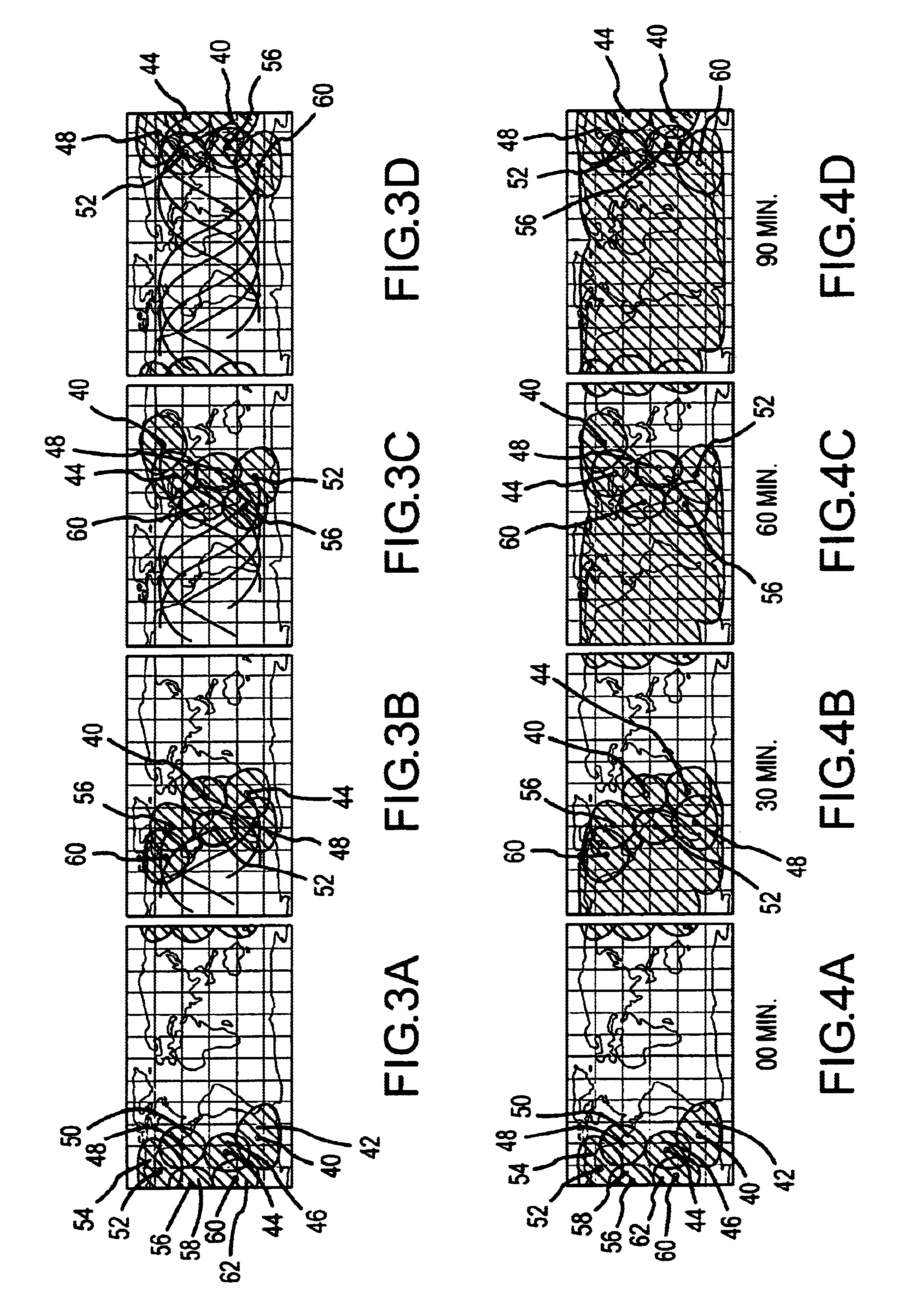
- An asymmetrical satellite constellation with a serpentine pattern of satellites in different orbits, each with incremental true anomaly offsets, allowing for extended continuous access and communication over a celestial body, maintaining line-of-sight between satellites and ground points, thereby increasing contiguous access time with a smaller number of satellites.

Space Regulatory Framework for Satellite Operations
The regulatory landscape governing satellite operations has evolved significantly to address the distinct operational characteristics and performance requirements of Fixed Satellite Service (FSS) geostationary satellites and Medium Earth Orbit (MEO) constellation systems. International frameworks established by the International Telecommunication Union (ITU) provide the foundational structure for frequency coordination, orbital slot allocation, and interference mitigation protocols that directly impact the comparative performance metrics between these orbital regimes.
Geostationary satellite operations are governed by well-established regulatory mechanisms that have been refined over decades. The ITU Radio Regulations provide specific provisions for coordination procedures, including advance publication requirements and coordination thresholds that account for the fixed coverage patterns and high-power transmission characteristics typical of GEO satellites. These regulations establish interference protection criteria that enable reliable service delivery but may limit operational flexibility compared to non-geostationary systems.
MEO constellation operations face a more complex regulatory environment due to their dynamic orbital characteristics and potential for interference with multiple satellite systems. The ITU has developed specialized coordination procedures for non-geostationary satellite systems, including equivalent power flux density limits and coordination triggers that account for the relative motion between satellites. These frameworks require sophisticated interference analysis methodologies that consider temporal and spatial variations in signal interactions.
National regulatory authorities implement additional licensing requirements that affect operational performance parameters. Spectrum allocation policies, power limitations, and coordination obligations vary significantly between jurisdictions, creating operational constraints that can impact system design choices between fixed and MEO architectures. Market access regulations and foreign ownership restrictions further influence deployment strategies and performance optimization approaches.
Recent regulatory developments have introduced more flexible frameworks for mega-constellation operations, including streamlined coordination procedures and updated interference protection criteria. These evolving regulations increasingly recognize the need to balance traditional satellite service protection with the operational requirements of next-generation constellation systems, potentially affecting the comparative advantages of different orbital approaches in future deployment scenarios.
Geostationary satellite operations are governed by well-established regulatory mechanisms that have been refined over decades. The ITU Radio Regulations provide specific provisions for coordination procedures, including advance publication requirements and coordination thresholds that account for the fixed coverage patterns and high-power transmission characteristics typical of GEO satellites. These regulations establish interference protection criteria that enable reliable service delivery but may limit operational flexibility compared to non-geostationary systems.
MEO constellation operations face a more complex regulatory environment due to their dynamic orbital characteristics and potential for interference with multiple satellite systems. The ITU has developed specialized coordination procedures for non-geostationary satellite systems, including equivalent power flux density limits and coordination triggers that account for the relative motion between satellites. These frameworks require sophisticated interference analysis methodologies that consider temporal and spatial variations in signal interactions.
National regulatory authorities implement additional licensing requirements that affect operational performance parameters. Spectrum allocation policies, power limitations, and coordination obligations vary significantly between jurisdictions, creating operational constraints that can impact system design choices between fixed and MEO architectures. Market access regulations and foreign ownership restrictions further influence deployment strategies and performance optimization approaches.
Recent regulatory developments have introduced more flexible frameworks for mega-constellation operations, including streamlined coordination procedures and updated interference protection criteria. These evolving regulations increasingly recognize the need to balance traditional satellite service protection with the operational requirements of next-generation constellation systems, potentially affecting the comparative advantages of different orbital approaches in future deployment scenarios.
Orbital Debris Mitigation in Satellite Design
The increasing deployment of satellites in both geostationary (GEO) and medium Earth orbit (MEO) constellations has intensified concerns about orbital debris generation and its long-term impact on space sustainability. As satellite operators evaluate the performance trade-offs between fixed GEO satellites and MEO constellations, debris mitigation strategies have become a critical design consideration that directly influences orbital selection and system architecture decisions.
GEO satellites, positioned at 35,786 kilometers above Earth's equator, present unique debris mitigation challenges due to their operational longevity and the crowded nature of the geostationary belt. The 25-year post-mission disposal rule requires GEO satellites to be moved to a graveyard orbit approximately 300 kilometers above the operational belt. This disposal strategy demands significant fuel reserves and robust propulsion systems, directly impacting satellite mass budgets and operational costs. Additionally, the high-energy environment at GEO altitude exposes satellites to increased micrometeoroid impacts and space weathering effects, necessitating enhanced shielding designs.
MEO constellations, typically operating between 8,000 to 20,000 kilometers altitude, face different debris mitigation requirements. The lower orbital energy compared to GEO enables more feasible deorbiting strategies, where satellites can be commanded to reenter Earth's atmosphere within 25 years of mission completion. This approach eliminates long-term debris accumulation but requires careful trajectory planning to ensure complete burnup during reentry and avoid ground impact risks.
Design-for-demise principles have become increasingly important for MEO satellites, emphasizing the use of materials and components that fully disintegrate during atmospheric reentry. This includes minimizing the use of high-melting-point materials like titanium and implementing breakup-friendly structural designs. Conversely, GEO satellites focus more on collision avoidance systems and end-of-life maneuverability to reach disposal orbits safely.
The debris mitigation requirements significantly influence the performance metrics comparison between GEO and MEO systems. MEO constellations must allocate additional mass and power for propulsion systems capable of controlled deorbiting, while GEO satellites require substantial fuel reserves for graveyard orbit insertion. These requirements directly impact payload capacity, mission duration, and overall system economics, making debris mitigation a fundamental factor in orbital architecture selection rather than merely a regulatory compliance issue.
GEO satellites, positioned at 35,786 kilometers above Earth's equator, present unique debris mitigation challenges due to their operational longevity and the crowded nature of the geostationary belt. The 25-year post-mission disposal rule requires GEO satellites to be moved to a graveyard orbit approximately 300 kilometers above the operational belt. This disposal strategy demands significant fuel reserves and robust propulsion systems, directly impacting satellite mass budgets and operational costs. Additionally, the high-energy environment at GEO altitude exposes satellites to increased micrometeoroid impacts and space weathering effects, necessitating enhanced shielding designs.
MEO constellations, typically operating between 8,000 to 20,000 kilometers altitude, face different debris mitigation requirements. The lower orbital energy compared to GEO enables more feasible deorbiting strategies, where satellites can be commanded to reenter Earth's atmosphere within 25 years of mission completion. This approach eliminates long-term debris accumulation but requires careful trajectory planning to ensure complete burnup during reentry and avoid ground impact risks.
Design-for-demise principles have become increasingly important for MEO satellites, emphasizing the use of materials and components that fully disintegrate during atmospheric reentry. This includes minimizing the use of high-melting-point materials like titanium and implementing breakup-friendly structural designs. Conversely, GEO satellites focus more on collision avoidance systems and end-of-life maneuverability to reach disposal orbits safely.
The debris mitigation requirements significantly influence the performance metrics comparison between GEO and MEO systems. MEO constellations must allocate additional mass and power for propulsion systems capable of controlled deorbiting, while GEO satellites require substantial fuel reserves for graveyard orbit insertion. These requirements directly impact payload capacity, mission duration, and overall system economics, making debris mitigation a fundamental factor in orbital architecture selection rather than merely a regulatory compliance issue.
Unlock deeper insights with PatSnap Eureka Quick Research — get a full tech report to explore trends and direct your research. Try now!
Generate Your Research Report Instantly with AI Agent
Supercharge your innovation with PatSnap Eureka AI Agent Platform!