

HBM Memory vs DRAM: Which Provides Lower Energy Drain?
MAY 18, 20269 MIN READ
Generate Your Research Report Instantly with AI Agent
PatSnap Eureka helps you evaluate technical feasibility & market potential.
HBM vs DRAM Energy Efficiency Background and Objectives
The evolution of memory technologies has been fundamentally driven by the relentless pursuit of higher performance, greater capacity, and improved energy efficiency in computing systems. As data-intensive applications continue to proliferate across artificial intelligence, high-performance computing, and graphics processing domains, the limitations of traditional memory architectures have become increasingly apparent. The bandwidth wall between processors and memory has emerged as a critical bottleneck, necessitating innovative approaches to memory design and implementation.
High Bandwidth Memory represents a paradigm shift in memory architecture, utilizing through-silicon via technology and 3D stacking to achieve unprecedented bandwidth densities. This revolutionary approach addresses the fundamental constraints of traditional planar memory designs by vertically integrating multiple memory dies with sophisticated thermal and electrical management systems. The technology emerged from collaborative efforts between memory manufacturers and processor designers who recognized the urgent need for memory solutions capable of feeding increasingly powerful computational engines.
Dynamic Random Access Memory has served as the cornerstone of computer memory systems for decades, continuously evolving through successive generations to meet growing performance demands. From early single data rate implementations to current DDR5 specifications, DRAM technology has demonstrated remarkable scalability while maintaining cost-effectiveness and broad compatibility across diverse computing platforms. However, the physical limitations of traditional packaging and interconnect technologies have constrained DRAM's ability to scale bandwidth proportionally with capacity increases.
The primary objective of comparing HBM and DRAM energy efficiency centers on understanding how architectural differences translate into power consumption characteristics under various operational scenarios. This analysis aims to quantify the energy trade-offs between HBM's high-bandwidth, low-voltage signaling approach and DRAM's mature, optimized power management techniques. The investigation seeks to establish clear guidelines for technology selection based on specific application requirements, workload characteristics, and system-level energy budgets.
Furthermore, this comparative study endeavors to project future energy efficiency trajectories for both technologies, considering ongoing developments in process technology, circuit design, and system integration approaches. The analysis will provide strategic insights for organizations evaluating memory technology roadmaps and inform decision-making processes for next-generation system architectures where energy efficiency represents a critical design constraint.
High Bandwidth Memory represents a paradigm shift in memory architecture, utilizing through-silicon via technology and 3D stacking to achieve unprecedented bandwidth densities. This revolutionary approach addresses the fundamental constraints of traditional planar memory designs by vertically integrating multiple memory dies with sophisticated thermal and electrical management systems. The technology emerged from collaborative efforts between memory manufacturers and processor designers who recognized the urgent need for memory solutions capable of feeding increasingly powerful computational engines.
Dynamic Random Access Memory has served as the cornerstone of computer memory systems for decades, continuously evolving through successive generations to meet growing performance demands. From early single data rate implementations to current DDR5 specifications, DRAM technology has demonstrated remarkable scalability while maintaining cost-effectiveness and broad compatibility across diverse computing platforms. However, the physical limitations of traditional packaging and interconnect technologies have constrained DRAM's ability to scale bandwidth proportionally with capacity increases.
The primary objective of comparing HBM and DRAM energy efficiency centers on understanding how architectural differences translate into power consumption characteristics under various operational scenarios. This analysis aims to quantify the energy trade-offs between HBM's high-bandwidth, low-voltage signaling approach and DRAM's mature, optimized power management techniques. The investigation seeks to establish clear guidelines for technology selection based on specific application requirements, workload characteristics, and system-level energy budgets.
Furthermore, this comparative study endeavors to project future energy efficiency trajectories for both technologies, considering ongoing developments in process technology, circuit design, and system integration approaches. The analysis will provide strategic insights for organizations evaluating memory technology roadmaps and inform decision-making processes for next-generation system architectures where energy efficiency represents a critical design constraint.
Market Demand for Low-Power Memory Solutions
The global semiconductor industry is experiencing unprecedented demand for memory solutions that can deliver high performance while minimizing power consumption. This trend is driven by the exponential growth of data-intensive applications across multiple sectors, including artificial intelligence, machine learning, high-performance computing, and mobile devices. As computational workloads become increasingly complex, the traditional trade-off between performance and energy efficiency has become a critical bottleneck that organizations must address.
Data centers represent one of the largest growth segments for low-power memory solutions. With cloud computing infrastructure consuming substantial amounts of global electricity, operators are actively seeking memory technologies that can reduce operational costs while maintaining or improving system performance. The rising emphasis on sustainability and carbon footprint reduction has further accelerated this demand, as organizations face increasing pressure from stakeholders and regulatory bodies to implement energy-efficient technologies.
The mobile and edge computing markets are driving another significant wave of demand for power-efficient memory solutions. Smartphones, tablets, and IoT devices require memory architectures that can support advanced features while preserving battery life. The proliferation of 5G networks and edge AI applications has intensified this requirement, as devices must process larger volumes of data locally without compromising user experience or device longevity.
Automotive applications, particularly in electric vehicles and autonomous driving systems, represent an emerging high-growth segment. These applications demand memory solutions that can handle real-time processing requirements while operating within strict power budgets to maximize vehicle range and system reliability. The automotive industry's transition toward electrification has made energy-efficient memory a critical component in overall vehicle efficiency.
Enterprise applications in financial services, healthcare, and scientific computing are increasingly adopting memory-intensive workloads that require both high bandwidth and energy efficiency. These sectors face growing regulatory requirements for operational efficiency and environmental responsibility, creating additional market pressure for low-power memory solutions that can deliver superior performance per watt.
The market dynamics are further influenced by rising electricity costs and increasing awareness of total cost of ownership considerations. Organizations are recognizing that memory power consumption significantly impacts long-term operational expenses, making energy-efficient solutions economically attractive beyond their environmental benefits.
Data centers represent one of the largest growth segments for low-power memory solutions. With cloud computing infrastructure consuming substantial amounts of global electricity, operators are actively seeking memory technologies that can reduce operational costs while maintaining or improving system performance. The rising emphasis on sustainability and carbon footprint reduction has further accelerated this demand, as organizations face increasing pressure from stakeholders and regulatory bodies to implement energy-efficient technologies.
The mobile and edge computing markets are driving another significant wave of demand for power-efficient memory solutions. Smartphones, tablets, and IoT devices require memory architectures that can support advanced features while preserving battery life. The proliferation of 5G networks and edge AI applications has intensified this requirement, as devices must process larger volumes of data locally without compromising user experience or device longevity.
Automotive applications, particularly in electric vehicles and autonomous driving systems, represent an emerging high-growth segment. These applications demand memory solutions that can handle real-time processing requirements while operating within strict power budgets to maximize vehicle range and system reliability. The automotive industry's transition toward electrification has made energy-efficient memory a critical component in overall vehicle efficiency.
Enterprise applications in financial services, healthcare, and scientific computing are increasingly adopting memory-intensive workloads that require both high bandwidth and energy efficiency. These sectors face growing regulatory requirements for operational efficiency and environmental responsibility, creating additional market pressure for low-power memory solutions that can deliver superior performance per watt.
The market dynamics are further influenced by rising electricity costs and increasing awareness of total cost of ownership considerations. Organizations are recognizing that memory power consumption significantly impacts long-term operational expenses, making energy-efficient solutions economically attractive beyond their environmental benefits.
Current Energy Consumption Challenges in HBM and DRAM
HBM and DRAM technologies face distinct energy consumption challenges that significantly impact their deployment in modern computing systems. The fundamental architectural differences between these memory types create unique power management complexities that system designers must navigate carefully.
HBM's primary energy challenge stems from its sophisticated 3D stacked architecture and high-bandwidth interface requirements. The Through-Silicon Via (TSV) interconnects, while enabling exceptional bandwidth density, introduce parasitic capacitances that contribute to increased static power consumption. The complex signaling protocols required to maintain coherency across multiple memory dies within a single HBM stack demand continuous power, even during idle states. Additionally, the high-speed serializer-deserializer circuits operating at frequencies exceeding 3.2 Gbps per pin generate substantial dynamic power consumption, particularly during peak data transfer operations.
The thermal management challenges in HBM further exacerbate energy consumption issues. The dense 3D stacking creates hotspots that require active cooling solutions, indirectly increasing overall system power consumption. The temperature-dependent leakage currents in HBM become more pronounced due to the confined thermal envelope, leading to exponential increases in static power consumption as operating temperatures rise.
DRAM faces different but equally significant energy consumption challenges. The periodic refresh operations required to maintain data integrity in DRAM cells consume substantial background power, with refresh energy accounting for up to 40% of total DRAM power consumption in modern high-density modules. As DRAM density increases, the refresh overhead grows proportionally, creating scalability concerns for future generations.
The distributed nature of DRAM modules across multiple channels introduces additional energy penalties through longer trace lengths and higher capacitive loads on memory buses. The need for error correction coding in enterprise DRAM applications further increases power consumption through additional logic operations and memory overhead.
Both technologies struggle with voltage scaling limitations as manufacturing processes approach physical boundaries. The inability to proportionally reduce operating voltages while maintaining reliability margins constrains energy efficiency improvements. Process variation effects become more pronounced at advanced nodes, requiring wider voltage margins that directly impact energy consumption.
The challenge of maintaining signal integrity at high frequencies forces both HBM and DRAM systems to employ power-hungry equalization and error correction mechanisms. These overhead circuits can consume significant portions of the total memory subsystem power budget, particularly in high-performance applications where data rates push the limits of current technology capabilities.
HBM's primary energy challenge stems from its sophisticated 3D stacked architecture and high-bandwidth interface requirements. The Through-Silicon Via (TSV) interconnects, while enabling exceptional bandwidth density, introduce parasitic capacitances that contribute to increased static power consumption. The complex signaling protocols required to maintain coherency across multiple memory dies within a single HBM stack demand continuous power, even during idle states. Additionally, the high-speed serializer-deserializer circuits operating at frequencies exceeding 3.2 Gbps per pin generate substantial dynamic power consumption, particularly during peak data transfer operations.
The thermal management challenges in HBM further exacerbate energy consumption issues. The dense 3D stacking creates hotspots that require active cooling solutions, indirectly increasing overall system power consumption. The temperature-dependent leakage currents in HBM become more pronounced due to the confined thermal envelope, leading to exponential increases in static power consumption as operating temperatures rise.
DRAM faces different but equally significant energy consumption challenges. The periodic refresh operations required to maintain data integrity in DRAM cells consume substantial background power, with refresh energy accounting for up to 40% of total DRAM power consumption in modern high-density modules. As DRAM density increases, the refresh overhead grows proportionally, creating scalability concerns for future generations.
The distributed nature of DRAM modules across multiple channels introduces additional energy penalties through longer trace lengths and higher capacitive loads on memory buses. The need for error correction coding in enterprise DRAM applications further increases power consumption through additional logic operations and memory overhead.
Both technologies struggle with voltage scaling limitations as manufacturing processes approach physical boundaries. The inability to proportionally reduce operating voltages while maintaining reliability margins constrains energy efficiency improvements. Process variation effects become more pronounced at advanced nodes, requiring wider voltage margins that directly impact energy consumption.
The challenge of maintaining signal integrity at high frequencies forces both HBM and DRAM systems to employ power-hungry equalization and error correction mechanisms. These overhead circuits can consume significant portions of the total memory subsystem power budget, particularly in high-performance applications where data rates push the limits of current technology capabilities.
Existing Energy Optimization Solutions for Memory Systems
01 Power management techniques for memory systems
Various power management techniques can be implemented in memory systems to reduce energy consumption. These include dynamic voltage and frequency scaling, power gating, and clock gating mechanisms that selectively disable unused portions of the memory during idle periods. Advanced power management controllers can monitor memory usage patterns and automatically adjust power states to optimize energy efficiency while maintaining performance requirements.- Power management techniques for memory systems: Various power management techniques can be implemented in memory systems to reduce energy consumption. These include dynamic voltage and frequency scaling, power gating, and clock gating mechanisms that allow memory controllers to adjust power consumption based on workload demands. Advanced power management circuits can monitor memory usage patterns and automatically switch between different power states to optimize energy efficiency while maintaining performance requirements.
- Memory controller optimization for energy efficiency: Memory controllers can be optimized to reduce energy drain through intelligent scheduling algorithms and improved data management techniques. These optimizations include predictive prefetching, adaptive refresh control, and efficient command scheduling that minimizes unnecessary memory accesses. Enhanced controller architectures can also implement energy-aware memory allocation strategies that distribute workloads to minimize overall power consumption.
- Refresh rate optimization and retention techniques: Dynamic random access memory requires periodic refresh operations to maintain data integrity, which contributes significantly to energy consumption. Advanced refresh optimization techniques can reduce energy drain by implementing variable refresh rates based on temperature and retention characteristics. Smart refresh algorithms can selectively refresh only the memory cells that require it, reducing unnecessary power consumption while ensuring data reliability.
- Low-power memory interface design: Memory interface designs can be optimized to reduce energy consumption through improved signaling techniques and reduced voltage swing operations. These designs include differential signaling methods, termination optimization, and advanced encoding schemes that minimize power consumption during data transmission. Interface circuits can also implement adaptive impedance control and signal conditioning to reduce energy requirements while maintaining signal integrity.
- Thermal management and energy-aware memory architectures: Thermal management plays a crucial role in memory energy efficiency, as temperature affects both power consumption and refresh requirements. Energy-aware memory architectures incorporate thermal sensors and adaptive cooling mechanisms to optimize operating conditions. These systems can dynamically adjust memory operating parameters based on thermal conditions and implement intelligent workload distribution to minimize hotspots and reduce overall energy consumption.
02 Memory refresh optimization strategies
Memory refresh operations consume significant power in dynamic memory systems. Optimization strategies include adaptive refresh rate control, selective refresh of active memory regions, and temperature-compensated refresh timing. These techniques reduce unnecessary refresh cycles while ensuring data integrity, leading to substantial energy savings in both high-bandwidth memory and traditional memory architectures.Expand Specific Solutions03 Low-power memory interface design
Energy-efficient memory interfaces incorporate advanced signaling techniques, reduced voltage swing operations, and optimized data transmission protocols. These designs minimize power consumption during data transfer operations while maintaining high bandwidth capabilities. Interface optimization includes termination resistance management, signal integrity enhancements, and adaptive impedance control mechanisms.Expand Specific Solutions04 Memory architecture modifications for energy efficiency
Architectural enhancements focus on reducing energy consumption through improved memory cell design, optimized sense amplifier circuits, and enhanced data path efficiency. These modifications include multi-level cell technologies, advanced error correction with lower overhead, and hierarchical memory organization that minimizes active power consumption during typical operation scenarios.Expand Specific Solutions05 Thermal management and energy correlation
Thermal management systems directly impact energy consumption in high-performance memory systems. Advanced thermal control mechanisms include dynamic thermal throttling, temperature-aware power allocation, and heat dissipation optimization. These systems prevent thermal runaway conditions while maintaining optimal energy efficiency across varying operational temperatures and workload conditions.Expand Specific Solutions
Key Players in HBM and DRAM Memory Industry
The HBM memory versus DRAM energy efficiency landscape represents a rapidly evolving competitive arena driven by AI and high-performance computing demands. The industry is in a growth phase with significant market expansion, as companies like Samsung Electronics, Micron Technology, and Intel lead traditional DRAM manufacturing while simultaneously investing heavily in HBM development. Technology maturity varies significantly across players - established memory giants Samsung and Micron demonstrate advanced HBM capabilities, while emerging companies like ChangXin Memory Technologies and specialized firms like Luminous Computing pursue innovative approaches. AMD, Apple, and Qualcomm drive demand-side innovation through processor integration, while TSMC enables advanced packaging solutions. The competitive dynamics show traditional memory manufacturers racing to optimize HBM energy efficiency against conventional DRAM, with Chinese players like ChangXin and research institutions accelerating domestic capabilities in this strategic technology sector.
Advanced Micro Devices, Inc.
Technical Solution: AMD implements energy-efficient memory architectures through their Infinity Cache technology and optimized memory controllers in their RDNA and CDNA GPU architectures. Their approach reduces reliance on external memory bandwidth by implementing large on-chip caches, thereby reducing HBM access frequency and associated power consumption. AMD's solutions include dynamic memory clock gating, adaptive memory refresh rates, and intelligent workload-based power scaling that can reduce memory subsystem power consumption by up to 35%. The company also develops custom memory interfaces optimized for specific compute workloads to minimize energy overhead.
Strengths: Innovative cache hierarchy design, GPU-optimized memory solutions, workload-specific optimizations. Weaknesses: Limited to AMD GPU ecosystem, complex software optimization requirements.
Samsung Electronics Co., Ltd.
Technical Solution: Samsung has developed advanced HBM3 technology with significant energy efficiency improvements. Their HBM3 solutions feature enhanced power management through dynamic voltage and frequency scaling, achieving up to 30% lower power consumption compared to previous generations while maintaining high bandwidth of 819 GB/s per stack. Samsung implements advanced process nodes (1α nm-class DRAM) and optimized circuit designs to reduce standby power and active power consumption. The company also integrates thermal management solutions and power gating techniques to minimize energy drain during idle states.
Strengths: Leading HBM manufacturing capability, advanced process technology, strong thermal management. Weaknesses: Higher manufacturing costs, complex integration requirements.
Core Innovations in Memory Power Management Technologies
High bandwidth memory control method and apparatus
PatentWO2026012169A1
Innovation
- By acquiring the traffic status of the uplink interface, the operating frequency of the logic circuit and the refresh mode of the DRAM are adjusted to match the traffic status and reduce the power consumption of the logic circuit and DRAM.


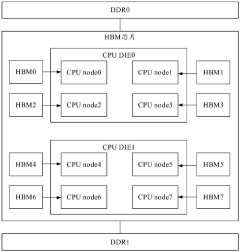
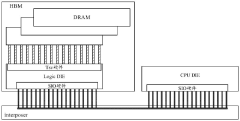
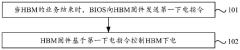
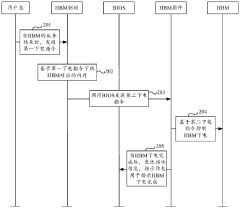
Power-on and power-off method and device of chip
PatentPendingCN117806441A
Innovation
- By completely shutting down the HBM when it is not in use, and only supplying power when needed, using a combination of software and hardware, the HBM firmware controls the HBM's power-on and power-off process based on power-on or power-off instructions, reducing hardware overhead and costs.
Thermal Management Considerations for Memory Systems
Thermal management represents a critical consideration when evaluating the energy efficiency differences between HBM memory and traditional DRAM systems. The relationship between power consumption and heat generation directly impacts overall system performance, reliability, and long-term operational costs in modern computing environments.
HBM memory architectures demonstrate superior thermal characteristics compared to conventional DRAM implementations due to their three-dimensional stacking design and advanced packaging technologies. The vertical integration of memory dies with through-silicon vias enables more efficient heat dissipation pathways, reducing localized hotspots that typically plague distributed DRAM configurations. This improved thermal distribution translates to lower cooling requirements and reduced energy overhead for thermal management systems.
The power density characteristics of HBM versus DRAM create distinctly different thermal profiles that influence cooling strategies. HBM's concentrated footprint generates heat in a smaller area but benefits from integrated thermal solutions, including advanced heat spreaders and direct cooling interfaces. Traditional DRAM modules distribute heat across larger board areas, requiring more extensive cooling infrastructure and higher fan speeds to maintain optimal operating temperatures.
Temperature-dependent leakage currents significantly impact the energy efficiency comparison between these memory technologies. HBM's superior thermal management capabilities help maintain lower junction temperatures, reducing leakage power consumption that can account for substantial portions of total memory system energy usage. DRAM systems operating at higher temperatures experience increased leakage currents, creating a compounding effect where poor thermal management leads to higher power consumption and additional heat generation.
Advanced cooling solutions for HBM implementations, including liquid cooling interfaces and enhanced thermal interface materials, enable more aggressive power optimization strategies. These thermal management improvements allow HBM systems to operate at higher performance levels while maintaining energy efficiency advantages over DRAM alternatives that rely on conventional air cooling methods.
HBM memory architectures demonstrate superior thermal characteristics compared to conventional DRAM implementations due to their three-dimensional stacking design and advanced packaging technologies. The vertical integration of memory dies with through-silicon vias enables more efficient heat dissipation pathways, reducing localized hotspots that typically plague distributed DRAM configurations. This improved thermal distribution translates to lower cooling requirements and reduced energy overhead for thermal management systems.
The power density characteristics of HBM versus DRAM create distinctly different thermal profiles that influence cooling strategies. HBM's concentrated footprint generates heat in a smaller area but benefits from integrated thermal solutions, including advanced heat spreaders and direct cooling interfaces. Traditional DRAM modules distribute heat across larger board areas, requiring more extensive cooling infrastructure and higher fan speeds to maintain optimal operating temperatures.
Temperature-dependent leakage currents significantly impact the energy efficiency comparison between these memory technologies. HBM's superior thermal management capabilities help maintain lower junction temperatures, reducing leakage power consumption that can account for substantial portions of total memory system energy usage. DRAM systems operating at higher temperatures experience increased leakage currents, creating a compounding effect where poor thermal management leads to higher power consumption and additional heat generation.
Advanced cooling solutions for HBM implementations, including liquid cooling interfaces and enhanced thermal interface materials, enable more aggressive power optimization strategies. These thermal management improvements allow HBM systems to operate at higher performance levels while maintaining energy efficiency advantages over DRAM alternatives that rely on conventional air cooling methods.
Performance-Power Trade-offs in Memory Architecture Design
The fundamental trade-off between performance and power consumption in memory architecture design represents one of the most critical engineering challenges in modern computing systems. This balance becomes particularly pronounced when comparing High Bandwidth Memory (HBM) and traditional Dynamic Random Access Memory (DRAM) technologies, where architectural decisions directly impact both computational capability and energy efficiency.
Memory bandwidth requirements have grown exponentially with the advancement of data-intensive applications, artificial intelligence workloads, and high-performance computing scenarios. HBM architecture addresses these demands through its three-dimensional stacking approach and wide interface design, delivering significantly higher bandwidth compared to conventional DRAM. However, this enhanced performance comes with complex power management considerations that must be carefully evaluated against application-specific requirements.
The architectural differences between HBM and DRAM create distinct power consumption profiles that vary significantly under different operational conditions. HBM's through-silicon via technology and shorter signal paths can reduce certain types of power overhead, particularly in high-throughput scenarios where the energy cost per bit transferred becomes favorable. Conversely, traditional DRAM maintains advantages in idle power consumption and simpler thermal management due to its distributed architecture.
Performance scaling in memory systems introduces non-linear power relationships that complicate direct comparisons between technologies. While HBM can achieve superior performance per watt in bandwidth-intensive applications, DRAM may demonstrate better energy efficiency in scenarios with irregular access patterns or lower utilization rates. The integration density of HBM also creates thermal constraints that can impact sustained performance, requiring sophisticated power management strategies.
System-level considerations further influence the performance-power equation, including controller complexity, interface power requirements, and cooling infrastructure demands. The choice between HBM and DRAM ultimately depends on optimizing these multifaceted trade-offs for specific application domains, workload characteristics, and operational constraints within the broader system architecture.
Memory bandwidth requirements have grown exponentially with the advancement of data-intensive applications, artificial intelligence workloads, and high-performance computing scenarios. HBM architecture addresses these demands through its three-dimensional stacking approach and wide interface design, delivering significantly higher bandwidth compared to conventional DRAM. However, this enhanced performance comes with complex power management considerations that must be carefully evaluated against application-specific requirements.
The architectural differences between HBM and DRAM create distinct power consumption profiles that vary significantly under different operational conditions. HBM's through-silicon via technology and shorter signal paths can reduce certain types of power overhead, particularly in high-throughput scenarios where the energy cost per bit transferred becomes favorable. Conversely, traditional DRAM maintains advantages in idle power consumption and simpler thermal management due to its distributed architecture.
Performance scaling in memory systems introduces non-linear power relationships that complicate direct comparisons between technologies. While HBM can achieve superior performance per watt in bandwidth-intensive applications, DRAM may demonstrate better energy efficiency in scenarios with irregular access patterns or lower utilization rates. The integration density of HBM also creates thermal constraints that can impact sustained performance, requiring sophisticated power management strategies.
System-level considerations further influence the performance-power equation, including controller complexity, interface power requirements, and cooling infrastructure demands. The choice between HBM and DRAM ultimately depends on optimizing these multifaceted trade-offs for specific application domains, workload characteristics, and operational constraints within the broader system architecture.
Unlock deeper insights with PatSnap Eureka Quick Research — get a full tech report to explore trends and direct your research. Try now!
Generate Your Research Report Instantly with AI Agent
Supercharge your innovation with PatSnap Eureka AI Agent Platform!