

How to Design Edge Intelligence for Energy-Efficient IoT Systems
MAY 21, 202610 MIN READ
Generate Your Research Report Instantly with AI Agent
PatSnap Eureka helps you evaluate technical feasibility & market potential.
Edge Intelligence Background and Energy Efficiency Goals
Edge intelligence represents a paradigm shift in distributed computing architectures, where artificial intelligence capabilities are deployed at the network edge rather than centralized cloud infrastructures. This approach emerged from the convergence of several technological trends: the proliferation of Internet of Things devices, advances in miniaturized processing units, and the growing demand for real-time decision-making in resource-constrained environments. The concept fundamentally addresses the limitations of traditional cloud-centric AI models by bringing computational intelligence closer to data sources and end users.
The evolution of edge intelligence has been driven by the exponential growth of IoT deployments across various sectors, including smart cities, industrial automation, healthcare monitoring, and environmental sensing. Traditional IoT architectures relied heavily on cloud connectivity for data processing and analysis, creating bottlenecks in bandwidth utilization, latency performance, and energy consumption. As IoT networks scaled to billions of connected devices, the limitations of centralized processing became increasingly apparent, necessitating a more distributed approach to intelligence deployment.
Energy efficiency has emerged as a critical design constraint in IoT systems due to several converging factors. Many IoT devices operate on battery power or energy harvesting mechanisms, making power consumption a primary determinant of system viability and operational lifespan. The sheer scale of IoT deployments means that even marginal improvements in energy efficiency can translate to significant environmental and economic benefits. Additionally, energy constraints directly impact the computational capabilities that can be deployed at edge nodes, creating a complex optimization challenge between intelligence sophistication and power consumption.
The primary goal of energy-efficient edge intelligence is to maximize the computational value delivered per unit of energy consumed while maintaining acceptable performance levels for target applications. This involves optimizing multiple dimensions simultaneously: algorithm efficiency, hardware utilization, communication protocols, and system-level power management. The challenge extends beyond simple energy minimization to encompass intelligent trade-offs between local processing and remote computation, dynamic resource allocation based on energy availability, and adaptive performance scaling based on application requirements.
Contemporary research in this domain focuses on developing lightweight machine learning algorithms specifically designed for resource-constrained environments, implementing dynamic voltage and frequency scaling techniques, and creating intelligent task scheduling mechanisms that consider both computational requirements and energy budgets. The ultimate objective is to create IoT systems that can operate autonomously for extended periods while providing sophisticated intelligence capabilities that enhance system functionality and user experience.
The evolution of edge intelligence has been driven by the exponential growth of IoT deployments across various sectors, including smart cities, industrial automation, healthcare monitoring, and environmental sensing. Traditional IoT architectures relied heavily on cloud connectivity for data processing and analysis, creating bottlenecks in bandwidth utilization, latency performance, and energy consumption. As IoT networks scaled to billions of connected devices, the limitations of centralized processing became increasingly apparent, necessitating a more distributed approach to intelligence deployment.
Energy efficiency has emerged as a critical design constraint in IoT systems due to several converging factors. Many IoT devices operate on battery power or energy harvesting mechanisms, making power consumption a primary determinant of system viability and operational lifespan. The sheer scale of IoT deployments means that even marginal improvements in energy efficiency can translate to significant environmental and economic benefits. Additionally, energy constraints directly impact the computational capabilities that can be deployed at edge nodes, creating a complex optimization challenge between intelligence sophistication and power consumption.
The primary goal of energy-efficient edge intelligence is to maximize the computational value delivered per unit of energy consumed while maintaining acceptable performance levels for target applications. This involves optimizing multiple dimensions simultaneously: algorithm efficiency, hardware utilization, communication protocols, and system-level power management. The challenge extends beyond simple energy minimization to encompass intelligent trade-offs between local processing and remote computation, dynamic resource allocation based on energy availability, and adaptive performance scaling based on application requirements.
Contemporary research in this domain focuses on developing lightweight machine learning algorithms specifically designed for resource-constrained environments, implementing dynamic voltage and frequency scaling techniques, and creating intelligent task scheduling mechanisms that consider both computational requirements and energy budgets. The ultimate objective is to create IoT systems that can operate autonomously for extended periods while providing sophisticated intelligence capabilities that enhance system functionality and user experience.
Market Demand for Energy-Efficient IoT Solutions
The global IoT ecosystem is experiencing unprecedented growth, with billions of connected devices generating massive amounts of data that require intelligent processing capabilities. Traditional cloud-centric architectures face significant limitations in meeting the stringent requirements of modern IoT applications, particularly regarding latency, bandwidth consumption, and energy efficiency. This has created substantial market demand for edge intelligence solutions that can process data locally while maintaining optimal energy consumption patterns.
Smart cities represent one of the most significant market drivers for energy-efficient IoT systems. Urban infrastructure deployments require thousands of sensors and actuators that must operate continuously with minimal maintenance and energy consumption. Applications such as intelligent traffic management, environmental monitoring, and smart lighting systems demand real-time decision-making capabilities while operating under strict power constraints. The distributed nature of these deployments makes centralized processing impractical, driving the need for edge intelligence solutions.
Industrial IoT applications constitute another major market segment demanding energy-efficient edge intelligence. Manufacturing facilities, oil and gas operations, and logistics networks require robust monitoring and control systems that can operate reliably in harsh environments with limited power infrastructure. Predictive maintenance applications, quality control systems, and supply chain optimization solutions need local processing capabilities to ensure operational continuity while minimizing energy costs and environmental impact.
Healthcare and wearable technology markets are experiencing rapid expansion, with devices requiring sophisticated processing capabilities while maintaining extended battery life. Remote patient monitoring, fitness tracking, and medical diagnostic devices must balance computational complexity with energy efficiency to ensure user acceptance and clinical viability. The sensitive nature of healthcare data also drives demand for local processing capabilities to address privacy and security concerns.
Agricultural technology represents an emerging market segment where energy-efficient IoT solutions are becoming critical. Precision farming applications, livestock monitoring, and crop management systems often operate in remote locations with limited power infrastructure. These applications require intelligent data processing capabilities to optimize resource utilization while maintaining sustainable energy consumption patterns throughout extended deployment periods.
The convergence of artificial intelligence and IoT technologies is creating new market opportunities across various sectors. Edge AI applications require sophisticated processing capabilities that must be balanced against energy constraints, particularly in battery-powered and energy-harvesting devices. This technological convergence is driving innovation in hardware design, algorithm optimization, and system architecture to meet the growing demand for intelligent, energy-efficient IoT solutions across diverse application domains.
Smart cities represent one of the most significant market drivers for energy-efficient IoT systems. Urban infrastructure deployments require thousands of sensors and actuators that must operate continuously with minimal maintenance and energy consumption. Applications such as intelligent traffic management, environmental monitoring, and smart lighting systems demand real-time decision-making capabilities while operating under strict power constraints. The distributed nature of these deployments makes centralized processing impractical, driving the need for edge intelligence solutions.
Industrial IoT applications constitute another major market segment demanding energy-efficient edge intelligence. Manufacturing facilities, oil and gas operations, and logistics networks require robust monitoring and control systems that can operate reliably in harsh environments with limited power infrastructure. Predictive maintenance applications, quality control systems, and supply chain optimization solutions need local processing capabilities to ensure operational continuity while minimizing energy costs and environmental impact.
Healthcare and wearable technology markets are experiencing rapid expansion, with devices requiring sophisticated processing capabilities while maintaining extended battery life. Remote patient monitoring, fitness tracking, and medical diagnostic devices must balance computational complexity with energy efficiency to ensure user acceptance and clinical viability. The sensitive nature of healthcare data also drives demand for local processing capabilities to address privacy and security concerns.
Agricultural technology represents an emerging market segment where energy-efficient IoT solutions are becoming critical. Precision farming applications, livestock monitoring, and crop management systems often operate in remote locations with limited power infrastructure. These applications require intelligent data processing capabilities to optimize resource utilization while maintaining sustainable energy consumption patterns throughout extended deployment periods.
The convergence of artificial intelligence and IoT technologies is creating new market opportunities across various sectors. Edge AI applications require sophisticated processing capabilities that must be balanced against energy constraints, particularly in battery-powered and energy-harvesting devices. This technological convergence is driving innovation in hardware design, algorithm optimization, and system architecture to meet the growing demand for intelligent, energy-efficient IoT solutions across diverse application domains.
Current State and Challenges of Edge AI in IoT Systems
Edge AI in IoT systems has emerged as a transformative paradigm that brings artificial intelligence capabilities closer to data sources, enabling real-time processing and decision-making at the network periphery. Currently, the technology landscape encompasses various deployment models, from lightweight machine learning algorithms running on microcontrollers to sophisticated neural networks operating on edge computing devices. Major cloud providers and semiconductor companies have developed specialized edge AI platforms, including AWS IoT Greengrass, Google Edge TPU, and NVIDIA Jetson series, which offer different levels of computational power and energy efficiency trade-offs.
The integration of edge intelligence into IoT ecosystems has achieved significant milestones in specific application domains. Smart manufacturing facilities utilize edge AI for predictive maintenance and quality control, while autonomous vehicles leverage real-time object detection and path planning algorithms. Healthcare IoT devices employ edge-based anomaly detection for continuous patient monitoring, and smart city infrastructure implements distributed intelligence for traffic optimization and environmental sensing.
Despite these advances, several critical challenges persist in achieving truly energy-efficient edge AI deployments. The primary constraint lies in the fundamental tension between computational complexity and power consumption, particularly in battery-powered IoT devices where energy resources are severely limited. Current deep learning models, even when optimized through techniques like quantization and pruning, often exceed the computational budgets of resource-constrained devices.
Hardware heterogeneity presents another significant obstacle, as IoT ecosystems typically comprise diverse device types with varying processing capabilities, memory constraints, and power profiles. This diversity complicates the development of unified edge AI solutions and necessitates device-specific optimizations that increase development complexity and maintenance overhead.
Communication bottlenecks further compound these challenges, as edge devices must balance local processing with selective data transmission to cloud services. Determining optimal workload distribution between edge and cloud resources remains a complex optimization problem that depends on network conditions, computational requirements, and energy constraints.
Latency requirements in mission-critical applications create additional pressure on edge AI systems, demanding real-time inference capabilities while maintaining accuracy standards. Current solutions often struggle to meet stringent timing constraints without compromising either energy efficiency or model performance, particularly in applications requiring complex decision-making processes.
Security and privacy concerns also pose significant challenges, as edge devices often lack robust security mechanisms while handling sensitive data. The distributed nature of edge AI deployments increases attack surfaces and complicates the implementation of comprehensive security frameworks, creating vulnerabilities that could compromise entire IoT networks.
The integration of edge intelligence into IoT ecosystems has achieved significant milestones in specific application domains. Smart manufacturing facilities utilize edge AI for predictive maintenance and quality control, while autonomous vehicles leverage real-time object detection and path planning algorithms. Healthcare IoT devices employ edge-based anomaly detection for continuous patient monitoring, and smart city infrastructure implements distributed intelligence for traffic optimization and environmental sensing.
Despite these advances, several critical challenges persist in achieving truly energy-efficient edge AI deployments. The primary constraint lies in the fundamental tension between computational complexity and power consumption, particularly in battery-powered IoT devices where energy resources are severely limited. Current deep learning models, even when optimized through techniques like quantization and pruning, often exceed the computational budgets of resource-constrained devices.
Hardware heterogeneity presents another significant obstacle, as IoT ecosystems typically comprise diverse device types with varying processing capabilities, memory constraints, and power profiles. This diversity complicates the development of unified edge AI solutions and necessitates device-specific optimizations that increase development complexity and maintenance overhead.
Communication bottlenecks further compound these challenges, as edge devices must balance local processing with selective data transmission to cloud services. Determining optimal workload distribution between edge and cloud resources remains a complex optimization problem that depends on network conditions, computational requirements, and energy constraints.
Latency requirements in mission-critical applications create additional pressure on edge AI systems, demanding real-time inference capabilities while maintaining accuracy standards. Current solutions often struggle to meet stringent timing constraints without compromising either energy efficiency or model performance, particularly in applications requiring complex decision-making processes.
Security and privacy concerns also pose significant challenges, as edge devices often lack robust security mechanisms while handling sensitive data. The distributed nature of edge AI deployments increases attack surfaces and complicates the implementation of comprehensive security frameworks, creating vulnerabilities that could compromise entire IoT networks.
Existing Edge Intelligence Architectures for IoT
01 Edge computing optimization algorithms for energy efficiency
Advanced algorithms and optimization techniques are employed to reduce energy consumption in edge computing environments. These methods focus on intelligent resource allocation, dynamic workload management, and adaptive processing strategies to minimize power usage while maintaining performance. The algorithms can automatically adjust computational loads and optimize system parameters based on real-time energy consumption patterns.- Edge computing optimization algorithms for energy efficiency: Advanced algorithms and optimization techniques are employed to minimize energy consumption in edge computing environments. These methods focus on intelligent resource allocation, dynamic workload distribution, and adaptive power management strategies to reduce overall system energy requirements while maintaining performance standards.
- Hardware-level energy management in edge devices: Specialized hardware architectures and components designed specifically for energy-efficient edge computing operations. This includes low-power processors, energy-aware circuit designs, and hardware accelerators that optimize computational tasks while minimizing power consumption at the device level.
- Intelligent task scheduling and resource allocation: Smart scheduling mechanisms that dynamically allocate computational tasks and resources across edge networks to optimize energy usage. These systems consider factors such as processing requirements, network conditions, and power constraints to make intelligent decisions about task placement and execution timing.
- Network-aware energy optimization strategies: Energy efficiency approaches that consider network topology, communication patterns, and data transmission requirements in edge computing environments. These strategies optimize both computational and communication energy consumption through intelligent network management and data flow optimization.
- Adaptive power management systems: Dynamic power management frameworks that automatically adjust system parameters based on real-time conditions and workload demands. These systems implement various power-saving modes, voltage scaling techniques, and sleep state management to achieve optimal energy efficiency without compromising service quality.
02 Hardware-based energy management systems for edge devices
Specialized hardware architectures and energy management systems designed specifically for edge computing devices to enhance energy efficiency. These systems incorporate low-power processors, energy-aware circuit designs, and intelligent power management units that can dynamically control energy consumption based on computational demands and operational requirements.Expand Specific Solutions03 Machine learning approaches for energy optimization in edge intelligence
Implementation of machine learning models and artificial intelligence techniques to predict and optimize energy consumption patterns in edge computing systems. These approaches utilize predictive analytics, reinforcement learning, and neural networks to automatically adjust system parameters and improve energy efficiency through intelligent decision-making processes.Expand Specific Solutions04 Distributed computing frameworks for energy-efficient edge processing
Development of distributed computing architectures and frameworks that enable efficient task distribution and load balancing across multiple edge nodes to optimize overall energy consumption. These frameworks implement intelligent scheduling algorithms and resource sharing mechanisms to minimize energy usage while maintaining system performance and reliability.Expand Specific Solutions05 Communication protocols and networking solutions for energy-aware edge systems
Design and implementation of energy-efficient communication protocols and networking solutions specifically tailored for edge computing environments. These solutions focus on reducing transmission power, optimizing data routing, and implementing adaptive communication strategies that minimize energy consumption during data exchange between edge devices and cloud infrastructure.Expand Specific Solutions
Key Players in Edge AI and IoT Industry
The edge intelligence for energy-efficient IoT systems market is experiencing rapid growth, driven by increasing demand for real-time processing and reduced latency in IoT applications. The industry is in an expansion phase with significant market potential, as organizations seek to minimize energy consumption while maximizing computational efficiency at network edges. Technology maturity varies across players, with established giants like IBM, Intel, Microsoft, and Siemens leading in advanced edge computing solutions and AI integration. Telecommunications leaders including China Mobile and NTT are advancing network infrastructure capabilities, while specialized companies like ClearBlade and Veea focus on dedicated edge platforms. Academic institutions such as University of South Florida and National University of Defense Technology contribute foundational research. The competitive landscape shows a mix of mature enterprise solutions and emerging specialized technologies, indicating a market transitioning from early adoption to mainstream deployment across various industrial sectors.
International Business Machines Corp.
Technical Solution: IBM develops edge intelligence solutions through their Watson IoT Edge Analytics platform, which enables real-time data processing and machine learning inference at the edge. Their approach utilizes federated learning algorithms to train models locally while preserving data privacy, reducing bandwidth consumption by up to 90% compared to cloud-based processing. The system incorporates dynamic power management techniques that adjust computational loads based on battery levels and energy harvesting capabilities, extending IoT device lifetime by 40-60%. IBM's edge intelligence framework supports containerized microservices architecture, allowing selective activation of AI functions based on energy availability and task priority.
Strengths: Mature enterprise-grade platform with strong federated learning capabilities and proven energy optimization algorithms. Weaknesses: High implementation complexity and significant computational overhead for resource-constrained devices.
Siemens AG
Technical Solution: Siemens develops edge intelligence solutions through their MindSphere IoT platform, specifically targeting industrial IoT applications with energy-efficient AI processing capabilities. Their approach utilizes distributed edge computing nodes that implement collaborative inference algorithms, sharing computational loads across multiple devices to optimize overall system energy consumption. The solution features predictive maintenance algorithms that operate with minimal power requirements, using event-driven processing and smart sensor fusion to reduce continuous monitoring overhead by 60%. Siemens' edge intelligence framework incorporates industrial-grade power management systems with energy harvesting integration, enabling autonomous operation in remote industrial environments while maintaining real-time decision-making capabilities.
Strengths: Deep industrial domain expertise with ruggedized hardware solutions and proven track record in mission-critical applications. Weaknesses: Higher cost structure and limited applicability outside industrial use cases, with complex integration requirements.
Core Technologies in Energy-Efficient Edge AI
Edge Intelligence Platform, and Internet of Things Sensor Streams System
PatentActiveUS20170060574A1
Innovation
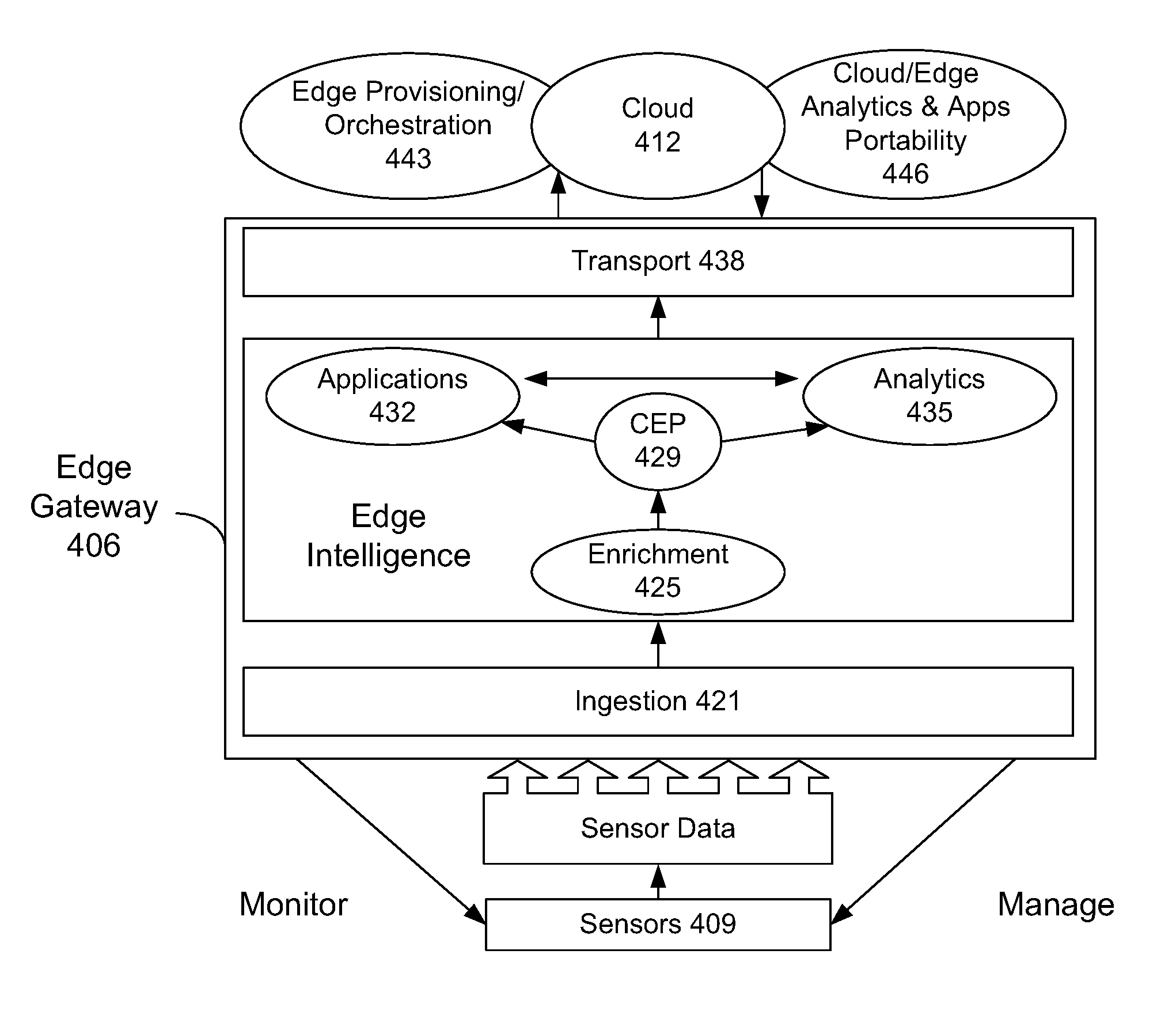
- The implementation of an edge computing platform that processes and analyzes data closer to the source using a software layer hosted on gateway devices or embedded systems, enabling real-time analytics and automated responses through a highly expressive computer language and a complex event processing engine, while also allowing data to be published to the cloud for further machine learning.

Real-time, distributed wireless sensor network for cellular connected devices
PatentPendingEP4325796A1
Innovation
- A method and device that utilize a machine learning model to process data from edge devices associated with a radio access network, generating edge analytic data to detect problems or predict issues, and perform actions such as configuration changes, retraining, or dispatching technicians, while providing insights to a cloud-computing system.


Standards and Protocols for Edge IoT Systems
The standardization landscape for edge IoT systems encompasses multiple layers of protocols and frameworks that collectively enable energy-efficient edge intelligence deployment. At the foundational level, IEEE 802.11ah (Wi-Fi HaLow) and IEEE 802.15.4 provide low-power wireless communication standards specifically designed for IoT devices, offering extended range and reduced energy consumption compared to traditional wireless protocols. These standards incorporate adaptive power management mechanisms that allow devices to dynamically adjust transmission power based on network conditions and computational requirements.
Communication protocols such as MQTT-SN (MQTT for Sensor Networks) and CoAP (Constrained Application Protocol) have emerged as lightweight alternatives to traditional internet protocols, specifically optimized for resource-constrained edge devices. These protocols implement efficient message queuing and publish-subscribe mechanisms that minimize network overhead while maintaining reliable data transmission. The integration of these protocols with edge intelligence frameworks enables distributed decision-making capabilities without compromising energy efficiency.
The Open Edge Computing Initiative and EdgeX Foundry have established comprehensive frameworks that standardize edge computing architectures and API specifications. These frameworks define standardized interfaces for device management, data processing, and service orchestration across heterogeneous edge environments. The modular architecture approach allows for selective deployment of intelligence components based on available energy budgets and computational resources.
Industrial standards such as OPC UA (Open Platform Communications Unified Architecture) and Time-Sensitive Networking (TSN) protocols provide deterministic communication capabilities essential for real-time edge intelligence applications. These standards incorporate quality-of-service mechanisms that prioritize critical data flows while implementing energy-aware scheduling algorithms to optimize overall system efficiency.
Security standardization efforts, including the Industrial Internet Consortium's security framework and NIST cybersecurity guidelines, establish protocols for secure edge intelligence deployment. These standards define lightweight cryptographic protocols and distributed authentication mechanisms that maintain security integrity while minimizing computational overhead on energy-constrained devices.
Emerging standardization initiatives focus on federated learning protocols and distributed AI frameworks that enable collaborative intelligence across edge networks. These protocols standardize model synchronization, gradient aggregation, and consensus mechanisms while incorporating energy-aware optimization strategies that balance learning performance with power consumption constraints across participating edge nodes.
Communication protocols such as MQTT-SN (MQTT for Sensor Networks) and CoAP (Constrained Application Protocol) have emerged as lightweight alternatives to traditional internet protocols, specifically optimized for resource-constrained edge devices. These protocols implement efficient message queuing and publish-subscribe mechanisms that minimize network overhead while maintaining reliable data transmission. The integration of these protocols with edge intelligence frameworks enables distributed decision-making capabilities without compromising energy efficiency.
The Open Edge Computing Initiative and EdgeX Foundry have established comprehensive frameworks that standardize edge computing architectures and API specifications. These frameworks define standardized interfaces for device management, data processing, and service orchestration across heterogeneous edge environments. The modular architecture approach allows for selective deployment of intelligence components based on available energy budgets and computational resources.
Industrial standards such as OPC UA (Open Platform Communications Unified Architecture) and Time-Sensitive Networking (TSN) protocols provide deterministic communication capabilities essential for real-time edge intelligence applications. These standards incorporate quality-of-service mechanisms that prioritize critical data flows while implementing energy-aware scheduling algorithms to optimize overall system efficiency.
Security standardization efforts, including the Industrial Internet Consortium's security framework and NIST cybersecurity guidelines, establish protocols for secure edge intelligence deployment. These standards define lightweight cryptographic protocols and distributed authentication mechanisms that maintain security integrity while minimizing computational overhead on energy-constrained devices.
Emerging standardization initiatives focus on federated learning protocols and distributed AI frameworks that enable collaborative intelligence across edge networks. These protocols standardize model synchronization, gradient aggregation, and consensus mechanisms while incorporating energy-aware optimization strategies that balance learning performance with power consumption constraints across participating edge nodes.
Security Considerations in Distributed Edge Intelligence
Security considerations in distributed edge intelligence systems represent a critical challenge that directly impacts the viability of energy-efficient IoT deployments. The distributed nature of edge computing creates multiple attack surfaces, where compromised edge nodes can serve as entry points for malicious activities. Unlike centralized cloud architectures, edge intelligence systems must maintain security across numerous geographically dispersed nodes with varying computational capabilities and network connectivity patterns.
Authentication and authorization mechanisms in distributed edge environments require lightweight protocols that minimize energy consumption while ensuring robust security. Traditional cryptographic approaches often impose significant computational overhead, creating tension between security requirements and energy efficiency goals. Edge nodes must implement adaptive security protocols that can dynamically adjust encryption strength based on available energy resources and threat assessment levels.
Data privacy protection becomes particularly complex when intelligence processing occurs across multiple edge nodes. Federated learning approaches, while preserving data locality, introduce new vulnerabilities related to model poisoning and inference attacks. Secure aggregation protocols must be designed to protect individual node contributions while enabling collaborative intelligence without compromising the energy efficiency of participating IoT devices.
Network security in distributed edge intelligence systems faces unique challenges due to intermittent connectivity and heterogeneous communication protocols. Edge nodes often operate in untrusted network environments where traditional perimeter-based security models are ineffective. Zero-trust architectures become essential, requiring continuous verification of node identity and behavior patterns while maintaining minimal energy overhead for security operations.
Intrusion detection and response mechanisms must operate autonomously at edge nodes due to potential isolation from central security infrastructure. Machine learning-based anomaly detection systems need to balance detection accuracy with computational efficiency, as false positives can trigger unnecessary security responses that drain energy resources. Distributed consensus mechanisms for threat intelligence sharing must consider both security requirements and the energy constraints of participating nodes.
Hardware security features, including trusted execution environments and secure enclaves, provide foundational protection for edge intelligence systems. However, implementing these features in resource-constrained IoT devices requires careful consideration of energy implications. Secure boot processes, hardware-based key management, and tamper detection mechanisms must be optimized for low-power operation while maintaining effectiveness against sophisticated attacks targeting distributed edge infrastructure.
Authentication and authorization mechanisms in distributed edge environments require lightweight protocols that minimize energy consumption while ensuring robust security. Traditional cryptographic approaches often impose significant computational overhead, creating tension between security requirements and energy efficiency goals. Edge nodes must implement adaptive security protocols that can dynamically adjust encryption strength based on available energy resources and threat assessment levels.
Data privacy protection becomes particularly complex when intelligence processing occurs across multiple edge nodes. Federated learning approaches, while preserving data locality, introduce new vulnerabilities related to model poisoning and inference attacks. Secure aggregation protocols must be designed to protect individual node contributions while enabling collaborative intelligence without compromising the energy efficiency of participating IoT devices.
Network security in distributed edge intelligence systems faces unique challenges due to intermittent connectivity and heterogeneous communication protocols. Edge nodes often operate in untrusted network environments where traditional perimeter-based security models are ineffective. Zero-trust architectures become essential, requiring continuous verification of node identity and behavior patterns while maintaining minimal energy overhead for security operations.
Intrusion detection and response mechanisms must operate autonomously at edge nodes due to potential isolation from central security infrastructure. Machine learning-based anomaly detection systems need to balance detection accuracy with computational efficiency, as false positives can trigger unnecessary security responses that drain energy resources. Distributed consensus mechanisms for threat intelligence sharing must consider both security requirements and the energy constraints of participating nodes.
Hardware security features, including trusted execution environments and secure enclaves, provide foundational protection for edge intelligence systems. However, implementing these features in resource-constrained IoT devices requires careful consideration of energy implications. Secure boot processes, hardware-based key management, and tamper detection mechanisms must be optimized for low-power operation while maintaining effectiveness against sophisticated attacks targeting distributed edge infrastructure.
Unlock deeper insights with PatSnap Eureka Quick Research — get a full tech report to explore trends and direct your research. Try now!
Generate Your Research Report Instantly with AI Agent
Supercharge your innovation with PatSnap Eureka AI Agent Platform!