

How to Develop Edge Intelligence for Stable High-Speed IoT Communication
MAY 21, 202610 MIN READ
Generate Your Research Report Instantly with AI Agent
PatSnap Eureka helps you evaluate technical feasibility & market potential.
Edge Intelligence Background and IoT Communication Goals
Edge intelligence represents a paradigm shift in computing architecture that brings artificial intelligence capabilities closer to data sources and end devices, fundamentally transforming how IoT systems process and respond to information. This distributed computing approach emerged from the limitations of traditional cloud-centric models, where latency, bandwidth constraints, and reliability issues hindered real-time decision-making in IoT applications. By deploying AI algorithms and processing power at the network edge, organizations can achieve faster response times, reduced data transmission costs, and enhanced system resilience.
The evolution of edge intelligence has been driven by several technological convergences, including the miniaturization of powerful processors, advances in machine learning algorithms optimized for resource-constrained environments, and the proliferation of IoT devices across industries. This technological progression has enabled the deployment of sophisticated AI capabilities in edge devices, from smart sensors and gateways to autonomous vehicles and industrial equipment.
IoT communication systems face unprecedented challenges as device density continues to grow exponentially, with projections indicating billions of connected devices generating massive data volumes. Traditional communication architectures struggle to maintain stable, high-speed connectivity while managing this scale, particularly in scenarios requiring real-time responsiveness such as autonomous driving, industrial automation, and smart city applications.
The primary goals for stable high-speed IoT communication encompass multiple dimensions of performance optimization. Latency reduction stands as a critical objective, aiming to achieve sub-millisecond response times for mission-critical applications. Bandwidth efficiency represents another key goal, focusing on intelligent data filtering and compression at the edge to minimize network congestion and reduce transmission costs.
Reliability and fault tolerance constitute essential targets, ensuring continuous operation even when network connectivity is intermittent or compromised. This includes developing adaptive communication protocols that can dynamically adjust to changing network conditions and maintain service quality. Additionally, scalability objectives focus on supporting massive IoT deployments without degrading performance, requiring innovative approaches to resource allocation and network management.
Security and privacy goals emphasize protecting sensitive data through edge-based processing, reducing exposure during transmission while maintaining compliance with regulatory requirements. Energy efficiency targets aim to optimize power consumption across IoT devices and edge infrastructure, extending device lifespans and reducing operational costs. These interconnected objectives form the foundation for developing comprehensive edge intelligence solutions that can transform IoT communication capabilities.
The evolution of edge intelligence has been driven by several technological convergences, including the miniaturization of powerful processors, advances in machine learning algorithms optimized for resource-constrained environments, and the proliferation of IoT devices across industries. This technological progression has enabled the deployment of sophisticated AI capabilities in edge devices, from smart sensors and gateways to autonomous vehicles and industrial equipment.
IoT communication systems face unprecedented challenges as device density continues to grow exponentially, with projections indicating billions of connected devices generating massive data volumes. Traditional communication architectures struggle to maintain stable, high-speed connectivity while managing this scale, particularly in scenarios requiring real-time responsiveness such as autonomous driving, industrial automation, and smart city applications.
The primary goals for stable high-speed IoT communication encompass multiple dimensions of performance optimization. Latency reduction stands as a critical objective, aiming to achieve sub-millisecond response times for mission-critical applications. Bandwidth efficiency represents another key goal, focusing on intelligent data filtering and compression at the edge to minimize network congestion and reduce transmission costs.
Reliability and fault tolerance constitute essential targets, ensuring continuous operation even when network connectivity is intermittent or compromised. This includes developing adaptive communication protocols that can dynamically adjust to changing network conditions and maintain service quality. Additionally, scalability objectives focus on supporting massive IoT deployments without degrading performance, requiring innovative approaches to resource allocation and network management.
Security and privacy goals emphasize protecting sensitive data through edge-based processing, reducing exposure during transmission while maintaining compliance with regulatory requirements. Energy efficiency targets aim to optimize power consumption across IoT devices and edge infrastructure, extending device lifespans and reducing operational costs. These interconnected objectives form the foundation for developing comprehensive edge intelligence solutions that can transform IoT communication capabilities.
Market Demand for Stable High-Speed IoT Solutions
The global IoT ecosystem is experiencing unprecedented growth, driven by digital transformation initiatives across industries and the increasing need for real-time data processing capabilities. Organizations worldwide are recognizing that traditional cloud-centric architectures cannot adequately support the latency-sensitive applications that define modern IoT deployments. This fundamental shift has created substantial market demand for edge intelligence solutions that can deliver stable, high-speed communication while processing data closer to its source.
Industrial automation represents one of the most significant demand drivers for stable high-speed IoT solutions. Manufacturing facilities require millisecond-level response times for critical operations such as predictive maintenance, quality control, and safety monitoring. The inability to tolerate communication delays or interruptions has pushed manufacturers to seek edge intelligence platforms that can maintain consistent performance even under challenging network conditions.
Smart city initiatives constitute another major market segment demanding robust IoT communication solutions. Traffic management systems, emergency response networks, and public safety infrastructure require uninterrupted connectivity to function effectively. Municipal governments are increasingly investing in edge-enabled IoT platforms that can operate autonomously during network disruptions while maintaining high-speed data transmission capabilities.
The healthcare sector presents compelling use cases for stable high-speed IoT communication, particularly in remote patient monitoring and telemedicine applications. Medical devices generating continuous data streams require reliable transmission capabilities to ensure patient safety and enable timely interventions. Edge intelligence solutions that can process critical health data locally while maintaining secure, high-speed connections to healthcare providers are experiencing strong market adoption.
Autonomous vehicle development has created substantial demand for ultra-reliable IoT communication systems. Vehicle-to-everything communication requires consistent, low-latency data exchange to ensure safety and operational efficiency. Edge intelligence platforms capable of processing sensor data in real-time while maintaining stable communication links are essential for advancing autonomous transportation technologies.
The telecommunications industry itself represents a significant market opportunity, as network operators seek to enhance service quality and reduce infrastructure costs. Edge intelligence solutions enable distributed processing capabilities that can improve network performance while reducing bandwidth requirements for backhaul connections.
Market research indicates that organizations are prioritizing solutions that combine artificial intelligence capabilities with robust communication protocols. The convergence of edge computing, machine learning, and advanced networking technologies is creating new opportunities for integrated platforms that can address multiple IoT communication challenges simultaneously.
Industrial automation represents one of the most significant demand drivers for stable high-speed IoT solutions. Manufacturing facilities require millisecond-level response times for critical operations such as predictive maintenance, quality control, and safety monitoring. The inability to tolerate communication delays or interruptions has pushed manufacturers to seek edge intelligence platforms that can maintain consistent performance even under challenging network conditions.
Smart city initiatives constitute another major market segment demanding robust IoT communication solutions. Traffic management systems, emergency response networks, and public safety infrastructure require uninterrupted connectivity to function effectively. Municipal governments are increasingly investing in edge-enabled IoT platforms that can operate autonomously during network disruptions while maintaining high-speed data transmission capabilities.
The healthcare sector presents compelling use cases for stable high-speed IoT communication, particularly in remote patient monitoring and telemedicine applications. Medical devices generating continuous data streams require reliable transmission capabilities to ensure patient safety and enable timely interventions. Edge intelligence solutions that can process critical health data locally while maintaining secure, high-speed connections to healthcare providers are experiencing strong market adoption.
Autonomous vehicle development has created substantial demand for ultra-reliable IoT communication systems. Vehicle-to-everything communication requires consistent, low-latency data exchange to ensure safety and operational efficiency. Edge intelligence platforms capable of processing sensor data in real-time while maintaining stable communication links are essential for advancing autonomous transportation technologies.
The telecommunications industry itself represents a significant market opportunity, as network operators seek to enhance service quality and reduce infrastructure costs. Edge intelligence solutions enable distributed processing capabilities that can improve network performance while reducing bandwidth requirements for backhaul connections.
Market research indicates that organizations are prioritizing solutions that combine artificial intelligence capabilities with robust communication protocols. The convergence of edge computing, machine learning, and advanced networking technologies is creating new opportunities for integrated platforms that can address multiple IoT communication challenges simultaneously.
Current Edge AI and IoT Communication Challenges
The integration of edge artificial intelligence with IoT communication systems faces significant technical barriers that impede the achievement of stable high-speed connectivity. Current edge AI processing capabilities are constrained by limited computational resources at edge nodes, creating bottlenecks when handling complex machine learning algorithms required for intelligent communication optimization. These resource limitations force a trade-off between processing sophistication and response time, directly impacting communication stability.
Latency remains a critical challenge in edge-enabled IoT networks, particularly when AI inference tasks compete with communication processing for limited hardware resources. The computational overhead of real-time AI decision-making often conflicts with the stringent timing requirements of high-speed IoT protocols, resulting in unpredictable delays that compromise network reliability. This issue becomes more pronounced as the number of connected devices increases exponentially.
Power consumption presents another fundamental constraint, especially for battery-powered edge devices that must simultaneously support AI processing and continuous communication functions. Current hardware architectures struggle to efficiently balance the energy demands of neural network computations with the power requirements of maintaining stable wireless connections, leading to shortened operational lifespans and reduced network coverage.
Interference management in dense IoT deployments poses substantial challenges for maintaining communication stability. Traditional interference mitigation techniques lack the adaptability required for dynamic environments, while AI-based solutions demand computational resources that may not be available at edge nodes. The complexity increases when multiple edge devices attempt to coordinate their AI-driven communication strategies without centralized control.
Data synchronization and consistency across distributed edge nodes create additional complications for maintaining stable communication. Edge AI systems require up-to-date information to make optimal decisions, but the overhead of maintaining data coherence can saturate available bandwidth and introduce communication delays. This challenge is amplified in mobile IoT scenarios where network topology changes frequently.
Security vulnerabilities emerge as edge AI systems become more sophisticated, creating new attack vectors that can compromise both intelligence capabilities and communication integrity. The distributed nature of edge computing makes it difficult to implement comprehensive security measures without significantly impacting performance, leaving systems vulnerable to adversarial attacks that can destabilize entire communication networks.
Latency remains a critical challenge in edge-enabled IoT networks, particularly when AI inference tasks compete with communication processing for limited hardware resources. The computational overhead of real-time AI decision-making often conflicts with the stringent timing requirements of high-speed IoT protocols, resulting in unpredictable delays that compromise network reliability. This issue becomes more pronounced as the number of connected devices increases exponentially.
Power consumption presents another fundamental constraint, especially for battery-powered edge devices that must simultaneously support AI processing and continuous communication functions. Current hardware architectures struggle to efficiently balance the energy demands of neural network computations with the power requirements of maintaining stable wireless connections, leading to shortened operational lifespans and reduced network coverage.
Interference management in dense IoT deployments poses substantial challenges for maintaining communication stability. Traditional interference mitigation techniques lack the adaptability required for dynamic environments, while AI-based solutions demand computational resources that may not be available at edge nodes. The complexity increases when multiple edge devices attempt to coordinate their AI-driven communication strategies without centralized control.
Data synchronization and consistency across distributed edge nodes create additional complications for maintaining stable communication. Edge AI systems require up-to-date information to make optimal decisions, but the overhead of maintaining data coherence can saturate available bandwidth and introduce communication delays. This challenge is amplified in mobile IoT scenarios where network topology changes frequently.
Security vulnerabilities emerge as edge AI systems become more sophisticated, creating new attack vectors that can compromise both intelligence capabilities and communication integrity. The distributed nature of edge computing makes it difficult to implement comprehensive security measures without significantly impacting performance, leaving systems vulnerable to adversarial attacks that can destabilize entire communication networks.
Existing Edge AI Solutions for IoT Communication
01 Edge computing architecture for intelligent communication systems
Edge computing architectures are designed to process data closer to the source, reducing latency and improving communication efficiency. These systems integrate intelligent algorithms at the network edge to enable real-time decision making and optimize data transmission paths. The architecture supports distributed processing capabilities that enhance overall system performance and reliability.- Edge computing architecture for intelligent communication systems: Edge computing architectures are designed to process data closer to the source, reducing latency and improving communication efficiency. These systems integrate intelligent processing capabilities at network edges to enable real-time decision making and optimize data transmission paths. The architecture supports distributed computing models that enhance overall system performance and reliability.
- High-speed data transmission protocols and methods: Advanced protocols and transmission methods are implemented to achieve stable high-speed communication in edge intelligence systems. These techniques focus on optimizing data packet routing, minimizing transmission delays, and ensuring reliable data delivery across network nodes. The methods incorporate adaptive algorithms that dynamically adjust transmission parameters based on network conditions.
- Network stability and reliability enhancement mechanisms: Mechanisms are developed to maintain network stability and ensure reliable communication in edge intelligence environments. These systems implement fault tolerance features, redundancy protocols, and automatic recovery procedures to handle network disruptions. The enhancement mechanisms monitor network performance continuously and adapt to changing conditions to maintain optimal communication quality.
- Intelligent resource allocation and management systems: Smart resource allocation systems optimize the distribution of computational and communication resources across edge nodes. These systems use machine learning algorithms and predictive analytics to anticipate resource demands and allocate bandwidth, processing power, and storage efficiently. The management framework ensures optimal utilization of available resources while maintaining service quality.
- Communication security and data protection frameworks: Security frameworks are implemented to protect data integrity and ensure secure communication channels in edge intelligence networks. These systems incorporate encryption protocols, authentication mechanisms, and access control measures to prevent unauthorized access and data breaches. The protection frameworks maintain communication security while preserving system performance and speed requirements.
02 High-speed data transmission protocols and methods
Advanced communication protocols are implemented to achieve stable high-speed data transmission in edge intelligence systems. These methods include optimized signal processing techniques, adaptive modulation schemes, and error correction mechanisms that maintain communication quality under varying network conditions. The protocols are specifically designed to handle the demanding requirements of edge computing environments.Expand Specific Solutions03 Network stability and reliability enhancement techniques
Various techniques are employed to ensure network stability and reliability in edge intelligence communication systems. These include redundancy mechanisms, fault tolerance protocols, and adaptive routing algorithms that maintain continuous operation even under adverse conditions. The systems incorporate monitoring and self-healing capabilities to automatically detect and resolve communication issues.Expand Specific Solutions04 Intelligent resource allocation and management systems
Smart resource allocation mechanisms are implemented to optimize bandwidth utilization and processing power distribution across edge nodes. These systems use machine learning algorithms and predictive analytics to dynamically allocate resources based on real-time demand and network conditions. The management systems ensure efficient utilization of available resources while maintaining service quality.Expand Specific Solutions05 Security and authentication frameworks for edge communications
Comprehensive security frameworks are integrated into edge intelligence communication systems to protect data integrity and prevent unauthorized access. These frameworks include encryption protocols, authentication mechanisms, and intrusion detection systems specifically designed for distributed edge environments. The security measures ensure safe and reliable communication while maintaining high-speed performance requirements.Expand Specific Solutions
Key Players in Edge Intelligence and IoT Industry
The edge intelligence for stable high-speed IoT communication market is in a mature growth phase, driven by increasing demand for real-time processing and reduced latency in IoT applications. The market demonstrates substantial scale with diverse players spanning telecommunications, technology giants, and specialized solution providers. Technology maturity varies significantly across the competitive landscape. Established telecommunications leaders like Samsung Electronics, Ericsson, and China Mobile provide foundational infrastructure and connectivity solutions. Technology giants including IBM, Microsoft Technology Licensing, and SAP SE contribute enterprise-grade platforms and cloud integration capabilities. Specialized edge computing companies such as ClearBlade and Veea offer dedicated IoT edge solutions, while automotive manufacturers like Toyota and industrial companies like Daikin drive sector-specific implementations. Academic institutions including Zhejiang University and Nanjing University contribute research advancement. The fragmented competitive environment reflects the technology's cross-industry applicability and varying implementation approaches across different market segments.
Samsung Electronics Co., Ltd.
Technical Solution: Samsung develops edge intelligence solutions through their SmartThings Edge platform and 5G network equipment portfolio. Their approach integrates AI-powered edge computing capabilities directly into IoT devices and network infrastructure to enable autonomous communication optimization. The solution features intelligent protocol selection algorithms that automatically choose the most efficient communication methods based on real-time network conditions. Samsung's edge intelligence includes adaptive power management systems that balance communication performance with energy efficiency, ensuring stable high-speed IoT connectivity while extending device battery life in mobile and remote deployment scenarios.
Strengths: Comprehensive device ecosystem, strong semiconductor capabilities, integrated hardware-software solutions. Weaknesses: Limited carrier network infrastructure presence, fragmented platform approach across different product lines.
Telefonaktiebolaget LM Ericsson
Technical Solution: Ericsson develops comprehensive edge intelligence solutions for IoT communication through their 5G Edge Computing platform. Their approach integrates Multi-access Edge Computing (MEC) with AI/ML capabilities to enable real-time processing at network edges. The solution includes intelligent traffic management algorithms that dynamically allocate bandwidth based on IoT device priorities and communication patterns. Their edge nodes feature distributed intelligence that can predict network congestion and automatically reroute traffic to maintain stable high-speed connections. The platform supports ultra-low latency applications with sub-millisecond response times through localized data processing and intelligent caching mechanisms.
Strengths: Industry-leading 5G infrastructure expertise, comprehensive MEC solutions, strong network optimization capabilities. Weaknesses: High implementation costs, complex integration requirements for existing networks.
Core Edge Intelligence Patents and Innovations
Efficient state machines for real-time dataflow programming
PatentActiveUS12093666B2
Innovation
- An efficient state-machine-based pattern matching technique processes tokens in an input queue without backtracking, enabling edge intelligence by specifying patterns in a state table and using a state stack, allowing for real-time data processing and analytics at the edge of the network.


Edge Intelligence Platform, and Internet of Things Sensor Streams System
PatentActiveUS20170060574A1
Innovation
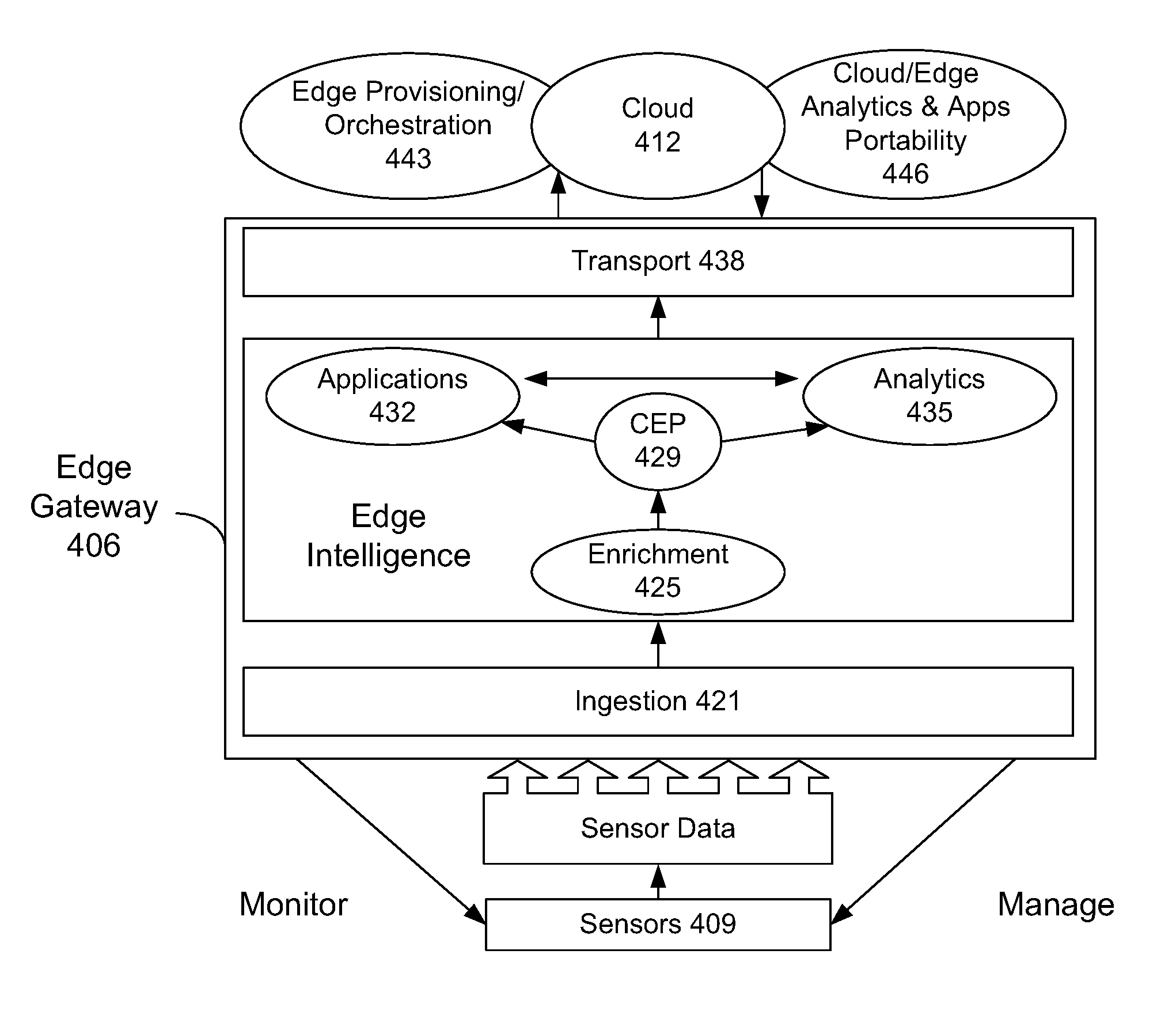
- The implementation of an edge computing platform that processes and analyzes data closer to the source using a software layer hosted on gateway devices or embedded systems, enabling real-time analytics and automated responses through a highly expressive computer language and a complex event processing engine, while also allowing data to be published to the cloud for further machine learning.

Network Standards and IoT Regulatory Framework
The development of edge intelligence for stable high-speed IoT communication operates within a complex regulatory landscape that encompasses multiple network standards and governance frameworks. Current IoT regulatory structures are primarily built around traditional centralized communication models, creating significant challenges for edge-based intelligent systems that require distributed processing capabilities and real-time decision-making at network peripheries.
International standardization bodies including the International Telecommunication Union (ITU), Institute of Electrical and Electronics Engineers (IEEE), and 3rd Generation Partnership Project (3GPP) have established foundational frameworks for IoT communications. However, these standards often lack specific provisions for edge intelligence integration, particularly regarding data processing sovereignty, latency guarantees, and distributed algorithm deployment across heterogeneous network infrastructures.
The regulatory framework for edge intelligence in IoT faces particular complexity in spectrum allocation and interference management. Traditional spectrum policies assume centralized control mechanisms, while edge intelligence systems require dynamic spectrum access and autonomous interference mitigation capabilities. Current regulations in major markets including the United States, European Union, and Asia-Pacific regions are gradually evolving to accommodate these requirements through experimental licensing frameworks and sandbox regulatory approaches.
Data governance represents another critical regulatory dimension, as edge intelligence systems process sensitive information locally while maintaining connectivity to broader networks. Privacy regulations such as GDPR in Europe and various national data protection laws create compliance requirements that directly impact edge intelligence architecture design. These regulations mandate data minimization, purpose limitation, and user consent mechanisms that must be embedded within edge processing algorithms.
Network security standards present both opportunities and constraints for edge intelligence deployment. Existing cybersecurity frameworks require adaptation to address the distributed attack surfaces inherent in edge computing architectures. Regulatory bodies are developing new certification processes for edge devices and distributed security protocols, though standardization remains fragmented across different jurisdictions and application domains.
Interoperability standards emerge as fundamental enablers for stable high-speed IoT communication with edge intelligence. Current regulatory frameworks are evolving toward technology-neutral approaches that emphasize performance outcomes rather than prescriptive technical specifications, allowing greater flexibility for innovative edge intelligence implementations while maintaining essential safety and reliability requirements.
International standardization bodies including the International Telecommunication Union (ITU), Institute of Electrical and Electronics Engineers (IEEE), and 3rd Generation Partnership Project (3GPP) have established foundational frameworks for IoT communications. However, these standards often lack specific provisions for edge intelligence integration, particularly regarding data processing sovereignty, latency guarantees, and distributed algorithm deployment across heterogeneous network infrastructures.
The regulatory framework for edge intelligence in IoT faces particular complexity in spectrum allocation and interference management. Traditional spectrum policies assume centralized control mechanisms, while edge intelligence systems require dynamic spectrum access and autonomous interference mitigation capabilities. Current regulations in major markets including the United States, European Union, and Asia-Pacific regions are gradually evolving to accommodate these requirements through experimental licensing frameworks and sandbox regulatory approaches.
Data governance represents another critical regulatory dimension, as edge intelligence systems process sensitive information locally while maintaining connectivity to broader networks. Privacy regulations such as GDPR in Europe and various national data protection laws create compliance requirements that directly impact edge intelligence architecture design. These regulations mandate data minimization, purpose limitation, and user consent mechanisms that must be embedded within edge processing algorithms.
Network security standards present both opportunities and constraints for edge intelligence deployment. Existing cybersecurity frameworks require adaptation to address the distributed attack surfaces inherent in edge computing architectures. Regulatory bodies are developing new certification processes for edge devices and distributed security protocols, though standardization remains fragmented across different jurisdictions and application domains.
Interoperability standards emerge as fundamental enablers for stable high-speed IoT communication with edge intelligence. Current regulatory frameworks are evolving toward technology-neutral approaches that emphasize performance outcomes rather than prescriptive technical specifications, allowing greater flexibility for innovative edge intelligence implementations while maintaining essential safety and reliability requirements.
Energy Efficiency in Edge Intelligence Systems
Energy efficiency represents a critical design consideration in edge intelligence systems supporting high-speed IoT communication networks. As computational workloads migrate closer to data sources, the power consumption characteristics of edge devices directly impact system sustainability, operational costs, and deployment scalability. Traditional cloud-centric architectures benefit from centralized power management and cooling infrastructure, whereas distributed edge intelligence systems must operate within stringent power budgets while maintaining computational performance requirements.
The fundamental challenge lies in balancing processing capability with energy consumption across heterogeneous edge computing nodes. Modern edge intelligence systems typically consume 10-50 watts per node, depending on computational complexity and communication requirements. This power envelope must accommodate multiple subsystems including processing units, memory hierarchies, communication interfaces, and environmental conditioning systems. Advanced power management techniques become essential to optimize energy utilization without compromising real-time processing capabilities.
Dynamic voltage and frequency scaling emerges as a primary energy optimization strategy for edge intelligence processors. By adjusting operating parameters based on workload characteristics, systems can achieve 30-60% energy savings during periods of reduced computational demand. Machine learning workloads exhibit varying computational intensity, creating opportunities for adaptive power management that responds to inference complexity and communication traffic patterns.
Communication subsystems represent significant energy consumers in edge intelligence architectures, often accounting for 40-70% of total system power consumption. High-speed IoT communication protocols require continuous radio frequency operations, signal processing, and protocol stack management. Energy-efficient communication strategies include adaptive transmission power control, intelligent duty cycling, and protocol optimization techniques that minimize unnecessary signaling overhead while maintaining connection stability.
Specialized hardware accelerators designed for edge AI workloads demonstrate superior energy efficiency compared to general-purpose processors. Neural processing units and dedicated inference engines can deliver 10-100x improvements in energy per operation for specific machine learning tasks. These specialized architectures optimize data movement patterns, reduce memory access overhead, and implement precision-optimized arithmetic units that minimize power consumption while preserving computational accuracy.
Thermal management considerations significantly influence energy efficiency in edge intelligence systems. Compact form factors and limited cooling capabilities require careful thermal design to prevent performance throttling and ensure reliable operation. Advanced thermal interface materials, intelligent fan control systems, and heat spreading techniques help maintain optimal operating temperatures while minimizing cooling-related energy consumption.
The fundamental challenge lies in balancing processing capability with energy consumption across heterogeneous edge computing nodes. Modern edge intelligence systems typically consume 10-50 watts per node, depending on computational complexity and communication requirements. This power envelope must accommodate multiple subsystems including processing units, memory hierarchies, communication interfaces, and environmental conditioning systems. Advanced power management techniques become essential to optimize energy utilization without compromising real-time processing capabilities.
Dynamic voltage and frequency scaling emerges as a primary energy optimization strategy for edge intelligence processors. By adjusting operating parameters based on workload characteristics, systems can achieve 30-60% energy savings during periods of reduced computational demand. Machine learning workloads exhibit varying computational intensity, creating opportunities for adaptive power management that responds to inference complexity and communication traffic patterns.
Communication subsystems represent significant energy consumers in edge intelligence architectures, often accounting for 40-70% of total system power consumption. High-speed IoT communication protocols require continuous radio frequency operations, signal processing, and protocol stack management. Energy-efficient communication strategies include adaptive transmission power control, intelligent duty cycling, and protocol optimization techniques that minimize unnecessary signaling overhead while maintaining connection stability.
Specialized hardware accelerators designed for edge AI workloads demonstrate superior energy efficiency compared to general-purpose processors. Neural processing units and dedicated inference engines can deliver 10-100x improvements in energy per operation for specific machine learning tasks. These specialized architectures optimize data movement patterns, reduce memory access overhead, and implement precision-optimized arithmetic units that minimize power consumption while preserving computational accuracy.
Thermal management considerations significantly influence energy efficiency in edge intelligence systems. Compact form factors and limited cooling capabilities require careful thermal design to prevent performance throttling and ensure reliable operation. Advanced thermal interface materials, intelligent fan control systems, and heat spreading techniques help maintain optimal operating temperatures while minimizing cooling-related energy consumption.
Unlock deeper insights with PatSnap Eureka Quick Research — get a full tech report to explore trends and direct your research. Try now!
Generate Your Research Report Instantly with AI Agent
Supercharge your innovation with PatSnap Eureka AI Agent Platform!