
How to Develop EUV Lithography Techniques for Silicon Photonics
APR 2, 20269 MIN READ
Generate Your Research Report Instantly with AI Agent
Patsnap Eureka helps you evaluate technical feasibility & market potential.
EUV Lithography for Silicon Photonics Background and Objectives
Silicon photonics has emerged as a transformative technology that leverages silicon's optical properties to create integrated photonic circuits, enabling high-speed data transmission, optical computing, and advanced sensing applications. The field has evolved from basic research in the 1980s to commercial deployment in data centers and telecommunications infrastructure. As data demands continue to exponentially increase, driven by cloud computing, artificial intelligence, and 5G networks, silicon photonics offers a compelling solution for bandwidth-intensive applications while maintaining cost-effectiveness through silicon manufacturing compatibility.
The integration of Extreme Ultraviolet (EUV) lithography into silicon photonics manufacturing represents a critical technological convergence. Traditional optical lithography faces fundamental limitations when fabricating the nanoscale features required for next-generation photonic devices. EUV lithography, operating at 13.5 nm wavelength, provides the resolution capability necessary to pattern sub-10 nm features with high precision and uniformity. This advancement is essential for developing compact photonic integrated circuits with enhanced performance characteristics.
Current silicon photonic devices rely on deep ultraviolet (DUV) lithography processes, which limit feature sizes to approximately 40-50 nm minimum dimensions. These constraints restrict device density, optical confinement efficiency, and overall system performance. The transition to EUV lithography promises to overcome these limitations by enabling precise fabrication of ultra-compact waveguides, resonators, and coupling structures with dimensions approaching the fundamental optical mode size.
The primary objective of developing EUV lithography techniques for silicon photonics is to achieve sub-wavelength optical confinement in silicon-based structures while maintaining low optical losses and high manufacturing yield. This requires addressing unique challenges including resist sensitivity optimization for photonic applications, overlay accuracy requirements for multi-layer photonic circuits, and defect control strategies specific to optical device performance.
Key technical targets include achieving waveguide width variations below 1 nm across wafer scales, enabling fabrication of photonic crystals with sub-10 nm feature sizes, and developing process integration flows that maintain the optical quality of silicon photonic materials. Success in these areas will unlock new device architectures including ultra-compact modulators, high-Q resonators, and dense wavelength division multiplexing components that are essential for next-generation optical communication systems and emerging applications in quantum photonics and optical computing.
The integration of Extreme Ultraviolet (EUV) lithography into silicon photonics manufacturing represents a critical technological convergence. Traditional optical lithography faces fundamental limitations when fabricating the nanoscale features required for next-generation photonic devices. EUV lithography, operating at 13.5 nm wavelength, provides the resolution capability necessary to pattern sub-10 nm features with high precision and uniformity. This advancement is essential for developing compact photonic integrated circuits with enhanced performance characteristics.
Current silicon photonic devices rely on deep ultraviolet (DUV) lithography processes, which limit feature sizes to approximately 40-50 nm minimum dimensions. These constraints restrict device density, optical confinement efficiency, and overall system performance. The transition to EUV lithography promises to overcome these limitations by enabling precise fabrication of ultra-compact waveguides, resonators, and coupling structures with dimensions approaching the fundamental optical mode size.
The primary objective of developing EUV lithography techniques for silicon photonics is to achieve sub-wavelength optical confinement in silicon-based structures while maintaining low optical losses and high manufacturing yield. This requires addressing unique challenges including resist sensitivity optimization for photonic applications, overlay accuracy requirements for multi-layer photonic circuits, and defect control strategies specific to optical device performance.
Key technical targets include achieving waveguide width variations below 1 nm across wafer scales, enabling fabrication of photonic crystals with sub-10 nm feature sizes, and developing process integration flows that maintain the optical quality of silicon photonic materials. Success in these areas will unlock new device architectures including ultra-compact modulators, high-Q resonators, and dense wavelength division multiplexing components that are essential for next-generation optical communication systems and emerging applications in quantum photonics and optical computing.
Market Demand for Advanced Silicon Photonic Devices
The silicon photonics market is experiencing unprecedented growth driven by the exponential increase in data traffic and the limitations of traditional electronic interconnects. Data centers worldwide are struggling with bandwidth bottlenecks and power consumption challenges, creating substantial demand for high-performance optical communication solutions. Silicon photonic devices offer superior bandwidth density, lower power consumption, and reduced latency compared to conventional copper-based systems, making them essential for next-generation computing infrastructure.
Hyperscale data center operators are actively seeking advanced silicon photonic solutions to support artificial intelligence workloads, machine learning applications, and high-performance computing clusters. The transition from electrical to optical interconnects at shorter distances within data centers represents a fundamental shift in architecture design. This transformation requires silicon photonic devices with increasingly smaller feature sizes and higher integration densities, directly driving the need for advanced lithography techniques including EUV technology.
The telecommunications sector presents another significant demand driver, particularly with the global deployment of 5G networks and the anticipated evolution toward 6G systems. Advanced silicon photonic transceivers and optical switches are critical components for supporting the massive bandwidth requirements and ultra-low latency specifications of these networks. Service providers require cost-effective, high-volume manufacturing of sophisticated photonic integrated circuits to meet deployment timelines and economic targets.
Emerging applications in autonomous vehicles, augmented reality systems, and quantum computing platforms are creating new market segments for specialized silicon photonic devices. These applications demand unprecedented precision in optical component manufacturing, requiring lithography capabilities that can achieve sub-wavelength features with exceptional uniformity and yield. The automotive sector alone represents a rapidly expanding market for LiDAR systems and optical sensors built on silicon photonic platforms.
The convergence of artificial intelligence and photonics is generating demand for neuromorphic computing architectures that leverage optical processing capabilities. These systems require complex photonic neural networks with thousands of interconnected optical components, necessitating advanced manufacturing techniques capable of producing large-scale integrated circuits with minimal defects and precise optical characteristics.
Market analysts project continued expansion across all application segments, with particular strength in co-packaged optics solutions that integrate photonic and electronic components at the package level. This integration trend demands manufacturing processes capable of achieving the dimensional accuracy and surface quality required for efficient optical coupling and thermal management in compact form factors.
Hyperscale data center operators are actively seeking advanced silicon photonic solutions to support artificial intelligence workloads, machine learning applications, and high-performance computing clusters. The transition from electrical to optical interconnects at shorter distances within data centers represents a fundamental shift in architecture design. This transformation requires silicon photonic devices with increasingly smaller feature sizes and higher integration densities, directly driving the need for advanced lithography techniques including EUV technology.
The telecommunications sector presents another significant demand driver, particularly with the global deployment of 5G networks and the anticipated evolution toward 6G systems. Advanced silicon photonic transceivers and optical switches are critical components for supporting the massive bandwidth requirements and ultra-low latency specifications of these networks. Service providers require cost-effective, high-volume manufacturing of sophisticated photonic integrated circuits to meet deployment timelines and economic targets.
Emerging applications in autonomous vehicles, augmented reality systems, and quantum computing platforms are creating new market segments for specialized silicon photonic devices. These applications demand unprecedented precision in optical component manufacturing, requiring lithography capabilities that can achieve sub-wavelength features with exceptional uniformity and yield. The automotive sector alone represents a rapidly expanding market for LiDAR systems and optical sensors built on silicon photonic platforms.
The convergence of artificial intelligence and photonics is generating demand for neuromorphic computing architectures that leverage optical processing capabilities. These systems require complex photonic neural networks with thousands of interconnected optical components, necessitating advanced manufacturing techniques capable of producing large-scale integrated circuits with minimal defects and precise optical characteristics.
Market analysts project continued expansion across all application segments, with particular strength in co-packaged optics solutions that integrate photonic and electronic components at the package level. This integration trend demands manufacturing processes capable of achieving the dimensional accuracy and surface quality required for efficient optical coupling and thermal management in compact form factors.
Current EUV Lithography Challenges in Photonic Applications
EUV lithography faces significant technical barriers when applied to silicon photonics manufacturing, primarily stemming from the fundamental differences between electronic and photonic device requirements. The most critical challenge lies in achieving the precise dimensional control necessary for photonic structures, where even nanometer-scale variations can dramatically affect optical performance. Unlike traditional semiconductor devices that primarily rely on electrical properties, photonic components demand exceptional geometric accuracy to maintain proper light propagation and coupling efficiency.
Resist material compatibility presents another major obstacle in photonic applications. Current EUV photoresists, optimized for electronic device fabrication, often exhibit insufficient resolution uniformity and edge roughness control required for optical waveguides and resonators. The chemical composition and molecular structure of existing resists can introduce unwanted optical absorption and scattering, particularly problematic for silicon photonics operating in the near-infrared spectrum where material purity is paramount.
Pattern fidelity challenges become amplified in photonic structures due to their three-dimensional nature and complex geometries. Photonic devices frequently require non-standard shapes such as curved waveguides, tapered couplers, and circular resonators that push EUV lithography beyond its conventional rectangular pattern capabilities. The proximity effects and flare characteristics inherent in EUV systems can cause significant distortions in these intricate photonic geometries.
Thermal management during EUV exposure poses unique difficulties for photonic device fabrication. The high-energy photons generate substantial heat that can cause thermal expansion and stress in the silicon substrate, leading to dimensional instabilities that are particularly detrimental to optical performance. This thermal sensitivity is exacerbated by the typically larger die sizes required for photonic integrated circuits compared to electronic components.
Process integration complexity increases substantially when combining EUV lithography with the specialized materials used in silicon photonics. The integration of III-V compound semiconductors, silicon nitride, and various metal layers for optical functionality requires careful consideration of material compatibility with EUV processing conditions. Chemical interactions between EUV-generated species and these optical materials can degrade device performance or introduce unwanted optical losses.
Metrology and inspection capabilities represent another significant challenge, as traditional semiconductor measurement techniques may not adequately characterize the optical properties critical to photonic device performance. The need for real-time feedback on optical characteristics during EUV processing remains largely unaddressed by current manufacturing infrastructure.
Resist material compatibility presents another major obstacle in photonic applications. Current EUV photoresists, optimized for electronic device fabrication, often exhibit insufficient resolution uniformity and edge roughness control required for optical waveguides and resonators. The chemical composition and molecular structure of existing resists can introduce unwanted optical absorption and scattering, particularly problematic for silicon photonics operating in the near-infrared spectrum where material purity is paramount.
Pattern fidelity challenges become amplified in photonic structures due to their three-dimensional nature and complex geometries. Photonic devices frequently require non-standard shapes such as curved waveguides, tapered couplers, and circular resonators that push EUV lithography beyond its conventional rectangular pattern capabilities. The proximity effects and flare characteristics inherent in EUV systems can cause significant distortions in these intricate photonic geometries.
Thermal management during EUV exposure poses unique difficulties for photonic device fabrication. The high-energy photons generate substantial heat that can cause thermal expansion and stress in the silicon substrate, leading to dimensional instabilities that are particularly detrimental to optical performance. This thermal sensitivity is exacerbated by the typically larger die sizes required for photonic integrated circuits compared to electronic components.
Process integration complexity increases substantially when combining EUV lithography with the specialized materials used in silicon photonics. The integration of III-V compound semiconductors, silicon nitride, and various metal layers for optical functionality requires careful consideration of material compatibility with EUV processing conditions. Chemical interactions between EUV-generated species and these optical materials can degrade device performance or introduce unwanted optical losses.
Metrology and inspection capabilities represent another significant challenge, as traditional semiconductor measurement techniques may not adequately characterize the optical properties critical to photonic device performance. The need for real-time feedback on optical characteristics during EUV processing remains largely unaddressed by current manufacturing infrastructure.
Existing EUV Solutions for Photonic Device Fabrication
01 EUV light source and plasma generation techniques
Extreme ultraviolet lithography systems utilize specialized light sources that generate EUV radiation through plasma formation. These techniques involve creating high-temperature plasma by bombarding target materials with laser pulses or electrical discharges to produce the required 13.5nm wavelength radiation. The light source design includes collector optics to efficiently gather and direct the EUV radiation toward the optical system while managing debris and thermal effects.- EUV light source and plasma generation techniques: Extreme ultraviolet lithography systems utilize specialized light sources that generate EUV radiation through plasma formation. These techniques involve the use of laser-produced plasma or discharge-produced plasma to create the necessary wavelengths for high-resolution patterning. The light source design and optimization are critical for achieving sufficient power and stability for semiconductor manufacturing processes.
- EUV optical systems and reflective optics: EUV lithography employs reflective optical systems due to the absorption characteristics of EUV light by most materials. These systems utilize multilayer mirrors with precise coatings to reflect and focus EUV radiation onto the wafer surface. The optical design includes collector optics, illumination systems, and projection optics that work together to achieve nanometer-scale resolution with minimal aberrations.
- EUV mask and pellicle technologies: Photomasks for EUV lithography require specialized reflective designs with absorber patterns on multilayer-coated substrates. Pellicle technologies protect these masks from contamination while maintaining transparency to EUV radiation. Advanced mask inspection and defect mitigation techniques are essential for ensuring pattern fidelity and yield in high-volume manufacturing environments.
- EUV resist materials and patterning processes: Photoresist materials designed for EUV lithography must exhibit high sensitivity to extreme ultraviolet radiation while maintaining excellent resolution and line edge roughness characteristics. These chemically amplified resists and metal-containing resists undergo specific chemical reactions upon EUV exposure. The development and optimization of these materials are crucial for achieving the desired pattern transfer with minimal defects.
- EUV metrology and process control: Measurement and inspection techniques for EUV lithography include overlay metrology, critical dimension measurement, and defect detection systems. These methods ensure precise alignment and dimensional control throughout the patterning process. Advanced computational techniques and sensor technologies enable real-time monitoring and feedback control to maintain process stability and optimize manufacturing yield.
02 EUV optical systems and reflective optics
EUV lithography employs all-reflective optical systems due to the absorption of extreme ultraviolet light by most materials. These systems utilize multilayer mirrors with alternating thin films optimized for maximum reflectivity at the EUV wavelength. The optical design includes projection optics with multiple aspherical mirrors arranged to achieve high numerical aperture and minimize aberrations for precise pattern transfer onto wafers.Expand Specific Solutions03 EUV mask and pellicle technologies
EUV masks are reflective structures consisting of multilayer coatings on substrates with patterned absorber layers. These masks require specialized designs to handle the reflective nature of EUV lithography and minimize defects. Pellicle technologies for EUV masks involve ultra-thin membranes that protect the mask surface from contamination while maintaining high transmission of EUV radiation, addressing challenges unique to the short wavelength.Expand Specific Solutions04 EUV resist materials and patterning processes
Photoresist materials for EUV lithography are specifically formulated to be sensitive to extreme ultraviolet radiation while providing high resolution and low line edge roughness. These materials must balance sensitivity, resolution, and etch resistance for advanced node patterning. The patterning processes involve optimized exposure and development techniques that account for the unique interaction between EUV photons and resist chemistry to achieve nanoscale feature definition.Expand Specific Solutions05 EUV metrology and inspection systems
Metrology and inspection techniques for EUV lithography include specialized systems for measuring critical dimensions, overlay accuracy, and defect detection at extreme ultraviolet wavelengths. These systems employ advanced imaging and scatterometry methods to characterize patterns and monitor process variations. Inspection technologies are designed to detect and classify defects on EUV masks and wafers with high sensitivity, ensuring manufacturing yield and quality control in high-volume production.Expand Specific Solutions
Key Players in EUV and Silicon Photonics Industry
The EUV lithography for silicon photonics market represents a rapidly evolving sector at the intersection of advanced semiconductor manufacturing and photonic integration. The industry is in a growth phase, driven by increasing demand for high-speed optical communication and data processing applications. Market size is expanding significantly as hyperscale data centers and 5G infrastructure deployment accelerate adoption. Technology maturity varies considerably across the competitive landscape. Leading players like TSMC, Samsung Electronics, and Intel demonstrate advanced EUV capabilities with established manufacturing processes. Equipment suppliers including Carl Zeiss SMT, Nikon, and Tokyo Electron provide critical lithography infrastructure. Material specialists such as Shin-Etsu Chemical and Applied Materials contribute essential components for EUV processes. Chinese companies like SMIC and Shanghai Sinyang are rapidly developing capabilities, while research institutions including Fudan University and Institute of Microelectronics advance fundamental technologies, creating a dynamic competitive environment with varying technological readiness levels.
Taiwan Semiconductor Manufacturing Co., Ltd.
Technical Solution: TSMC has developed advanced EUV lithography processes for silicon photonics applications, leveraging their industry-leading 7nm and 5nm EUV nodes. Their approach focuses on optimizing EUV resist materials and exposure conditions specifically for photonic device geometries. TSMC's silicon photonics platform integrates EUV-defined waveguides with sub-100nm critical dimensions, enabling high-density photonic integrated circuits. They have established specialized process flows that address the unique challenges of photonic structures, including managing the interaction between EUV radiation and silicon-on-insulator substrates, optimizing etch selectivity for photonic waveguides, and developing metrology solutions for measuring photonic device performance.
Strengths: World's largest contract manufacturer with extensive EUV experience and high-volume production capabilities. Weaknesses: High manufacturing costs and limited availability for smaller customers due to capacity constraints.
Carl Zeiss SMT GmbH
Technical Solution: Carl Zeiss SMT is the exclusive supplier of EUV optics systems and has developed specialized optical solutions for silicon photonics lithography applications. Their EUV systems feature ultra-precise mirror systems with sub-nanometer surface roughness to minimize scattering effects critical for photonic applications. Zeiss has engineered custom illumination systems that provide optimal coherence conditions for patterning photonic structures, advanced aberration correction algorithms specifically tuned for the periodic structures common in photonic devices, and specialized reticle technologies that account for the unique diffraction patterns of photonic geometries. Their collaboration with leading foundries has resulted in EUV systems optimized for the stringent requirements of silicon photonics manufacturing, including enhanced focus control and improved overlay accuracy.
Strengths: Monopoly position in EUV optics with unmatched precision and technical expertise. Weaknesses: High equipment costs and long delivery times due to complex manufacturing processes.
Core EUV Innovations for Silicon Photonic Patterning
Materials, components, and methods for use with extreme ultraviolet radiation in lithography and other applications
PatentInactiveUS20220155671A1
Innovation
- Development of materials with integrated nanostructures that exhibit greater than 70% reflectivity, reducing absorption and enabling lower power operation, fabricated using techniques such as self-assembly, electroforming, and soft templating to optimize performance across UV, EUV, and soft X-ray wavelengths.


Extreme ultraviolet (EUV) lithography patterning methods utilizing EUV resist hardening
PatentInactiveUS10901317B2
Innovation
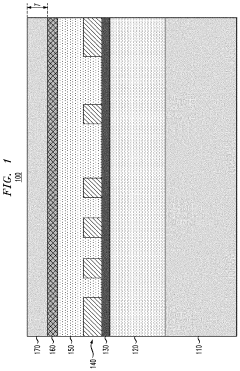
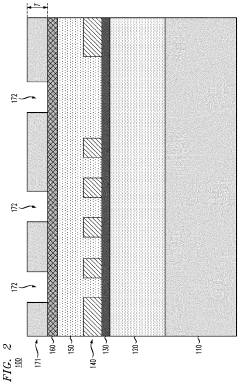
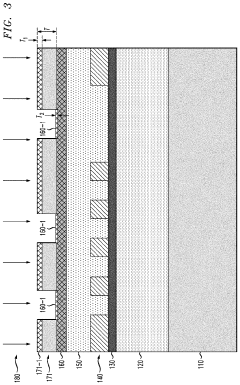
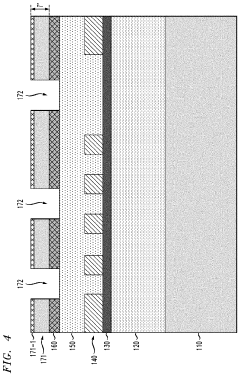
- Implementing a surface-hardened EUV resist mask with an etch-resistant layer formed by a neutral atom beam process that implants metallic or chemical species into the upper surface of the EUV resist mask to enhance etch resistance, allowing for patterning of sub-36 nm pitch features without significant mask thickness reduction.
EUV Equipment Supply Chain and Manufacturing Constraints
The EUV lithography equipment supply chain represents one of the most complex and concentrated manufacturing ecosystems in the semiconductor industry. ASML, as the sole supplier of EUV scanners, sits at the apex of this highly specialized supply chain, creating a critical bottleneck for the entire industry. The company's monopolistic position stems from decades of collaborative development with research institutions and suppliers, resulting in technological barriers that are extremely difficult to replicate.
The supply chain complexity extends far beyond the final scanner assembly. Critical components such as EUV light sources, multilayer mirrors, photomasks, and resist materials require specialized suppliers with unique expertise. The EUV light source alone involves intricate laser systems, tin droplet generators, and debris mitigation technologies that demand precision manufacturing capabilities available only from a handful of global suppliers. This concentration creates vulnerability points where disruptions can cascade throughout the entire production network.
Manufacturing constraints in EUV equipment production are multifaceted and interconnected. The production capacity of EUV scanners remains severely limited, with ASML capable of manufacturing only dozens of systems annually. Each scanner requires approximately 18-24 months to complete, involving thousands of precision components that must meet extraordinary specifications. The manufacturing process demands ultra-clean environments, specialized assembly techniques, and extensive testing protocols that further constrain throughput.
Component availability presents another significant manufacturing bottleneck. High-numerical-aperture mirrors require specialized coating facilities with atomic-level precision, while EUV photomasks demand advanced pellicle technologies and defect-free substrates. The limited number of qualified suppliers for these critical components creates dependencies that can halt production when supply disruptions occur.
For silicon photonics applications, these supply chain constraints present unique challenges. The specialized requirements for photonic device fabrication, including precise overlay accuracy and minimal line edge roughness, may necessitate customized EUV solutions. However, the current supply chain structure makes such customization extremely costly and time-consuming, potentially limiting the adoption of EUV technology in emerging photonic applications.
The geopolitical dimensions of EUV supply chains add another layer of complexity. Export controls and technology transfer restrictions affect component sourcing and equipment deployment, particularly impacting global semiconductor manufacturing strategies. These constraints may influence the development timeline and accessibility of EUV technology for silicon photonics applications across different regions.
The supply chain complexity extends far beyond the final scanner assembly. Critical components such as EUV light sources, multilayer mirrors, photomasks, and resist materials require specialized suppliers with unique expertise. The EUV light source alone involves intricate laser systems, tin droplet generators, and debris mitigation technologies that demand precision manufacturing capabilities available only from a handful of global suppliers. This concentration creates vulnerability points where disruptions can cascade throughout the entire production network.
Manufacturing constraints in EUV equipment production are multifaceted and interconnected. The production capacity of EUV scanners remains severely limited, with ASML capable of manufacturing only dozens of systems annually. Each scanner requires approximately 18-24 months to complete, involving thousands of precision components that must meet extraordinary specifications. The manufacturing process demands ultra-clean environments, specialized assembly techniques, and extensive testing protocols that further constrain throughput.
Component availability presents another significant manufacturing bottleneck. High-numerical-aperture mirrors require specialized coating facilities with atomic-level precision, while EUV photomasks demand advanced pellicle technologies and defect-free substrates. The limited number of qualified suppliers for these critical components creates dependencies that can halt production when supply disruptions occur.
For silicon photonics applications, these supply chain constraints present unique challenges. The specialized requirements for photonic device fabrication, including precise overlay accuracy and minimal line edge roughness, may necessitate customized EUV solutions. However, the current supply chain structure makes such customization extremely costly and time-consuming, potentially limiting the adoption of EUV technology in emerging photonic applications.
The geopolitical dimensions of EUV supply chains add another layer of complexity. Export controls and technology transfer restrictions affect component sourcing and equipment deployment, particularly impacting global semiconductor manufacturing strategies. These constraints may influence the development timeline and accessibility of EUV technology for silicon photonics applications across different regions.
Intellectual Property Landscape in EUV Photonic Applications
The intellectual property landscape surrounding EUV lithography techniques for silicon photonics represents a complex and rapidly evolving domain where semiconductor manufacturing giants, photonics specialists, and research institutions compete for technological supremacy. Patent filings in this intersection have accelerated significantly since 2018, reflecting the growing recognition of EUV's potential in enabling next-generation photonic devices with unprecedented precision and miniaturization capabilities.
ASML dominates the foundational EUV lithography patent portfolio, holding critical intellectual property related to light source technology, optical systems, and resist materials. Their patents cover essential aspects of EUV scanner architecture, including collector optics, contamination control systems, and metrology solutions. However, silicon photonics-specific applications have created new patent opportunities that extend beyond traditional semiconductor manufacturing, particularly in areas of waveguide fabrication, photonic crystal structures, and integrated optical components.
Intel, TSMC, and Samsung have established substantial patent portfolios focusing on EUV process integration for photonic applications. These patents typically address challenges unique to photonic device manufacturing, such as maintaining optical quality during high-resolution patterning, managing stress in silicon-on-insulator substrates, and achieving precise dimensional control for wavelength-sensitive structures. Notable patent clusters emerge around techniques for fabricating sub-100nm photonic features while preserving optical properties.
Research institutions including MIT, Stanford, and IMEC have contributed significant intellectual property in specialized areas such as EUV resist chemistry optimization for photonic materials, novel exposure strategies for three-dimensional photonic structures, and metrology techniques for characterizing photonic device performance post-EUV processing. These academic patents often focus on fundamental breakthroughs that enable commercial applications.
The patent landscape reveals several white space opportunities, particularly in areas combining EUV lithography with emerging photonic technologies such as quantum photonics, neuromorphic computing applications, and advanced packaging solutions. Cross-licensing agreements between EUV equipment manufacturers and photonics companies are becoming increasingly common, suggesting collaborative approaches to overcoming technical barriers and accelerating market adoption in this specialized application domain.
ASML dominates the foundational EUV lithography patent portfolio, holding critical intellectual property related to light source technology, optical systems, and resist materials. Their patents cover essential aspects of EUV scanner architecture, including collector optics, contamination control systems, and metrology solutions. However, silicon photonics-specific applications have created new patent opportunities that extend beyond traditional semiconductor manufacturing, particularly in areas of waveguide fabrication, photonic crystal structures, and integrated optical components.
Intel, TSMC, and Samsung have established substantial patent portfolios focusing on EUV process integration for photonic applications. These patents typically address challenges unique to photonic device manufacturing, such as maintaining optical quality during high-resolution patterning, managing stress in silicon-on-insulator substrates, and achieving precise dimensional control for wavelength-sensitive structures. Notable patent clusters emerge around techniques for fabricating sub-100nm photonic features while preserving optical properties.
Research institutions including MIT, Stanford, and IMEC have contributed significant intellectual property in specialized areas such as EUV resist chemistry optimization for photonic materials, novel exposure strategies for three-dimensional photonic structures, and metrology techniques for characterizing photonic device performance post-EUV processing. These academic patents often focus on fundamental breakthroughs that enable commercial applications.
The patent landscape reveals several white space opportunities, particularly in areas combining EUV lithography with emerging photonic technologies such as quantum photonics, neuromorphic computing applications, and advanced packaging solutions. Cross-licensing agreements between EUV equipment manufacturers and photonics companies are becoming increasingly common, suggesting collaborative approaches to overcoming technical barriers and accelerating market adoption in this specialized application domain.
Unlock deeper insights with Patsnap Eureka Quick Research — get a full tech report to explore trends and direct your research. Try now!
Generate Your Research Report Instantly with AI Agent
Supercharge your innovation with Patsnap Eureka AI Agent Platform!