

How to Increase Racetrack Memory Domain Wall Mobility
MAY 14, 20269 MIN READ
Generate Your Research Report Instantly with AI Agent
PatSnap Eureka helps you evaluate technical feasibility & market potential.
Racetrack Memory DW Mobility Background and Objectives
Racetrack memory represents a revolutionary approach to data storage that leverages the controlled movement of magnetic domain walls along nanoscale magnetic tracks. This technology, first conceptualized by IBM's Stuart Parkin in 2008, fundamentally reimagines how information can be stored and accessed by utilizing the intrinsic magnetic properties of ferromagnetic materials. Unlike conventional memory architectures that rely on physical movement of mechanical components or charge-based storage mechanisms, racetrack memory exploits the quantum mechanical behavior of electron spins within magnetic domains.
The foundational principle underlying racetrack memory involves the manipulation of domain walls - the boundaries between regions of opposing magnetic orientations within a ferromagnetic material. These domain walls can be precisely controlled and moved along predefined tracks using spin-polarized electrical currents, a phenomenon known as spin-transfer torque. The position of domain walls along the track represents binary information, with data bits encoded as the presence or absence of domain walls at specific locations.
Historical development of this technology has been driven by the increasing demand for high-density, low-power, and non-volatile memory solutions. Traditional memory technologies face fundamental scaling limitations as semiconductor manufacturing approaches atomic dimensions. Racetrack memory emerged as a potential solution to overcome these constraints by offering three-dimensional storage capabilities within nanoscale footprints, potentially achieving storage densities exceeding current flash memory technologies by orders of magnitude.
The primary technical objective centers on achieving sufficiently high domain wall mobility to enable practical read and write operations within acceptable timeframes. Current research indicates that domain wall velocities must reach several hundred meters per second to compete with existing memory technologies in terms of access speed. This requirement necessitates precise control over material properties, current densities, and structural geometries to optimize the spin-transfer torque efficiency.
Secondary objectives include minimizing power consumption during domain wall manipulation, ensuring reliable and reproducible domain wall motion, and maintaining data integrity over extended operational periods. These goals require comprehensive understanding of the underlying physics governing domain wall dynamics, including the interplay between material crystallography, magnetic anisotropy, and current-induced torques. Achievement of these objectives would position racetrack memory as a transformative technology capable of bridging the performance gap between volatile and non-volatile memory systems.
The foundational principle underlying racetrack memory involves the manipulation of domain walls - the boundaries between regions of opposing magnetic orientations within a ferromagnetic material. These domain walls can be precisely controlled and moved along predefined tracks using spin-polarized electrical currents, a phenomenon known as spin-transfer torque. The position of domain walls along the track represents binary information, with data bits encoded as the presence or absence of domain walls at specific locations.
Historical development of this technology has been driven by the increasing demand for high-density, low-power, and non-volatile memory solutions. Traditional memory technologies face fundamental scaling limitations as semiconductor manufacturing approaches atomic dimensions. Racetrack memory emerged as a potential solution to overcome these constraints by offering three-dimensional storage capabilities within nanoscale footprints, potentially achieving storage densities exceeding current flash memory technologies by orders of magnitude.
The primary technical objective centers on achieving sufficiently high domain wall mobility to enable practical read and write operations within acceptable timeframes. Current research indicates that domain wall velocities must reach several hundred meters per second to compete with existing memory technologies in terms of access speed. This requirement necessitates precise control over material properties, current densities, and structural geometries to optimize the spin-transfer torque efficiency.
Secondary objectives include minimizing power consumption during domain wall manipulation, ensuring reliable and reproducible domain wall motion, and maintaining data integrity over extended operational periods. These goals require comprehensive understanding of the underlying physics governing domain wall dynamics, including the interplay between material crystallography, magnetic anisotropy, and current-induced torques. Achievement of these objectives would position racetrack memory as a transformative technology capable of bridging the performance gap between volatile and non-volatile memory systems.
Market Demand for High-Speed Magnetic Memory Solutions
The global memory market is experiencing unprecedented demand for high-speed, low-power storage solutions driven by the exponential growth of data-intensive applications. Cloud computing, artificial intelligence, machine learning, and edge computing applications require memory technologies that can deliver superior performance while maintaining energy efficiency. Traditional memory technologies, including DRAM and NAND flash, are approaching their physical scaling limits, creating significant market opportunities for emerging magnetic memory solutions.
Racetrack memory represents a promising next-generation storage technology that addresses critical market needs through its unique combination of high density, non-volatility, and potential for ultra-fast operation. The technology's ability to store multiple bits per device while maintaining DRAM-like access speeds positions it as an attractive solution for applications requiring both high performance and data persistence. Enterprise data centers, high-performance computing systems, and mobile devices represent primary target markets where these characteristics provide substantial value propositions.
The automotive industry presents another significant market opportunity, particularly with the rise of autonomous vehicles and advanced driver assistance systems. These applications demand memory solutions capable of rapid data processing and reliable operation under extreme conditions. Racetrack memory's inherent radiation tolerance and temperature stability make it particularly suitable for automotive applications where traditional memory technologies may face reliability challenges.
Market research indicates strong demand for storage-class memory solutions that bridge the performance gap between volatile and non-volatile memory technologies. The increasing adoption of in-memory computing architectures and real-time analytics applications drives requirements for memory systems that combine the speed of DRAM with the persistence of flash storage. Racetrack memory's potential to achieve nanosecond-level switching speeds through enhanced domain wall mobility directly addresses these market requirements.
The Internet of Things ecosystem further amplifies demand for energy-efficient memory solutions. Battery-powered devices and sensors require memory technologies that minimize power consumption while maintaining adequate performance levels. Enhanced domain wall mobility in racetrack memory devices could enable lower operating voltages and reduced energy consumption per bit operation, making the technology highly competitive in power-constrained applications.
Manufacturing scalability represents a crucial market consideration, as potential customers require assurance of volume production capabilities and cost-effective manufacturing processes. The semiconductor industry's established magnetic thin-film processing infrastructure provides a foundation for racetrack memory commercialization, though achieving the domain wall mobility improvements necessary for market competitiveness remains a key technical challenge that directly impacts market adoption timelines and commercial viability.
Racetrack memory represents a promising next-generation storage technology that addresses critical market needs through its unique combination of high density, non-volatility, and potential for ultra-fast operation. The technology's ability to store multiple bits per device while maintaining DRAM-like access speeds positions it as an attractive solution for applications requiring both high performance and data persistence. Enterprise data centers, high-performance computing systems, and mobile devices represent primary target markets where these characteristics provide substantial value propositions.
The automotive industry presents another significant market opportunity, particularly with the rise of autonomous vehicles and advanced driver assistance systems. These applications demand memory solutions capable of rapid data processing and reliable operation under extreme conditions. Racetrack memory's inherent radiation tolerance and temperature stability make it particularly suitable for automotive applications where traditional memory technologies may face reliability challenges.
Market research indicates strong demand for storage-class memory solutions that bridge the performance gap between volatile and non-volatile memory technologies. The increasing adoption of in-memory computing architectures and real-time analytics applications drives requirements for memory systems that combine the speed of DRAM with the persistence of flash storage. Racetrack memory's potential to achieve nanosecond-level switching speeds through enhanced domain wall mobility directly addresses these market requirements.
The Internet of Things ecosystem further amplifies demand for energy-efficient memory solutions. Battery-powered devices and sensors require memory technologies that minimize power consumption while maintaining adequate performance levels. Enhanced domain wall mobility in racetrack memory devices could enable lower operating voltages and reduced energy consumption per bit operation, making the technology highly competitive in power-constrained applications.
Manufacturing scalability represents a crucial market consideration, as potential customers require assurance of volume production capabilities and cost-effective manufacturing processes. The semiconductor industry's established magnetic thin-film processing infrastructure provides a foundation for racetrack memory commercialization, though achieving the domain wall mobility improvements necessary for market competitiveness remains a key technical challenge that directly impacts market adoption timelines and commercial viability.
Current DW Mobility Limitations in Racetrack Devices
Racetrack memory devices face several fundamental limitations that constrain domain wall mobility, significantly impacting their commercial viability and performance characteristics. The primary challenge stems from the inherent material properties of ferromagnetic nanowires, where domain walls experience substantial pinning forces that impede their controlled movement along the track.
Structural defects represent one of the most significant barriers to achieving high domain wall mobility. These defects include grain boundaries, surface roughness, and crystallographic imperfections that create energy barriers for domain wall propagation. When domain walls encounter these irregularities, they become trapped or pinned, requiring additional energy to overcome these obstacles and continue their motion along the nanowire.
The magnetic anisotropy of the racetrack material creates another substantial limitation. Magnetocrystalline anisotropy and shape anisotropy contribute to the formation of complex domain wall structures that are inherently more difficult to manipulate. These anisotropic effects can lead to domain wall tilting, distortion, and increased width, all of which reduce the efficiency of current-driven domain wall motion.
Current density requirements pose a critical operational constraint in racetrack devices. The threshold current density needed to initiate domain wall motion often approaches levels that cause significant Joule heating and potential device degradation. This limitation creates a trade-off between operational speed and device reliability, as higher current densities can accelerate domain wall motion but may compromise the long-term stability of the device.
Thermal fluctuations introduce stochastic behavior that undermines the precise control required for reliable memory operations. Temperature variations can cause random domain wall motion, leading to data corruption and reduced device reliability. The thermal energy can also assist in depinning domain walls from defect sites, but this assistance comes at the cost of predictable and controllable behavior.
The Dzyaloshinskii-Moriya interaction, while potentially beneficial for domain wall stabilization, can also create limitations in certain material systems. This interaction can lead to the formation of chiral domain walls that exhibit complex dynamics and may require specific material engineering to optimize their mobility characteristics.
Interface effects between different layers in multilayer racetrack structures introduce additional complexity. These interfaces can create spin-orbit coupling effects that influence domain wall motion, but they can also introduce new sources of pinning and scattering that limit overall mobility performance in practical device implementations.
Structural defects represent one of the most significant barriers to achieving high domain wall mobility. These defects include grain boundaries, surface roughness, and crystallographic imperfections that create energy barriers for domain wall propagation. When domain walls encounter these irregularities, they become trapped or pinned, requiring additional energy to overcome these obstacles and continue their motion along the nanowire.
The magnetic anisotropy of the racetrack material creates another substantial limitation. Magnetocrystalline anisotropy and shape anisotropy contribute to the formation of complex domain wall structures that are inherently more difficult to manipulate. These anisotropic effects can lead to domain wall tilting, distortion, and increased width, all of which reduce the efficiency of current-driven domain wall motion.
Current density requirements pose a critical operational constraint in racetrack devices. The threshold current density needed to initiate domain wall motion often approaches levels that cause significant Joule heating and potential device degradation. This limitation creates a trade-off between operational speed and device reliability, as higher current densities can accelerate domain wall motion but may compromise the long-term stability of the device.
Thermal fluctuations introduce stochastic behavior that undermines the precise control required for reliable memory operations. Temperature variations can cause random domain wall motion, leading to data corruption and reduced device reliability. The thermal energy can also assist in depinning domain walls from defect sites, but this assistance comes at the cost of predictable and controllable behavior.
The Dzyaloshinskii-Moriya interaction, while potentially beneficial for domain wall stabilization, can also create limitations in certain material systems. This interaction can lead to the formation of chiral domain walls that exhibit complex dynamics and may require specific material engineering to optimize their mobility characteristics.
Interface effects between different layers in multilayer racetrack structures introduce additional complexity. These interfaces can create spin-orbit coupling effects that influence domain wall motion, but they can also introduce new sources of pinning and scattering that limit overall mobility performance in practical device implementations.
Existing Methods for Enhancing DW Velocity
01 Domain wall motion control mechanisms
Various mechanisms are employed to control the movement of domain walls in racetrack memory devices. These include the application of magnetic fields, current-induced spin transfer torque, and voltage-controlled magnetic anisotropy. The control mechanisms enable precise positioning and manipulation of domain walls along the racetrack structure, which is essential for reliable data storage and retrieval operations.- Domain wall motion control mechanisms: Various mechanisms are employed to control the movement of domain walls in racetrack memory devices. These include the application of magnetic fields, spin-polarized currents, and voltage-controlled magnetic anisotropy. The control mechanisms enable precise positioning and manipulation of domain walls along the racetrack structure, which is essential for data storage and retrieval operations.
- Spin-orbit torque enhancement techniques: Enhancement of domain wall mobility through spin-orbit torque effects involves the use of heavy metal layers and specific material compositions. These techniques improve the efficiency of current-induced domain wall motion by leveraging spin-orbit coupling phenomena. The optimization of material interfaces and layer structures plays a crucial role in achieving higher domain wall velocities with reduced current densities.
- Magnetic material optimization for domain wall propagation: The selection and engineering of magnetic materials significantly impact domain wall mobility in racetrack memory systems. This includes the use of perpendicular magnetic anisotropy materials, synthetic antiferromagnetic structures, and tailored magnetic layer compositions. Material optimization focuses on reducing pinning effects and enhancing domain wall stability during motion.
- Current density and pulse optimization: Optimization of current parameters including density, pulse duration, and waveform characteristics is critical for efficient domain wall motion. This involves developing current injection schemes that minimize energy consumption while maximizing domain wall velocity. The relationship between current characteristics and domain wall dynamics is fundamental to achieving reliable memory operation.
- Device architecture and structural design: The physical design and architecture of racetrack memory devices directly influence domain wall mobility characteristics. This encompasses track geometry, electrode placement, substrate selection, and integration with control circuitry. Structural optimization aims to create uniform domain wall motion paths while minimizing defects and irregularities that could impede wall propagation.
02 Magnetic material optimization for enhanced mobility
The selection and engineering of magnetic materials play a crucial role in improving domain wall mobility. This involves optimizing magnetic properties such as perpendicular magnetic anisotropy, saturation magnetization, and damping parameters. Advanced magnetic alloys and multilayer structures are designed to reduce pinning effects and enhance the speed of domain wall propagation through the racetrack.Expand Specific Solutions03 Current-driven domain wall dynamics
Current-induced domain wall motion is achieved through spin-polarized currents that exert torques on the magnetic moments within the domain wall. The efficiency of current-driven motion depends on factors such as current density, pulse duration, and the spin polarization of the current. Optimization of these parameters enables faster and more energy-efficient domain wall displacement in racetrack memory systems.Expand Specific Solutions04 Structural design for improved wall propagation
The physical structure of racetrack memory devices significantly influences domain wall mobility. This includes the geometry of the magnetic track, the presence of notches or constrictions for controlled positioning, and the integration of nucleation and detection elements. Careful structural design minimizes defects and irregularities that could impede domain wall motion and cause operational failures.Expand Specific Solutions05 Detection and readout systems for domain wall position
Accurate detection of domain wall positions is essential for reliable memory operation. Various sensing mechanisms are employed, including magnetoresistive elements, Hall effect sensors, and tunneling magnetoresistance devices. These detection systems must provide high sensitivity and fast response times to enable rapid data access while maintaining compatibility with the domain wall motion mechanisms.Expand Specific Solutions
Key Players in Spintronic Memory Industry
The racetrack memory domain wall mobility enhancement field represents an emerging technology sector in the early development stage, with significant growth potential driven by the increasing demand for next-generation memory solutions. The market remains nascent but shows promise as organizations seek alternatives to traditional memory architectures. Technology maturity varies considerably across key players, with established semiconductor giants like IBM, Samsung Electronics, and GlobalFoundries leading fundamental research and development efforts. Academic institutions including Carnegie Mellon University, Max Planck Gesellschaft, and Nanyang Technological University contribute crucial theoretical foundations and experimental breakthroughs. Japanese companies such as TDK Corp., NEC Corp., and Fujitsu Ltd. leverage their materials science expertise, while Chinese entities like Yangtze Memory Technologies and ChangXin Memory Technologies focus on practical implementation. Research organizations like Fraunhofer-Gesellschaft and Imec bridge the gap between academic research and industrial application, indicating a collaborative ecosystem still defining technical standards and commercial viability pathways.
International Business Machines Corp.
Technical Solution: IBM has developed comprehensive approaches to enhance domain wall mobility in racetrack memory through material engineering and structural optimization. Their research focuses on utilizing heavy metal underlayers such as tantalum and platinum to create strong spin-orbit coupling effects, which significantly improve domain wall velocity. IBM's approach includes optimizing the magnetic anisotropy through careful selection of ferromagnetic materials like CoFeB and implementing current-induced spin-orbit torques for efficient domain wall motion. They have demonstrated domain wall velocities exceeding 400 m/s through precise control of interfacial properties and current density optimization. Additionally, IBM explores synthetic antiferromagnetic structures to reduce stray field effects and improve domain wall stability during motion.
Strengths: Extensive research experience in spintronics, strong material science capabilities, proven track record in magnetic memory development. Weaknesses: High manufacturing complexity, significant power consumption requirements for achieving optimal performance.
Samsung Electronics Co., Ltd.
Technical Solution: Samsung's approach to increasing racetrack memory domain wall mobility centers on advanced thin film engineering and interface optimization techniques. They focus on developing ultra-thin magnetic layers with precisely controlled thickness to enhance perpendicular magnetic anisotropy while maintaining high domain wall mobility. Samsung utilizes sophisticated sputtering techniques to create multilayer structures with optimized heavy metal/ferromagnet interfaces, particularly using materials like Pt/Co/AlOx stacks. Their research emphasizes reducing pinning sites through improved film quality and implementing voltage-controlled magnetic anisotropy to reduce the current required for domain wall motion. Samsung has achieved significant improvements in domain wall velocity through careful control of interfacial Dzyaloshinskii-Moriya interaction and optimization of current pulse parameters for efficient spin-orbit torque generation.
Strengths: Advanced semiconductor manufacturing capabilities, strong materials engineering expertise, established memory technology infrastructure. Weaknesses: Limited fundamental research compared to specialized institutions, focus primarily on commercial viability may constrain innovative approaches.
Core Innovations in DW Mobility Enhancement Techniques
Race-track memory with improved domain wall motion control
PatentActiveKR1020220029347A
Innovation
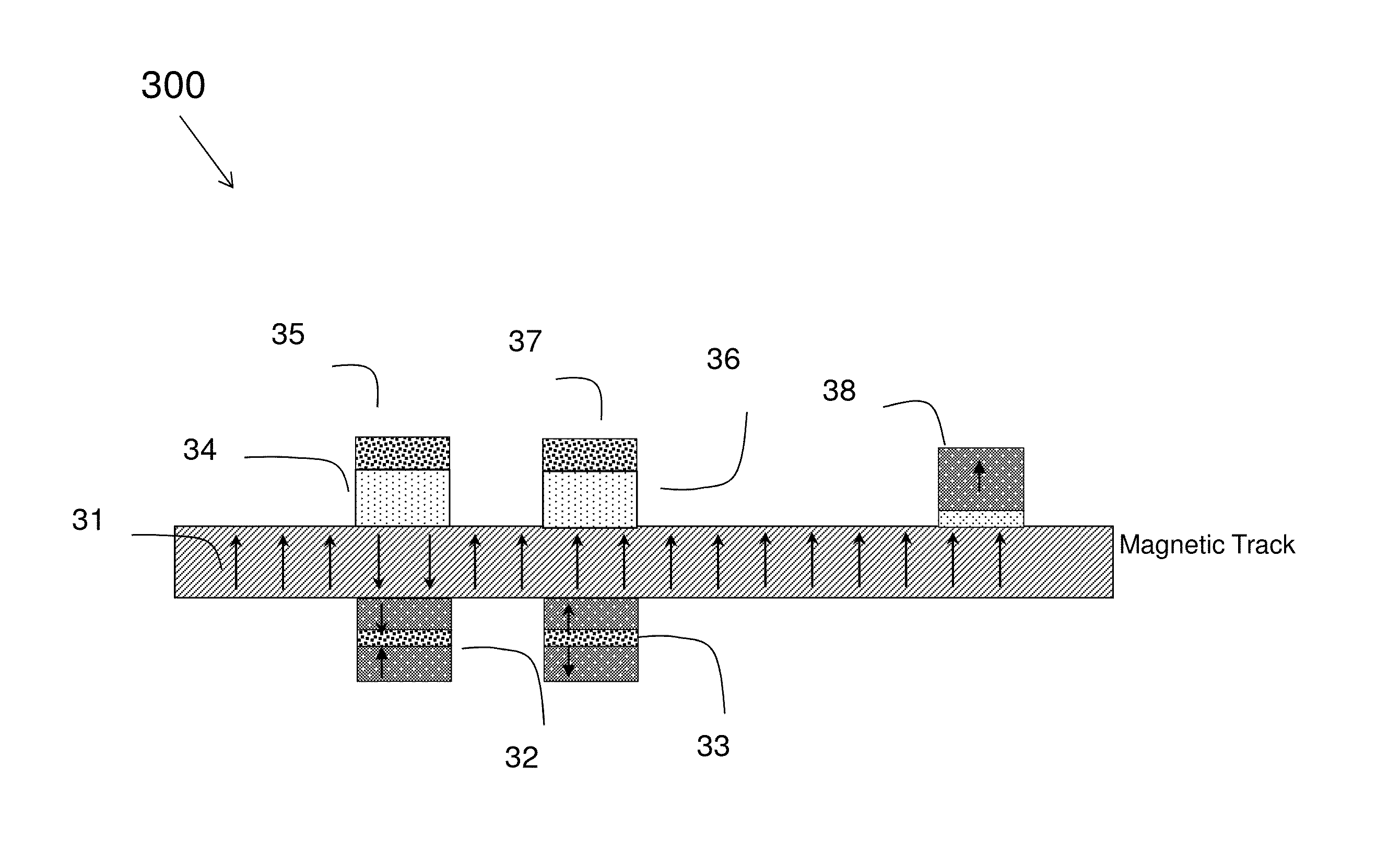
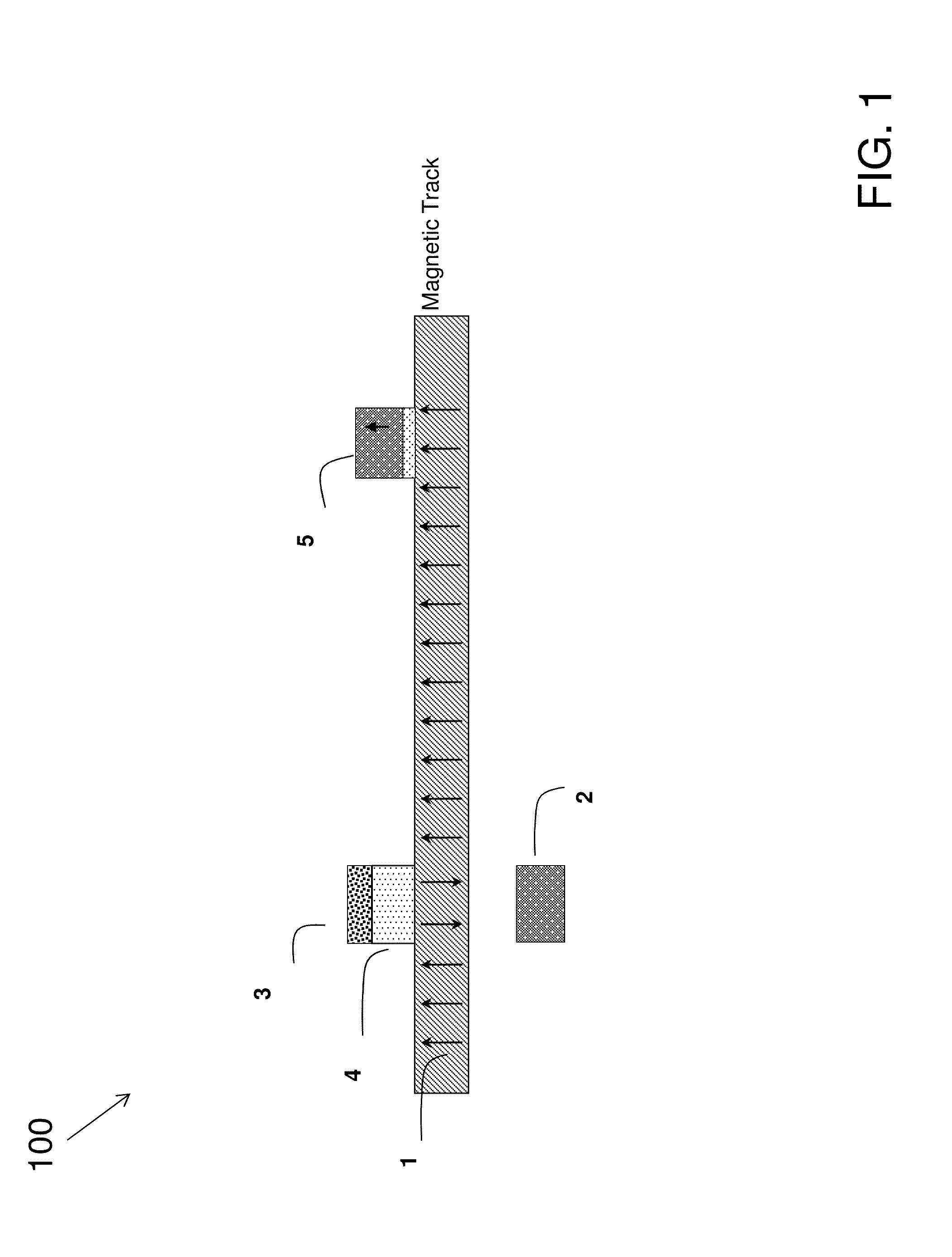
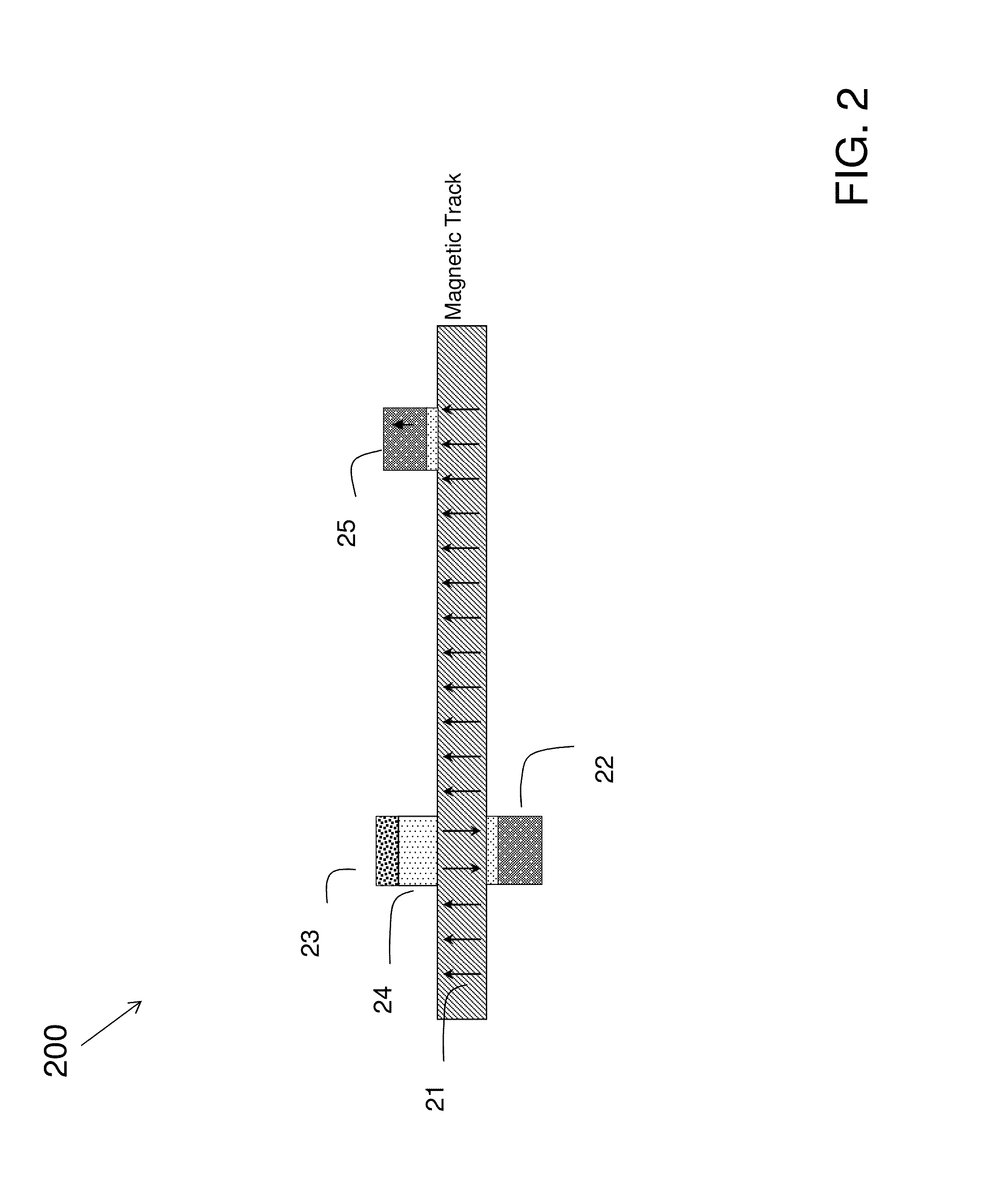
- A race track memory layer with interleaved bit positions and domain wall traps, featuring distinct domain wall velocities and Dzyaloshinskii-Moriya Interaction (DMI) and Synthetic Antiferromagnetic (SAF) effects, along with a nonmagnetic coupling layer and ferromagnetic layer, to modulate domain wall speeds and improve control.


Racetrack memory with electric-field assisted domain wall injection for low-power write operation
PatentActiveUS9042151B2
Innovation
- A method involving a magnetic racetrack memory with a nanowire coupled to a gate and a pinning layer, utilizing surface anisotropy modulation via an electric field and spin torque or Oersted field to inject domain walls, minimizing power dissipation.

Material Engineering for Optimized DW Dynamics
Material engineering represents the most fundamental approach to enhancing domain wall mobility in racetrack memory devices. The selection and optimization of magnetic materials directly influence the intrinsic properties that govern domain wall dynamics, including magnetic anisotropy, exchange coupling strength, and damping parameters. Advanced ferromagnetic alloys, particularly those based on cobalt-iron-boron compositions, have demonstrated superior domain wall velocities compared to traditional permalloy systems due to their reduced Gilbert damping coefficient and optimized magnetic moment.
Interface engineering plays a crucial role in achieving optimal domain wall dynamics through careful control of magnetic interactions at material boundaries. The integration of heavy metal underlayers such as tantalum, platinum, or tungsten creates spin-orbit coupling effects that can significantly enhance domain wall mobility through spin Hall torque mechanisms. These interfacial effects enable electric field-driven domain wall motion with reduced current densities, addressing one of the primary challenges in racetrack memory implementation.
Compositional tuning of magnetic multilayer stacks offers precise control over magnetic parameters essential for high-mobility domain wall propagation. Strategic incorporation of rare earth elements like gadolinium or terbium can modify magnetic anisotropy and exchange stiffness, creating favorable conditions for domain wall motion. Additionally, controlled oxidation at specific interfaces introduces perpendicular magnetic anisotropy gradients that facilitate domain wall nucleation and propagation along the racetrack structure.
Crystallographic optimization through advanced deposition techniques and post-processing treatments significantly impacts domain wall mobility. Epitaxial growth methods and controlled annealing processes can minimize structural defects that typically pin domain walls and impede their motion. The development of single-crystal or highly textured polycrystalline magnetic films reduces scattering mechanisms and enables coherent domain wall propagation over extended distances.
Emerging material systems, including synthetic antiferromagnets and compensated ferrimagnets, present novel pathways for achieving ultra-high domain wall velocities. These engineered magnetic structures exploit interlayer exchange coupling to create domain walls with reduced magnetic moments while maintaining structural stability, potentially enabling domain wall velocities exceeding conventional ferromagnetic limits through reduced stray field interactions and enhanced current-driven torque efficiency.
Interface engineering plays a crucial role in achieving optimal domain wall dynamics through careful control of magnetic interactions at material boundaries. The integration of heavy metal underlayers such as tantalum, platinum, or tungsten creates spin-orbit coupling effects that can significantly enhance domain wall mobility through spin Hall torque mechanisms. These interfacial effects enable electric field-driven domain wall motion with reduced current densities, addressing one of the primary challenges in racetrack memory implementation.
Compositional tuning of magnetic multilayer stacks offers precise control over magnetic parameters essential for high-mobility domain wall propagation. Strategic incorporation of rare earth elements like gadolinium or terbium can modify magnetic anisotropy and exchange stiffness, creating favorable conditions for domain wall motion. Additionally, controlled oxidation at specific interfaces introduces perpendicular magnetic anisotropy gradients that facilitate domain wall nucleation and propagation along the racetrack structure.
Crystallographic optimization through advanced deposition techniques and post-processing treatments significantly impacts domain wall mobility. Epitaxial growth methods and controlled annealing processes can minimize structural defects that typically pin domain walls and impede their motion. The development of single-crystal or highly textured polycrystalline magnetic films reduces scattering mechanisms and enables coherent domain wall propagation over extended distances.
Emerging material systems, including synthetic antiferromagnets and compensated ferrimagnets, present novel pathways for achieving ultra-high domain wall velocities. These engineered magnetic structures exploit interlayer exchange coupling to create domain walls with reduced magnetic moments while maintaining structural stability, potentially enabling domain wall velocities exceeding conventional ferromagnetic limits through reduced stray field interactions and enhanced current-driven torque efficiency.
Energy Efficiency Considerations in DW-Based Memories
Energy efficiency represents a critical design parameter for domain wall-based racetrack memories, directly impacting their commercial viability and competitive positioning against conventional memory technologies. The energy consumption in DW-based memories primarily stems from current-induced domain wall motion, where electrical currents generate the necessary forces to move magnetic domains along nanowires. Understanding and optimizing these energy requirements becomes essential as memory systems scale toward higher densities and faster operation speeds.
The fundamental energy consumption mechanisms in racetrack memories involve both static and dynamic components. Static energy losses occur through leakage currents and maintaining magnetic states, while dynamic energy consumption dominates during read and write operations. Current-induced domain wall motion typically requires current densities ranging from 10^6 to 10^8 A/cm², translating to significant power dissipation when multiplied across thousands of memory cells operating simultaneously.
Spin-orbit torque mechanisms offer promising pathways for reducing energy consumption compared to traditional spin-transfer torque approaches. Heavy metal underlayers such as platinum, tantalum, or tungsten can generate efficient spin currents with lower electrical current requirements. These materials exhibit strong spin-orbit coupling, enabling domain wall manipulation with reduced current densities while maintaining reliable switching characteristics.
Material engineering strategies focus on optimizing magnetic anisotropy and damping parameters to minimize energy barriers for domain wall motion. Perpendicular magnetic anisotropy materials with tailored interfacial properties can reduce the threshold currents needed for domain wall nucleation and propagation. Additionally, synthetic antiferromagnetic structures provide enhanced thermal stability while potentially lowering switching energies through reduced stray field interactions.
Circuit-level optimizations complement material improvements through intelligent power management schemes. Adaptive voltage scaling, selective cell activation, and optimized pulse shaping techniques can significantly reduce overall system energy consumption. Furthermore, exploiting the non-volatile nature of magnetic storage enables aggressive power gating strategies, where inactive memory segments consume virtually zero standby power, providing substantial energy savings compared to volatile memory technologies.
The fundamental energy consumption mechanisms in racetrack memories involve both static and dynamic components. Static energy losses occur through leakage currents and maintaining magnetic states, while dynamic energy consumption dominates during read and write operations. Current-induced domain wall motion typically requires current densities ranging from 10^6 to 10^8 A/cm², translating to significant power dissipation when multiplied across thousands of memory cells operating simultaneously.
Spin-orbit torque mechanisms offer promising pathways for reducing energy consumption compared to traditional spin-transfer torque approaches. Heavy metal underlayers such as platinum, tantalum, or tungsten can generate efficient spin currents with lower electrical current requirements. These materials exhibit strong spin-orbit coupling, enabling domain wall manipulation with reduced current densities while maintaining reliable switching characteristics.
Material engineering strategies focus on optimizing magnetic anisotropy and damping parameters to minimize energy barriers for domain wall motion. Perpendicular magnetic anisotropy materials with tailored interfacial properties can reduce the threshold currents needed for domain wall nucleation and propagation. Additionally, synthetic antiferromagnetic structures provide enhanced thermal stability while potentially lowering switching energies through reduced stray field interactions.
Circuit-level optimizations complement material improvements through intelligent power management schemes. Adaptive voltage scaling, selective cell activation, and optimized pulse shaping techniques can significantly reduce overall system energy consumption. Furthermore, exploiting the non-volatile nature of magnetic storage enables aggressive power gating strategies, where inactive memory segments consume virtually zero standby power, providing substantial energy savings compared to volatile memory technologies.
Unlock deeper insights with PatSnap Eureka Quick Research — get a full tech report to explore trends and direct your research. Try now!
Generate Your Research Report Instantly with AI Agent
Supercharge your innovation with PatSnap Eureka AI Agent Platform!