

How to Optimize Edge Intelligence for Real-Time Data Processing
MAY 21, 20269 MIN READ
Generate Your Research Report Instantly with AI Agent
PatSnap Eureka helps you evaluate technical feasibility & market potential.
Edge Intelligence Background and Real-Time Processing Goals
Edge intelligence represents a paradigm shift in computing architecture that brings artificial intelligence capabilities closer to data sources, fundamentally transforming how organizations process and analyze information. This distributed computing approach emerged from the convergence of several technological trends, including the proliferation of Internet of Things devices, advances in miniaturized processors, and the growing demand for low-latency decision-making systems. Unlike traditional cloud-centric models, edge intelligence enables data processing and AI inference to occur at or near the point of data generation, reducing dependency on centralized infrastructure.
The evolution of edge intelligence stems from critical limitations inherent in cloud-based processing systems. Network latency, bandwidth constraints, privacy concerns, and reliability issues have driven the need for more distributed approaches. As organizations deploy increasingly sophisticated sensor networks and IoT ecosystems, the volume of generated data has grown exponentially, making it impractical and costly to transmit all information to remote data centers for processing.
Real-time data processing within edge intelligence frameworks aims to achieve sub-millisecond response times for critical applications. This capability is essential for autonomous vehicles, industrial automation systems, healthcare monitoring devices, and smart city infrastructure where delayed responses can result in safety hazards or operational failures. The primary objective involves minimizing the time between data acquisition and actionable insights while maintaining high accuracy and reliability standards.
Current technological goals focus on developing lightweight AI models that can operate efficiently on resource-constrained edge devices without compromising performance. This includes optimizing neural network architectures, implementing model compression techniques, and creating adaptive algorithms that can dynamically adjust processing loads based on available computational resources. Additionally, edge intelligence systems must seamlessly integrate with existing enterprise infrastructure while providing robust security measures to protect sensitive data processed at distributed locations.
The ultimate vision encompasses creating intelligent edge ecosystems that can autonomously adapt to changing conditions, collaborate across multiple nodes, and provide predictive capabilities that enhance operational efficiency across various industry verticals.
The evolution of edge intelligence stems from critical limitations inherent in cloud-based processing systems. Network latency, bandwidth constraints, privacy concerns, and reliability issues have driven the need for more distributed approaches. As organizations deploy increasingly sophisticated sensor networks and IoT ecosystems, the volume of generated data has grown exponentially, making it impractical and costly to transmit all information to remote data centers for processing.
Real-time data processing within edge intelligence frameworks aims to achieve sub-millisecond response times for critical applications. This capability is essential for autonomous vehicles, industrial automation systems, healthcare monitoring devices, and smart city infrastructure where delayed responses can result in safety hazards or operational failures. The primary objective involves minimizing the time between data acquisition and actionable insights while maintaining high accuracy and reliability standards.
Current technological goals focus on developing lightweight AI models that can operate efficiently on resource-constrained edge devices without compromising performance. This includes optimizing neural network architectures, implementing model compression techniques, and creating adaptive algorithms that can dynamically adjust processing loads based on available computational resources. Additionally, edge intelligence systems must seamlessly integrate with existing enterprise infrastructure while providing robust security measures to protect sensitive data processed at distributed locations.
The ultimate vision encompasses creating intelligent edge ecosystems that can autonomously adapt to changing conditions, collaborate across multiple nodes, and provide predictive capabilities that enhance operational efficiency across various industry verticals.
Market Demand for Edge Computing and Real-Time Analytics
The global edge computing market has experienced unprecedented growth driven by the exponential increase in data generation and the critical need for real-time processing capabilities. Organizations across industries are generating massive volumes of data at the network edge, creating substantial demand for intelligent processing solutions that can deliver immediate insights without relying on centralized cloud infrastructure.
Industrial IoT applications represent one of the largest demand drivers, where manufacturing facilities require instantaneous analysis of sensor data for predictive maintenance, quality control, and operational optimization. The automotive sector has emerged as another significant market segment, with autonomous vehicles and connected car systems demanding ultra-low latency processing for safety-critical applications such as collision avoidance and real-time navigation.
Healthcare organizations are increasingly adopting edge intelligence solutions for medical device monitoring, patient vital sign analysis, and emergency response systems. The ability to process sensitive medical data locally while maintaining privacy compliance has created substantial market opportunities for edge-based real-time analytics platforms.
Smart city initiatives worldwide are driving demand for edge computing solutions that can process traffic management data, environmental monitoring information, and public safety analytics in real-time. These applications require distributed intelligence capable of making autonomous decisions without constant connectivity to central systems.
The retail and e-commerce sectors are leveraging edge analytics for inventory management, customer behavior analysis, and personalized shopping experiences. Real-time processing of point-of-sale data, customer movement patterns, and supply chain information has become essential for competitive advantage.
Financial services organizations are implementing edge intelligence for fraud detection, algorithmic trading, and risk assessment applications where millisecond response times can significantly impact business outcomes. The need for immediate transaction processing and threat detection continues to expand market demand.
Telecommunications providers are investing heavily in edge infrastructure to support 5G networks and enable new services such as augmented reality, virtual reality, and ultra-reliable low-latency communications. These applications require sophisticated real-time analytics capabilities distributed across network edge locations.
Industrial IoT applications represent one of the largest demand drivers, where manufacturing facilities require instantaneous analysis of sensor data for predictive maintenance, quality control, and operational optimization. The automotive sector has emerged as another significant market segment, with autonomous vehicles and connected car systems demanding ultra-low latency processing for safety-critical applications such as collision avoidance and real-time navigation.
Healthcare organizations are increasingly adopting edge intelligence solutions for medical device monitoring, patient vital sign analysis, and emergency response systems. The ability to process sensitive medical data locally while maintaining privacy compliance has created substantial market opportunities for edge-based real-time analytics platforms.
Smart city initiatives worldwide are driving demand for edge computing solutions that can process traffic management data, environmental monitoring information, and public safety analytics in real-time. These applications require distributed intelligence capable of making autonomous decisions without constant connectivity to central systems.
The retail and e-commerce sectors are leveraging edge analytics for inventory management, customer behavior analysis, and personalized shopping experiences. Real-time processing of point-of-sale data, customer movement patterns, and supply chain information has become essential for competitive advantage.
Financial services organizations are implementing edge intelligence for fraud detection, algorithmic trading, and risk assessment applications where millisecond response times can significantly impact business outcomes. The need for immediate transaction processing and threat detection continues to expand market demand.
Telecommunications providers are investing heavily in edge infrastructure to support 5G networks and enable new services such as augmented reality, virtual reality, and ultra-reliable low-latency communications. These applications require sophisticated real-time analytics capabilities distributed across network edge locations.
Current State and Challenges of Edge Intelligence Systems
Edge intelligence systems have emerged as a critical paradigm for processing data closer to its source, reducing latency and bandwidth requirements while enabling real-time decision-making. Currently, these systems are deployed across diverse sectors including autonomous vehicles, industrial IoT, smart cities, and healthcare monitoring. The technology has matured from basic sensor data collection to sophisticated AI-powered edge nodes capable of running complex machine learning models locally.
The global edge intelligence market has witnessed significant growth, with major cloud providers like Amazon, Microsoft, and Google offering edge computing platforms. Hardware manufacturers including NVIDIA, Intel, and Qualcomm have developed specialized edge AI chips optimized for low-power, high-performance computing. Open-source frameworks such as TensorFlow Lite, OpenVINO, and Apache EdgeX have democratized edge intelligence development, enabling broader adoption across industries.
Despite substantial progress, edge intelligence systems face several critical challenges that limit their optimization potential. Resource constraints represent the most fundamental limitation, as edge devices typically operate with limited computational power, memory, and energy capacity. This constraint becomes particularly acute when deploying sophisticated AI models that require substantial processing resources for real-time inference.
Network connectivity issues pose another significant challenge, especially in remote or mobile environments where reliable internet access is intermittent. Edge systems must maintain functionality during network disruptions while efficiently synchronizing with cloud infrastructure when connectivity is restored. This dual requirement creates complex architectural challenges for data consistency and system reliability.
Latency optimization remains a persistent challenge despite edge computing's proximity advantages. While edge processing reduces network latency, computational latency at the edge can become a bottleneck when dealing with complex algorithms or high-volume data streams. Balancing processing complexity with response time requirements requires sophisticated workload distribution strategies.
Security and privacy concerns have intensified as edge devices become more prevalent and handle sensitive data. Unlike centralized cloud systems, edge devices are often physically accessible and may lack robust security infrastructure. Ensuring data integrity, preventing unauthorized access, and maintaining privacy compliance across distributed edge networks presents ongoing challenges.
Scalability and management complexity increase exponentially as edge deployments grow. Coordinating thousands of distributed edge nodes, managing software updates, monitoring system health, and ensuring consistent performance across heterogeneous hardware platforms requires sophisticated orchestration capabilities that are still evolving.
The global edge intelligence market has witnessed significant growth, with major cloud providers like Amazon, Microsoft, and Google offering edge computing platforms. Hardware manufacturers including NVIDIA, Intel, and Qualcomm have developed specialized edge AI chips optimized for low-power, high-performance computing. Open-source frameworks such as TensorFlow Lite, OpenVINO, and Apache EdgeX have democratized edge intelligence development, enabling broader adoption across industries.
Despite substantial progress, edge intelligence systems face several critical challenges that limit their optimization potential. Resource constraints represent the most fundamental limitation, as edge devices typically operate with limited computational power, memory, and energy capacity. This constraint becomes particularly acute when deploying sophisticated AI models that require substantial processing resources for real-time inference.
Network connectivity issues pose another significant challenge, especially in remote or mobile environments where reliable internet access is intermittent. Edge systems must maintain functionality during network disruptions while efficiently synchronizing with cloud infrastructure when connectivity is restored. This dual requirement creates complex architectural challenges for data consistency and system reliability.
Latency optimization remains a persistent challenge despite edge computing's proximity advantages. While edge processing reduces network latency, computational latency at the edge can become a bottleneck when dealing with complex algorithms or high-volume data streams. Balancing processing complexity with response time requirements requires sophisticated workload distribution strategies.
Security and privacy concerns have intensified as edge devices become more prevalent and handle sensitive data. Unlike centralized cloud systems, edge devices are often physically accessible and may lack robust security infrastructure. Ensuring data integrity, preventing unauthorized access, and maintaining privacy compliance across distributed edge networks presents ongoing challenges.
Scalability and management complexity increase exponentially as edge deployments grow. Coordinating thousands of distributed edge nodes, managing software updates, monitoring system health, and ensuring consistent performance across heterogeneous hardware platforms requires sophisticated orchestration capabilities that are still evolving.
Existing Edge Intelligence Optimization Solutions
01 Edge computing architectures for real-time processing
Edge computing systems designed to process data in real-time at the network edge, reducing latency and improving response times. These architectures enable distributed processing capabilities that bring computation closer to data sources, allowing for immediate analysis and decision-making without relying on centralized cloud infrastructure.- Edge computing architectures for real-time processing: Systems and methods for implementing distributed computing architectures at the network edge to enable real-time data processing capabilities. These architectures utilize edge nodes and computing resources positioned closer to data sources to reduce latency and improve processing efficiency for time-sensitive applications.
- Intelligent data filtering and preprocessing at edge devices: Techniques for implementing intelligent filtering, preprocessing, and data reduction algorithms directly on edge devices before transmission to central systems. These methods help optimize bandwidth usage and reduce computational load while maintaining data quality and relevance for real-time decision making.
- Machine learning inference optimization for edge environments: Methods for optimizing machine learning models and inference engines specifically for deployment in resource-constrained edge computing environments. These approaches focus on model compression, quantization, and efficient execution to enable real-time intelligent processing with limited computational resources.
- Real-time data streaming and communication protocols: Communication protocols and streaming mechanisms designed for low-latency data transmission between edge devices and processing nodes. These solutions address network optimization, data synchronization, and reliable delivery requirements for real-time applications in distributed edge computing environments.
- Adaptive resource management and load balancing: Systems for dynamic resource allocation and load balancing across distributed edge computing nodes to optimize real-time processing performance. These methods include adaptive scheduling algorithms, workload distribution strategies, and automatic scaling mechanisms to handle varying computational demands efficiently.
02 Intelligent data filtering and preprocessing at edge nodes
Advanced filtering mechanisms and preprocessing techniques implemented at edge devices to optimize data quality and reduce bandwidth requirements. These systems employ machine learning algorithms to identify relevant data patterns and perform initial processing before transmission to central systems.Expand Specific Solutions03 Real-time analytics and machine learning inference
Implementation of real-time analytical capabilities and machine learning inference engines at edge locations. These systems enable immediate insights generation and automated decision-making based on streaming data, supporting applications requiring instant responses and continuous monitoring.Expand Specific Solutions04 Distributed data synchronization and consistency management
Methods and systems for maintaining data consistency and synchronization across distributed edge computing environments. These approaches ensure data integrity while managing the challenges of network partitions, latency variations, and concurrent updates in real-time processing scenarios.Expand Specific Solutions05 Edge-to-cloud integration and hybrid processing frameworks
Frameworks that seamlessly integrate edge computing capabilities with cloud infrastructure to create hybrid processing environments. These systems optimize workload distribution between edge and cloud resources based on processing requirements, network conditions, and real-time constraints.Expand Specific Solutions
Key Players in Edge Intelligence and Real-Time Processing
The edge intelligence market for real-time data processing is experiencing rapid growth, driven by increasing demand for low-latency applications and IoT proliferation. The industry is transitioning from early adoption to mainstream deployment, with market size expanding significantly as enterprises seek to reduce cloud dependency and enhance response times. Technology maturity varies considerably across market players, with established giants like IBM, Microsoft Technology Licensing, Samsung Electronics, and Siemens AG leading in comprehensive edge computing platforms and AI integration. Telecommunications leaders including China Mobile, Deutsche Telekom, and NTT are advancing network edge capabilities, while specialized firms like Eagle Eye Networks focus on vertical applications. Research institutions such as Southeast University and Korea Electronics Technology Institute are driving innovation in edge algorithms and hardware optimization, indicating a competitive landscape where traditional tech companies, telecom operators, and emerging specialists are converging to capture this transformative market opportunity.
International Business Machines Corp.
Technical Solution: IBM develops comprehensive edge computing solutions through their Edge Application Manager and Watson IoT platform for real-time data processing. Their approach utilizes distributed computing architectures that deploy AI models directly at edge devices, reducing latency to under 10ms for critical applications. The company implements federated learning frameworks that enable model training across distributed edge nodes without centralizing sensitive data. IBM's edge intelligence platform incorporates automated model optimization techniques including quantization and pruning to reduce computational requirements by up to 90% while maintaining accuracy. Their solution supports containerized workloads using Kubernetes orchestration for scalable deployment across heterogeneous edge infrastructure, enabling real-time analytics for industrial IoT, autonomous vehicles, and smart city applications.
Strengths: Enterprise-grade security, comprehensive AI/ML toolkit, strong hybrid cloud integration. Weaknesses: Higher implementation costs, complex deployment for smaller organizations, requires significant technical expertise.
Cisco Technology, Inc.
Technical Solution: Cisco's edge intelligence platform leverages their networking expertise through the Industrial IoT (IIoT) portfolio and Edge Intelligence software suite for real-time data processing. Their solution implements fog computing architectures that distribute processing across network infrastructure, reducing data transmission by 75% and improving response times to under 5ms. Cisco utilizes intent-based networking (IBN) with AI-driven network optimization that automatically adjusts bandwidth allocation and routing based on real-time application demands. The platform incorporates secure edge analytics engines that process streaming data from thousands of sensors simultaneously, supporting complex machine learning inference at network edges. Their approach includes adaptive data governance frameworks that implement intelligent data retention policies, automatically categorizing and processing data based on business value and regulatory requirements.
Strengths: Network infrastructure expertise, robust security features, comprehensive IoT connectivity solutions. Weaknesses: Higher networking complexity, requires specialized networking knowledge, limited AI/ML development tools compared to cloud providers.
Core Technologies for Real-Time Edge Data Processing
Edge Intelligence Platform, and Internet of Things Sensor Streams System
PatentActiveUS20170060574A1
Innovation
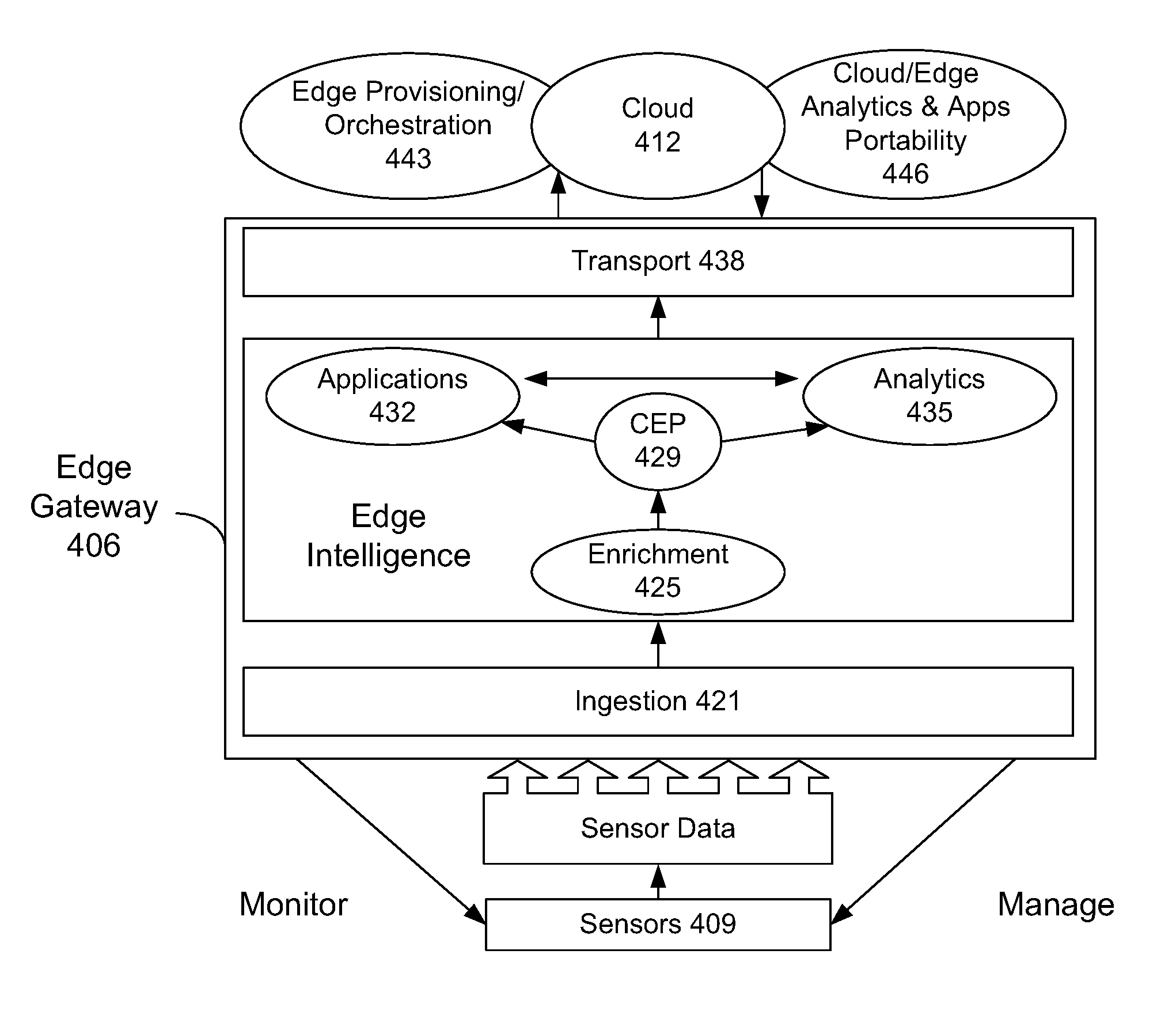
- The implementation of an edge computing platform that processes and analyzes data closer to the source using a software layer hosted on gateway devices or embedded systems, enabling real-time analytics and automated responses through a highly expressive computer language and a complex event processing engine, while also allowing data to be published to the cloud for further machine learning.

Privacy and Security Considerations for Edge Intelligence
Privacy and security considerations represent critical challenges in edge intelligence deployments for real-time data processing, as the distributed nature of edge computing introduces unique vulnerabilities and compliance requirements. The proximity of edge devices to data sources means sensitive information is processed at multiple points across the network infrastructure, creating expanded attack surfaces that require comprehensive protection strategies.
Data privacy concerns arise from the distributed processing model where sensitive information may be temporarily stored or processed on edge devices with varying security capabilities. Personal identifiable information, industrial control data, and proprietary business intelligence flowing through edge nodes require robust encryption mechanisms both at rest and in transit. The challenge intensifies when considering cross-border data flows and varying regional privacy regulations such as GDPR, CCPA, and emerging data sovereignty laws.
Authentication and access control mechanisms must be redesigned for edge environments where traditional centralized security models prove inadequate. Edge devices often operate in physically accessible locations, making them vulnerable to tampering, unauthorized access, and device compromise. Implementing zero-trust architectures becomes essential, requiring continuous verification of device identity, user credentials, and data integrity throughout the processing pipeline.
Secure communication protocols between edge nodes and central systems face bandwidth and latency constraints that complicate traditional security implementations. Lightweight cryptographic algorithms and efficient key management systems must balance security strength with real-time processing requirements. The intermittent connectivity common in edge deployments necessitates offline security capabilities and secure data synchronization mechanisms.
Compliance frameworks for edge intelligence must address the distributed nature of data processing while maintaining audit trails and regulatory adherence. Organizations must implement privacy-preserving techniques such as differential privacy, homomorphic encryption, and federated learning approaches that enable intelligent processing without exposing raw sensitive data. These techniques allow edge systems to derive insights while maintaining individual privacy and corporate data confidentiality.
The integration of hardware-based security features, including trusted execution environments and secure enclaves, provides additional protection layers for critical edge processing workloads, ensuring that even compromised edge devices cannot expose sensitive computational processes or data.
Data privacy concerns arise from the distributed processing model where sensitive information may be temporarily stored or processed on edge devices with varying security capabilities. Personal identifiable information, industrial control data, and proprietary business intelligence flowing through edge nodes require robust encryption mechanisms both at rest and in transit. The challenge intensifies when considering cross-border data flows and varying regional privacy regulations such as GDPR, CCPA, and emerging data sovereignty laws.
Authentication and access control mechanisms must be redesigned for edge environments where traditional centralized security models prove inadequate. Edge devices often operate in physically accessible locations, making them vulnerable to tampering, unauthorized access, and device compromise. Implementing zero-trust architectures becomes essential, requiring continuous verification of device identity, user credentials, and data integrity throughout the processing pipeline.
Secure communication protocols between edge nodes and central systems face bandwidth and latency constraints that complicate traditional security implementations. Lightweight cryptographic algorithms and efficient key management systems must balance security strength with real-time processing requirements. The intermittent connectivity common in edge deployments necessitates offline security capabilities and secure data synchronization mechanisms.
Compliance frameworks for edge intelligence must address the distributed nature of data processing while maintaining audit trails and regulatory adherence. Organizations must implement privacy-preserving techniques such as differential privacy, homomorphic encryption, and federated learning approaches that enable intelligent processing without exposing raw sensitive data. These techniques allow edge systems to derive insights while maintaining individual privacy and corporate data confidentiality.
The integration of hardware-based security features, including trusted execution environments and secure enclaves, provides additional protection layers for critical edge processing workloads, ensuring that even compromised edge devices cannot expose sensitive computational processes or data.
Energy Efficiency and Sustainability in Edge Computing
Energy efficiency has emerged as a critical consideration in edge computing architectures designed for real-time data processing. As edge devices proliferate across industrial IoT, autonomous vehicles, and smart city infrastructures, their collective energy consumption presents significant operational and environmental challenges. Traditional cloud-centric approaches that rely on continuous data transmission to remote servers consume substantial bandwidth and energy, making localized processing increasingly attractive from both performance and sustainability perspectives.
The energy profile of edge intelligence systems is fundamentally different from conventional computing environments. Edge devices typically operate under strict power constraints, often relying on battery power or limited electrical infrastructure. Processing real-time data streams requires maintaining continuous operation while balancing computational intensity with energy availability. This constraint becomes particularly acute in applications requiring low-latency responses, where energy-efficient algorithms must deliver results within milliseconds without compromising accuracy.
Modern edge computing platforms are adopting several energy optimization strategies to address these challenges. Dynamic voltage and frequency scaling allows processors to adjust their operating parameters based on workload demands, reducing power consumption during periods of lower computational intensity. Additionally, heterogeneous computing architectures that combine general-purpose processors with specialized accelerators like GPUs, FPGAs, or AI chips enable more efficient task allocation based on energy-performance trade-offs.
Sustainable edge computing extends beyond immediate energy efficiency to encompass broader environmental considerations. This includes utilizing renewable energy sources for edge infrastructure, implementing intelligent workload scheduling that aligns processing tasks with available green energy, and designing hardware with longer operational lifespans to reduce electronic waste. Edge devices increasingly incorporate energy harvesting capabilities, drawing power from solar, thermal, or kinetic sources to achieve greater autonomy.
The sustainability imperative is driving innovation in edge intelligence algorithms themselves. Techniques such as model compression, quantization, and pruning reduce the computational overhead of machine learning models without significantly impacting accuracy. Federated learning approaches minimize data transmission requirements by training models locally and sharing only model updates, substantially reducing network energy consumption while maintaining privacy and reducing latency for real-time applications.
The energy profile of edge intelligence systems is fundamentally different from conventional computing environments. Edge devices typically operate under strict power constraints, often relying on battery power or limited electrical infrastructure. Processing real-time data streams requires maintaining continuous operation while balancing computational intensity with energy availability. This constraint becomes particularly acute in applications requiring low-latency responses, where energy-efficient algorithms must deliver results within milliseconds without compromising accuracy.
Modern edge computing platforms are adopting several energy optimization strategies to address these challenges. Dynamic voltage and frequency scaling allows processors to adjust their operating parameters based on workload demands, reducing power consumption during periods of lower computational intensity. Additionally, heterogeneous computing architectures that combine general-purpose processors with specialized accelerators like GPUs, FPGAs, or AI chips enable more efficient task allocation based on energy-performance trade-offs.
Sustainable edge computing extends beyond immediate energy efficiency to encompass broader environmental considerations. This includes utilizing renewable energy sources for edge infrastructure, implementing intelligent workload scheduling that aligns processing tasks with available green energy, and designing hardware with longer operational lifespans to reduce electronic waste. Edge devices increasingly incorporate energy harvesting capabilities, drawing power from solar, thermal, or kinetic sources to achieve greater autonomy.
The sustainability imperative is driving innovation in edge intelligence algorithms themselves. Techniques such as model compression, quantization, and pruning reduce the computational overhead of machine learning models without significantly impacting accuracy. Federated learning approaches minimize data transmission requirements by training models locally and sharing only model updates, substantially reducing network energy consumption while maintaining privacy and reducing latency for real-time applications.
Unlock deeper insights with PatSnap Eureka Quick Research — get a full tech report to explore trends and direct your research. Try now!
Generate Your Research Report Instantly with AI Agent
Supercharge your innovation with PatSnap Eureka AI Agent Platform!