

How to Safeguard Transformer Grid Interfaces Using Advanced Solid State Units
JUN 4, 20269 MIN READ
Generate Your Research Report Instantly with AI Agent
PatSnap Eureka helps you evaluate technical feasibility & market potential.
Transformer Grid Protection Background and Objectives
The electrical power grid has undergone significant transformation since its inception in the late 19th century, evolving from simple radial distribution systems to complex interconnected networks spanning continents. Traditional transformer protection systems, developed in the early-to-mid 20th century, relied primarily on electromechanical relays and basic overcurrent protection schemes. These legacy systems, while reliable for their time, face increasing challenges in modern grid environments characterized by bidirectional power flows, renewable energy integration, and sophisticated cyber-physical threats.
The emergence of distributed energy resources, including solar photovoltaics, wind farms, and energy storage systems, has fundamentally altered the operational dynamics of power transformers. Unlike conventional unidirectional power flow scenarios, modern transformers must handle variable and sometimes unpredictable load patterns, voltage fluctuations, and harmonic distortions. This operational complexity has exposed limitations in traditional protection schemes, which were designed for predictable, centralized generation patterns.
Contemporary grid infrastructure faces unprecedented challenges including increased frequency of extreme weather events, aging equipment, and sophisticated cybersecurity threats targeting critical infrastructure. Traditional transformer protection systems often lack the speed, precision, and adaptability required to respond effectively to these modern threats. The integration of renewable energy sources has introduced additional complexities such as fault current variations, voltage regulation challenges, and grid stability concerns that conventional protection systems struggle to address adequately.
The primary objective of implementing advanced solid-state protection units is to enhance the reliability, speed, and intelligence of transformer grid interface protection. These systems aim to provide sub-cycle fault detection and isolation capabilities, significantly reducing equipment damage and improving grid stability. Advanced solid-state units target the achievement of adaptive protection schemes that can automatically adjust their operating parameters based on real-time grid conditions and operational modes.
Furthermore, the integration of advanced communication capabilities and data analytics into solid-state protection systems enables predictive maintenance strategies and enhanced situational awareness. The ultimate goal encompasses the development of self-healing grid capabilities where protection systems can automatically reconfigure network topology to maintain power delivery during fault conditions while ensuring optimal system performance and minimal service disruption.
The emergence of distributed energy resources, including solar photovoltaics, wind farms, and energy storage systems, has fundamentally altered the operational dynamics of power transformers. Unlike conventional unidirectional power flow scenarios, modern transformers must handle variable and sometimes unpredictable load patterns, voltage fluctuations, and harmonic distortions. This operational complexity has exposed limitations in traditional protection schemes, which were designed for predictable, centralized generation patterns.
Contemporary grid infrastructure faces unprecedented challenges including increased frequency of extreme weather events, aging equipment, and sophisticated cybersecurity threats targeting critical infrastructure. Traditional transformer protection systems often lack the speed, precision, and adaptability required to respond effectively to these modern threats. The integration of renewable energy sources has introduced additional complexities such as fault current variations, voltage regulation challenges, and grid stability concerns that conventional protection systems struggle to address adequately.
The primary objective of implementing advanced solid-state protection units is to enhance the reliability, speed, and intelligence of transformer grid interface protection. These systems aim to provide sub-cycle fault detection and isolation capabilities, significantly reducing equipment damage and improving grid stability. Advanced solid-state units target the achievement of adaptive protection schemes that can automatically adjust their operating parameters based on real-time grid conditions and operational modes.
Furthermore, the integration of advanced communication capabilities and data analytics into solid-state protection systems enables predictive maintenance strategies and enhanced situational awareness. The ultimate goal encompasses the development of self-healing grid capabilities where protection systems can automatically reconfigure network topology to maintain power delivery during fault conditions while ensuring optimal system performance and minimal service disruption.
Market Demand for Advanced Grid Protection Systems
The global power grid infrastructure faces unprecedented challenges as electricity demand continues to surge while aging equipment struggles to maintain reliability and safety standards. Traditional electromechanical protection systems, which have served the industry for decades, are increasingly inadequate for modern grid complexities. The integration of renewable energy sources, distributed generation, and smart grid technologies has created new vulnerabilities that require more sophisticated protection mechanisms.
Advanced solid-state protection systems represent a critical evolution in grid safeguarding technology, addressing the limitations of conventional relay-based systems. These systems offer superior response times, enhanced precision, and greater adaptability to dynamic grid conditions. The market demand is particularly driven by the need to protect expensive transformer assets, which can cost millions of dollars and require months to replace when damaged.
Utility companies worldwide are experiencing mounting pressure to improve grid resilience and reduce outage frequencies. Regulatory bodies are implementing stricter reliability standards, compelling utilities to invest in advanced protection technologies. The increasing frequency of extreme weather events and cybersecurity threats further amplifies the urgency for robust grid protection solutions.
The industrial sector represents another significant demand driver, as manufacturing facilities require uninterrupted power supply to maintain operations and prevent costly production losses. Data centers, hospitals, and other critical infrastructure facilities are particularly sensitive to power quality issues, creating substantial market opportunities for advanced protection systems.
Emerging markets are experiencing rapid electrification and grid expansion, creating opportunities for deploying state-of-the-art protection technologies from the outset. These regions often lack legacy infrastructure constraints, enabling more flexible adoption of solid-state protection solutions.
The market is also influenced by the growing emphasis on grid modernization initiatives and smart city developments. Government investments in infrastructure upgrades and the push toward carbon neutrality are creating favorable conditions for advanced grid protection technology adoption. Additionally, the increasing penetration of electric vehicles and energy storage systems introduces new grid dynamics that traditional protection systems cannot adequately handle, further driving demand for sophisticated solid-state solutions.
Advanced solid-state protection systems represent a critical evolution in grid safeguarding technology, addressing the limitations of conventional relay-based systems. These systems offer superior response times, enhanced precision, and greater adaptability to dynamic grid conditions. The market demand is particularly driven by the need to protect expensive transformer assets, which can cost millions of dollars and require months to replace when damaged.
Utility companies worldwide are experiencing mounting pressure to improve grid resilience and reduce outage frequencies. Regulatory bodies are implementing stricter reliability standards, compelling utilities to invest in advanced protection technologies. The increasing frequency of extreme weather events and cybersecurity threats further amplifies the urgency for robust grid protection solutions.
The industrial sector represents another significant demand driver, as manufacturing facilities require uninterrupted power supply to maintain operations and prevent costly production losses. Data centers, hospitals, and other critical infrastructure facilities are particularly sensitive to power quality issues, creating substantial market opportunities for advanced protection systems.
Emerging markets are experiencing rapid electrification and grid expansion, creating opportunities for deploying state-of-the-art protection technologies from the outset. These regions often lack legacy infrastructure constraints, enabling more flexible adoption of solid-state protection solutions.
The market is also influenced by the growing emphasis on grid modernization initiatives and smart city developments. Government investments in infrastructure upgrades and the push toward carbon neutrality are creating favorable conditions for advanced grid protection technology adoption. Additionally, the increasing penetration of electric vehicles and energy storage systems introduces new grid dynamics that traditional protection systems cannot adequately handle, further driving demand for sophisticated solid-state solutions.
Current State of Solid State Protection Technologies
Solid state protection technologies have emerged as a transformative solution for safeguarding transformer grid interfaces, representing a significant advancement from traditional electromechanical and electromagnetic relay systems. These technologies leverage semiconductor-based components and advanced digital signal processing to provide faster, more accurate, and highly configurable protection mechanisms for critical power infrastructure.
Current solid state protection units primarily utilize silicon-based power semiconductors, including IGBTs, MOSFETs, and thyristors, integrated with sophisticated microprocessor-controlled systems. These devices can detect fault conditions within microseconds, compared to the millisecond response times of conventional protection systems. The integration of digital signal processors enables real-time analysis of voltage, current, and frequency parameters with unprecedented precision.
Modern solid state protection systems incorporate multiple protection algorithms simultaneously, including overcurrent, undervoltage, overvoltage, frequency deviation, and differential protection schemes. Advanced units feature adaptive protection settings that can automatically adjust parameters based on grid conditions and operational requirements. Communication capabilities through protocols such as IEC 61850 enable seamless integration with SCADA systems and smart grid infrastructure.
The technology landscape includes both hybrid solutions that combine solid state switching with traditional circuit breakers and fully solid state systems that eliminate mechanical components entirely. Leading implementations demonstrate fault clearing times under 1 millisecond for critical applications, significantly reducing equipment stress and improving grid stability. Wide bandgap semiconductors, particularly silicon carbide and gallium nitride devices, are increasingly being adopted to enhance switching speeds and reduce power losses.
Current challenges include managing thermal dissipation in high-power applications, ensuring long-term reliability under harsh grid conditions, and addressing cost considerations for widespread deployment. Cybersecurity concerns have also emerged as these systems become more connected and digitally integrated. Despite these challenges, solid state protection technologies continue to evolve rapidly, with ongoing developments in artificial intelligence integration, predictive maintenance capabilities, and enhanced fault discrimination algorithms driving the next generation of transformer protection solutions.
Current solid state protection units primarily utilize silicon-based power semiconductors, including IGBTs, MOSFETs, and thyristors, integrated with sophisticated microprocessor-controlled systems. These devices can detect fault conditions within microseconds, compared to the millisecond response times of conventional protection systems. The integration of digital signal processors enables real-time analysis of voltage, current, and frequency parameters with unprecedented precision.
Modern solid state protection systems incorporate multiple protection algorithms simultaneously, including overcurrent, undervoltage, overvoltage, frequency deviation, and differential protection schemes. Advanced units feature adaptive protection settings that can automatically adjust parameters based on grid conditions and operational requirements. Communication capabilities through protocols such as IEC 61850 enable seamless integration with SCADA systems and smart grid infrastructure.
The technology landscape includes both hybrid solutions that combine solid state switching with traditional circuit breakers and fully solid state systems that eliminate mechanical components entirely. Leading implementations demonstrate fault clearing times under 1 millisecond for critical applications, significantly reducing equipment stress and improving grid stability. Wide bandgap semiconductors, particularly silicon carbide and gallium nitride devices, are increasingly being adopted to enhance switching speeds and reduce power losses.
Current challenges include managing thermal dissipation in high-power applications, ensuring long-term reliability under harsh grid conditions, and addressing cost considerations for widespread deployment. Cybersecurity concerns have also emerged as these systems become more connected and digitally integrated. Despite these challenges, solid state protection technologies continue to evolve rapidly, with ongoing developments in artificial intelligence integration, predictive maintenance capabilities, and enhanced fault discrimination algorithms driving the next generation of transformer protection solutions.
Existing Solid State Protection Solutions
01 Solid state protection circuits and devices
Advanced solid state units incorporate specialized protection circuits and devices to safeguard against electrical faults, overcurrent conditions, and voltage irregularities. These protection mechanisms utilize semiconductor-based components that provide fast response times and reliable operation without mechanical moving parts. The protection systems can detect abnormal conditions and automatically isolate or shut down the unit to prevent damage to critical components.- Solid state protection circuits and devices: Advanced solid state units incorporate specialized protection circuits and devices to safeguard against electrical faults, overcurrent conditions, and voltage irregularities. These protection mechanisms utilize semiconductor-based components that provide fast response times and reliable operation without mechanical moving parts. The protection systems can detect abnormal conditions and automatically isolate or limit current flow to prevent damage to connected equipment.
- Thermal management and heat dissipation systems: Solid state units require effective thermal management to maintain safe operating temperatures and prevent thermal damage. Advanced heat dissipation systems include heat sinks, thermal interface materials, and active cooling mechanisms. These systems ensure that semiconductor components operate within specified temperature ranges, maintaining performance and extending operational lifespan under various load conditions.
- Control and monitoring systems for solid state units: Advanced control systems provide real-time monitoring and management of solid state unit operations. These systems include sensors, microprocessors, and communication interfaces that enable remote monitoring, diagnostic capabilities, and automated control functions. The monitoring systems can track performance parameters, detect potential issues, and provide feedback for optimal operation.
- Power switching and conversion technologies: Solid state units utilize advanced power switching technologies including transistors, thyristors, and other semiconductor devices for efficient power conversion and control. These switching systems provide precise control over electrical power flow, enable high-frequency operation, and offer improved efficiency compared to traditional mechanical switching methods. The technology supports various power levels and applications.
- Fault detection and diagnostic capabilities: Advanced diagnostic systems in solid state units provide comprehensive fault detection and analysis capabilities. These systems can identify various types of failures, degradation patterns, and performance anomalies through continuous monitoring and analysis. The diagnostic features enable predictive maintenance, reduce downtime, and improve overall system reliability through early detection of potential problems.
02 Thermal management and heat dissipation systems
Solid state units require sophisticated thermal management systems to maintain safe operating temperatures and prevent thermal damage. These systems include advanced heat sinks, thermal interface materials, and temperature monitoring circuits that ensure optimal performance under various load conditions. The thermal protection mechanisms can dynamically adjust operating parameters or initiate shutdown procedures when temperature thresholds are exceeded.Expand Specific Solutions03 Power management and control systems
Advanced power management systems in solid state units provide comprehensive control over power distribution, voltage regulation, and current limiting functions. These systems incorporate intelligent algorithms that optimize power efficiency while maintaining system stability and protecting against power-related failures. The control mechanisms can adapt to changing load conditions and provide real-time monitoring of power parameters.Expand Specific Solutions04 Fault detection and diagnostic capabilities
Modern solid state units feature advanced fault detection and diagnostic systems that continuously monitor system health and performance parameters. These systems can identify potential issues before they become critical failures, enabling predictive maintenance and reducing downtime. The diagnostic capabilities include self-testing functions, error logging, and communication interfaces for remote monitoring and troubleshooting.Expand Specific Solutions05 Communication and interface protection
Solid state units incorporate robust communication interfaces and data protection mechanisms to ensure secure and reliable data transmission. These systems include isolation circuits, signal conditioning, and protocol protection that safeguard against electromagnetic interference and communication errors. The interface protection extends to both wired and wireless communication channels, maintaining data integrity under various environmental conditions.Expand Specific Solutions
Key Players in Grid Protection and Solid State Technology
The competitive landscape for safeguarding transformer grid interfaces using advanced solid state units is characterized by a mature market with established industry leaders and emerging technological convergence. The industry has evolved from traditional electromechanical solutions to sophisticated digital and solid-state technologies, driven by grid modernization demands and renewable energy integration. Major players include traditional power equipment manufacturers like ABB Ltd., Siemens AG, and Schneider Electric, who leverage decades of transformer expertise, alongside technology giants such as Intel Corp. and AMD providing semiconductor foundations. State Grid Corp. of China and its subsidiaries represent significant market influence in Asia, while specialized companies like Maschinenfabrik Reinhausen GmbH and Hitachi Energy Ltd. focus on transformer-specific solutions. The technology maturity varies across segments, with solid-state switching and digital monitoring reaching commercial deployment, while advanced AI-driven protection systems remain in development phases, indicating a transitioning market with substantial growth potential.
ABB Ltd.
Technical Solution: ABB develops comprehensive solid-state protection systems for transformer grid interfaces, featuring advanced digital relays with integrated solid-state switching technology. Their solutions include solid-state circuit breakers with microsecond-level fault detection and isolation capabilities, utilizing wide bandgap semiconductors like SiC and GaN for enhanced switching performance. The system incorporates intelligent protection algorithms with real-time monitoring, predictive maintenance features, and seamless integration with digital substations. ABB's solid-state units provide galvanic isolation, overvoltage protection, and harmonic filtering while maintaining high efficiency and reliability in harsh grid conditions.
Strengths: Market-leading experience in power grid protection, proven reliability in utility applications, comprehensive digital integration capabilities. Weaknesses: Higher initial cost compared to conventional solutions, complexity in retrofitting existing infrastructure.
Siemens AG
Technical Solution: Siemens offers advanced solid-state protection units specifically designed for transformer grid interfaces, incorporating their SIPPROTEC series with solid-state switching elements. The solution features high-speed semiconductor-based protection with sub-cycle fault clearing capabilities, utilizing silicon carbide power electronics for superior thermal performance and switching speeds. Their system includes integrated communication protocols, cybersecurity features, and advanced analytics for grid stability enhancement. The solid-state units provide precise voltage regulation, fault current limitation, and seamless load transfer capabilities while offering modular design for scalable deployment across different voltage levels and grid configurations.
Strengths: Strong industrial automation expertise, robust cybersecurity integration, excellent scalability and modularity. Weaknesses: Complex system integration requirements, higher maintenance expertise needed for advanced features.
Core Innovations in Advanced Solid State Protection Units
Solid-state transformer for mitigation of common mode insults
PatentActiveUS12500415B1
Innovation
- A solid-state transformer (SST) with a four-legged converter, dual active bridge, and energy storage system (ESS) to control CM currents and absorb incident energy, maintaining nominal transformer behavior during CM events.


Solid-state transformer in-grid operations and maintenance circuit and method therefor, controller, and storage medium
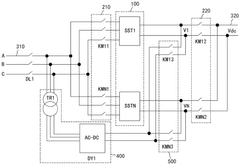
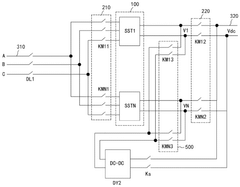
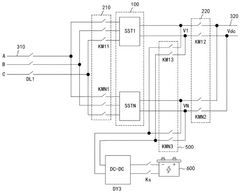
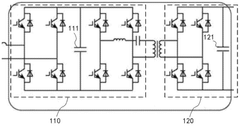
PatentWO2025148799A1
Innovation
- The circuit consisting of multiple solid-state transformer singles is used to connect parallel to the input and output side switches and auxiliary charging circuits to realize the disconnection and impact-free recovery of some singles. The auxiliary charging circuit is used to charge the singles to ensure that the system can still operate normally during maintenance or replacement.
Grid Code Compliance and Safety Standards
Grid code compliance represents a fundamental requirement for integrating advanced solid-state units into transformer grid interfaces. These regulatory frameworks establish mandatory technical specifications that govern voltage levels, frequency stability, power quality parameters, and grid connection procedures. Modern grid codes such as IEEE 1547, IEC 61727, and regional standards like the European Network Code require solid-state protection systems to demonstrate precise response times, typically within 2-16 milliseconds for fault detection and isolation.
Safety standards form the cornerstone of reliable grid interface protection, with IEC 61850 providing comprehensive communication protocols for substation automation and protection systems. Advanced solid-state units must comply with functional safety requirements outlined in IEC 61508, ensuring systematic integrity levels appropriate for critical grid applications. These standards mandate rigorous testing procedures, including type testing, routine testing, and periodic verification to validate protection system performance under various operating conditions.
Harmonic distortion limits specified in IEEE 519 and IEC 61000 series standards directly impact solid-state unit design parameters. Protection systems must maintain total harmonic distortion below 5% while ensuring power factor correction capabilities meet grid operator requirements. Compliance verification involves extensive electromagnetic compatibility testing to demonstrate immunity against grid disturbances and minimal interference generation.
Cybersecurity compliance has emerged as a critical aspect following standards like NERC CIP and IEC 62351. Advanced solid-state protection units require secure communication channels, authentication protocols, and intrusion detection capabilities to prevent malicious attacks on grid infrastructure. These requirements necessitate regular security assessments and firmware updates to maintain compliance with evolving cybersecurity frameworks.
Documentation and certification processes demand comprehensive technical files demonstrating conformity with applicable standards. This includes detailed test reports, design verification documents, and ongoing monitoring procedures to ensure sustained compliance throughout the operational lifecycle of transformer grid interface protection systems.
Safety standards form the cornerstone of reliable grid interface protection, with IEC 61850 providing comprehensive communication protocols for substation automation and protection systems. Advanced solid-state units must comply with functional safety requirements outlined in IEC 61508, ensuring systematic integrity levels appropriate for critical grid applications. These standards mandate rigorous testing procedures, including type testing, routine testing, and periodic verification to validate protection system performance under various operating conditions.
Harmonic distortion limits specified in IEEE 519 and IEC 61000 series standards directly impact solid-state unit design parameters. Protection systems must maintain total harmonic distortion below 5% while ensuring power factor correction capabilities meet grid operator requirements. Compliance verification involves extensive electromagnetic compatibility testing to demonstrate immunity against grid disturbances and minimal interference generation.
Cybersecurity compliance has emerged as a critical aspect following standards like NERC CIP and IEC 62351. Advanced solid-state protection units require secure communication channels, authentication protocols, and intrusion detection capabilities to prevent malicious attacks on grid infrastructure. These requirements necessitate regular security assessments and firmware updates to maintain compliance with evolving cybersecurity frameworks.
Documentation and certification processes demand comprehensive technical files demonstrating conformity with applicable standards. This includes detailed test reports, design verification documents, and ongoing monitoring procedures to ensure sustained compliance throughout the operational lifecycle of transformer grid interface protection systems.
Cybersecurity Considerations for Smart Protection Systems
The integration of advanced solid-state protection units into transformer grid interfaces introduces significant cybersecurity vulnerabilities that require comprehensive security frameworks. These intelligent protection systems, while offering enhanced operational capabilities, create expanded attack surfaces through their network connectivity and digital communication protocols. The convergence of operational technology and information technology in smart grid environments necessitates robust cybersecurity measures to protect critical infrastructure assets.
Modern solid-state protection units rely heavily on digital communication protocols such as IEC 61850, DNP3, and Modbus, which can be exploited by malicious actors if not properly secured. These protocols often lack inherent security features, making them susceptible to man-in-the-middle attacks, data manipulation, and unauthorized access. The implementation of secure communication channels through encryption, authentication mechanisms, and digital certificates becomes essential for maintaining system integrity.
Network segmentation represents a critical defense strategy for smart protection systems. Implementing proper network isolation between operational technology networks and corporate IT infrastructure helps contain potential security breaches. The deployment of industrial firewalls, intrusion detection systems, and network monitoring tools provides multiple layers of protection against cyber threats targeting transformer protection systems.
Authentication and access control mechanisms must be rigorously implemented to prevent unauthorized manipulation of protection settings and operational parameters. Multi-factor authentication, role-based access controls, and regular credential rotation help ensure that only authorized personnel can access critical protection functions. The principle of least privilege should govern all access permissions to minimize potential security exposure.
Continuous monitoring and anomaly detection capabilities are essential for identifying potential cybersecurity incidents in real-time. Advanced threat detection systems can analyze communication patterns, operational behaviors, and system performance metrics to identify suspicious activities that may indicate cyber attacks or system compromises.
Regular security assessments, penetration testing, and vulnerability management programs ensure that protection systems maintain adequate security postures against evolving cyber threats. The implementation of security incident response procedures and recovery protocols enables rapid containment and restoration of normal operations following security incidents.
Modern solid-state protection units rely heavily on digital communication protocols such as IEC 61850, DNP3, and Modbus, which can be exploited by malicious actors if not properly secured. These protocols often lack inherent security features, making them susceptible to man-in-the-middle attacks, data manipulation, and unauthorized access. The implementation of secure communication channels through encryption, authentication mechanisms, and digital certificates becomes essential for maintaining system integrity.
Network segmentation represents a critical defense strategy for smart protection systems. Implementing proper network isolation between operational technology networks and corporate IT infrastructure helps contain potential security breaches. The deployment of industrial firewalls, intrusion detection systems, and network monitoring tools provides multiple layers of protection against cyber threats targeting transformer protection systems.
Authentication and access control mechanisms must be rigorously implemented to prevent unauthorized manipulation of protection settings and operational parameters. Multi-factor authentication, role-based access controls, and regular credential rotation help ensure that only authorized personnel can access critical protection functions. The principle of least privilege should govern all access permissions to minimize potential security exposure.
Continuous monitoring and anomaly detection capabilities are essential for identifying potential cybersecurity incidents in real-time. Advanced threat detection systems can analyze communication patterns, operational behaviors, and system performance metrics to identify suspicious activities that may indicate cyber attacks or system compromises.
Regular security assessments, penetration testing, and vulnerability management programs ensure that protection systems maintain adequate security postures against evolving cyber threats. The implementation of security incident response procedures and recovery protocols enables rapid containment and restoration of normal operations following security incidents.
Unlock deeper insights with PatSnap Eureka Quick Research — get a full tech report to explore trends and direct your research. Try now!
Generate Your Research Report Instantly with AI Agent
Supercharge your innovation with PatSnap Eureka AI Agent Platform!