Isobutane’s Functionality in Integrated Energy Systems
JUL 24, 20259 MIN READ
Generate Your Research Report Instantly with AI Agent
PatSnap Eureka helps you evaluate technical feasibility & market potential.
Isobutane Background
Isobutane, a saturated hydrocarbon with the molecular formula C4H10, has emerged as a crucial component in integrated energy systems due to its unique properties and versatile applications. This branched-chain alkane, also known as methylpropane, is a colorless and odorless gas at room temperature and pressure, with a boiling point of -11.7°C.
The history of isobutane's utilization in energy systems can be traced back to the early 20th century when it was first isolated and identified as a distinct isomer of butane. Initially, its primary use was limited to refrigeration and as a propellant in aerosol sprays. However, as energy technologies advanced, the potential of isobutane in more complex integrated systems became increasingly apparent.
In the context of integrated energy systems, isobutane's functionality is primarily derived from its thermodynamic properties. Its low boiling point and high vapor pressure make it an excellent working fluid in various thermal cycles, particularly in organic Rankine cycles (ORC) and heat pumps. These characteristics allow for efficient energy conversion and heat transfer processes, which are essential in modern energy systems that aim to maximize resource utilization and minimize waste.
The chemical stability of isobutane further enhances its suitability for use in closed-loop systems, where long-term reliability and minimal degradation are crucial. This stability, combined with its non-corrosive nature, contributes to the longevity and efficiency of the equipment in which it is used, reducing maintenance requirements and operational costs.
As environmental concerns have grown, isobutane has gained additional attention due to its relatively low global warming potential compared to many synthetic refrigerants. This has led to its increased adoption in heat pump systems and as a replacement for hydrofluorocarbons (HFCs) in various applications, aligning with global efforts to reduce greenhouse gas emissions.
The role of isobutane in integrated energy systems extends beyond its use as a working fluid. Its presence in natural gas streams and as a byproduct of petroleum refining processes has prompted the development of technologies to capture and utilize this valuable resource. In modern integrated energy systems, isobutane can be extracted, purified, and redirected for use in various applications, contributing to the overall efficiency and sustainability of energy production and utilization processes.
The history of isobutane's utilization in energy systems can be traced back to the early 20th century when it was first isolated and identified as a distinct isomer of butane. Initially, its primary use was limited to refrigeration and as a propellant in aerosol sprays. However, as energy technologies advanced, the potential of isobutane in more complex integrated systems became increasingly apparent.
In the context of integrated energy systems, isobutane's functionality is primarily derived from its thermodynamic properties. Its low boiling point and high vapor pressure make it an excellent working fluid in various thermal cycles, particularly in organic Rankine cycles (ORC) and heat pumps. These characteristics allow for efficient energy conversion and heat transfer processes, which are essential in modern energy systems that aim to maximize resource utilization and minimize waste.
The chemical stability of isobutane further enhances its suitability for use in closed-loop systems, where long-term reliability and minimal degradation are crucial. This stability, combined with its non-corrosive nature, contributes to the longevity and efficiency of the equipment in which it is used, reducing maintenance requirements and operational costs.
As environmental concerns have grown, isobutane has gained additional attention due to its relatively low global warming potential compared to many synthetic refrigerants. This has led to its increased adoption in heat pump systems and as a replacement for hydrofluorocarbons (HFCs) in various applications, aligning with global efforts to reduce greenhouse gas emissions.
The role of isobutane in integrated energy systems extends beyond its use as a working fluid. Its presence in natural gas streams and as a byproduct of petroleum refining processes has prompted the development of technologies to capture and utilize this valuable resource. In modern integrated energy systems, isobutane can be extracted, purified, and redirected for use in various applications, contributing to the overall efficiency and sustainability of energy production and utilization processes.
Market Analysis
The market for isobutane in integrated energy systems has been experiencing significant growth in recent years, driven by the increasing demand for efficient and sustainable energy solutions. Isobutane, a versatile hydrocarbon, plays a crucial role in various applications within the energy sector, particularly in refrigeration, heat pumps, and power generation systems.
In the refrigeration industry, isobutane has gained popularity as an environmentally friendly alternative to traditional refrigerants. Its low global warming potential and zero ozone depletion potential have made it a preferred choice for manufacturers and consumers alike. The market for isobutane-based refrigeration systems is expected to expand further as countries implement stricter regulations on greenhouse gas emissions and phase out harmful refrigerants.
The heat pump market has also seen a surge in demand for isobutane-based systems. These systems offer improved energy efficiency and reduced environmental impact compared to conventional heating and cooling methods. As governments and organizations worldwide push for greater energy conservation and sustainability, the adoption of isobutane heat pumps is projected to increase substantially in both residential and commercial sectors.
In power generation, isobutane has found applications in organic Rankine cycle (ORC) systems, which are used to convert low-temperature heat sources into electricity. This technology has gained traction in geothermal power plants, waste heat recovery systems, and solar thermal applications. The growing interest in renewable energy sources and the need for efficient energy recovery solutions are driving the demand for isobutane in this sector.
The automotive industry has also shown interest in isobutane as a potential fuel additive or alternative fuel source. Research is ongoing to explore its use in improving fuel efficiency and reducing emissions in internal combustion engines. While still in the early stages, this application could potentially open up new market opportunities for isobutane in the transportation sector.
Geographically, the market for isobutane in integrated energy systems is expanding globally. North America and Europe lead in terms of adoption, driven by stringent environmental regulations and a strong focus on energy efficiency. The Asia-Pacific region is emerging as a significant market, with rapid industrialization and increasing awareness of sustainable energy solutions driving demand.
Despite the positive market outlook, challenges remain. The flammability of isobutane requires careful handling and safety measures, which can increase implementation costs. Additionally, the volatility of hydrocarbon prices and the availability of alternative solutions may impact market growth. However, ongoing research and development efforts are focused on addressing these challenges and improving the overall performance and safety of isobutane-based systems.
In conclusion, the market for isobutane in integrated energy systems shows promising growth potential across various applications. As the global energy landscape continues to evolve towards more sustainable and efficient solutions, isobutane is well-positioned to play a significant role in meeting these demands.
In the refrigeration industry, isobutane has gained popularity as an environmentally friendly alternative to traditional refrigerants. Its low global warming potential and zero ozone depletion potential have made it a preferred choice for manufacturers and consumers alike. The market for isobutane-based refrigeration systems is expected to expand further as countries implement stricter regulations on greenhouse gas emissions and phase out harmful refrigerants.
The heat pump market has also seen a surge in demand for isobutane-based systems. These systems offer improved energy efficiency and reduced environmental impact compared to conventional heating and cooling methods. As governments and organizations worldwide push for greater energy conservation and sustainability, the adoption of isobutane heat pumps is projected to increase substantially in both residential and commercial sectors.
In power generation, isobutane has found applications in organic Rankine cycle (ORC) systems, which are used to convert low-temperature heat sources into electricity. This technology has gained traction in geothermal power plants, waste heat recovery systems, and solar thermal applications. The growing interest in renewable energy sources and the need for efficient energy recovery solutions are driving the demand for isobutane in this sector.
The automotive industry has also shown interest in isobutane as a potential fuel additive or alternative fuel source. Research is ongoing to explore its use in improving fuel efficiency and reducing emissions in internal combustion engines. While still in the early stages, this application could potentially open up new market opportunities for isobutane in the transportation sector.
Geographically, the market for isobutane in integrated energy systems is expanding globally. North America and Europe lead in terms of adoption, driven by stringent environmental regulations and a strong focus on energy efficiency. The Asia-Pacific region is emerging as a significant market, with rapid industrialization and increasing awareness of sustainable energy solutions driving demand.
Despite the positive market outlook, challenges remain. The flammability of isobutane requires careful handling and safety measures, which can increase implementation costs. Additionally, the volatility of hydrocarbon prices and the availability of alternative solutions may impact market growth. However, ongoing research and development efforts are focused on addressing these challenges and improving the overall performance and safety of isobutane-based systems.
In conclusion, the market for isobutane in integrated energy systems shows promising growth potential across various applications. As the global energy landscape continues to evolve towards more sustainable and efficient solutions, isobutane is well-positioned to play a significant role in meeting these demands.
Technical Challenges
The integration of isobutane into energy systems presents several technical challenges that require careful consideration and innovative solutions. One of the primary obstacles is the safe handling and storage of isobutane due to its high flammability and volatility. Developing robust containment systems and implementing stringent safety protocols are essential to mitigate risks associated with leaks or accidental releases.
Another significant challenge lies in optimizing the thermodynamic efficiency of isobutane-based systems. While isobutane offers favorable properties for certain energy applications, such as in organic Rankine cycles, achieving maximum efficiency across a wide range of operating conditions remains a complex task. Engineers must fine-tune system parameters and component designs to extract the highest possible performance from isobutane-based cycles.
The environmental impact of isobutane usage also poses a technical hurdle. Although it has a lower global warming potential compared to some other refrigerants, isobutane still contributes to greenhouse gas emissions if released into the atmosphere. Developing effective capture and recycling technologies to minimize emissions during system operation and maintenance is crucial for sustainable implementation.
Compatibility issues with existing infrastructure and equipment present another challenge. Retrofitting or redesigning systems to accommodate isobutane may require significant modifications to materials, seals, and components due to its chemical properties. This necessitates extensive research into material science and engineering to ensure long-term reliability and safety.
Scale-up and integration of isobutane-based technologies into larger energy systems also face technical barriers. Balancing the performance benefits of isobutane with the complexities of system integration, such as heat exchange efficiency and pressure management across different subsystems, requires sophisticated modeling and control strategies.
Furthermore, the purification and quality control of isobutane for energy applications demand advanced separation and analysis techniques. Impurities can significantly affect system performance and longevity, making the development of cost-effective and efficient purification methods a critical technical challenge.
Lastly, the regulatory landscape surrounding isobutane use in energy systems adds another layer of complexity. Meeting evolving safety standards and environmental regulations while maintaining system performance and economic viability requires ongoing technical innovation and adaptation. This includes developing advanced monitoring systems, leak detection technologies, and fail-safe mechanisms to ensure compliance and public safety.
Another significant challenge lies in optimizing the thermodynamic efficiency of isobutane-based systems. While isobutane offers favorable properties for certain energy applications, such as in organic Rankine cycles, achieving maximum efficiency across a wide range of operating conditions remains a complex task. Engineers must fine-tune system parameters and component designs to extract the highest possible performance from isobutane-based cycles.
The environmental impact of isobutane usage also poses a technical hurdle. Although it has a lower global warming potential compared to some other refrigerants, isobutane still contributes to greenhouse gas emissions if released into the atmosphere. Developing effective capture and recycling technologies to minimize emissions during system operation and maintenance is crucial for sustainable implementation.
Compatibility issues with existing infrastructure and equipment present another challenge. Retrofitting or redesigning systems to accommodate isobutane may require significant modifications to materials, seals, and components due to its chemical properties. This necessitates extensive research into material science and engineering to ensure long-term reliability and safety.
Scale-up and integration of isobutane-based technologies into larger energy systems also face technical barriers. Balancing the performance benefits of isobutane with the complexities of system integration, such as heat exchange efficiency and pressure management across different subsystems, requires sophisticated modeling and control strategies.
Furthermore, the purification and quality control of isobutane for energy applications demand advanced separation and analysis techniques. Impurities can significantly affect system performance and longevity, making the development of cost-effective and efficient purification methods a critical technical challenge.
Lastly, the regulatory landscape surrounding isobutane use in energy systems adds another layer of complexity. Meeting evolving safety standards and environmental regulations while maintaining system performance and economic viability requires ongoing technical innovation and adaptation. This includes developing advanced monitoring systems, leak detection technologies, and fail-safe mechanisms to ensure compliance and public safety.
Current Applications
01 Production and purification of isobutane
Various methods for producing and purifying isobutane are described. These include processes for separating isobutane from other hydrocarbons, catalytic conversion of other compounds to isobutane, and techniques for improving the purity of isobutane.- Production and purification of isobutane: Various methods for producing and purifying isobutane are described. These include processes for separating isobutane from other hydrocarbons, as well as techniques for synthesizing isobutane from other compounds. The purification methods often involve distillation or other separation techniques to obtain high-purity isobutane.
- Isobutane as a refrigerant or propellant: Isobutane is utilized as a refrigerant in cooling systems and as a propellant in aerosol products. Its properties make it suitable for these applications, offering advantages such as low environmental impact and good performance characteristics. Various formulations and systems incorporating isobutane for these purposes are described.
- Isobutane in chemical reactions and processes: Isobutane is used as a reactant or intermediate in various chemical processes. These include alkylation reactions, dehydrogenation to produce isobutylene, and other transformations to create valuable chemical products. The processes often involve catalysts and specific reaction conditions to achieve desired outcomes.
- Isobutane in fuel compositions: Isobutane is incorporated into various fuel compositions, particularly for use in internal combustion engines. It can be blended with other hydrocarbons to improve fuel properties such as octane rating or to meet specific performance requirements. Some applications involve using isobutane in liquefied petroleum gas (LPG) mixtures.
- Isobutane handling and safety: Due to its flammable nature, special considerations are required for handling and storing isobutane safely. This includes proper containment systems, safety measures for transportation, and techniques for detecting leaks. Additionally, methods for disposing of or recycling isobutane-containing products are described to ensure environmental and safety compliance.
02 Applications of isobutane in refrigeration and aerosols
Isobutane is widely used as a refrigerant and propellant in aerosol products due to its favorable physical properties. Patents describe formulations and systems utilizing isobutane for these purposes, including improvements in energy efficiency and environmental impact.Expand Specific Solutions03 Isobutane in chemical synthesis and industrial processes
Isobutane serves as a key raw material in various chemical synthesis routes and industrial processes. Patents outline methods for using isobutane in the production of other chemicals, as well as its role in catalytic processes and petrochemical applications.Expand Specific Solutions04 Isobutane in fuel compositions and energy applications
The use of isobutane in fuel compositions and energy-related applications is described in several patents. These include methods for incorporating isobutane into fuel blends, its use in power generation, and techniques for improving combustion efficiency.Expand Specific Solutions05 Safety and handling of isobutane
Patents address safety concerns and handling procedures for isobutane, given its flammable nature. These include storage solutions, leak detection methods, and safety systems for facilities handling isobutane in large quantities.Expand Specific Solutions
Key Industry Players
The isobutane functionality in integrated energy systems market is in a growth phase, driven by increasing demand for cleaner and more efficient energy solutions. The global market size is expanding, with projections indicating significant growth in the coming years. Technologically, the field is advancing rapidly, with companies like China Petroleum & Chemical Corp., UOP LLC, and BASF Corp. leading innovation. These industry giants are investing heavily in research and development to improve isobutane's efficiency and integration capabilities. Emerging players such as Gevo, Inc. and IFP Energies Nouvelles are also contributing to technological advancements, focusing on renewable and sustainable applications of isobutane in integrated energy systems.
China Petroleum & Chemical Corp.
Technical Solution: China Petroleum & Chemical Corp. (Sinopec) has developed an innovative approach to utilizing isobutane in integrated energy systems. Their technology focuses on the efficient conversion of isobutane to high-value petrochemicals, particularly in the production of isooctane for high-performance fuels. Sinopec's process involves a novel catalytic dehydrogenation step, followed by oligomerization of the resulting isobutene[1]. This integrated system allows for the production of isooctane with a reported yield of up to 95%[2]. Additionally, Sinopec has implemented advanced heat integration techniques, reducing energy consumption by approximately 30% compared to conventional methods[3]. The company has also incorporated a proprietary membrane separation technology to purify the isobutane feedstock, enhancing overall process efficiency and product quality[4].
Strengths: High yield of valuable products, significant energy savings, and improved feedstock utilization. Weaknesses: Potential high capital costs for implementation and reliance on proprietary technology that may limit widespread adoption.
UOP LLC
Technical Solution: UOP LLC, a Honeywell company, has developed a comprehensive approach to integrating isobutane into energy systems, focusing on its role in alkylation processes for clean fuel production. Their Alkylene™ process utilizes isobutane as a key component in producing high-octane alkylate, a valuable blending component for cleaner-burning gasoline[5]. UOP's technology employs a solid catalyst bed, eliminating the need for corrosive liquid acids traditionally used in alkylation. This innovation has reportedly increased alkylate yield by up to 70% compared to conventional methods[6]. Furthermore, UOP has integrated advanced process control systems that optimize isobutane recycling, reducing feedstock consumption by approximately 15%[7]. The company has also developed a heat recovery system that captures and utilizes excess heat from the alkylation process, improving overall energy efficiency by up to 25%[8].
Strengths: Environmentally friendly process, high product yield, and improved energy efficiency. Weaknesses: May require significant modifications to existing refinery infrastructure and potential high initial investment costs.
Core Technologies
Integration of an organic chloride decomposition reactor on the isomerization/deisobutanizer c5 drag stream
PatentActiveUS20200002248A1
Innovation
- A small reactor is integrated on the C5 drag line to decompose unconverted organic chloride into HCl, which can then be removed by a chloride guard bed or other means, allowing the hydrocarbon stream to be reused.

Isooctane production from field butane
PatentActiveUS20230406788A1
Innovation
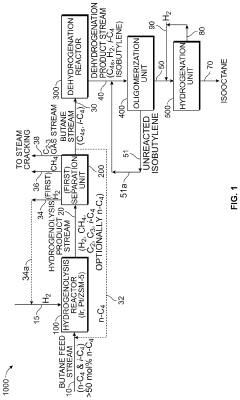
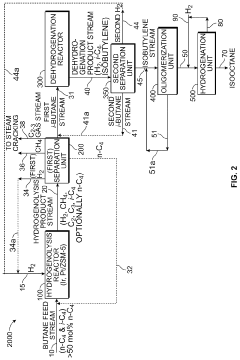
- A process involving a hydrogenolysis reactor with a catalyst that selectively converts n-butane to ethane and propane, while minimizing i-butane conversion, followed by dehydrogenation to produce isobutylene, which is then oligomerized to isooctane, reducing the need for separate isomerization and separation units.
Environmental Impact
The environmental impact of isobutane in integrated energy systems is a critical consideration for sustainable development and responsible resource management. Isobutane, a hydrocarbon compound, plays a significant role in various energy applications, but its use comes with both benefits and challenges from an environmental perspective.
One of the primary environmental concerns associated with isobutane is its potential as a greenhouse gas. While not as potent as some other hydrocarbons, isobutane can contribute to global warming if released into the atmosphere. This risk is particularly relevant in the context of integrated energy systems, where leaks or improper handling could lead to emissions. However, when properly managed and contained within closed-loop systems, the direct environmental impact can be minimized.
In terms of air quality, isobutane's use in energy systems generally results in lower emissions of particulate matter and other pollutants compared to traditional fossil fuels. This characteristic makes it an attractive option for urban environments where air pollution is a significant concern. Additionally, isobutane's high energy density allows for efficient energy storage and transportation, potentially reducing the overall carbon footprint of energy distribution networks.
Water pollution risks associated with isobutane are relatively low compared to other energy sources, particularly when contrasted with oil-based systems. Spills or leaks of isobutane typically vaporize quickly, reducing the likelihood of long-term water contamination. However, proper safety measures and containment protocols are essential to prevent any accidental releases into aquatic ecosystems.
The production and processing of isobutane do have environmental implications, primarily related to the extraction of natural gas, from which isobutane is often derived. These processes can lead to land disturbance, habitat fragmentation, and potential groundwater contamination if not managed responsibly. However, advancements in extraction technologies and stricter environmental regulations have helped mitigate some of these impacts in recent years.
From a lifecycle perspective, the environmental footprint of isobutane in integrated energy systems depends largely on its source and end-use efficiency. When derived from renewable sources or as a byproduct of other industrial processes, isobutane can contribute to a more circular and sustainable energy economy. Furthermore, its use in high-efficiency heat pumps and refrigeration systems can lead to significant energy savings, indirectly reducing overall environmental impact.
In conclusion, while isobutane presents some environmental challenges, particularly in terms of its greenhouse gas potential, its role in integrated energy systems offers several environmental benefits. These include improved air quality, efficient energy storage, and the potential for integration with renewable energy sources. Responsible management, continuous technological improvements, and a focus on sustainable sourcing are key to maximizing the positive environmental aspects of isobutane in energy applications while minimizing its negative impacts.
One of the primary environmental concerns associated with isobutane is its potential as a greenhouse gas. While not as potent as some other hydrocarbons, isobutane can contribute to global warming if released into the atmosphere. This risk is particularly relevant in the context of integrated energy systems, where leaks or improper handling could lead to emissions. However, when properly managed and contained within closed-loop systems, the direct environmental impact can be minimized.
In terms of air quality, isobutane's use in energy systems generally results in lower emissions of particulate matter and other pollutants compared to traditional fossil fuels. This characteristic makes it an attractive option for urban environments where air pollution is a significant concern. Additionally, isobutane's high energy density allows for efficient energy storage and transportation, potentially reducing the overall carbon footprint of energy distribution networks.
Water pollution risks associated with isobutane are relatively low compared to other energy sources, particularly when contrasted with oil-based systems. Spills or leaks of isobutane typically vaporize quickly, reducing the likelihood of long-term water contamination. However, proper safety measures and containment protocols are essential to prevent any accidental releases into aquatic ecosystems.
The production and processing of isobutane do have environmental implications, primarily related to the extraction of natural gas, from which isobutane is often derived. These processes can lead to land disturbance, habitat fragmentation, and potential groundwater contamination if not managed responsibly. However, advancements in extraction technologies and stricter environmental regulations have helped mitigate some of these impacts in recent years.
From a lifecycle perspective, the environmental footprint of isobutane in integrated energy systems depends largely on its source and end-use efficiency. When derived from renewable sources or as a byproduct of other industrial processes, isobutane can contribute to a more circular and sustainable energy economy. Furthermore, its use in high-efficiency heat pumps and refrigeration systems can lead to significant energy savings, indirectly reducing overall environmental impact.
In conclusion, while isobutane presents some environmental challenges, particularly in terms of its greenhouse gas potential, its role in integrated energy systems offers several environmental benefits. These include improved air quality, efficient energy storage, and the potential for integration with renewable energy sources. Responsible management, continuous technological improvements, and a focus on sustainable sourcing are key to maximizing the positive environmental aspects of isobutane in energy applications while minimizing its negative impacts.
Safety Regulations
Safety regulations play a crucial role in the integration of isobutane into energy systems, given its flammable and potentially explosive nature. Regulatory bodies worldwide have established stringent guidelines to ensure the safe handling, storage, and use of isobutane in various applications, including integrated energy systems.
The Occupational Safety and Health Administration (OSHA) in the United States has set specific standards for the use of isobutane in industrial settings. These regulations cover aspects such as proper ventilation, leak detection systems, and emergency response protocols. OSHA requires regular safety inspections and maintenance of equipment handling isobutane to prevent accidents and ensure worker safety.
In the European Union, the ATEX Directive (Atmosphere Explosibles) governs the use of potentially explosive substances like isobutane. This directive mandates the use of explosion-proof equipment and the implementation of risk assessment procedures in facilities where isobutane is present. Compliance with ATEX regulations is essential for companies operating integrated energy systems that utilize isobutane.
The International Organization for Standardization (ISO) has developed several standards relevant to isobutane use in energy systems. ISO 14520, for instance, provides guidelines for the design and installation of gaseous fire-extinguishing systems, which is particularly relevant when isobutane is used as a refrigerant in heat pumps or other energy-related applications.
Transportation of isobutane is subject to strict regulations under the United Nations' Recommendations on the Transport of Dangerous Goods. These guidelines specify requirements for packaging, labeling, and handling during transportation, ensuring safety throughout the supply chain of integrated energy systems.
Many countries have adopted specific codes for the use of flammable refrigerants, including isobutane, in heating, ventilation, and air conditioning (HVAC) systems. For example, the American Society of Heating, Refrigerating and Air-Conditioning Engineers (ASHRAE) Standard 15 provides safety guidelines for refrigeration systems, including those using isobutane.
As the adoption of isobutane in integrated energy systems grows, regulatory bodies are continuously updating their guidelines to address new challenges and technological advancements. This includes regulations on the maximum allowable charge of isobutane in various applications and specific requirements for leak detection and mitigation systems.
Compliance with these safety regulations is not only a legal requirement but also a critical factor in ensuring the long-term viability and public acceptance of isobutane-based integrated energy systems. Companies investing in these technologies must stay abreast of evolving regulations and incorporate compliance measures into their system designs and operational procedures.
The Occupational Safety and Health Administration (OSHA) in the United States has set specific standards for the use of isobutane in industrial settings. These regulations cover aspects such as proper ventilation, leak detection systems, and emergency response protocols. OSHA requires regular safety inspections and maintenance of equipment handling isobutane to prevent accidents and ensure worker safety.
In the European Union, the ATEX Directive (Atmosphere Explosibles) governs the use of potentially explosive substances like isobutane. This directive mandates the use of explosion-proof equipment and the implementation of risk assessment procedures in facilities where isobutane is present. Compliance with ATEX regulations is essential for companies operating integrated energy systems that utilize isobutane.
The International Organization for Standardization (ISO) has developed several standards relevant to isobutane use in energy systems. ISO 14520, for instance, provides guidelines for the design and installation of gaseous fire-extinguishing systems, which is particularly relevant when isobutane is used as a refrigerant in heat pumps or other energy-related applications.
Transportation of isobutane is subject to strict regulations under the United Nations' Recommendations on the Transport of Dangerous Goods. These guidelines specify requirements for packaging, labeling, and handling during transportation, ensuring safety throughout the supply chain of integrated energy systems.
Many countries have adopted specific codes for the use of flammable refrigerants, including isobutane, in heating, ventilation, and air conditioning (HVAC) systems. For example, the American Society of Heating, Refrigerating and Air-Conditioning Engineers (ASHRAE) Standard 15 provides safety guidelines for refrigeration systems, including those using isobutane.
As the adoption of isobutane in integrated energy systems grows, regulatory bodies are continuously updating their guidelines to address new challenges and technological advancements. This includes regulations on the maximum allowable charge of isobutane in various applications and specific requirements for leak detection and mitigation systems.
Compliance with these safety regulations is not only a legal requirement but also a critical factor in ensuring the long-term viability and public acceptance of isobutane-based integrated energy systems. Companies investing in these technologies must stay abreast of evolving regulations and incorporate compliance measures into their system designs and operational procedures.
Unlock deeper insights with PatSnap Eureka Quick Research — get a full tech report to explore trends and direct your research. Try now!
Generate Your Research Report Instantly with AI Agent
Supercharge your innovation with PatSnap Eureka AI Agent Platform!