Laser Engineered Net Shaping vs Forging: Cost Efficiency
APR 1, 20269 MIN READ
Generate Your Research Report Instantly with AI Agent
PatSnap Eureka helps you evaluate technical feasibility & market potential.
LENS vs Forging Technology Background and Objectives
Laser Engineered Net Shaping (LENS) represents a revolutionary additive manufacturing technology that emerged in the mid-1990s, fundamentally transforming how complex metallic components are produced. This direct metal deposition process utilizes high-powered lasers to simultaneously melt metal powder and substrate materials, creating near-net-shape components layer by layer. The technology has evolved from experimental laboratory applications to industrial-scale manufacturing solutions, particularly in aerospace, defense, and high-performance automotive sectors.
Traditional forging, conversely, represents one of humanity's oldest manufacturing processes, dating back thousands of years and continuously refined through industrial revolutions. Modern forging techniques employ sophisticated hydraulic presses, hammers, and dies to shape heated metal through controlled plastic deformation. This subtractive and formative manufacturing approach has established itself as the backbone of mass production for structural components, leveraging economies of scale and proven metallurgical properties.
The technological evolution of both processes reflects distinct developmental trajectories. LENS technology has progressed from single-material deposition systems to multi-material capabilities, incorporating real-time monitoring, closed-loop control systems, and hybrid manufacturing platforms. Recent advancements include improved powder delivery mechanisms, enhanced laser beam control, and integrated machining capabilities that enable complete part finishing within single setups.
Forging technology has simultaneously advanced through digitalization, incorporating computer-aided design optimization, precision temperature control, and automated handling systems. Modern forging operations utilize advanced materials science, predictive modeling, and Industry 4.0 integration to achieve unprecedented precision and efficiency levels while maintaining the fundamental mechanical advantages of grain flow optimization and material densification.
The primary objective of comparing these technologies centers on comprehensive cost efficiency analysis across multiple dimensions. This includes direct manufacturing costs, tooling investments, material utilization rates, post-processing requirements, and lifecycle considerations. Understanding when LENS technology becomes economically viable compared to traditional forging requires detailed examination of production volumes, component complexity, material specifications, and quality requirements.
Secondary objectives encompass evaluating technological complementarity rather than pure competition. Many applications benefit from hybrid approaches where LENS technology repairs or enhances forged components, or where forging provides base structures subsequently modified through additive processes. This synergistic potential represents significant opportunities for optimized manufacturing strategies that leverage the strengths of both technologies while mitigating individual limitations.
Traditional forging, conversely, represents one of humanity's oldest manufacturing processes, dating back thousands of years and continuously refined through industrial revolutions. Modern forging techniques employ sophisticated hydraulic presses, hammers, and dies to shape heated metal through controlled plastic deformation. This subtractive and formative manufacturing approach has established itself as the backbone of mass production for structural components, leveraging economies of scale and proven metallurgical properties.
The technological evolution of both processes reflects distinct developmental trajectories. LENS technology has progressed from single-material deposition systems to multi-material capabilities, incorporating real-time monitoring, closed-loop control systems, and hybrid manufacturing platforms. Recent advancements include improved powder delivery mechanisms, enhanced laser beam control, and integrated machining capabilities that enable complete part finishing within single setups.
Forging technology has simultaneously advanced through digitalization, incorporating computer-aided design optimization, precision temperature control, and automated handling systems. Modern forging operations utilize advanced materials science, predictive modeling, and Industry 4.0 integration to achieve unprecedented precision and efficiency levels while maintaining the fundamental mechanical advantages of grain flow optimization and material densification.
The primary objective of comparing these technologies centers on comprehensive cost efficiency analysis across multiple dimensions. This includes direct manufacturing costs, tooling investments, material utilization rates, post-processing requirements, and lifecycle considerations. Understanding when LENS technology becomes economically viable compared to traditional forging requires detailed examination of production volumes, component complexity, material specifications, and quality requirements.
Secondary objectives encompass evaluating technological complementarity rather than pure competition. Many applications benefit from hybrid approaches where LENS technology repairs or enhances forged components, or where forging provides base structures subsequently modified through additive processes. This synergistic potential represents significant opportunities for optimized manufacturing strategies that leverage the strengths of both technologies while mitigating individual limitations.
Market Demand Analysis for LENS and Forging Applications
The aerospace industry represents the most significant market segment for both LENS and forging technologies, driven by stringent requirements for high-performance components with complex geometries. LENS technology demonstrates particular strength in producing low-volume, high-value aerospace parts such as turbine blades, engine components, and structural elements where traditional manufacturing faces geometric limitations. The technology's ability to create internal cooling channels and complex lattice structures positions it favorably for next-generation aircraft engines seeking improved fuel efficiency.
Forging maintains dominance in high-volume aerospace applications where mechanical properties and material integrity are paramount. Critical safety components including landing gear, engine shafts, and structural frames continue to rely on forging processes due to their superior fatigue resistance and proven reliability track records. The aerospace sector's conservative approach to new technologies creates a gradual adoption curve for LENS, primarily in non-critical applications initially.
The automotive industry presents contrasting demand patterns, with forging holding substantial market share in mass production scenarios. Engine components, transmission parts, and chassis elements benefit from forging's cost-effectiveness at scale and established supply chain infrastructure. LENS technology finds niche applications in automotive prototyping, custom racing components, and specialized tooling where design flexibility outweighs volume considerations.
Medical device manufacturing emerges as a growing market for LENS technology, particularly in patient-specific implants and surgical instruments. The ability to customize geometries for individual patients creates unique value propositions that traditional forging cannot match. Orthopedic implants, dental prosthetics, and surgical guides represent expanding application areas where LENS technology addresses specific market needs.
Energy sector applications, including oil and gas equipment, power generation components, and renewable energy systems, show mixed adoption patterns. Forging remains preferred for large-scale components requiring proven durability, while LENS technology gains traction in specialized applications such as heat exchangers with complex internal geometries and repair operations for high-value equipment.
The defense and military sectors drive demand for both technologies, with LENS offering advantages in rapid prototyping, spare parts production, and specialized components with unique performance requirements. Forging continues to serve high-volume military applications where cost control and established qualification processes remain critical factors.
Forging maintains dominance in high-volume aerospace applications where mechanical properties and material integrity are paramount. Critical safety components including landing gear, engine shafts, and structural frames continue to rely on forging processes due to their superior fatigue resistance and proven reliability track records. The aerospace sector's conservative approach to new technologies creates a gradual adoption curve for LENS, primarily in non-critical applications initially.
The automotive industry presents contrasting demand patterns, with forging holding substantial market share in mass production scenarios. Engine components, transmission parts, and chassis elements benefit from forging's cost-effectiveness at scale and established supply chain infrastructure. LENS technology finds niche applications in automotive prototyping, custom racing components, and specialized tooling where design flexibility outweighs volume considerations.
Medical device manufacturing emerges as a growing market for LENS technology, particularly in patient-specific implants and surgical instruments. The ability to customize geometries for individual patients creates unique value propositions that traditional forging cannot match. Orthopedic implants, dental prosthetics, and surgical guides represent expanding application areas where LENS technology addresses specific market needs.
Energy sector applications, including oil and gas equipment, power generation components, and renewable energy systems, show mixed adoption patterns. Forging remains preferred for large-scale components requiring proven durability, while LENS technology gains traction in specialized applications such as heat exchangers with complex internal geometries and repair operations for high-value equipment.
The defense and military sectors drive demand for both technologies, with LENS offering advantages in rapid prototyping, spare parts production, and specialized components with unique performance requirements. Forging continues to serve high-volume military applications where cost control and established qualification processes remain critical factors.
Current Status and Cost Challenges in LENS vs Forging
Laser Engineered Net Shaping (LENS) technology currently operates within a niche manufacturing segment, primarily serving aerospace, defense, and high-value component industries. The technology demonstrates exceptional capabilities in producing complex geometries and functionally graded materials that are difficult or impossible to achieve through conventional forging processes. However, LENS faces significant cost barriers that limit its broader industrial adoption compared to traditional forging methods.
The primary cost challenge in LENS manufacturing stems from the high capital investment required for equipment acquisition and maintenance. Industrial-grade LENS systems typically cost between $500,000 to $2 million, substantially higher than conventional forging equipment of comparable production capacity. Additionally, the technology requires specialized powder feedstock materials that command premium prices, often 3-5 times more expensive than raw materials used in forging operations.
Production speed represents another critical cost factor affecting LENS competitiveness. Current LENS systems achieve deposition rates ranging from 1-10 kg/hour depending on material and component complexity, significantly slower than forging processes that can shape components in seconds to minutes. This speed limitation directly impacts per-unit manufacturing costs, particularly for high-volume production scenarios where forging maintains substantial advantages.
Forging technology, despite being a mature manufacturing process, continues to face its own cost challenges in modern manufacturing environments. Rising energy costs significantly impact forging operations due to the high-temperature heating requirements for material processing. Environmental compliance costs have also increased substantially, as forging facilities must invest in emission control systems and waste management infrastructure to meet stringent regulatory standards.
The skilled labor shortage affects both technologies but manifests differently in cost structures. LENS operations require highly trained technicians capable of managing complex process parameters and post-processing requirements, commanding higher wage premiums. Forging operations, while requiring fewer specialized skills, face increasing labor costs due to the physically demanding nature of the work and declining workforce availability in traditional manufacturing regions.
Quality control and post-processing costs present additional challenges for both technologies. LENS components often require extensive machining and heat treatment to achieve final specifications, adding 20-40% to total manufacturing costs. Forging processes, while producing near-net-shape components, still require significant machining operations and quality inspection procedures that contribute to overall cost structures.
Material utilization efficiency creates contrasting cost profiles between the technologies. LENS achieves near 100% material utilization through its additive nature, eliminating waste associated with traditional subtractive manufacturing. Conversely, forging operations typically achieve 60-80% material utilization, with significant material waste contributing to higher raw material costs per finished component.
The primary cost challenge in LENS manufacturing stems from the high capital investment required for equipment acquisition and maintenance. Industrial-grade LENS systems typically cost between $500,000 to $2 million, substantially higher than conventional forging equipment of comparable production capacity. Additionally, the technology requires specialized powder feedstock materials that command premium prices, often 3-5 times more expensive than raw materials used in forging operations.
Production speed represents another critical cost factor affecting LENS competitiveness. Current LENS systems achieve deposition rates ranging from 1-10 kg/hour depending on material and component complexity, significantly slower than forging processes that can shape components in seconds to minutes. This speed limitation directly impacts per-unit manufacturing costs, particularly for high-volume production scenarios where forging maintains substantial advantages.
Forging technology, despite being a mature manufacturing process, continues to face its own cost challenges in modern manufacturing environments. Rising energy costs significantly impact forging operations due to the high-temperature heating requirements for material processing. Environmental compliance costs have also increased substantially, as forging facilities must invest in emission control systems and waste management infrastructure to meet stringent regulatory standards.
The skilled labor shortage affects both technologies but manifests differently in cost structures. LENS operations require highly trained technicians capable of managing complex process parameters and post-processing requirements, commanding higher wage premiums. Forging operations, while requiring fewer specialized skills, face increasing labor costs due to the physically demanding nature of the work and declining workforce availability in traditional manufacturing regions.
Quality control and post-processing costs present additional challenges for both technologies. LENS components often require extensive machining and heat treatment to achieve final specifications, adding 20-40% to total manufacturing costs. Forging processes, while producing near-net-shape components, still require significant machining operations and quality inspection procedures that contribute to overall cost structures.
Material utilization efficiency creates contrasting cost profiles between the technologies. LENS achieves near 100% material utilization through its additive nature, eliminating waste associated with traditional subtractive manufacturing. Conversely, forging operations typically achieve 60-80% material utilization, with significant material waste contributing to higher raw material costs per finished component.
Current Cost-Efficiency Solutions in Manufacturing
01 Hybrid manufacturing combining laser deposition and forging processes
Integration of laser engineered net shaping with subsequent forging operations to create near-net-shape components with improved mechanical properties. This hybrid approach reduces material waste by using additive manufacturing for complex geometries, followed by forging to enhance density and strength. The combination optimizes both manufacturing time and material costs while achieving superior part performance compared to either process alone.- Hybrid manufacturing combining laser deposition and forging processes: Integration of laser engineered net shaping with subsequent forging operations to create near-net-shape components with improved mechanical properties. This hybrid approach reduces material waste by using additive manufacturing for complex geometries, followed by forging to enhance density and strength. The combination optimizes both manufacturing time and material costs while achieving superior part performance compared to either process alone.
- Process parameter optimization for cost reduction in laser net shaping: Optimization of laser power, scanning speed, powder feed rate, and layer thickness to minimize energy consumption and material usage while maintaining part quality. Advanced control systems and real-time monitoring enable adaptive processing that reduces defects and rework costs. Strategic parameter selection significantly impacts production efficiency and overall manufacturing economics.
- Material utilization and powder recycling systems: Implementation of closed-loop powder management systems that capture, filter, and reuse unmelted powder materials to minimize waste. Advanced powder handling equipment ensures consistent material quality while reducing raw material costs. Efficient material utilization strategies can decrease overall production costs by reducing material consumption and disposal expenses.
- Automated process planning and toolpath generation: Development of intelligent software systems for automated slicing, support structure generation, and optimized toolpath planning that reduce programming time and human error. Computer-aided manufacturing integration streamlines the transition from design to production, minimizing setup costs and improving repeatability. Advanced algorithms optimize build orientation and support placement to reduce post-processing requirements.
- Post-processing integration and heat treatment optimization: Streamlined post-processing workflows that combine heat treatment, surface finishing, and quality inspection to reduce handling time and labor costs. Optimized thermal cycles tailored to laser-deposited materials improve mechanical properties while minimizing energy consumption. Integration of in-situ or near-net-shape finishing techniques reduces the need for extensive machining operations.
02 Process parameter optimization for cost reduction in laser net shaping
Systematic optimization of laser power, scanning speed, powder feed rate, and layer thickness to minimize energy consumption and material usage. Advanced control systems and real-time monitoring enable adaptive parameter adjustment during manufacturing, reducing defects and rework costs. Optimization strategies focus on balancing deposition rate with part quality to achieve maximum cost efficiency.Expand Specific Solutions03 Material utilization and powder recycling systems
Implementation of closed-loop powder management systems to capture, filter, and reuse unmelted powder materials in laser deposition processes. Advanced powder handling equipment minimizes contamination and degradation, enabling high recycling rates that significantly reduce raw material costs. Powder characterization and quality control protocols ensure consistent performance across multiple recycling cycles.Expand Specific Solutions04 Automated process planning and toolpath generation
Development of intelligent software systems for automated slicing, toolpath optimization, and build strategy selection in laser net shaping operations. Machine learning algorithms analyze part geometry to determine optimal build orientation, support structures, and deposition sequences that minimize build time and material consumption. Integration with CAD/CAM systems streamlines the transition from design to manufacturing.Expand Specific Solutions05 Post-processing integration and heat treatment optimization
Streamlined post-processing workflows that combine heat treatment, machining, and surface finishing operations to reduce overall manufacturing cycle time. Optimized thermal processing schedules tailored to laser-deposited materials improve microstructure and mechanical properties while minimizing energy costs. Integration of forging operations as a post-processing step enhances material consolidation and reduces the need for extensive machining.Expand Specific Solutions
Major Players in LENS and Forging Industries
The Laser Engineered Net Shaping (LENS) versus forging cost efficiency landscape represents an emerging competitive arena where traditional manufacturing meets advanced additive technologies. The industry is in a transitional phase, with the global additive manufacturing market expanding rapidly while conventional forging maintains dominance in high-volume production. Technology maturity varies significantly across players: established forging companies like Bharat Forge Ltd., JFE Steel Corp., and ELLWOOD NATIONAL FORGE COMPANY demonstrate mature, cost-effective processes for large-scale manufacturing, while laser technology providers such as IPG (Beijing) Fiber Laser Technology Co., Ltd. and ACSYS Lasertechnik GmbH are advancing LENS capabilities. Research institutions including Xi'an Jiaotong University, Jiangsu University, and National Research Council of Canada are bridging the gap through innovation. Industrial manufacturers like Siemens Energy AG, Lockheed Martin Corp., and automotive companies such as Hyundai Motor Co., Ltd. are evaluating both technologies for specific applications, driving demand for cost-efficient solutions that balance precision, material properties, and production economics.
ELLWOOD NATIONAL FORGE COMPANY
Technical Solution: As a traditional forging specialist, Ellwood has conducted extensive comparative studies between LENS and conventional forging processes to understand competitive positioning. Their analysis shows that while forging maintains significant cost advantages for high-volume production (>10,000 units annually), LENS presents compelling economics for specialized applications. Ellwood's research indicates that forging achieves superior mechanical properties through grain refinement and work hardening, resulting in 15-25% higher strength-to-weight ratios compared to LENS-produced components. However, their cost analysis reveals that LENS eliminates the substantial upfront tooling investments required for forging, which can range from $50,000 to over $1 million depending on component complexity. The company has identified hybrid manufacturing strategies combining both technologies.
Strengths: Superior mechanical properties, excellent for high-volume production, established supply chains and quality systems. Weaknesses: High tooling costs for low volumes, limited geometric complexity, significant material waste in machining operations.
Bharat Forge Ltd.
Technical Solution: Bharat Forge, as one of the world's largest forging companies, has invested in understanding LENS technology's impact on traditional forging economics. Their comprehensive analysis demonstrates that forging maintains cost leadership for automotive components with production volumes exceeding 50,000 units annually, achieving per-unit costs 30-50% lower than LENS for standard geometries. However, their research shows LENS offers compelling advantages for prototype development and low-volume specialty components, reducing development timelines from 12-16 weeks (including tooling) to 2-3 weeks. The company has identified that LENS technology threatens traditional forging in niche markets, particularly for complex geometries requiring extensive machining after forging, where LENS's near-net-shape capabilities provide significant cost advantages through reduced material waste and machining time.
Strengths: Proven high-volume manufacturing capabilities, excellent mechanical properties, established automotive supply chain relationships. Weaknesses: High setup costs for new designs, limited flexibility for design changes, significant material waste in complex geometries requiring extensive machining.
Core Technologies for LENS Cost Optimization
Methods for fabricating gradient alloy articles with multi-functional properties
PatentActiveUS20150044084A1
Innovation
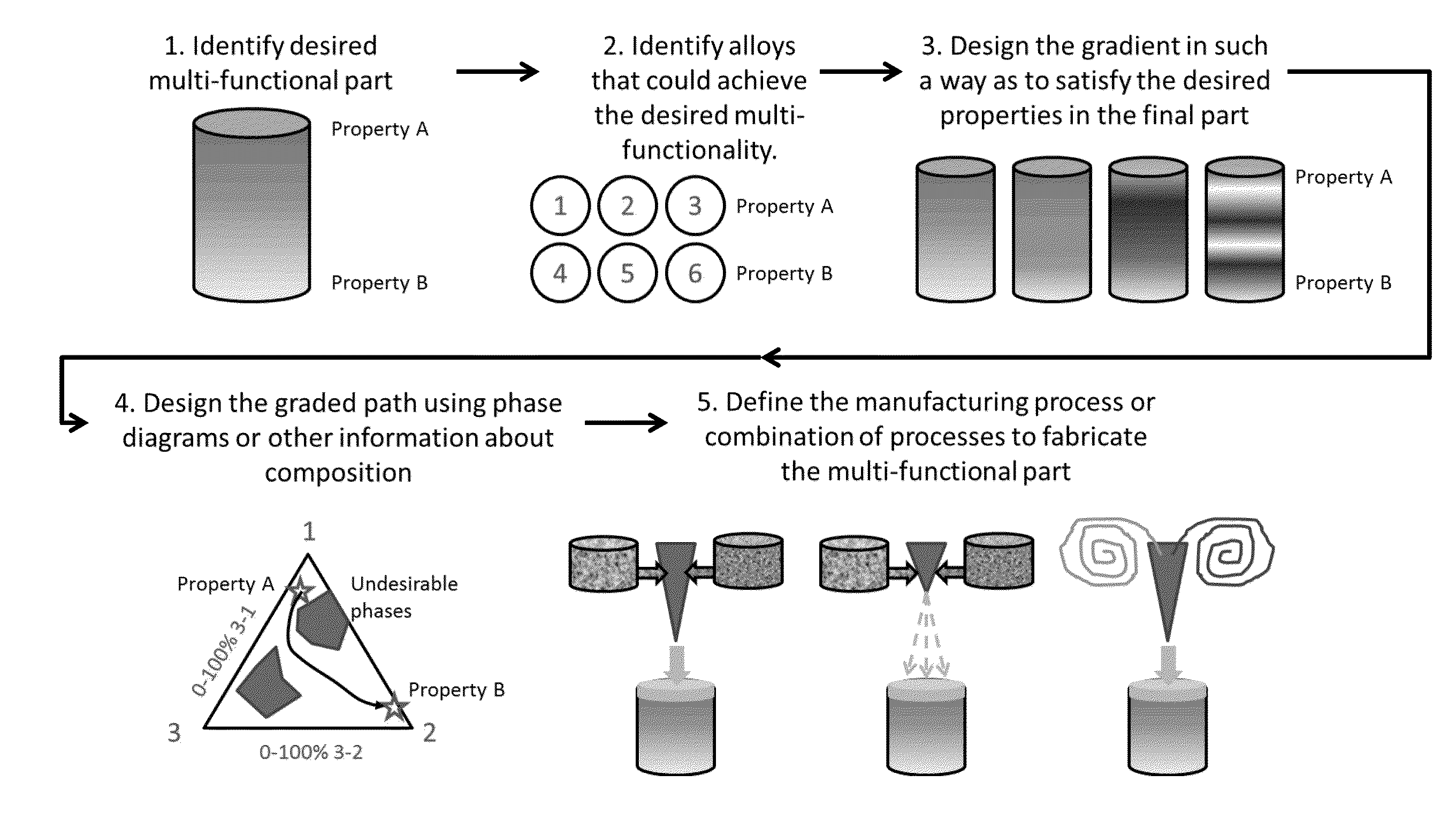
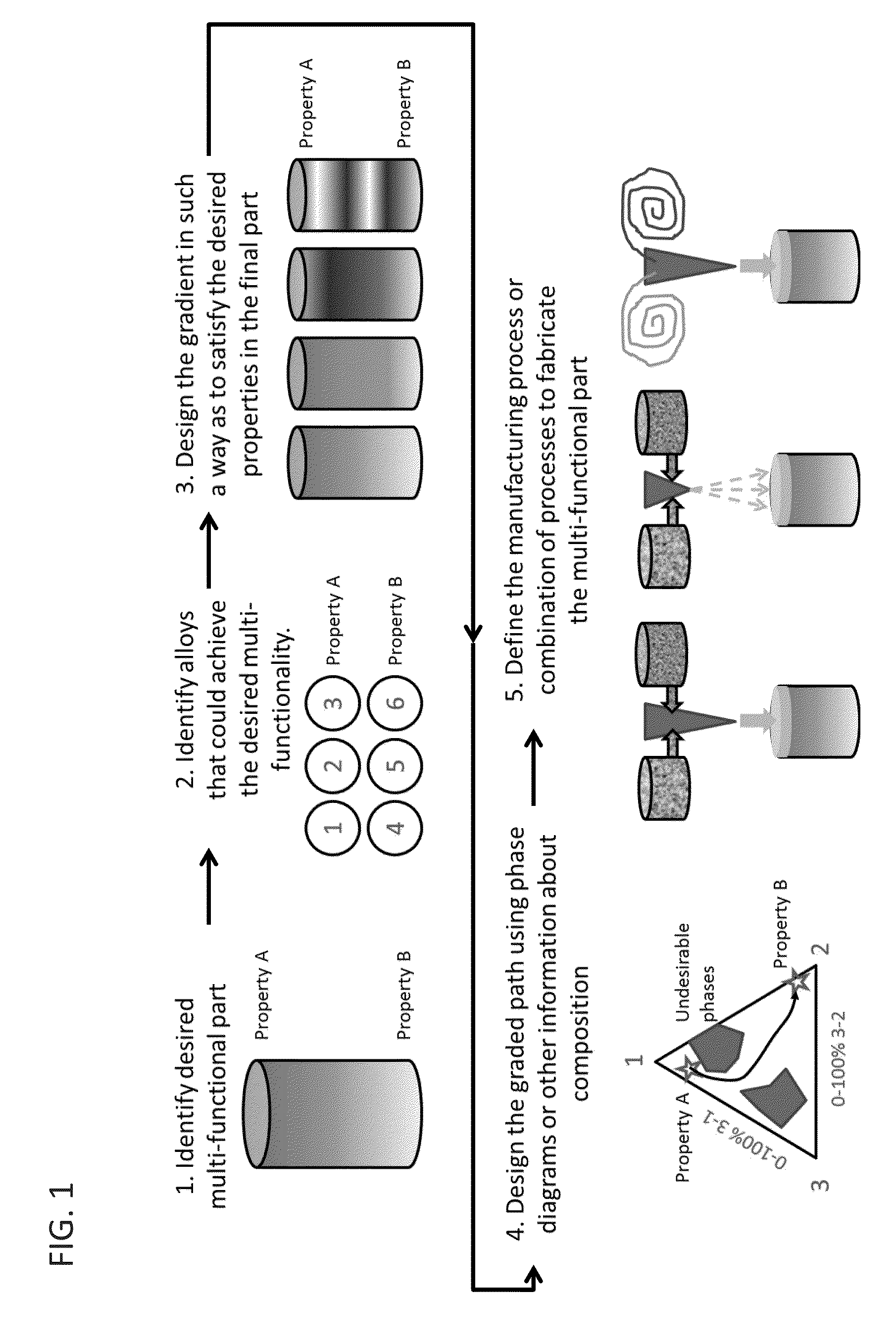
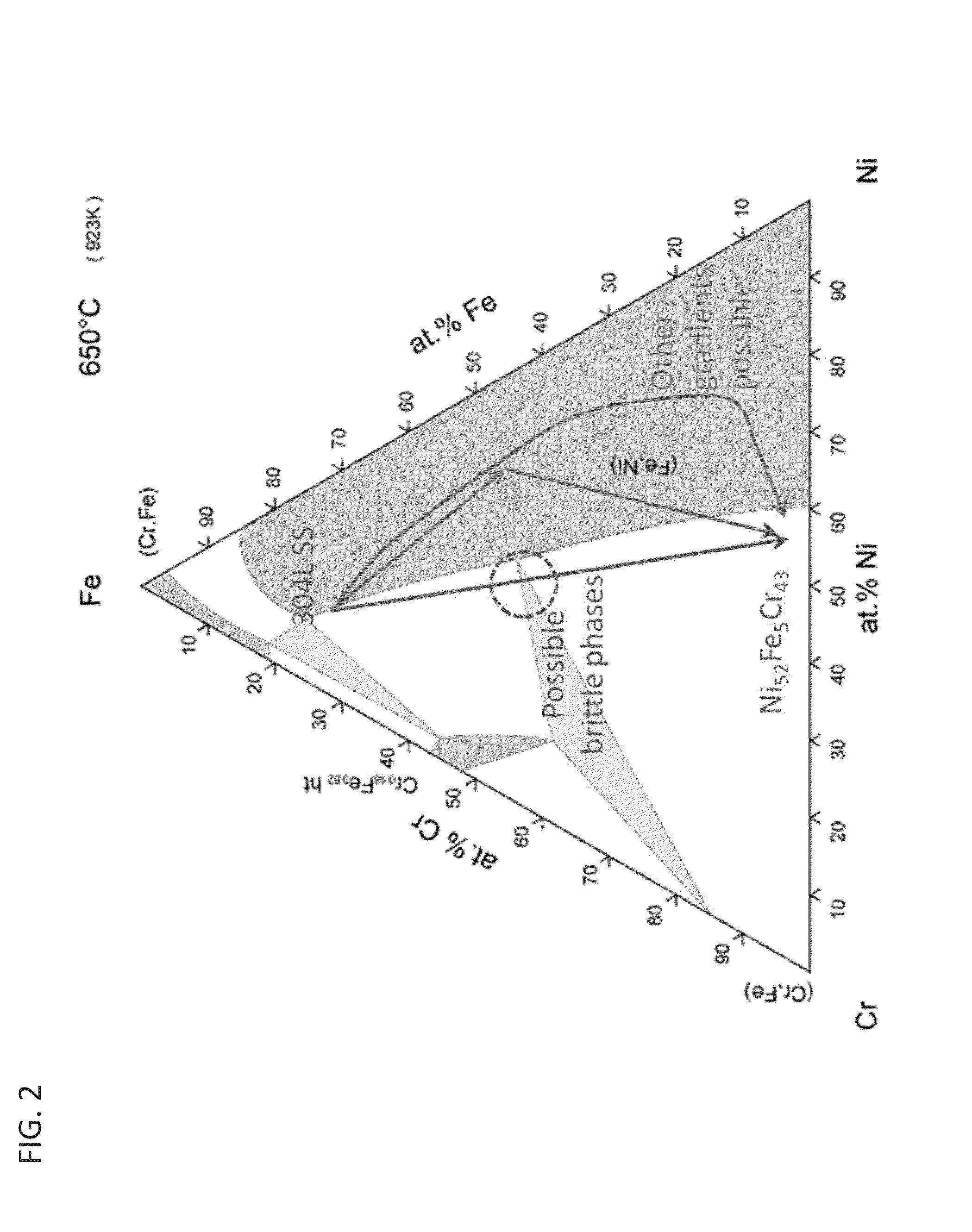
- The method involves determining a compositional gradient pathway between distinct materials using phase diagrams to avoid undesirable phases, and then using additive manufacturing techniques like Laser Engineered Net Shaping (LENS) to form multi-functional articles with precise compositional transitions, allowing for the creation of gradient layers with varying mechanical and thermophysical properties.

Process for Making Forged and Machined Components
PatentInactiveUS20140238099A1
Innovation
- A process combining open die and closed die forging, with intermediate steps of cogging, upsetting, closed die forging, rough machining, heat treatment, and finishing, optimized through 3D metal flow simulation and CAM simulation to minimize flash and maximize material utilization, reducing material wastage and machining time.


Environmental Impact Assessment of LENS vs Forging
The environmental implications of manufacturing processes have become increasingly critical in industrial decision-making, particularly when comparing advanced additive manufacturing techniques like Laser Engineered Net Shaping (LENS) with traditional forging methods. This assessment examines the comprehensive environmental footprint of both technologies across their operational lifecycles.
LENS technology demonstrates significantly lower material waste generation compared to conventional forging processes. The additive nature of LENS enables near-net-shape manufacturing with material utilization rates exceeding 95%, while traditional forging typically achieves 60-80% material efficiency due to machining requirements and flash removal. This reduction in raw material consumption directly translates to decreased mining activities and associated environmental degradation.
Energy consumption patterns reveal contrasting profiles between the two technologies. LENS operations require substantial electrical energy for laser generation and precise environmental controls, with power consumption ranging from 2-8 kW per kilogram of processed material. Forging processes, while energy-intensive during heating and forming phases, often demonstrate lower overall energy requirements per unit mass, particularly in high-volume production scenarios.
Carbon footprint analysis indicates that LENS technology generally produces lower greenhouse gas emissions per component, primarily due to reduced material waste and elimination of extensive machining operations. However, the carbon intensity varies significantly based on the local electrical grid composition and production volumes. Forging processes benefit from established supply chains and energy-efficient furnace technologies, but suffer from higher indirect emissions through material waste processing.
Waste stream characteristics differ substantially between the technologies. LENS generates minimal solid waste, primarily consisting of unused powder that can often be recycled through sieving and reconditioning processes. Forging operations produce significant quantities of metal chips, scale, and lubricant waste requiring specialized disposal or recycling infrastructure.
The assessment reveals that LENS technology offers superior environmental performance for low-to-medium volume production, while forging maintains advantages in high-volume scenarios where economies of scale offset material inefficiencies.
LENS technology demonstrates significantly lower material waste generation compared to conventional forging processes. The additive nature of LENS enables near-net-shape manufacturing with material utilization rates exceeding 95%, while traditional forging typically achieves 60-80% material efficiency due to machining requirements and flash removal. This reduction in raw material consumption directly translates to decreased mining activities and associated environmental degradation.
Energy consumption patterns reveal contrasting profiles between the two technologies. LENS operations require substantial electrical energy for laser generation and precise environmental controls, with power consumption ranging from 2-8 kW per kilogram of processed material. Forging processes, while energy-intensive during heating and forming phases, often demonstrate lower overall energy requirements per unit mass, particularly in high-volume production scenarios.
Carbon footprint analysis indicates that LENS technology generally produces lower greenhouse gas emissions per component, primarily due to reduced material waste and elimination of extensive machining operations. However, the carbon intensity varies significantly based on the local electrical grid composition and production volumes. Forging processes benefit from established supply chains and energy-efficient furnace technologies, but suffer from higher indirect emissions through material waste processing.
Waste stream characteristics differ substantially between the technologies. LENS generates minimal solid waste, primarily consisting of unused powder that can often be recycled through sieving and reconditioning processes. Forging operations produce significant quantities of metal chips, scale, and lubricant waste requiring specialized disposal or recycling infrastructure.
The assessment reveals that LENS technology offers superior environmental performance for low-to-medium volume production, while forging maintains advantages in high-volume scenarios where economies of scale offset material inefficiencies.
Supply Chain Economics in Advanced Manufacturing
The supply chain economics of advanced manufacturing technologies like Laser Engineered Net Shaping (LENS) and traditional forging present fundamentally different cost structures and operational considerations. LENS technology operates within a more streamlined supply chain framework, requiring fewer raw material suppliers and intermediary processing steps. The additive nature of LENS allows for direct powder-to-part manufacturing, eliminating the need for extensive tooling suppliers, die manufacturers, and secondary machining operations that characterize traditional forging supply chains.
Raw material procurement strategies differ significantly between these manufacturing approaches. LENS relies on specialized metal powders with stringent quality specifications, creating dependency on a limited supplier base but reducing inventory complexity. The powder supply chain typically involves fewer intermediaries, enabling more direct relationships with material producers. Conversely, forging operations require bulk raw materials, multiple tooling suppliers, and extensive quality control networks throughout the supply chain.
Inventory management economics favor LENS technology in low-volume, high-complexity scenarios. The technology enables just-in-time production capabilities, reducing work-in-process inventory and finished goods storage requirements. Traditional forging operations necessitate larger inventory buffers due to batch processing requirements and longer lead times for tooling modifications. This inventory reduction translates to significant working capital advantages for LENS-based manufacturing systems.
Transportation and logistics costs present contrasting patterns between the two technologies. LENS operations can be geographically distributed closer to end customers due to lower capital investment requirements and reduced facility footprints. This proximity reduces transportation costs and enables responsive local manufacturing. Forging operations typically require centralized facilities with substantial infrastructure investments, leading to higher transportation costs but potentially lower per-unit production costs at scale.
Supply chain risk profiles differ substantially between LENS and forging approaches. LENS technology reduces supplier dependency risks through simplified supply networks but introduces technology-specific risks related to powder quality and equipment reliability. Forging operations face traditional supply chain risks including raw material price volatility, tooling supplier capacity constraints, and multi-tier supplier coordination challenges. The geographic concentration of forging capabilities also creates regional supply chain vulnerabilities that distributed LENS operations can mitigate.
Raw material procurement strategies differ significantly between these manufacturing approaches. LENS relies on specialized metal powders with stringent quality specifications, creating dependency on a limited supplier base but reducing inventory complexity. The powder supply chain typically involves fewer intermediaries, enabling more direct relationships with material producers. Conversely, forging operations require bulk raw materials, multiple tooling suppliers, and extensive quality control networks throughout the supply chain.
Inventory management economics favor LENS technology in low-volume, high-complexity scenarios. The technology enables just-in-time production capabilities, reducing work-in-process inventory and finished goods storage requirements. Traditional forging operations necessitate larger inventory buffers due to batch processing requirements and longer lead times for tooling modifications. This inventory reduction translates to significant working capital advantages for LENS-based manufacturing systems.
Transportation and logistics costs present contrasting patterns between the two technologies. LENS operations can be geographically distributed closer to end customers due to lower capital investment requirements and reduced facility footprints. This proximity reduces transportation costs and enables responsive local manufacturing. Forging operations typically require centralized facilities with substantial infrastructure investments, leading to higher transportation costs but potentially lower per-unit production costs at scale.
Supply chain risk profiles differ substantially between LENS and forging approaches. LENS technology reduces supplier dependency risks through simplified supply networks but introduces technology-specific risks related to powder quality and equipment reliability. Forging operations face traditional supply chain risks including raw material price volatility, tooling supplier capacity constraints, and multi-tier supplier coordination challenges. The geographic concentration of forging capabilities also creates regional supply chain vulnerabilities that distributed LENS operations can mitigate.
Unlock deeper insights with PatSnap Eureka Quick Research — get a full tech report to explore trends and direct your research. Try now!
Generate Your Research Report Instantly with AI Agent
Supercharge your innovation with PatSnap Eureka AI Agent Platform!