

Microgrid Arc Flash Mitigation: Best Practices
MAR 18, 20269 MIN READ
Generate Your Research Report Instantly with AI Agent
PatSnap Eureka helps you evaluate technical feasibility & market potential.
Microgrid Arc Flash Background and Safety Objectives
Arc flash incidents represent one of the most severe electrical hazards in power systems, characterized by explosive energy releases that can reach temperatures exceeding 35,000°F and generate pressures capable of causing catastrophic equipment damage and fatal injuries. In traditional centralized power grids, arc flash mitigation has been extensively studied and standardized. However, the emergence of microgrids introduces unique complexities that challenge conventional safety approaches and necessitate specialized protection strategies.
Microgrids, as localized energy systems capable of operating independently or in conjunction with the main electrical grid, present distinct arc flash challenges due to their dynamic operational modes, diverse energy sources, and variable fault current contributions. The bidirectional power flow characteristics inherent in microgrids, combined with the integration of renewable energy sources such as solar photovoltaics and wind turbines, create unpredictable fault current patterns that traditional arc flash analysis methods struggle to accurately predict.
The historical development of arc flash safety measures began in the 1980s with the recognition of electrical arc hazards in industrial settings. The IEEE 1584 standard, first published in 2002 and subsequently updated, established the foundation for arc flash hazard calculations and safety protocols. However, these standards were primarily developed for conventional radial distribution systems and do not adequately address the complexities introduced by microgrid architectures.
The evolution of microgrid technology has accelerated significantly over the past two decades, driven by the need for enhanced grid resilience, renewable energy integration, and distributed generation capabilities. This technological advancement has outpaced the development of corresponding safety standards, creating a critical gap in arc flash protection methodologies specifically tailored for microgrid applications.
Current safety objectives for microgrid arc flash mitigation encompass multiple dimensions, including personnel protection through appropriate personal protective equipment selection, equipment preservation via advanced protection schemes, and operational continuity through rapid fault isolation and system reconfiguration. The primary goal is to minimize incident energy levels at potential arc flash locations while maintaining system reliability and operational flexibility.
The technical challenges in achieving these objectives stem from the variable nature of fault current contributions in microgrids, which can change dramatically based on operational mode, connected distributed energy resources, and grid connection status. This variability necessitates dynamic arc flash hazard assessment capabilities and adaptive protection strategies that can respond to changing system conditions in real-time.
Microgrids, as localized energy systems capable of operating independently or in conjunction with the main electrical grid, present distinct arc flash challenges due to their dynamic operational modes, diverse energy sources, and variable fault current contributions. The bidirectional power flow characteristics inherent in microgrids, combined with the integration of renewable energy sources such as solar photovoltaics and wind turbines, create unpredictable fault current patterns that traditional arc flash analysis methods struggle to accurately predict.
The historical development of arc flash safety measures began in the 1980s with the recognition of electrical arc hazards in industrial settings. The IEEE 1584 standard, first published in 2002 and subsequently updated, established the foundation for arc flash hazard calculations and safety protocols. However, these standards were primarily developed for conventional radial distribution systems and do not adequately address the complexities introduced by microgrid architectures.
The evolution of microgrid technology has accelerated significantly over the past two decades, driven by the need for enhanced grid resilience, renewable energy integration, and distributed generation capabilities. This technological advancement has outpaced the development of corresponding safety standards, creating a critical gap in arc flash protection methodologies specifically tailored for microgrid applications.
Current safety objectives for microgrid arc flash mitigation encompass multiple dimensions, including personnel protection through appropriate personal protective equipment selection, equipment preservation via advanced protection schemes, and operational continuity through rapid fault isolation and system reconfiguration. The primary goal is to minimize incident energy levels at potential arc flash locations while maintaining system reliability and operational flexibility.
The technical challenges in achieving these objectives stem from the variable nature of fault current contributions in microgrids, which can change dramatically based on operational mode, connected distributed energy resources, and grid connection status. This variability necessitates dynamic arc flash hazard assessment capabilities and adaptive protection strategies that can respond to changing system conditions in real-time.
Market Demand for Microgrid Arc Flash Protection Solutions
The global microgrid market has experienced substantial growth driven by increasing demand for energy resilience, grid modernization initiatives, and the integration of renewable energy sources. This expansion has simultaneously heightened awareness of arc flash hazards within microgrid systems, creating a significant market opportunity for specialized protection solutions. Arc flash incidents in microgrids pose severe risks to personnel safety and equipment integrity, making protection systems essential rather than optional components.
Industrial and commercial sectors represent the largest demand segments for microgrid arc flash protection solutions. Manufacturing facilities, data centers, hospitals, and educational institutions increasingly deploy microgrids to ensure power reliability and reduce energy costs. These facilities require comprehensive arc flash protection due to their complex electrical configurations and the critical nature of their operations. The potential for extended downtime and substantial financial losses from arc flash incidents drives strong demand for advanced protection technologies.
Utility-scale microgrids and military installations constitute another significant market segment. These applications demand robust arc flash protection systems capable of operating in diverse environmental conditions while maintaining high reliability standards. The growing deployment of microgrids in remote locations and critical infrastructure applications further amplifies the need for sophisticated protection solutions that can operate autonomously with minimal maintenance requirements.
Regulatory compliance requirements significantly influence market demand patterns. Evolving safety standards and workplace protection regulations mandate comprehensive arc flash risk assessments and mitigation measures. Organizations face increasing liability exposure and regulatory scrutiny regarding electrical safety, driving adoption of advanced protection systems beyond basic compliance requirements.
The integration of renewable energy sources within microgrids creates additional complexity in arc flash protection requirements. Solar photovoltaic systems, energy storage installations, and wind generation introduce unique electrical characteristics that traditional protection schemes may not adequately address. This complexity generates demand for intelligent protection systems capable of adapting to dynamic operating conditions and multiple energy source configurations.
Emerging markets in developing regions present substantial growth opportunities as electrification efforts expand and grid infrastructure modernizes. These markets increasingly recognize the importance of incorporating safety systems from initial deployment phases rather than retrofitting protection measures later. The cost of comprehensive protection solutions continues to decrease relative to overall microgrid system costs, making advanced arc flash protection more accessible across diverse market segments.
Industrial and commercial sectors represent the largest demand segments for microgrid arc flash protection solutions. Manufacturing facilities, data centers, hospitals, and educational institutions increasingly deploy microgrids to ensure power reliability and reduce energy costs. These facilities require comprehensive arc flash protection due to their complex electrical configurations and the critical nature of their operations. The potential for extended downtime and substantial financial losses from arc flash incidents drives strong demand for advanced protection technologies.
Utility-scale microgrids and military installations constitute another significant market segment. These applications demand robust arc flash protection systems capable of operating in diverse environmental conditions while maintaining high reliability standards. The growing deployment of microgrids in remote locations and critical infrastructure applications further amplifies the need for sophisticated protection solutions that can operate autonomously with minimal maintenance requirements.
Regulatory compliance requirements significantly influence market demand patterns. Evolving safety standards and workplace protection regulations mandate comprehensive arc flash risk assessments and mitigation measures. Organizations face increasing liability exposure and regulatory scrutiny regarding electrical safety, driving adoption of advanced protection systems beyond basic compliance requirements.
The integration of renewable energy sources within microgrids creates additional complexity in arc flash protection requirements. Solar photovoltaic systems, energy storage installations, and wind generation introduce unique electrical characteristics that traditional protection schemes may not adequately address. This complexity generates demand for intelligent protection systems capable of adapting to dynamic operating conditions and multiple energy source configurations.
Emerging markets in developing regions present substantial growth opportunities as electrification efforts expand and grid infrastructure modernizes. These markets increasingly recognize the importance of incorporating safety systems from initial deployment phases rather than retrofitting protection measures later. The cost of comprehensive protection solutions continues to decrease relative to overall microgrid system costs, making advanced arc flash protection more accessible across diverse market segments.
Current Arc Flash Hazards and Challenges in Microgrids
Arc flash incidents in microgrids present unique and complex hazards that differ significantly from traditional centralized power systems. The distributed nature of microgrid architectures creates multiple potential fault sources, including distributed energy resources, energy storage systems, and interconnection points with the main grid. These diverse energy sources operate at varying voltage levels and exhibit different fault current characteristics, making arc flash risk assessment and mitigation particularly challenging.
The bidirectional power flow capability inherent in modern microgrids fundamentally alters fault current behavior compared to conventional unidirectional systems. During islanded operation, fault currents may be significantly lower than grid-connected mode, while reconnection events can create transient conditions with unpredictable arc flash energy levels. This variability complicates the establishment of consistent protection coordination schemes and personal protective equipment requirements.
Energy storage systems, particularly battery energy storage systems, introduce additional complexity to arc flash hazard analysis. Unlike traditional rotating machines, batteries can sustain fault currents for extended periods without the natural decay characteristics of synchronous generators. The rapid response time of inverter-based resources also creates challenges in fault detection and interruption, potentially extending arc duration and increasing incident energy levels.
Protection coordination in microgrids faces significant obstacles due to the dynamic nature of system configuration and varying short-circuit current levels. Traditional overcurrent protection schemes may not provide adequate sensitivity during low-fault-current conditions typical of islanded operation. The integration of multiple protection devices from different manufacturers often results in coordination gaps that can lead to delayed fault clearing and increased arc flash exposure.
Existing arc flash calculation methodologies, primarily designed for radial distribution systems, often prove inadequate for microgrid applications. The IEEE 1584 standard assumptions may not accurately reflect the complex impedance characteristics and fault current contributions from distributed resources. This limitation creates uncertainty in incident energy calculations and appropriate boundary determinations for electrical safety programs.
Maintenance and operational challenges are amplified in microgrid environments where multiple stakeholders may be responsible for different system components. The lack of standardized arc flash labeling and safety procedures across interconnected systems creates potential safety gaps. Additionally, the frequent switching between grid-connected and islanded modes requires dynamic updates to arc flash studies and safety protocols, which many organizations struggle to implement effectively.
The bidirectional power flow capability inherent in modern microgrids fundamentally alters fault current behavior compared to conventional unidirectional systems. During islanded operation, fault currents may be significantly lower than grid-connected mode, while reconnection events can create transient conditions with unpredictable arc flash energy levels. This variability complicates the establishment of consistent protection coordination schemes and personal protective equipment requirements.
Energy storage systems, particularly battery energy storage systems, introduce additional complexity to arc flash hazard analysis. Unlike traditional rotating machines, batteries can sustain fault currents for extended periods without the natural decay characteristics of synchronous generators. The rapid response time of inverter-based resources also creates challenges in fault detection and interruption, potentially extending arc duration and increasing incident energy levels.
Protection coordination in microgrids faces significant obstacles due to the dynamic nature of system configuration and varying short-circuit current levels. Traditional overcurrent protection schemes may not provide adequate sensitivity during low-fault-current conditions typical of islanded operation. The integration of multiple protection devices from different manufacturers often results in coordination gaps that can lead to delayed fault clearing and increased arc flash exposure.
Existing arc flash calculation methodologies, primarily designed for radial distribution systems, often prove inadequate for microgrid applications. The IEEE 1584 standard assumptions may not accurately reflect the complex impedance characteristics and fault current contributions from distributed resources. This limitation creates uncertainty in incident energy calculations and appropriate boundary determinations for electrical safety programs.
Maintenance and operational challenges are amplified in microgrid environments where multiple stakeholders may be responsible for different system components. The lack of standardized arc flash labeling and safety procedures across interconnected systems creates potential safety gaps. Additionally, the frequent switching between grid-connected and islanded modes requires dynamic updates to arc flash studies and safety protocols, which many organizations struggle to implement effectively.
Existing Arc Flash Mitigation Solutions for Microgrids
01 Arc flash detection and protection systems in microgrids
Advanced detection systems are employed to identify arc flash events in microgrid environments through monitoring electrical parameters such as current, voltage, and light emissions. These systems utilize sensors and algorithms to rapidly detect abnormal conditions and trigger protective measures. The protection mechanisms include automatic circuit interruption, isolation of affected sections, and coordination with other protective devices to minimize damage and ensure personnel safety.- Arc flash detection and protection systems in microgrids: Advanced detection systems are employed to identify arc flash events in microgrid environments through monitoring electrical parameters such as current, voltage, and light emissions. These systems utilize sensors and algorithms to rapidly detect abnormal conditions and trigger protective measures. The protection mechanisms include automatic circuit interruption, isolation of affected sections, and coordination with other protective devices to minimize damage and ensure personnel safety.
- Arc flash hazard analysis and risk assessment for microgrids: Comprehensive analysis methodologies are developed to evaluate arc flash hazards in microgrid configurations, considering factors such as fault current levels, equipment ratings, and system topology. These assessments calculate incident energy levels at various points in the system and determine appropriate safety boundaries. The analysis results guide the selection of personal protective equipment and establishment of safe work practices for maintenance personnel.
- Coordination of protective devices for arc flash mitigation: Protective device coordination strategies are implemented to reduce arc flash incident energy by minimizing fault clearing times. This involves optimizing the settings and characteristics of circuit breakers, relays, and fuses to ensure selective operation while maintaining fast response to fault conditions. Advanced coordination schemes may incorporate communication between devices and adaptive protection settings based on real-time system conditions.
- Arc-resistant equipment and enclosure design: Specialized equipment designs incorporate arc-resistant features to contain and redirect the energy released during arc flash events. These designs include reinforced enclosures, pressure relief mechanisms, and venting systems that channel hot gases and debris away from personnel. Materials and construction methods are selected to withstand the thermal and mechanical stresses associated with arc flash incidents while maintaining system functionality.
- Real-time monitoring and adaptive protection for arc flash prevention: Intelligent monitoring systems continuously track microgrid operating conditions and dynamically adjust protection parameters to optimize arc flash safety. These systems utilize real-time data on load conditions, generation sources, and network configuration to update fault current calculations and protection settings. Predictive algorithms may identify potential arc flash hazards before they occur, enabling proactive maintenance and operational adjustments.
02 Arc flash hazard assessment and calculation methods for microgrids
Specialized methodologies are developed to assess and calculate arc flash hazards specific to microgrid configurations. These methods account for the unique characteristics of distributed generation, variable power sources, and complex network topologies. The assessment includes determining incident energy levels, arc flash boundaries, and required personal protective equipment ratings. Computational tools and software are utilized to perform dynamic analysis considering different operating modes and fault scenarios.Expand Specific Solutions03 Coordination of protective devices for arc flash mitigation in microgrids
Protective device coordination strategies are implemented to reduce arc flash incident energy and improve system reliability. This involves optimizing the settings and response times of circuit breakers, relays, and fuses to ensure selective operation during fault conditions. Advanced coordination schemes consider the bidirectional power flow and multiple source configurations typical in microgrids. Communication-based protection and adaptive relaying techniques are employed to enhance coordination effectiveness.Expand Specific Solutions04 Arc flash energy reduction through current limiting technologies
Current limiting devices and technologies are integrated into microgrid systems to reduce the magnitude of fault currents and consequently decrease arc flash incident energy. These solutions include current-limiting reactors, fault current limiters, and fast-acting switching devices. The implementation of these technologies helps to lower the arc flash hazard category and reduce the required personal protective equipment levels. Energy storage systems and power electronic interfaces can also be configured to limit fault current contribution.Expand Specific Solutions05 Monitoring and control systems for arc flash prevention in microgrids
Comprehensive monitoring and control systems are deployed to prevent arc flash incidents through real-time supervision and predictive maintenance. These systems collect data from multiple sensors throughout the microgrid to identify potential failure modes and degradation of equipment. Advanced analytics and machine learning algorithms process the data to predict arc flash risks before they occur. Remote monitoring capabilities enable operators to take preventive actions and implement maintenance schedules to minimize arc flash hazards.Expand Specific Solutions
Key Players in Microgrid Protection and Safety Industry
The microgrid arc flash mitigation market represents an emerging segment within the broader electrical safety industry, currently in its early growth phase with significant expansion potential driven by increasing microgrid deployments worldwide. The market remains relatively nascent but is experiencing accelerated development as distributed energy resources proliferate. Technology maturity varies considerably across market participants, with established electrical giants like Eaton Intelligent Power Ltd. and ABB Ltd. leveraging decades of traditional grid protection expertise to develop microgrid-specific solutions. State Grid Corp. of China and its subsidiaries, including regional entities like State Grid Zhejiang Electric Power Co., are driving innovation through large-scale implementation and research initiatives. Meanwhile, technology companies such as Google LLC are contributing advanced digital monitoring and predictive analytics capabilities. The competitive landscape features a mix of traditional power equipment manufacturers, utility operators, and emerging technology providers, with research institutions like The University of Hong Kong contributing to fundamental safety protocol development and standardization efforts.
Eaton Intelligent Power Ltd.
Technical Solution: Eaton has developed comprehensive arc flash mitigation solutions for microgrids including advanced protection relays with adaptive protection schemes, arc flash detection systems with optical and current sensors, and coordinated protection strategies. Their Power Xpert series offers real-time arc flash analysis capabilities, enabling dynamic protection settings adjustment based on microgrid operating conditions. The company's solutions integrate zone-selective interlocking (ZSI) and maintenance mode switching to reduce arc flash incident energy levels. Their microgrid controllers incorporate predictive analytics to identify potential arc flash hazards before they occur, while their energy storage integration ensures protection coordination during islanding operations.
Strengths: Comprehensive protection portfolio, proven track record in power systems, advanced analytics capabilities. Weaknesses: Higher initial investment costs, complexity in system integration with existing infrastructure.
State Grid Corp. of China
Technical Solution: State Grid has developed standardized arc flash mitigation protocols for microgrid applications, focusing on protection coordination and fault current limitation techniques. Their approach emphasizes the use of current-limiting reactors, fault current limiters, and coordinated protection schemes to reduce arc flash incident energy. The company has implemented pilot projects demonstrating the effectiveness of distributed protection systems and real-time monitoring for arc flash prevention. Their solutions include specialized protection settings for different microgrid operating modes and integration with renewable energy sources to maintain protection coordination during various generation scenarios.
Strengths: Extensive operational experience, large-scale implementation capabilities, cost-effective solutions. Weaknesses: Limited international market presence, primarily focused on domestic standards and regulations.
Core Technologies in Advanced Arc Flash Detection
Hybrid arc flash mitigation system
PatentWO2022078626A1
Innovation
- A hybrid arc flash mitigation system comprising an arc flash sensor and a mitigation device with a bypass power switch that includes a solid-state circuit interrupter and an electro-mechanical switch, capable of quickly interrupting fault currents using an ultra-fast actuator, and a system controller that generates trigger signals to activate the switch in response to detected arc flash events, allowing for rapid fault current interruption.


Arc flash elimination apparatus and method
PatentActiveUS7821749B2
Innovation
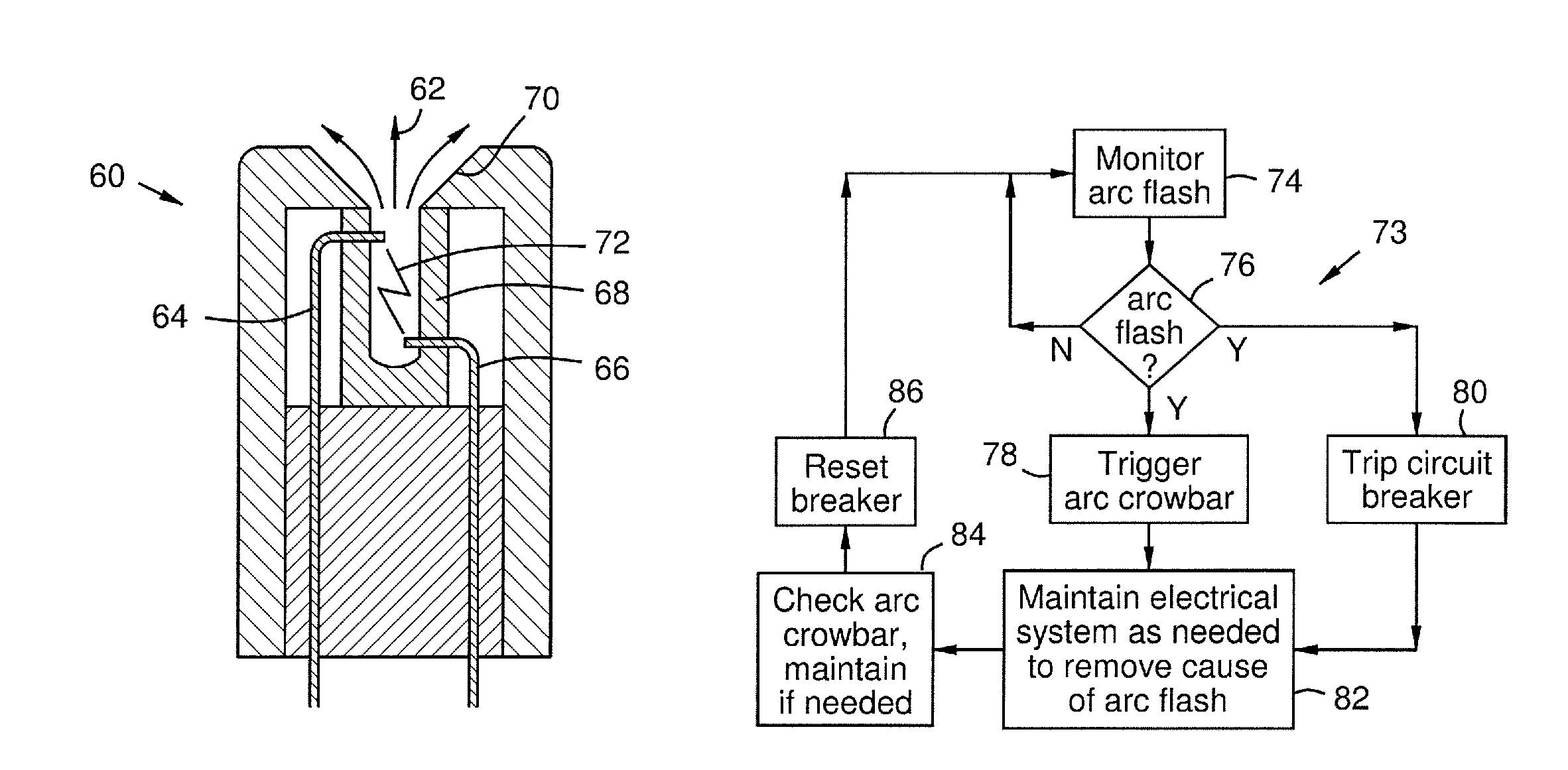
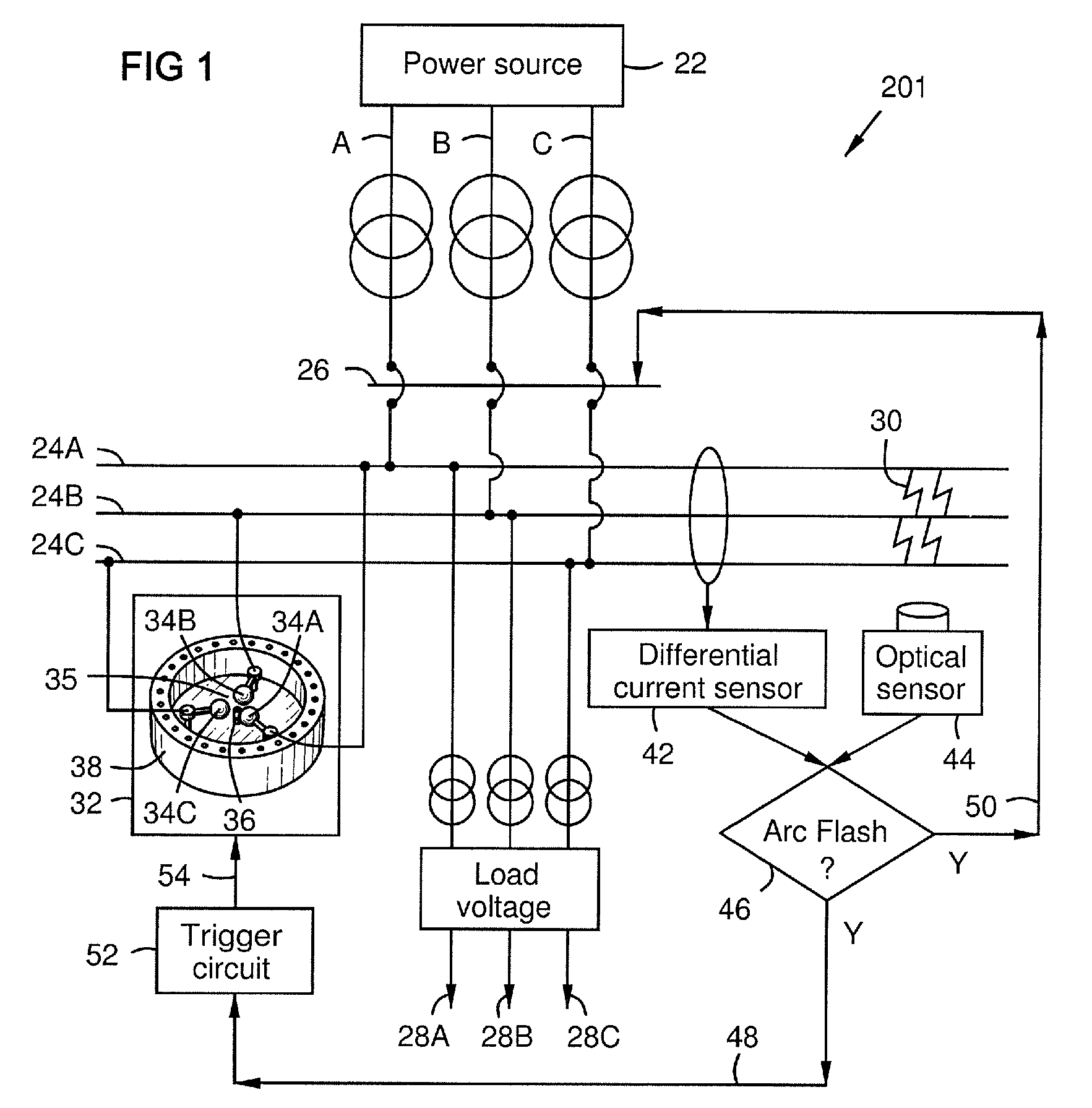
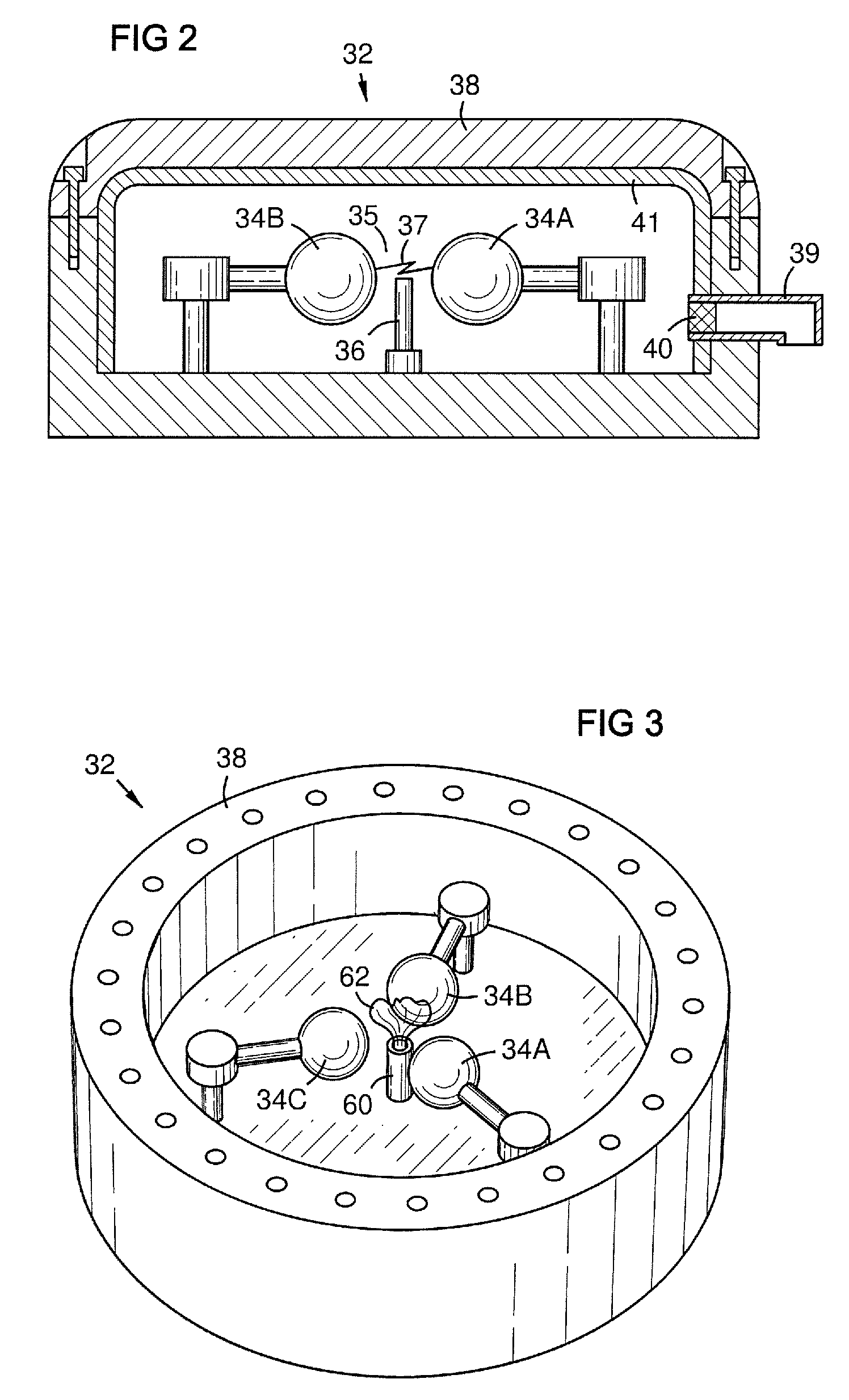
- An arc crowbar device with gap electrodes in a pressure containment vessel, equipped with an ablative plasma gun that initiates a protective arc by ionizing gas between the electrodes, quickly diverting energy away from the arc flash and triggering a circuit breaker to shut down the power.

Safety Standards and Regulatory Framework for Microgrids
The regulatory landscape for microgrid arc flash mitigation is governed by a complex framework of international, national, and local standards that establish mandatory safety requirements and best practices. The Institute of Electrical and Electronics Engineers (IEEE) provides foundational standards through IEEE 1547 series, which addresses interconnection requirements and safety protocols for distributed energy resources within microgrids. These standards specifically mandate arc flash hazard analysis and mitigation measures during both grid-connected and islanded operations.
The National Fire Protection Association (NFPA) 70E standard serves as the cornerstone for electrical safety in the workplace, requiring comprehensive arc flash risk assessments and the implementation of appropriate personal protective equipment protocols. NFPA 70E mandates that microgrid operators conduct incident energy calculations and establish arc flash protection boundaries, with specific requirements for maintenance procedures and worker training programs.
International Electrotechnical Commission (IEC) standards, particularly IEC 61850 and IEC 62351, provide global frameworks for communication protocols and cybersecurity measures that indirectly support arc flash prevention through enhanced system monitoring and control capabilities. These standards enable real-time fault detection and rapid system isolation, critical components of effective arc flash mitigation strategies.
Regulatory compliance varies significantly across jurisdictions, with the Occupational Safety and Health Administration (OSHA) in the United States enforcing workplace safety requirements that directly impact microgrid operations. European Union directives, including the Low Voltage Directive and Machinery Directive, establish similar safety obligations for microgrid installations within EU member states.
Local utility regulations and interconnection agreements often impose additional safety requirements beyond national standards, particularly regarding protection coordination and fault current contribution limits. These regulatory requirements frequently mandate specific arc flash mitigation technologies, such as arc flash relays and current-limiting devices, as conditions for microgrid interconnection approval.
The evolving regulatory framework increasingly emphasizes performance-based safety standards rather than prescriptive requirements, allowing microgrid operators greater flexibility in implementing innovative arc flash mitigation solutions while maintaining stringent safety outcomes. This trend reflects the growing recognition of microgrids' unique operational characteristics and the need for adaptive regulatory approaches.
The National Fire Protection Association (NFPA) 70E standard serves as the cornerstone for electrical safety in the workplace, requiring comprehensive arc flash risk assessments and the implementation of appropriate personal protective equipment protocols. NFPA 70E mandates that microgrid operators conduct incident energy calculations and establish arc flash protection boundaries, with specific requirements for maintenance procedures and worker training programs.
International Electrotechnical Commission (IEC) standards, particularly IEC 61850 and IEC 62351, provide global frameworks for communication protocols and cybersecurity measures that indirectly support arc flash prevention through enhanced system monitoring and control capabilities. These standards enable real-time fault detection and rapid system isolation, critical components of effective arc flash mitigation strategies.
Regulatory compliance varies significantly across jurisdictions, with the Occupational Safety and Health Administration (OSHA) in the United States enforcing workplace safety requirements that directly impact microgrid operations. European Union directives, including the Low Voltage Directive and Machinery Directive, establish similar safety obligations for microgrid installations within EU member states.
Local utility regulations and interconnection agreements often impose additional safety requirements beyond national standards, particularly regarding protection coordination and fault current contribution limits. These regulatory requirements frequently mandate specific arc flash mitigation technologies, such as arc flash relays and current-limiting devices, as conditions for microgrid interconnection approval.
The evolving regulatory framework increasingly emphasizes performance-based safety standards rather than prescriptive requirements, allowing microgrid operators greater flexibility in implementing innovative arc flash mitigation solutions while maintaining stringent safety outcomes. This trend reflects the growing recognition of microgrids' unique operational characteristics and the need for adaptive regulatory approaches.
Economic Impact Assessment of Arc Flash Incidents
Arc flash incidents in microgrid systems impose substantial economic burdens on organizations through multiple interconnected cost channels. Direct financial impacts include immediate equipment replacement costs, which can range from tens of thousands to millions of dollars depending on the affected infrastructure components. Critical switchgear, transformers, and protection devices damaged during arc flash events often require complete replacement rather than repair due to the severity of thermal and mechanical damage.
Personnel-related costs constitute another significant economic factor, encompassing medical expenses for injured workers, workers' compensation claims, and potential litigation costs. Severe arc flash injuries can result in medical bills exceeding hundreds of thousands of dollars per incident, while fatalities may lead to wrongful death settlements reaching millions of dollars. These human-related costs often represent the largest single expense category in major arc flash incidents.
Business interruption costs frequently exceed direct equipment and personnel expenses, particularly in mission-critical facilities such as hospitals, data centers, and manufacturing plants. Microgrid outages can cascade into broader facility shutdowns, resulting in lost production, missed deadlines, and customer dissatisfaction. Industries with continuous processes may face additional costs related to equipment restart, product spoilage, and quality control issues following power restoration.
Regulatory compliance and investigation costs add another layer of economic impact. Organizations must allocate resources for incident investigation, regulatory reporting, and potential fines from occupational safety agencies. Enhanced safety training programs, updated procedures, and additional protective equipment purchases represent ongoing costs following arc flash incidents.
Insurance implications create long-term economic consequences through increased premiums and potential coverage limitations. Repeated incidents may result in policy cancellations or requirements for extensive risk mitigation measures before coverage renewal. The total economic impact of arc flash incidents typically ranges from hundreds of thousands to tens of millions of dollars, making prevention strategies economically justified investments for microgrid operators.
Personnel-related costs constitute another significant economic factor, encompassing medical expenses for injured workers, workers' compensation claims, and potential litigation costs. Severe arc flash injuries can result in medical bills exceeding hundreds of thousands of dollars per incident, while fatalities may lead to wrongful death settlements reaching millions of dollars. These human-related costs often represent the largest single expense category in major arc flash incidents.
Business interruption costs frequently exceed direct equipment and personnel expenses, particularly in mission-critical facilities such as hospitals, data centers, and manufacturing plants. Microgrid outages can cascade into broader facility shutdowns, resulting in lost production, missed deadlines, and customer dissatisfaction. Industries with continuous processes may face additional costs related to equipment restart, product spoilage, and quality control issues following power restoration.
Regulatory compliance and investigation costs add another layer of economic impact. Organizations must allocate resources for incident investigation, regulatory reporting, and potential fines from occupational safety agencies. Enhanced safety training programs, updated procedures, and additional protective equipment purchases represent ongoing costs following arc flash incidents.
Insurance implications create long-term economic consequences through increased premiums and potential coverage limitations. Repeated incidents may result in policy cancellations or requirements for extensive risk mitigation measures before coverage renewal. The total economic impact of arc flash incidents typically ranges from hundreds of thousands to tens of millions of dollars, making prevention strategies economically justified investments for microgrid operators.
Unlock deeper insights with PatSnap Eureka Quick Research — get a full tech report to explore trends and direct your research. Try now!
Generate Your Research Report Instantly with AI Agent
Supercharge your innovation with PatSnap Eureka AI Agent Platform!