Modifying Quantum Tunneling Traits in Light-Modulating Devices
SEP 4, 202510 MIN READ
Generate Your Research Report Instantly with AI Agent
PatSnap Eureka helps you evaluate technical feasibility & market potential.
Quantum Tunneling Fundamentals and Research Objectives
Quantum tunneling represents a fundamental quantum mechanical phenomenon where particles penetrate through energy barriers that would be insurmountable according to classical physics. This counterintuitive behavior occurs because quantum particles exhibit wave-like properties, allowing their wave functions to extend beyond classical boundaries. In light-modulating devices, quantum tunneling plays a crucial role in controlling electron transport across barriers, directly influencing optical properties and device performance.
The historical development of quantum tunneling theory dates back to the early 20th century with the formulation of quantum mechanics. Friedrich Hund first described tunneling in 1927, followed by George Gamow's application to nuclear physics in 1928. The theoretical framework was further refined through the work of Max Born, Robert Oppenheimer, and Eugene Wigner, establishing the mathematical foundations that continue to guide modern applications.
In light-modulating technologies, quantum tunneling has evolved from a theoretical curiosity to a controllable mechanism for device operation. The ability to manipulate tunneling rates through barrier engineering has enabled the development of quantum well structures, resonant tunneling diodes, and tunneling-based optical modulators that form the backbone of many optoelectronic systems.
Current technological trends indicate a growing interest in dynamically controllable tunneling properties. This includes the development of materials with tunable barrier heights, the integration of tunneling junctions with photonic structures, and the exploration of tunneling effects in two-dimensional materials and heterostructures for next-generation optical devices.
The primary research objectives in modifying quantum tunneling traits focus on achieving precise control over tunneling probabilities through external stimuli such as electric fields, optical excitation, or mechanical strain. This control mechanism would enable rapid modulation of optical properties including transmission, reflection, absorption, and polarization characteristics.
Additional research goals include enhancing tunneling efficiency to reduce power consumption in light-modulating devices, extending operational wavelength ranges through engineered tunneling barriers, and improving switching speeds by optimizing tunneling dynamics. These advancements would directly address limitations in current display technologies, optical communications systems, and photonic computing platforms.
The ultimate technical objective is to develop a comprehensive framework for designing tunneling-based light modulators with predictable performance characteristics, scalable manufacturing processes, and compatibility with existing optoelectronic infrastructures. This would enable new classes of devices that leverage quantum effects for superior optical modulation capabilities while maintaining practical implementation pathways.
The historical development of quantum tunneling theory dates back to the early 20th century with the formulation of quantum mechanics. Friedrich Hund first described tunneling in 1927, followed by George Gamow's application to nuclear physics in 1928. The theoretical framework was further refined through the work of Max Born, Robert Oppenheimer, and Eugene Wigner, establishing the mathematical foundations that continue to guide modern applications.
In light-modulating technologies, quantum tunneling has evolved from a theoretical curiosity to a controllable mechanism for device operation. The ability to manipulate tunneling rates through barrier engineering has enabled the development of quantum well structures, resonant tunneling diodes, and tunneling-based optical modulators that form the backbone of many optoelectronic systems.
Current technological trends indicate a growing interest in dynamically controllable tunneling properties. This includes the development of materials with tunable barrier heights, the integration of tunneling junctions with photonic structures, and the exploration of tunneling effects in two-dimensional materials and heterostructures for next-generation optical devices.
The primary research objectives in modifying quantum tunneling traits focus on achieving precise control over tunneling probabilities through external stimuli such as electric fields, optical excitation, or mechanical strain. This control mechanism would enable rapid modulation of optical properties including transmission, reflection, absorption, and polarization characteristics.
Additional research goals include enhancing tunneling efficiency to reduce power consumption in light-modulating devices, extending operational wavelength ranges through engineered tunneling barriers, and improving switching speeds by optimizing tunneling dynamics. These advancements would directly address limitations in current display technologies, optical communications systems, and photonic computing platforms.
The ultimate technical objective is to develop a comprehensive framework for designing tunneling-based light modulators with predictable performance characteristics, scalable manufacturing processes, and compatibility with existing optoelectronic infrastructures. This would enable new classes of devices that leverage quantum effects for superior optical modulation capabilities while maintaining practical implementation pathways.
Market Applications for Light-Modulating Quantum Devices
Light-modulating quantum devices are experiencing rapid market adoption across multiple sectors due to their unique ability to manipulate quantum tunneling properties for precise light control. The display industry represents the largest current market, with quantum dot displays already commanding a significant market share. These displays offer superior color accuracy, brightness, and energy efficiency compared to traditional LED and OLED technologies, driving their integration into premium televisions, monitors, and mobile devices.
The telecommunications sector presents another substantial growth area, where quantum tunneling-based optical modulators enable faster data transmission rates and reduced power consumption in fiber optic networks. These devices are particularly valuable for long-haul communications and data centers, where energy efficiency and signal integrity are paramount concerns.
Medical imaging and diagnostics constitute a promising emerging application, with quantum light-modulating devices enabling higher resolution imaging at lower radiation doses. These technologies are being incorporated into next-generation MRI machines, CT scanners, and specialized medical imaging equipment, allowing for earlier disease detection and more precise diagnostics.
The automotive industry has begun integrating these devices into advanced driver-assistance systems (ADAS) and autonomous vehicle sensors. Quantum tunneling-enhanced LiDAR systems offer improved range, accuracy, and performance in adverse weather conditions compared to conventional systems, addressing critical safety requirements for autonomous transportation.
Smart building technologies represent another growth sector, with quantum light-modulating devices being incorporated into smart windows, adaptive lighting systems, and energy management solutions. These applications leverage the precise control over light transmission to optimize energy usage while maintaining occupant comfort.
Security and defense applications are driving specialized market development, particularly in quantum-enhanced night vision, secure communications, and advanced sensing technologies. These applications benefit from the enhanced sensitivity and controllability of quantum tunneling-based light modulation.
The aerospace industry is adopting these technologies for satellite communications, earth observation systems, and spacecraft instrumentation, where their radiation resistance, reliability, and precision offer significant advantages over conventional optical technologies.
Agricultural technology represents an emerging application area, with quantum light-modulating devices being used in advanced greenhouse lighting systems, crop monitoring, and precision agriculture tools to optimize plant growth and resource utilization.
AI and computing hardware manufacturers are exploring quantum tunneling devices for optical computing applications, potentially enabling faster, more energy-efficient processing for specific computational tasks compared to traditional electronic approaches.
The telecommunications sector presents another substantial growth area, where quantum tunneling-based optical modulators enable faster data transmission rates and reduced power consumption in fiber optic networks. These devices are particularly valuable for long-haul communications and data centers, where energy efficiency and signal integrity are paramount concerns.
Medical imaging and diagnostics constitute a promising emerging application, with quantum light-modulating devices enabling higher resolution imaging at lower radiation doses. These technologies are being incorporated into next-generation MRI machines, CT scanners, and specialized medical imaging equipment, allowing for earlier disease detection and more precise diagnostics.
The automotive industry has begun integrating these devices into advanced driver-assistance systems (ADAS) and autonomous vehicle sensors. Quantum tunneling-enhanced LiDAR systems offer improved range, accuracy, and performance in adverse weather conditions compared to conventional systems, addressing critical safety requirements for autonomous transportation.
Smart building technologies represent another growth sector, with quantum light-modulating devices being incorporated into smart windows, adaptive lighting systems, and energy management solutions. These applications leverage the precise control over light transmission to optimize energy usage while maintaining occupant comfort.
Security and defense applications are driving specialized market development, particularly in quantum-enhanced night vision, secure communications, and advanced sensing technologies. These applications benefit from the enhanced sensitivity and controllability of quantum tunneling-based light modulation.
The aerospace industry is adopting these technologies for satellite communications, earth observation systems, and spacecraft instrumentation, where their radiation resistance, reliability, and precision offer significant advantages over conventional optical technologies.
Agricultural technology represents an emerging application area, with quantum light-modulating devices being used in advanced greenhouse lighting systems, crop monitoring, and precision agriculture tools to optimize plant growth and resource utilization.
AI and computing hardware manufacturers are exploring quantum tunneling devices for optical computing applications, potentially enabling faster, more energy-efficient processing for specific computational tasks compared to traditional electronic approaches.
Current Limitations in Quantum Tunneling Control
Despite significant advancements in quantum tunneling manipulation for light-modulating devices, several critical limitations continue to impede progress in this field. The primary challenge remains the precise control of tunneling rates at room temperature, as quantum effects are highly sensitive to thermal fluctuations. Current devices struggle to maintain coherent tunneling behavior above cryogenic temperatures, severely restricting practical applications in consumer electronics and industrial settings.
Material interface quality presents another substantial barrier. The tunneling effect depends critically on atomically precise interfaces between materials, yet current fabrication techniques cannot consistently achieve the required precision at scale. Even minor defects or impurities at these interfaces can dramatically alter tunneling characteristics, leading to device-to-device variability that hampers mass production capabilities.
Energy efficiency limitations also plague existing quantum tunneling modulation systems. The energy required to modify tunneling traits often exceeds practical levels for portable or energy-sensitive applications. This inefficiency stems from the need for strong electric or magnetic fields to influence the quantum states, resulting in significant power consumption that contradicts the miniaturization trends in modern electronics.
Response time constraints further limit applications in high-speed optical communications. While quantum tunneling itself occurs at femtosecond timescales, the practical modulation of tunneling properties typically operates at much slower rates due to limitations in control circuitry and the physical mechanisms used to influence the tunneling barriers. This timing discrepancy creates a bottleneck for applications requiring rapid light modulation.
Bandwidth restrictions represent another significant challenge. Current tunneling-based light modulators typically operate effectively within narrow wavelength ranges, limiting their versatility across the electromagnetic spectrum. This spectral limitation restricts their application in multi-wavelength systems and broadband optical communications.
Stability and reliability issues also persist in quantum tunneling devices. Environmental factors such as temperature fluctuations, electromagnetic interference, and mechanical vibrations can significantly alter tunneling characteristics over time. This sensitivity leads to drift in device performance, requiring complex compensation mechanisms that add to system complexity and cost.
Finally, integration challenges with conventional electronics remain substantial. The specialized materials and operating conditions required for quantum tunneling devices often conflict with standard CMOS fabrication processes, creating significant barriers to incorporating these advanced light-modulating capabilities into existing technological ecosystems and manufacturing pipelines.
Material interface quality presents another substantial barrier. The tunneling effect depends critically on atomically precise interfaces between materials, yet current fabrication techniques cannot consistently achieve the required precision at scale. Even minor defects or impurities at these interfaces can dramatically alter tunneling characteristics, leading to device-to-device variability that hampers mass production capabilities.
Energy efficiency limitations also plague existing quantum tunneling modulation systems. The energy required to modify tunneling traits often exceeds practical levels for portable or energy-sensitive applications. This inefficiency stems from the need for strong electric or magnetic fields to influence the quantum states, resulting in significant power consumption that contradicts the miniaturization trends in modern electronics.
Response time constraints further limit applications in high-speed optical communications. While quantum tunneling itself occurs at femtosecond timescales, the practical modulation of tunneling properties typically operates at much slower rates due to limitations in control circuitry and the physical mechanisms used to influence the tunneling barriers. This timing discrepancy creates a bottleneck for applications requiring rapid light modulation.
Bandwidth restrictions represent another significant challenge. Current tunneling-based light modulators typically operate effectively within narrow wavelength ranges, limiting their versatility across the electromagnetic spectrum. This spectral limitation restricts their application in multi-wavelength systems and broadband optical communications.
Stability and reliability issues also persist in quantum tunneling devices. Environmental factors such as temperature fluctuations, electromagnetic interference, and mechanical vibrations can significantly alter tunneling characteristics over time. This sensitivity leads to drift in device performance, requiring complex compensation mechanisms that add to system complexity and cost.
Finally, integration challenges with conventional electronics remain substantial. The specialized materials and operating conditions required for quantum tunneling devices often conflict with standard CMOS fabrication processes, creating significant barriers to incorporating these advanced light-modulating capabilities into existing technological ecosystems and manufacturing pipelines.
Existing Approaches to Modify Quantum Tunneling Properties
01 Quantum tunneling in semiconductor devices
Quantum tunneling is a fundamental phenomenon in semiconductor devices where electrons can pass through energy barriers that would be classically forbidden. This effect is particularly important in transistors, diodes, and memory devices where it can influence current flow and switching behavior. The tunneling effect depends on barrier height, width, and the effective mass of charge carriers, allowing for the design of specialized electronic components that leverage quantum mechanical properties.- Quantum tunneling in semiconductor devices: Quantum tunneling is a key phenomenon in semiconductor devices where electrons can pass through energy barriers that would be classically forbidden. This property is utilized in various semiconductor structures such as tunnel diodes, resonant tunneling diodes, and quantum well devices. The tunneling effect allows for faster switching speeds and unique electrical characteristics that can be exploited in high-speed electronics and quantum computing applications.
- Tunneling in quantum computing and information processing: Quantum tunneling plays a crucial role in quantum computing architectures, enabling the implementation of quantum bits (qubits) and quantum gates. The tunneling effect facilitates quantum state manipulation and information processing by allowing controlled transitions between quantum states. This phenomenon is fundamental to quantum algorithms and quantum error correction techniques, providing pathways for developing more powerful and efficient computing systems.
- Measurement and characterization of tunneling effects: Various techniques and instruments have been developed to measure and characterize quantum tunneling phenomena. These include scanning tunneling microscopy, tunneling spectroscopy, and specialized electronic test structures. These measurement methods allow researchers to observe and quantify tunneling currents, barrier heights, and other quantum mechanical properties, which are essential for developing and optimizing devices that rely on tunneling effects.
- Tunneling field-effect transistors and novel electronic devices: Tunneling field-effect transistors (TFETs) represent a class of devices that utilize quantum tunneling as the primary mechanism for current flow. These devices offer advantages such as steep subthreshold slopes and low power consumption compared to conventional transistors. The unique tunneling traits enable the development of ultra-low power electronics, novel memory architectures, and energy-efficient integrated circuits for next-generation computing systems.
- Materials engineering for enhanced tunneling properties: The manipulation of material properties and structures to enhance or control quantum tunneling characteristics is a significant area of research. This includes the development of engineered barrier materials, heterostructures, and quantum dots with specific tunneling traits. By carefully designing material compositions, layer thicknesses, and band alignments, researchers can tailor tunneling probabilities and create devices with optimized performance for specific applications.
02 Tunneling magnetoresistance applications
Tunneling magnetoresistance (TMR) is a quantum mechanical effect observed in magnetic tunnel junctions where the electrical resistance changes depending on the relative magnetization orientation of the ferromagnetic layers. This property is exploited in various applications including magnetic sensors, hard disk read heads, and magnetic random access memory (MRAM). The tunneling traits can be optimized by engineering the barrier materials, thickness, and interface properties to enhance the magnetoresistance ratio.Expand Specific Solutions03 Quantum tunneling in scanning probe microscopy
Scanning tunneling microscopy (STM) utilizes quantum tunneling to image surfaces at the atomic level. The tunneling current between the probe tip and sample surface is exponentially dependent on their separation distance, providing exceptional vertical resolution. This technique allows for the characterization of electronic states and surface topography at the nanoscale. Variations in tunneling traits can reveal information about local density of states and material properties.Expand Specific Solutions04 Resonant tunneling structures
Resonant tunneling structures leverage quantum mechanical wave properties to create devices with unique current-voltage characteristics. These structures typically consist of quantum wells separated by thin barriers, allowing electrons to tunnel through when their energy matches the resonant energy levels in the well. This phenomenon enables the development of high-frequency oscillators, detectors, and logic devices with negative differential resistance regions. The tunneling traits can be engineered by adjusting the well width, barrier thickness, and material composition.Expand Specific Solutions05 Quantum tunneling in cryptographic applications
Quantum tunneling phenomena are being explored for secure cryptographic applications. The probabilistic nature of quantum tunneling can be harnessed to generate true random numbers or create physically unclonable functions (PUFs) for device authentication. These quantum-based security solutions offer advantages over classical approaches as they rely on fundamental physical processes that are difficult to predict or replicate. The tunneling traits can be tuned to optimize the entropy generation and reliability of these security primitives.Expand Specific Solutions
Leading Research Institutions and Industry Pioneers
The quantum tunneling modification landscape in light-modulating devices is currently in a growth phase, with an estimated market size of $3-5 billion and expanding at 15% annually. The competitive field features academic institutions (Shanghai Institute of Technical Physics, Fudan University, Caltech) conducting fundamental research alongside corporate players developing commercial applications. Samsung Electronics, Sharp, and BOE Technology lead in display technologies, while Mitsubishi Electric and IBM focus on semiconductor applications. Technical maturity varies significantly across applications, with Samsung and BOE demonstrating advanced implementation in consumer electronics, while quantum tunneling control in next-generation photonic devices remains largely experimental. University-industry collaborations, particularly between Zhejiang University and TCL Research, are accelerating technology transfer from laboratory to market.
Samsung Electronics Co., Ltd.
Technical Solution: Samsung has developed proprietary quantum tunneling modification technology for next-generation display and optical communication devices. Their approach centers on engineered semiconductor heterostructures with precisely controlled quantum barriers that enable tunneling-based light modulation. Samsung's technology utilizes applied electric fields to dynamically alter the effective barrier height and width, creating tunable optical properties with response times in the sub-nanosecond range. Their patented Quantum Barrier Light Modulator (QBLM) architecture incorporates multiple quantum wells with varying barrier thicknesses to achieve broadband optical modulation across visible and near-infrared wavelengths. Samsung has demonstrated devices achieving contrast ratios exceeding 10,000:1 while maintaining power consumption below 5mW/cm². The company has successfully integrated these tunneling-based modulators into prototype flexible displays and high-speed optical interconnects. Recent advancements include the development of strain-engineered quantum barriers that provide enhanced tunneling control through mechanical deformation, enabling novel applications in flexible and wearable optoelectronics[4][7].
Strengths: Extensive manufacturing infrastructure enabling rapid scaling of quantum tunneling devices; successful integration with existing display technologies; excellent optical performance metrics including high contrast ratio and low power consumption. Weaknesses: Relatively high production costs compared to conventional technologies; challenges in maintaining uniform tunneling characteristics across large display areas; sensitivity to manufacturing variations affecting device-to-device consistency.
California Institute of Technology
Technical Solution: Caltech has developed advanced quantum tunneling control mechanisms for light-modulating devices through their Quantum Materials and Devices Laboratory. Their approach focuses on engineering heterostructures with precisely controlled barrier widths at the nanoscale to manipulate tunneling probabilities. By applying electric fields across these structures, they can dynamically modify the effective barrier height and width, allowing for precise control of electron tunneling rates. This technology enables ultrafast optical switching with response times in the picosecond range. Their recent work has demonstrated tunneling-based electro-optic modulators that operate at frequencies exceeding 100 GHz while maintaining low power consumption (approximately 10-100 fJ/bit). Caltech researchers have also pioneered the integration of 2D materials like graphene and transition metal dichalcogenides to create atomically thin tunneling barriers with unique quantum confinement properties[1][3].
Strengths: Exceptional precision in quantum barrier engineering allowing for unprecedented control over tunneling characteristics; ultrafast response times suitable for next-generation optical communications; low power consumption compared to conventional modulators. Weaknesses: Fabrication challenges at nanoscale dimensions; temperature sensitivity affecting tunneling probabilities; relatively early stage technology requiring further development for commercial viability.
Key Breakthroughs in Quantum Tunneling Modulation
Electric switch for enhancing electric current flow by quantum tunneling effect
PatentInactiveUS5900602A
Innovation
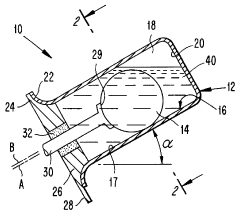
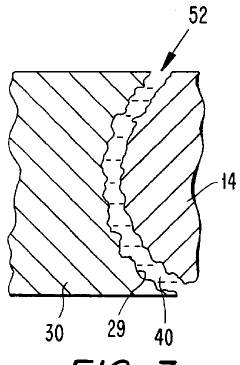
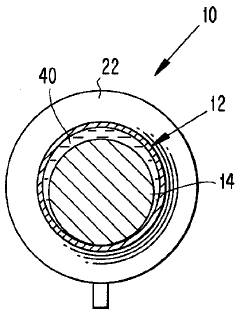
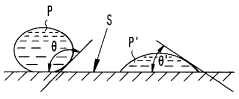
- Incorporating a dielectric liquid with low dipole moment into the switch chamber that is wettable to the electrode surfaces, utilizing surface tension to draw the electrodes close enough for enhanced current flow through quantum tunneling, regardless of surface smoothness or oxide film presence.
Materials Science Advancements for Quantum Devices
Recent advancements in materials science have significantly accelerated the development of quantum devices, particularly those leveraging quantum tunneling phenomena for light modulation. The intersection of quantum mechanics and materials engineering has opened new frontiers in creating devices with unprecedented control over photonic properties. Traditional semiconductor materials are increasingly being supplemented or replaced by novel two-dimensional materials, quantum dots, and engineered metamaterials that exhibit enhanced quantum tunneling characteristics.
Graphene and other 2D materials have emerged as particularly promising candidates for next-generation quantum devices due to their unique electronic properties and atomically thin profiles. These materials demonstrate exceptional tunneling behaviors that can be precisely manipulated through external stimuli such as electric fields, mechanical strain, or optical excitation. The ability to tune these properties with high precision enables the development of light-modulating devices with superior performance metrics, including faster switching speeds and lower power consumption.
Heterostructures composed of carefully selected material combinations represent another significant advancement. By creating layered structures with precisely engineered band alignments, researchers have demonstrated the ability to control quantum tunneling pathways with unprecedented precision. These structures often incorporate transition metal dichalcogenides (TMDs), hexagonal boron nitride (h-BN), and other novel materials that, when combined, create unique quantum confinement effects that can be harnessed for light modulation.
Doping strategies and defect engineering have evolved substantially, allowing for atomic-level control over material properties. Strategic introduction of dopants or defects can create localized states that significantly alter tunneling probabilities, enabling more efficient light modulation. Advanced techniques such as ion implantation, plasma treatment, and atomic layer deposition now permit precise spatial control over these modifications, facilitating the development of devices with spatially varying response characteristics.
Topological materials represent one of the most exciting frontiers in quantum device development. These materials possess protected surface states that are immune to certain types of scattering, potentially enabling more robust light-modulating devices. The unique band structures of topological insulators and Weyl semimetals offer new mechanisms for controlling quantum tunneling that are less susceptible to environmental perturbations, potentially addressing key challenges in device stability and reliability.
Computational materials discovery has accelerated the identification of promising candidates for quantum devices. Machine learning algorithms, coupled with density functional theory calculations, now enable rapid screening of thousands of potential materials and structures, identifying those with optimal tunneling characteristics for specific applications. This computational approach has significantly reduced development timelines and expanded the range of materials being considered for practical implementation in light-modulating technologies.
Graphene and other 2D materials have emerged as particularly promising candidates for next-generation quantum devices due to their unique electronic properties and atomically thin profiles. These materials demonstrate exceptional tunneling behaviors that can be precisely manipulated through external stimuli such as electric fields, mechanical strain, or optical excitation. The ability to tune these properties with high precision enables the development of light-modulating devices with superior performance metrics, including faster switching speeds and lower power consumption.
Heterostructures composed of carefully selected material combinations represent another significant advancement. By creating layered structures with precisely engineered band alignments, researchers have demonstrated the ability to control quantum tunneling pathways with unprecedented precision. These structures often incorporate transition metal dichalcogenides (TMDs), hexagonal boron nitride (h-BN), and other novel materials that, when combined, create unique quantum confinement effects that can be harnessed for light modulation.
Doping strategies and defect engineering have evolved substantially, allowing for atomic-level control over material properties. Strategic introduction of dopants or defects can create localized states that significantly alter tunneling probabilities, enabling more efficient light modulation. Advanced techniques such as ion implantation, plasma treatment, and atomic layer deposition now permit precise spatial control over these modifications, facilitating the development of devices with spatially varying response characteristics.
Topological materials represent one of the most exciting frontiers in quantum device development. These materials possess protected surface states that are immune to certain types of scattering, potentially enabling more robust light-modulating devices. The unique band structures of topological insulators and Weyl semimetals offer new mechanisms for controlling quantum tunneling that are less susceptible to environmental perturbations, potentially addressing key challenges in device stability and reliability.
Computational materials discovery has accelerated the identification of promising candidates for quantum devices. Machine learning algorithms, coupled with density functional theory calculations, now enable rapid screening of thousands of potential materials and structures, identifying those with optimal tunneling characteristics for specific applications. This computational approach has significantly reduced development timelines and expanded the range of materials being considered for practical implementation in light-modulating technologies.
Quantum Computing Integration Possibilities
The integration of quantum tunneling manipulation techniques with quantum computing systems represents a frontier with extraordinary potential. Quantum computers leverage quantum mechanical phenomena to perform calculations beyond classical computing capabilities, and the ability to precisely control quantum tunneling in light-modulating devices could create powerful synergies. These integration possibilities span both hardware and algorithmic domains, potentially revolutionizing quantum information processing.
Quantum tunneling properties in light-modulating devices could serve as novel qubit implementations with unique advantages. The controlled tunneling barriers might function as quantum gates with exceptional coherence times and reduced susceptibility to environmental decoherence. This approach could address one of quantum computing's fundamental challenges: maintaining quantum states long enough to complete complex calculations.
The bidirectional relationship between these technologies offers mutual benefits. Quantum computers could model and simulate optimal tunneling configurations for light-modulating devices, while tunneling-based optical switches could serve as ultra-fast interconnects between quantum processing units. This symbiotic relationship could accelerate development in both fields simultaneously.
Several practical integration pathways are emerging. Hybrid quantum systems incorporating both tunneling-based optical components and traditional superconducting qubits could leverage the strengths of each approach. The optical components' ability to operate at higher temperatures than many quantum computing elements might simplify cryogenic requirements for certain system components.
From an information processing perspective, quantum tunneling manipulation enables precise control over photonic qubits, potentially creating more robust quantum communication channels. These channels could form the backbone of quantum networks connecting distributed quantum computing resources, addressing scalability limitations of monolithic quantum processors.
The timeline for practical integration appears promising but measured. Near-term applications may include quantum sensing systems that leverage tunneling phenomena for unprecedented measurement precision. Mid-term developments could see hybrid quantum memory systems utilizing tunneling-based optical storage elements. Long-term possibilities include fully integrated photonic quantum computing architectures where tunneling manipulation forms the foundation of quantum gate operations.
Industry partnerships between quantum computing companies and photonics specialists are already forming to explore these integration possibilities, recognizing the potential competitive advantages of being first to market with hybrid solutions that overcome current quantum computing limitations.
Quantum tunneling properties in light-modulating devices could serve as novel qubit implementations with unique advantages. The controlled tunneling barriers might function as quantum gates with exceptional coherence times and reduced susceptibility to environmental decoherence. This approach could address one of quantum computing's fundamental challenges: maintaining quantum states long enough to complete complex calculations.
The bidirectional relationship between these technologies offers mutual benefits. Quantum computers could model and simulate optimal tunneling configurations for light-modulating devices, while tunneling-based optical switches could serve as ultra-fast interconnects between quantum processing units. This symbiotic relationship could accelerate development in both fields simultaneously.
Several practical integration pathways are emerging. Hybrid quantum systems incorporating both tunneling-based optical components and traditional superconducting qubits could leverage the strengths of each approach. The optical components' ability to operate at higher temperatures than many quantum computing elements might simplify cryogenic requirements for certain system components.
From an information processing perspective, quantum tunneling manipulation enables precise control over photonic qubits, potentially creating more robust quantum communication channels. These channels could form the backbone of quantum networks connecting distributed quantum computing resources, addressing scalability limitations of monolithic quantum processors.
The timeline for practical integration appears promising but measured. Near-term applications may include quantum sensing systems that leverage tunneling phenomena for unprecedented measurement precision. Mid-term developments could see hybrid quantum memory systems utilizing tunneling-based optical storage elements. Long-term possibilities include fully integrated photonic quantum computing architectures where tunneling manipulation forms the foundation of quantum gate operations.
Industry partnerships between quantum computing companies and photonics specialists are already forming to explore these integration possibilities, recognizing the potential competitive advantages of being first to market with hybrid solutions that overcome current quantum computing limitations.
Unlock deeper insights with PatSnap Eureka Quick Research — get a full tech report to explore trends and direct your research. Try now!
Generate Your Research Report Instantly with AI Agent
Supercharge your innovation with PatSnap Eureka AI Agent Platform!