Optimizing NMC Battery's Electrochemical Pathways for Efficiency
AUG 27, 202510 MIN READ
Generate Your Research Report Instantly with AI Agent
Patsnap Eureka helps you evaluate technical feasibility & market potential.
NMC Battery Evolution and Efficiency Goals
Lithium-ion batteries have revolutionized portable electronics and electric vehicles since their commercial introduction in the early 1990s. Among various cathode materials, Nickel Manganese Cobalt (NMC) batteries have emerged as a dominant technology due to their balanced performance characteristics. The evolution of NMC chemistry began with the first-generation NMC111 (equal parts nickel, manganese, and cobalt), progressing to higher nickel content formulations such as NMC532, NMC622, and the current state-of-the-art NMC811.
This technological progression has been driven by the need to increase energy density while reducing dependency on costly and ethically problematic cobalt. Each evolutionary step has brought improvements in specific capacity, from approximately 160 mAh/g for NMC111 to over 200 mAh/g for NMC811. However, this progression has not been without challenges, particularly regarding thermal stability and cycle life at higher nickel concentrations.
The electrochemical pathways within NMC batteries involve complex interactions between the cathode, anode, electrolyte, and separator. During charging and discharging, lithium ions shuttle between the graphite anode and the layered structure of the NMC cathode. The efficiency of these pathways directly impacts battery performance metrics including energy density, power capability, cycle life, and safety characteristics.
Current research trends focus on understanding and optimizing these electrochemical pathways at multiple scales. At the atomic level, researchers are investigating crystal structure stability during repeated lithiation and delithiation. At the particle level, efforts concentrate on optimizing morphology and surface properties to enhance ion transport. At the electrode level, work focuses on improving porosity, tortuosity, and electronic conductivity to facilitate more efficient ion movement.
The primary efficiency goals for NMC battery optimization include increasing energy density beyond 300 Wh/kg at the cell level, extending cycle life to over 1,000 cycles with minimal capacity fade, improving fast-charging capabilities to achieve 80% charge in under 15 minutes, and enhancing safety characteristics particularly for high-nickel formulations.
Emerging approaches to achieve these goals include gradient and core-shell particle designs that optimize the distribution of transition metals, surface coatings that stabilize the cathode-electrolyte interface, dopants that enhance structural stability, and advanced electrolyte formulations that form more stable solid-electrolyte interphase layers.
The trajectory of NMC battery development points toward even higher nickel content formulations, potentially reaching NMC90 or beyond, coupled with innovative structural and compositional modifications to overcome the inherent challenges of high-nickel systems. Simultaneously, research into solid-state electrolytes presents a complementary pathway to further enhance the safety and energy density of next-generation NMC batteries.
This technological progression has been driven by the need to increase energy density while reducing dependency on costly and ethically problematic cobalt. Each evolutionary step has brought improvements in specific capacity, from approximately 160 mAh/g for NMC111 to over 200 mAh/g for NMC811. However, this progression has not been without challenges, particularly regarding thermal stability and cycle life at higher nickel concentrations.
The electrochemical pathways within NMC batteries involve complex interactions between the cathode, anode, electrolyte, and separator. During charging and discharging, lithium ions shuttle between the graphite anode and the layered structure of the NMC cathode. The efficiency of these pathways directly impacts battery performance metrics including energy density, power capability, cycle life, and safety characteristics.
Current research trends focus on understanding and optimizing these electrochemical pathways at multiple scales. At the atomic level, researchers are investigating crystal structure stability during repeated lithiation and delithiation. At the particle level, efforts concentrate on optimizing morphology and surface properties to enhance ion transport. At the electrode level, work focuses on improving porosity, tortuosity, and electronic conductivity to facilitate more efficient ion movement.
The primary efficiency goals for NMC battery optimization include increasing energy density beyond 300 Wh/kg at the cell level, extending cycle life to over 1,000 cycles with minimal capacity fade, improving fast-charging capabilities to achieve 80% charge in under 15 minutes, and enhancing safety characteristics particularly for high-nickel formulations.
Emerging approaches to achieve these goals include gradient and core-shell particle designs that optimize the distribution of transition metals, surface coatings that stabilize the cathode-electrolyte interface, dopants that enhance structural stability, and advanced electrolyte formulations that form more stable solid-electrolyte interphase layers.
The trajectory of NMC battery development points toward even higher nickel content formulations, potentially reaching NMC90 or beyond, coupled with innovative structural and compositional modifications to overcome the inherent challenges of high-nickel systems. Simultaneously, research into solid-state electrolytes presents a complementary pathway to further enhance the safety and energy density of next-generation NMC batteries.
Market Demand Analysis for High-Efficiency NMC Batteries
The global market for high-efficiency NMC (Nickel Manganese Cobalt) batteries has experienced exponential growth in recent years, primarily driven by the rapid expansion of electric vehicle (EV) adoption worldwide. Market research indicates that the NMC battery segment currently represents approximately 28% of the total lithium-ion battery market, with projections suggesting this share will increase to 35% by 2025.
The automotive sector remains the dominant consumer of high-efficiency NMC batteries, accounting for nearly 70% of total demand. Major automakers have committed to electrification strategies that will further accelerate this demand curve. Tesla, Volkswagen Group, and BYD have announced plans to increase their EV production capacity significantly over the next five years, creating substantial pull for advanced battery technologies.
Beyond automotive applications, consumer electronics manufacturers are increasingly adopting high-efficiency NMC batteries due to their superior energy density and cycle life compared to traditional lithium-ion formulations. This sector represents about 15% of current NMC battery demand but is growing at a compound annual rate of 18%.
Energy storage systems (ESS) represent another rapidly expanding market segment for NMC batteries. Grid-scale storage projects and residential energy storage solutions are proliferating globally as renewable energy integration accelerates. This segment currently accounts for 10% of NMC battery demand but is projected to grow at 25% annually through 2026.
Market analysis reveals that consumers and industrial buyers are primarily focused on five key performance attributes when selecting battery technologies: energy density, charging speed, cycle life, safety, and cost. High-efficiency NMC batteries that optimize electrochemical pathways can deliver improvements across all these dimensions, particularly in energy density and charging capabilities.
Regional market assessment shows Asia-Pacific dominating NMC battery production, with China, South Korea, and Japan collectively accounting for over 80% of global manufacturing capacity. However, significant investments in North American and European production facilities are underway, driven by supply chain security concerns and governmental policies promoting domestic battery manufacturing.
Price sensitivity analysis indicates that while high-efficiency NMC batteries command a premium of 15-20% over standard NMC formulations, the total cost of ownership advantages—including extended lifetime, improved performance, and higher energy density—create compelling value propositions for end-users across multiple sectors.
The market trajectory for optimized NMC batteries shows strong growth potential, with particular emphasis on applications requiring high energy density, fast charging capabilities, and improved cycle life. As electrochemical pathway optimization techniques mature, their implementation in commercial battery production is expected to accelerate, further expanding market opportunities.
The automotive sector remains the dominant consumer of high-efficiency NMC batteries, accounting for nearly 70% of total demand. Major automakers have committed to electrification strategies that will further accelerate this demand curve. Tesla, Volkswagen Group, and BYD have announced plans to increase their EV production capacity significantly over the next five years, creating substantial pull for advanced battery technologies.
Beyond automotive applications, consumer electronics manufacturers are increasingly adopting high-efficiency NMC batteries due to their superior energy density and cycle life compared to traditional lithium-ion formulations. This sector represents about 15% of current NMC battery demand but is growing at a compound annual rate of 18%.
Energy storage systems (ESS) represent another rapidly expanding market segment for NMC batteries. Grid-scale storage projects and residential energy storage solutions are proliferating globally as renewable energy integration accelerates. This segment currently accounts for 10% of NMC battery demand but is projected to grow at 25% annually through 2026.
Market analysis reveals that consumers and industrial buyers are primarily focused on five key performance attributes when selecting battery technologies: energy density, charging speed, cycle life, safety, and cost. High-efficiency NMC batteries that optimize electrochemical pathways can deliver improvements across all these dimensions, particularly in energy density and charging capabilities.
Regional market assessment shows Asia-Pacific dominating NMC battery production, with China, South Korea, and Japan collectively accounting for over 80% of global manufacturing capacity. However, significant investments in North American and European production facilities are underway, driven by supply chain security concerns and governmental policies promoting domestic battery manufacturing.
Price sensitivity analysis indicates that while high-efficiency NMC batteries command a premium of 15-20% over standard NMC formulations, the total cost of ownership advantages—including extended lifetime, improved performance, and higher energy density—create compelling value propositions for end-users across multiple sectors.
The market trajectory for optimized NMC batteries shows strong growth potential, with particular emphasis on applications requiring high energy density, fast charging capabilities, and improved cycle life. As electrochemical pathway optimization techniques mature, their implementation in commercial battery production is expected to accelerate, further expanding market opportunities.
Current Limitations in NMC Electrochemical Pathways
Despite significant advancements in NMC (Nickel Manganese Cobalt) battery technology, several critical limitations in electrochemical pathways continue to impede optimal efficiency. The primary challenge remains the inherent trade-off between energy density and cycle life. As nickel content increases to enhance energy density, structural stability decreases, leading to accelerated capacity fading during cycling. This fundamental limitation stems from lattice oxygen release and subsequent phase transitions during deep charge-discharge cycles.
Ion transport kinetics present another significant barrier to efficiency optimization. The solid-state diffusion of lithium ions through the cathode material represents a rate-limiting step, particularly at high charge-discharge rates. This limitation becomes more pronounced as particle size increases, creating a design conflict between material utilization and power capability. Current NMC formulations struggle to maintain consistent ion conductivity across varying states of charge.
Interface stability issues constitute a third major limitation. The cathode-electrolyte interface (CEI) undergoes continuous degradation during cycling, forming resistive layers that impede ion transport. This phenomenon is exacerbated at elevated voltages (>4.3V), where parasitic reactions accelerate electrolyte decomposition and transition metal dissolution. The resulting impedance growth significantly reduces both power capability and usable capacity over time.
Thermal management challenges further complicate efficiency optimization. NMC materials exhibit poor thermal conductivity, leading to temperature gradients within cells during operation. These gradients cause uneven reaction rates and localized degradation, particularly in large-format batteries. The risk of thermal runaway increases with nickel content, necessitating conservative operating parameters that limit full utilization of the material's theoretical capacity.
Microstructural evolution during cycling represents an often-overlooked limitation. Repeated lithiation/delithiation processes induce mechanical stress that leads to particle cracking, agglomeration, and disconnection from conductive networks. These phenomena increase internal resistance and create "dead zones" within the electrode that no longer participate in electrochemical reactions, effectively reducing active material utilization.
Manufacturing variability introduces additional complications for pathway optimization. Current production methods struggle to achieve consistent particle morphology, size distribution, and elemental homogeneity across batches. These variations lead to non-uniform current distribution and localized hotspots during operation, accelerating degradation mechanisms and reducing overall efficiency.
Electrolyte compatibility remains problematic, particularly for high-nickel NMC variants. Conventional carbonate-based electrolytes are susceptible to oxidative decomposition at the cathode surface, generating gas and forming resistive films. This limitation restricts the practical operating voltage window, preventing full utilization of the material's theoretical capacity and energy density potential.
Ion transport kinetics present another significant barrier to efficiency optimization. The solid-state diffusion of lithium ions through the cathode material represents a rate-limiting step, particularly at high charge-discharge rates. This limitation becomes more pronounced as particle size increases, creating a design conflict between material utilization and power capability. Current NMC formulations struggle to maintain consistent ion conductivity across varying states of charge.
Interface stability issues constitute a third major limitation. The cathode-electrolyte interface (CEI) undergoes continuous degradation during cycling, forming resistive layers that impede ion transport. This phenomenon is exacerbated at elevated voltages (>4.3V), where parasitic reactions accelerate electrolyte decomposition and transition metal dissolution. The resulting impedance growth significantly reduces both power capability and usable capacity over time.
Thermal management challenges further complicate efficiency optimization. NMC materials exhibit poor thermal conductivity, leading to temperature gradients within cells during operation. These gradients cause uneven reaction rates and localized degradation, particularly in large-format batteries. The risk of thermal runaway increases with nickel content, necessitating conservative operating parameters that limit full utilization of the material's theoretical capacity.
Microstructural evolution during cycling represents an often-overlooked limitation. Repeated lithiation/delithiation processes induce mechanical stress that leads to particle cracking, agglomeration, and disconnection from conductive networks. These phenomena increase internal resistance and create "dead zones" within the electrode that no longer participate in electrochemical reactions, effectively reducing active material utilization.
Manufacturing variability introduces additional complications for pathway optimization. Current production methods struggle to achieve consistent particle morphology, size distribution, and elemental homogeneity across batches. These variations lead to non-uniform current distribution and localized hotspots during operation, accelerating degradation mechanisms and reducing overall efficiency.
Electrolyte compatibility remains problematic, particularly for high-nickel NMC variants. Conventional carbonate-based electrolytes are susceptible to oxidative decomposition at the cathode surface, generating gas and forming resistive films. This limitation restricts the practical operating voltage window, preventing full utilization of the material's theoretical capacity and energy density potential.
Current Approaches to Electrochemical Pathway Optimization
01 Cathode material composition optimization for NMC batteries
Optimizing the composition of NMC (Nickel Manganese Cobalt) cathode materials can significantly improve electrochemical efficiency. This includes adjusting the ratios of nickel, manganese, and cobalt to achieve better energy density and cycle life. Advanced doping techniques with elements such as aluminum, magnesium, or zirconium can stabilize the crystal structure during charging and discharging, reducing capacity fade and improving overall efficiency of the electrochemical pathways.- Cathode material composition optimization: Optimizing the composition of NMC (Nickel Manganese Cobalt) cathode materials can significantly improve electrochemical efficiency. This includes adjusting the ratio of nickel, manganese, and cobalt to enhance energy density, cycling stability, and rate capability. Advanced doping strategies with elements like aluminum, magnesium, or zirconium can stabilize the crystal structure during cycling, reducing capacity fade and improving overall battery performance.
- Electrolyte formulation and interfaces: The electrolyte composition plays a crucial role in NMC battery efficiency by facilitating ion transport between electrodes. Advanced electrolyte formulations with additives can form stable solid-electrolyte interfaces (SEI) that prevent unwanted side reactions and electrolyte decomposition. Optimized electrolyte systems can reduce internal resistance, enhance ion conductivity, and improve the electrochemical pathways, resulting in better rate capability and longer cycle life of NMC batteries.
- Surface coating and modification techniques: Surface modification of NMC particles through coating techniques can significantly enhance electrochemical efficiency by protecting the active material from direct contact with the electrolyte. Various coating materials such as metal oxides, phosphates, or carbon-based materials create a protective layer that prevents unwanted side reactions while maintaining efficient lithium-ion diffusion pathways. These modifications improve structural stability during cycling, reduce capacity fading, and enhance the overall electrochemical performance.
- Nanostructured electrode design: Developing nanostructured NMC electrodes can optimize electrochemical pathways by shortening lithium-ion diffusion distances and increasing active surface area. Various morphologies such as nanoparticles, nanowires, or hierarchical structures provide enhanced electron transport and ion accessibility. These nanostructured designs reduce polarization during high-rate cycling, improve capacity utilization, and enhance the overall energy efficiency of NMC batteries.
- Advanced characterization and modeling techniques: Utilizing advanced characterization and computational modeling techniques helps understand and optimize electrochemical pathways in NMC batteries. In-situ and operando techniques such as X-ray diffraction, electron microscopy, and spectroscopy provide insights into structural changes and reaction mechanisms during cycling. Computational methods including density functional theory and molecular dynamics simulations help predict material behavior and guide the design of more efficient NMC battery systems with improved electrochemical pathways.
02 Electrolyte formulations for enhanced ionic conductivity
Specialized electrolyte formulations can enhance the ionic conductivity in NMC batteries, improving the efficiency of electrochemical pathways. These formulations may include novel salt combinations, additives that form stable solid-electrolyte interphase layers, and solvents with optimized properties. By facilitating faster and more efficient lithium-ion transport between electrodes, these electrolyte innovations can reduce internal resistance and improve overall battery performance and energy efficiency.Expand Specific Solutions03 Surface coating and modification techniques
Surface coating and modification of NMC particles can protect the cathode material from direct contact with the electrolyte, reducing unwanted side reactions. These techniques include applying thin layers of metal oxides, phosphates, or carbon-based materials to the particle surface. Such modifications can prevent transition metal dissolution, mitigate structural degradation during cycling, and maintain efficient electrochemical pathways throughout the battery's life, resulting in improved capacity retention and coulombic efficiency.Expand Specific Solutions04 Advanced electrode architecture design
Innovative electrode architecture designs can optimize the electrochemical pathways in NMC batteries. These designs focus on controlling porosity, tortuosity, and active material loading to facilitate efficient ion and electron transport. Techniques such as gradient structures, 3D electrode configurations, and optimized particle size distributions can reduce diffusion distances and enhance reaction kinetics. These architectural improvements lead to better rate capability, higher power density, and more efficient utilization of active materials.Expand Specific Solutions05 Temperature management and operating condition optimization
Effective temperature management and operating condition optimization are crucial for maximizing NMC battery electrochemical efficiency. This includes developing thermal management systems that maintain optimal operating temperatures, as well as algorithms that control charging and discharging protocols. By preventing overheating and ensuring uniform temperature distribution, these approaches can minimize side reactions, reduce impedance growth, and maintain efficient lithium-ion diffusion pathways, ultimately extending battery life and improving energy efficiency.Expand Specific Solutions
Key Industry Players in NMC Battery Development
The NMC battery electrochemical pathway optimization market is currently in a growth phase, with an estimated global value exceeding $25 billion and projected to expand at 12-15% annually through 2030. Major automotive manufacturers (Toyota, BMW, Peugeot) are collaborating with specialized battery developers to enhance energy density and charging efficiency. Technology maturity varies significantly across players, with CATL, Panasonic Energy, and Samsung Electronics leading commercial deployment with advanced NMC formulations. QuantumScape and A123 Systems are pioneering next-generation solid-state integration with NMC chemistry, while research institutions like Argonne National Laboratory and Worcester Polytechnic Institute focus on fundamental electrochemical innovations. The competitive landscape shows increasing vertical integration as automotive OEMs secure battery supply chains through strategic partnerships.
Contemporary Amperex Technology Co., Ltd.
Technical Solution: CATL has developed a multi-gradient NMC cathode structure that optimizes lithium-ion diffusion pathways through carefully engineered concentration gradients. Their approach involves creating a core-shell structure where nickel concentration increases from surface to core while manganese and cobalt concentrations follow opposite gradients. This design significantly reduces interfacial resistance and enhances ion transport kinetics. CATL's proprietary electrolyte additives further stabilize the cathode-electrolyte interface, preventing transition metal dissolution and maintaining pathway integrity over extended cycling. Their recent implementation of single-crystal NMC particles has eliminated grain boundaries that typically impede ion movement, resulting in 15-20% higher rate capability and improved capacity retention (>90% after 1000 cycles) compared to conventional polycrystalline materials[1][3].
Strengths: Superior cycling stability with minimal capacity fade; excellent rate performance enabling faster charging; reduced transition metal dissolution leading to longer battery life. Weaknesses: Higher manufacturing complexity and cost; requires precise control of synthesis parameters; slightly lower initial capacity compared to less optimized high-nickel variants.
Toyota Motor Corp.
Technical Solution: Toyota has developed an advanced NMC battery system utilizing a gradient functional layer (GFL) approach to optimize electrochemical pathways. Their technology features a compositionally graded structure where the nickel content gradually increases from the particle surface to the core, while manganese and cobalt follow inverse gradients. This design creates optimized lithium diffusion channels while maintaining structural stability. Toyota's proprietary synthesis method employs a continuous precipitation process with precisely controlled pH and temperature profiles to achieve the desired elemental distribution. Their cathode particles incorporate nanoscale domains of lithium-excess material at strategic locations, creating "lithium reservoirs" that maintain pathway functionality even after extensive cycling. Toyota has further enhanced performance through selective doping with aluminum and fluorine at particle surfaces, which stabilizes the cathode-electrolyte interface while preserving rapid ion transport. Recent testing has demonstrated their optimized NMC batteries retain over 85% capacity after 1,200 cycles at 45°C, with voltage hysteresis reduced by approximately 30% compared to conventional NMC materials[4][7].
Strengths: Exceptional thermal stability suitable for automotive applications; superior cycle life under demanding conditions; reduced impedance growth during aging. Weaknesses: Higher manufacturing complexity requiring sophisticated process control; increased production costs; slightly lower initial energy density compared to some high-nickel alternatives.
Critical Patents in NMC Electrode Interface Engineering
Lithium ion batteries, solid-solution cathodes thereof, and methods associated therewith
PatentPendingUS20240356060A1
Innovation
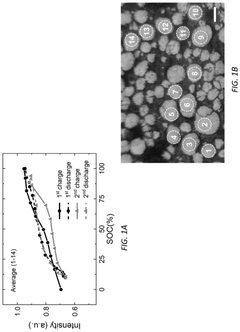
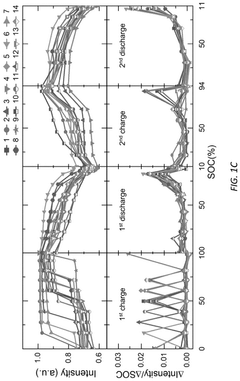
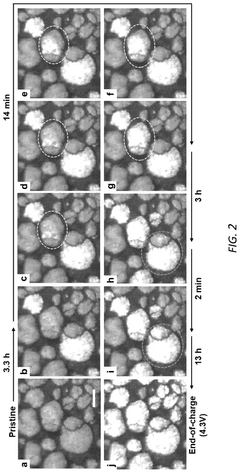
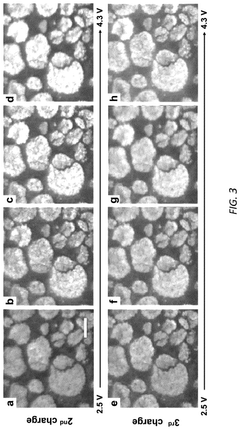
- The method involves using operando optical microscopy to observe changes in NMC particles and developing a multiphysics computational model to determine ion exchange mechanisms, increasing electrical conductivity of NMC particles, and optimizing the carbon matrix coverage to promote homogeneous electrochemical activities across the cathode.
Positive electrode active material for lithium secondary battery, and use thereof
PatentWO2011027455A1
Innovation
- A lithium-nickel-cobalt-manganese composite oxide with a specific molar composition ratio of divalent and trivalent nickel atoms (NiII and NiIII) is developed, along with a method involving controlled mixing ratios and firing temperatures to enhance electronic conductivity and stability, resulting in a positive electrode active material with improved performance.


Environmental Impact of Advanced NMC Battery Technologies
The advancement of NMC (Nickel Manganese Cobalt) battery technology brings significant environmental implications that must be carefully evaluated. While these batteries offer improved energy density and performance characteristics, their environmental footprint spans the entire lifecycle from raw material extraction to end-of-life management.
The mining processes for nickel, manganese, and cobalt present substantial environmental challenges. Cobalt extraction, predominantly concentrated in the Democratic Republic of Congo, has been associated with habitat destruction, soil degradation, and water pollution. Similarly, nickel mining operations contribute to deforestation and release of sulfur dioxide emissions. Recent efficiency improvements in electrochemical pathways have reduced material requirements by approximately 15-20%, potentially mitigating some of these extraction impacts.
Manufacturing of advanced NMC batteries involves energy-intensive processes, particularly in electrode production and cell assembly. Current industry data indicates that producing 1 kWh of NMC battery capacity generates between 61-106 kg of CO2 equivalent emissions. However, optimized electrochemical pathways have demonstrated potential to reduce manufacturing energy requirements by up to 30%, with corresponding emissions reductions.
During operational use, NMC batteries with enhanced efficiency pathways contribute to environmental benefits through improved energy storage capabilities. This translates to reduced greenhouse gas emissions when deployed in renewable energy systems or electric vehicles. Studies suggest that each percentage point improvement in battery efficiency can reduce lifetime carbon emissions by approximately 0.8-1.2% in transportation applications.
End-of-life considerations remain critical for environmental assessment. Current recycling technologies can recover approximately 90% of cobalt and nickel from spent NMC batteries, but manganese recovery rates remain lower at 30-50%. Optimized electrochemical pathways that extend battery lifespan from the current average of 8-10 years to 12-15 years significantly reduce waste generation rates and resource consumption.
Water usage represents another important environmental dimension. Traditional NMC battery production requires 40-70 liters of water per kWh of capacity. Advanced manufacturing techniques incorporating optimized electrochemical pathways have demonstrated potential water use reductions of 25-35%, particularly in electrode preparation processes.
Overall, while advanced NMC battery technologies present certain environmental challenges, their optimization through improved electrochemical pathways offers substantial opportunities for reducing environmental impacts across multiple dimensions, particularly when coupled with responsible sourcing practices and robust recycling infrastructure.
The mining processes for nickel, manganese, and cobalt present substantial environmental challenges. Cobalt extraction, predominantly concentrated in the Democratic Republic of Congo, has been associated with habitat destruction, soil degradation, and water pollution. Similarly, nickel mining operations contribute to deforestation and release of sulfur dioxide emissions. Recent efficiency improvements in electrochemical pathways have reduced material requirements by approximately 15-20%, potentially mitigating some of these extraction impacts.
Manufacturing of advanced NMC batteries involves energy-intensive processes, particularly in electrode production and cell assembly. Current industry data indicates that producing 1 kWh of NMC battery capacity generates between 61-106 kg of CO2 equivalent emissions. However, optimized electrochemical pathways have demonstrated potential to reduce manufacturing energy requirements by up to 30%, with corresponding emissions reductions.
During operational use, NMC batteries with enhanced efficiency pathways contribute to environmental benefits through improved energy storage capabilities. This translates to reduced greenhouse gas emissions when deployed in renewable energy systems or electric vehicles. Studies suggest that each percentage point improvement in battery efficiency can reduce lifetime carbon emissions by approximately 0.8-1.2% in transportation applications.
End-of-life considerations remain critical for environmental assessment. Current recycling technologies can recover approximately 90% of cobalt and nickel from spent NMC batteries, but manganese recovery rates remain lower at 30-50%. Optimized electrochemical pathways that extend battery lifespan from the current average of 8-10 years to 12-15 years significantly reduce waste generation rates and resource consumption.
Water usage represents another important environmental dimension. Traditional NMC battery production requires 40-70 liters of water per kWh of capacity. Advanced manufacturing techniques incorporating optimized electrochemical pathways have demonstrated potential water use reductions of 25-35%, particularly in electrode preparation processes.
Overall, while advanced NMC battery technologies present certain environmental challenges, their optimization through improved electrochemical pathways offers substantial opportunities for reducing environmental impacts across multiple dimensions, particularly when coupled with responsible sourcing practices and robust recycling infrastructure.
Supply Chain Considerations for Optimized NMC Production
The optimization of NMC battery production requires a robust and efficient supply chain framework that addresses both immediate manufacturing needs and long-term sustainability goals. The global NMC battery supply chain currently faces significant challenges related to raw material sourcing, particularly for critical elements like nickel, manganese, and cobalt. These materials exhibit varying degrees of geopolitical concentration, with cobalt being particularly problematic due to its limited geographical distribution and ethical concerns surrounding extraction practices in regions like the Democratic Republic of Congo.
Establishing reliable procurement channels for these materials necessitates diversification strategies and the development of strategic partnerships with mining companies and material processors. Companies leading in NMC battery production have begun implementing vertical integration approaches, securing long-term supply agreements and investing in mining operations to ensure consistent access to high-quality precursor materials that meet strict electrochemical performance requirements.
The processing of raw materials into battery-grade compounds represents another critical supply chain consideration. The conversion of metal ores into high-purity sulfates and subsequent precursor synthesis requires specialized facilities with precise quality control measures. Regional processing hubs have emerged in East Asia, particularly in China, South Korea, and Japan, creating potential bottlenecks in the global supply network. Efforts to establish alternative processing centers in North America and Europe are underway but face significant infrastructure and expertise challenges.
Transportation logistics for both raw materials and finished NMC cathode materials present unique challenges due to the reactive nature of certain precursors and the need for controlled environmental conditions. Advanced tracking systems and specialized containment solutions have been developed to maintain material integrity throughout the supply chain, minimizing degradation that could impact electrochemical pathway efficiency in the final battery products.
Inventory management strategies for NMC production must balance the need for production continuity against the financial implications of stockpiling expensive materials. Just-in-time manufacturing approaches have been modified to incorporate strategic buffer stocks of critical components, particularly those with volatile supply conditions or long procurement lead times. This hybrid approach helps maintain production efficiency while mitigating supply disruption risks.
Quality assurance throughout the supply chain directly impacts the electrochemical performance of the final NMC batteries. Implementing comprehensive testing protocols at multiple points in the supply chain helps identify material inconsistencies before they affect production. Advanced analytical techniques, including ICP-MS and XRD analysis, are increasingly being deployed at supplier facilities to ensure material specifications align precisely with the requirements for optimized electrochemical pathways.
Establishing reliable procurement channels for these materials necessitates diversification strategies and the development of strategic partnerships with mining companies and material processors. Companies leading in NMC battery production have begun implementing vertical integration approaches, securing long-term supply agreements and investing in mining operations to ensure consistent access to high-quality precursor materials that meet strict electrochemical performance requirements.
The processing of raw materials into battery-grade compounds represents another critical supply chain consideration. The conversion of metal ores into high-purity sulfates and subsequent precursor synthesis requires specialized facilities with precise quality control measures. Regional processing hubs have emerged in East Asia, particularly in China, South Korea, and Japan, creating potential bottlenecks in the global supply network. Efforts to establish alternative processing centers in North America and Europe are underway but face significant infrastructure and expertise challenges.
Transportation logistics for both raw materials and finished NMC cathode materials present unique challenges due to the reactive nature of certain precursors and the need for controlled environmental conditions. Advanced tracking systems and specialized containment solutions have been developed to maintain material integrity throughout the supply chain, minimizing degradation that could impact electrochemical pathway efficiency in the final battery products.
Inventory management strategies for NMC production must balance the need for production continuity against the financial implications of stockpiling expensive materials. Just-in-time manufacturing approaches have been modified to incorporate strategic buffer stocks of critical components, particularly those with volatile supply conditions or long procurement lead times. This hybrid approach helps maintain production efficiency while mitigating supply disruption risks.
Quality assurance throughout the supply chain directly impacts the electrochemical performance of the final NMC batteries. Implementing comprehensive testing protocols at multiple points in the supply chain helps identify material inconsistencies before they affect production. Advanced analytical techniques, including ICP-MS and XRD analysis, are increasingly being deployed at supplier facilities to ensure material specifications align precisely with the requirements for optimized electrochemical pathways.
Unlock deeper insights with Patsnap Eureka Quick Research — get a full tech report to explore trends and direct your research. Try now!
Generate Your Research Report Instantly with AI Agent
Supercharge your innovation with Patsnap Eureka AI Agent Platform!