

Optimizing Optical Backplanes for Latency-Free Streaming Applications
MAY 20, 20269 MIN READ
Generate Your Research Report Instantly with AI Agent
PatSnap Eureka helps you evaluate technical feasibility & market potential.
Optical Backplane Technology Background and Streaming Goals
Optical backplane technology represents a fundamental shift from traditional electrical interconnects to photonic-based communication systems within computing and networking infrastructure. This technology emerged from the growing limitations of copper-based backplanes, which suffer from signal degradation, electromagnetic interference, and bandwidth constraints as data rates continue to escalate. The evolution began in the early 2000s when researchers recognized that optical interconnects could overcome the physical limitations imposed by electrical systems, particularly in high-performance computing environments where massive parallel processing demands ultra-high bandwidth and minimal latency.
The core principle underlying optical backplanes involves the transmission of data through light signals rather than electrical currents. This approach leverages optical waveguides, typically implemented through polymer or glass-based substrates, to create high-speed communication channels between processing units, memory modules, and network interfaces. The technology incorporates various optical components including vertical-cavity surface-emitting lasers (VCSELs), photodetectors, and optical switching elements integrated directly into the backplane architecture.
Streaming applications have fundamentally transformed the performance requirements for modern computing systems, demanding unprecedented levels of real-time data processing and transmission capabilities. These applications encompass a broad spectrum of use cases, from live video broadcasting and interactive gaming to financial trading systems and autonomous vehicle control networks. The critical characteristic shared across all streaming applications is their intolerance for latency, where even microsecond delays can result in degraded user experiences or system failures.
The convergence of optical backplane technology with streaming application requirements creates a compelling technical objective: achieving truly latency-free data transmission within computing systems. Traditional electrical backplanes introduce cumulative delays through signal propagation, processing overhead, and buffering mechanisms that become increasingly problematic as streaming data volumes grow. The goal extends beyond merely reducing latency to practically eliminating it, enabling real-time processing of continuous data streams without perceptible delays.
Modern streaming goals encompass not only latency elimination but also scalability, reliability, and energy efficiency. Systems must handle multiple concurrent high-definition video streams, process real-time analytics, and maintain consistent performance under varying load conditions. The integration of optical backplanes aims to address these multifaceted requirements by providing the necessary bandwidth density and signal integrity to support next-generation streaming infrastructures.
The core principle underlying optical backplanes involves the transmission of data through light signals rather than electrical currents. This approach leverages optical waveguides, typically implemented through polymer or glass-based substrates, to create high-speed communication channels between processing units, memory modules, and network interfaces. The technology incorporates various optical components including vertical-cavity surface-emitting lasers (VCSELs), photodetectors, and optical switching elements integrated directly into the backplane architecture.
Streaming applications have fundamentally transformed the performance requirements for modern computing systems, demanding unprecedented levels of real-time data processing and transmission capabilities. These applications encompass a broad spectrum of use cases, from live video broadcasting and interactive gaming to financial trading systems and autonomous vehicle control networks. The critical characteristic shared across all streaming applications is their intolerance for latency, where even microsecond delays can result in degraded user experiences or system failures.
The convergence of optical backplane technology with streaming application requirements creates a compelling technical objective: achieving truly latency-free data transmission within computing systems. Traditional electrical backplanes introduce cumulative delays through signal propagation, processing overhead, and buffering mechanisms that become increasingly problematic as streaming data volumes grow. The goal extends beyond merely reducing latency to practically eliminating it, enabling real-time processing of continuous data streams without perceptible delays.
Modern streaming goals encompass not only latency elimination but also scalability, reliability, and energy efficiency. Systems must handle multiple concurrent high-definition video streams, process real-time analytics, and maintain consistent performance under varying load conditions. The integration of optical backplanes aims to address these multifaceted requirements by providing the necessary bandwidth density and signal integrity to support next-generation streaming infrastructures.
Market Demand for Low-Latency Streaming Infrastructure
The global streaming industry has experienced unprecedented growth, fundamentally reshaping how content is consumed across entertainment, gaming, enterprise communications, and live broadcasting sectors. This transformation has created an urgent demand for infrastructure capable of supporting real-time, high-quality streaming experiences without perceptible delays.
Financial services represent a critical market segment where ultra-low latency streaming infrastructure is essential. High-frequency trading platforms require instantaneous data transmission to capitalize on microsecond-level market movements. Similarly, real-time risk management systems depend on immediate data processing and distribution to prevent significant financial losses during volatile market conditions.
The gaming industry has emerged as another major driver of low-latency streaming demand. Cloud gaming services, competitive esports tournaments, and interactive streaming platforms require infrastructure that can deliver seamless experiences comparable to local processing. The proliferation of virtual and augmented reality applications further intensifies these requirements, as any perceptible delay can cause motion sickness and user discomfort.
Enterprise video conferencing and collaboration tools have become mission-critical following the global shift toward remote work. Organizations demand streaming infrastructure that can support high-definition video calls, screen sharing, and real-time collaboration without interruptions or delays that could impact productivity and communication effectiveness.
Live broadcasting and content creation industries face increasing pressure to deliver professional-quality streams with minimal latency. Social media platforms, news organizations, and entertainment companies require infrastructure that can handle multiple simultaneous high-resolution streams while maintaining consistent quality and responsiveness.
The telecommunications sector is experiencing growing demand for edge computing capabilities that can process and route streaming data closer to end users. This requirement is particularly acute for 5G network deployments, where service providers must deliver on promises of ultra-low latency for applications ranging from autonomous vehicles to industrial automation.
Data centers and cloud service providers are investing heavily in infrastructure upgrades to meet these evolving requirements. The need for optical backplane solutions that can eliminate bottlenecks in data transmission has become a strategic priority for maintaining competitive advantage in the streaming services market.
Financial services represent a critical market segment where ultra-low latency streaming infrastructure is essential. High-frequency trading platforms require instantaneous data transmission to capitalize on microsecond-level market movements. Similarly, real-time risk management systems depend on immediate data processing and distribution to prevent significant financial losses during volatile market conditions.
The gaming industry has emerged as another major driver of low-latency streaming demand. Cloud gaming services, competitive esports tournaments, and interactive streaming platforms require infrastructure that can deliver seamless experiences comparable to local processing. The proliferation of virtual and augmented reality applications further intensifies these requirements, as any perceptible delay can cause motion sickness and user discomfort.
Enterprise video conferencing and collaboration tools have become mission-critical following the global shift toward remote work. Organizations demand streaming infrastructure that can support high-definition video calls, screen sharing, and real-time collaboration without interruptions or delays that could impact productivity and communication effectiveness.
Live broadcasting and content creation industries face increasing pressure to deliver professional-quality streams with minimal latency. Social media platforms, news organizations, and entertainment companies require infrastructure that can handle multiple simultaneous high-resolution streams while maintaining consistent quality and responsiveness.
The telecommunications sector is experiencing growing demand for edge computing capabilities that can process and route streaming data closer to end users. This requirement is particularly acute for 5G network deployments, where service providers must deliver on promises of ultra-low latency for applications ranging from autonomous vehicles to industrial automation.
Data centers and cloud service providers are investing heavily in infrastructure upgrades to meet these evolving requirements. The need for optical backplane solutions that can eliminate bottlenecks in data transmission has become a strategic priority for maintaining competitive advantage in the streaming services market.
Current State and Latency Challenges in Optical Backplanes
Optical backplanes represent a critical infrastructure component in modern high-performance computing and data center environments, serving as the primary interconnect medium for transmitting data between processing units, memory modules, and network interfaces. Current implementations predominantly utilize silicon photonics technology, incorporating wavelength division multiplexing (WDM) to achieve multi-channel data transmission over single optical fibers. These systems typically operate at data rates ranging from 25 Gbps to 400 Gbps per channel, with aggregate throughput capabilities reaching several terabits per second.
The existing optical backplane architectures face significant latency challenges that directly impact streaming application performance. Signal propagation delays constitute a fundamental limitation, with optical signals experiencing approximately 5 nanoseconds of delay per meter of fiber length. In typical rack-scale deployments spanning 2-3 meters, this translates to 10-15 nanoseconds of pure propagation delay before considering additional processing overhead.
Electro-optical conversion processes introduce substantial latency penalties in current systems. The serialization and deserialization operations required at optical transceivers typically add 20-50 nanoseconds of processing delay, depending on the modulation scheme and signal processing complexity. Advanced coherent detection systems, while offering superior reach and spectral efficiency, can introduce additional latency of 100-200 nanoseconds due to digital signal processing requirements.
Protocol stack overhead represents another significant latency contributor in contemporary optical backplane implementations. Traditional Ethernet-based protocols, even in their low-latency variants, impose minimum frame processing delays of 64-128 nanoseconds. The interaction between optical layer management, forward error correction, and higher-layer protocols creates cumulative latency effects that can exceed 500 nanoseconds in complex multi-hop scenarios.
Thermal management and power consumption constraints further exacerbate latency challenges in current optical backplane designs. Dynamic thermal throttling mechanisms, implemented to prevent component overheating, can introduce variable latency characteristics that are particularly problematic for real-time streaming applications requiring deterministic performance guarantees.
The geographic distribution of advanced optical backplane technology remains concentrated in North America, Europe, and East Asia, with leading implementations primarily deployed in hyperscale data centers and high-frequency trading environments where latency optimization justifies the substantial infrastructure investment required for cutting-edge optical interconnect solutions.
The existing optical backplane architectures face significant latency challenges that directly impact streaming application performance. Signal propagation delays constitute a fundamental limitation, with optical signals experiencing approximately 5 nanoseconds of delay per meter of fiber length. In typical rack-scale deployments spanning 2-3 meters, this translates to 10-15 nanoseconds of pure propagation delay before considering additional processing overhead.
Electro-optical conversion processes introduce substantial latency penalties in current systems. The serialization and deserialization operations required at optical transceivers typically add 20-50 nanoseconds of processing delay, depending on the modulation scheme and signal processing complexity. Advanced coherent detection systems, while offering superior reach and spectral efficiency, can introduce additional latency of 100-200 nanoseconds due to digital signal processing requirements.
Protocol stack overhead represents another significant latency contributor in contemporary optical backplane implementations. Traditional Ethernet-based protocols, even in their low-latency variants, impose minimum frame processing delays of 64-128 nanoseconds. The interaction between optical layer management, forward error correction, and higher-layer protocols creates cumulative latency effects that can exceed 500 nanoseconds in complex multi-hop scenarios.
Thermal management and power consumption constraints further exacerbate latency challenges in current optical backplane designs. Dynamic thermal throttling mechanisms, implemented to prevent component overheating, can introduce variable latency characteristics that are particularly problematic for real-time streaming applications requiring deterministic performance guarantees.
The geographic distribution of advanced optical backplane technology remains concentrated in North America, Europe, and East Asia, with leading implementations primarily deployed in hyperscale data centers and high-frequency trading environments where latency optimization justifies the substantial infrastructure investment required for cutting-edge optical interconnect solutions.
Existing Solutions for Latency Optimization in Optical Systems
01 Optical switching architectures for reduced latency
Advanced optical switching architectures are designed to minimize signal propagation delays in backplane systems. These architectures utilize direct optical paths and optimized routing mechanisms to reduce the number of intermediate processing steps, thereby achieving lower overall system latency. The implementations focus on streamlined data flow and efficient optical signal management.- Optical switching architectures for reduced latency: Advanced optical switching architectures are designed to minimize signal propagation delays in backplane systems. These architectures utilize direct optical paths and optimized routing algorithms to reduce the number of intermediate switching stages, thereby decreasing overall system latency. The implementations focus on creating more efficient data flow patterns and reducing bottlenecks in high-speed optical communication systems.
- High-speed optical interconnect technologies: Implementation of high-speed optical interconnect solutions that enable faster data transmission between components in backplane systems. These technologies incorporate advanced modulation techniques, wavelength division multiplexing, and parallel optical channels to achieve higher bandwidth while maintaining low latency characteristics. The focus is on optimizing the physical layer transmission properties to support demanding applications.
- Latency optimization through signal processing techniques: Advanced signal processing methods are employed to minimize processing delays in optical backplane systems. These techniques include predictive algorithms, buffer management strategies, and real-time signal conditioning that reduce computational overhead. The approaches focus on streamlining data processing pipelines and eliminating unnecessary processing steps that contribute to system latency.
- Parallel processing and multi-channel architectures: Implementation of parallel processing capabilities and multi-channel architectures to distribute data loads and reduce individual channel latency. These systems utilize multiple optical paths operating simultaneously to handle high-volume data transmission while maintaining low latency performance. The designs incorporate load balancing mechanisms and intelligent channel allocation strategies.
- Timing synchronization and clock distribution systems: Precise timing synchronization mechanisms and optimized clock distribution networks designed to minimize timing-related latency in optical backplane systems. These systems ensure accurate synchronization across multiple components and channels, reducing jitter and timing uncertainties that can contribute to overall system latency. The implementations focus on maintaining phase coherence and minimizing clock skew effects.
02 High-speed optical interconnect technologies
Implementation of high-speed optical interconnect solutions that enable faster data transmission rates across backplane connections. These technologies incorporate advanced modulation schemes and signal processing techniques to achieve higher bandwidth while maintaining low latency characteristics. The focus is on optimizing the physical layer transmission properties.Expand Specific Solutions03 Parallel processing and multiplexing techniques
Utilization of parallel optical channels and advanced multiplexing methods to distribute data processing loads and reduce bottlenecks. These approaches enable simultaneous transmission of multiple data streams through different optical paths, effectively reducing overall system latency by avoiding sequential processing delays.Expand Specific Solutions04 Optical signal processing and buffering optimization
Advanced signal processing techniques and optimized buffering strategies designed to minimize processing delays in optical backplane systems. These methods include intelligent queue management, predictive buffering, and streamlined signal conversion processes that reduce the time required for data handling and transmission.Expand Specific Solutions05 Network topology and routing optimization
Optimized network topologies and intelligent routing algorithms specifically designed for optical backplane systems to minimize path lengths and reduce latency. These solutions focus on creating efficient data paths, reducing hop counts, and implementing smart routing decisions that prioritize low-latency transmission requirements.Expand Specific Solutions
Key Players in Optical Backplane and Streaming Industry
The optical backplane optimization market for latency-free streaming applications represents an emerging yet rapidly evolving sector within the broader data center and high-performance computing infrastructure landscape. The industry is currently in a growth phase, driven by increasing demands for ultra-low latency communications in AI, gaming, and real-time streaming applications. Market size is expanding significantly as hyperscale data centers and cloud providers invest heavily in next-generation optical interconnect technologies. Technology maturity varies considerably across market participants. Established players like NVIDIA, Intel, Samsung Electronics, and IBM possess advanced optical networking capabilities and substantial R&D resources. Display technology leaders including BOE Technology Group, Innolux, and Samsung Display contribute specialized optical components expertise. Emerging specialists such as Salience Labs are developing cutting-edge silicon photonics solutions specifically targeting AI infrastructure bottlenecks. Academic institutions like Huazhong University of Science & Technology and Zhejiang University provide foundational research support, while traditional networking companies like Orange SA and ARRIS Enterprises bring telecommunications infrastructure experience to enterprise applications.
NVIDIA Corp.
Technical Solution: NVIDIA develops advanced optical interconnect solutions leveraging their GPU architecture expertise for high-performance computing applications. Their approach integrates silicon photonics with CUDA-enabled processing units to achieve sub-microsecond latency in data center environments. The company's optical backplane technology utilizes wavelength division multiplexing (WDM) and advanced modulation schemes to support bandwidth requirements exceeding 400Gbps per channel. Their solutions incorporate real-time adaptive equalization and forward error correction specifically optimized for streaming workloads, enabling deterministic latency performance critical for live video processing and real-time analytics applications.
Strengths: Industry-leading GPU integration, extensive CUDA ecosystem, proven high-performance computing expertise. Weaknesses: Higher power consumption, premium pricing, primarily focused on data center rather than edge applications.
Samsung Electronics Co., Ltd.
Technical Solution: Samsung's optical backplane technology leverages their semiconductor manufacturing expertise to develop integrated photonic solutions for latency-critical streaming applications. Their approach combines advanced OLED display technology knowledge with optical interconnects, creating hybrid electro-optical systems optimized for media streaming infrastructure. Samsung's solution incorporates high-speed optical modulators fabricated using their advanced process nodes, enabling data rates exceeding 100Gbps per wavelength with sub-50 nanosecond switching capabilities. The technology includes intelligent buffering mechanisms and priority-based optical routing that ensures consistent performance for real-time streaming protocols. Their platform integrates with existing data center infrastructure through standardized optical interfaces while providing enhanced power efficiency compared to traditional electrical backplanes.
Strengths: Advanced semiconductor manufacturing capabilities, strong consumer electronics integration, competitive cost structure. Weaknesses: Limited optical networking experience compared to specialized vendors, primarily focused on component-level rather than system-level solutions.
Core Innovations in Ultra-Low Latency Optical Design
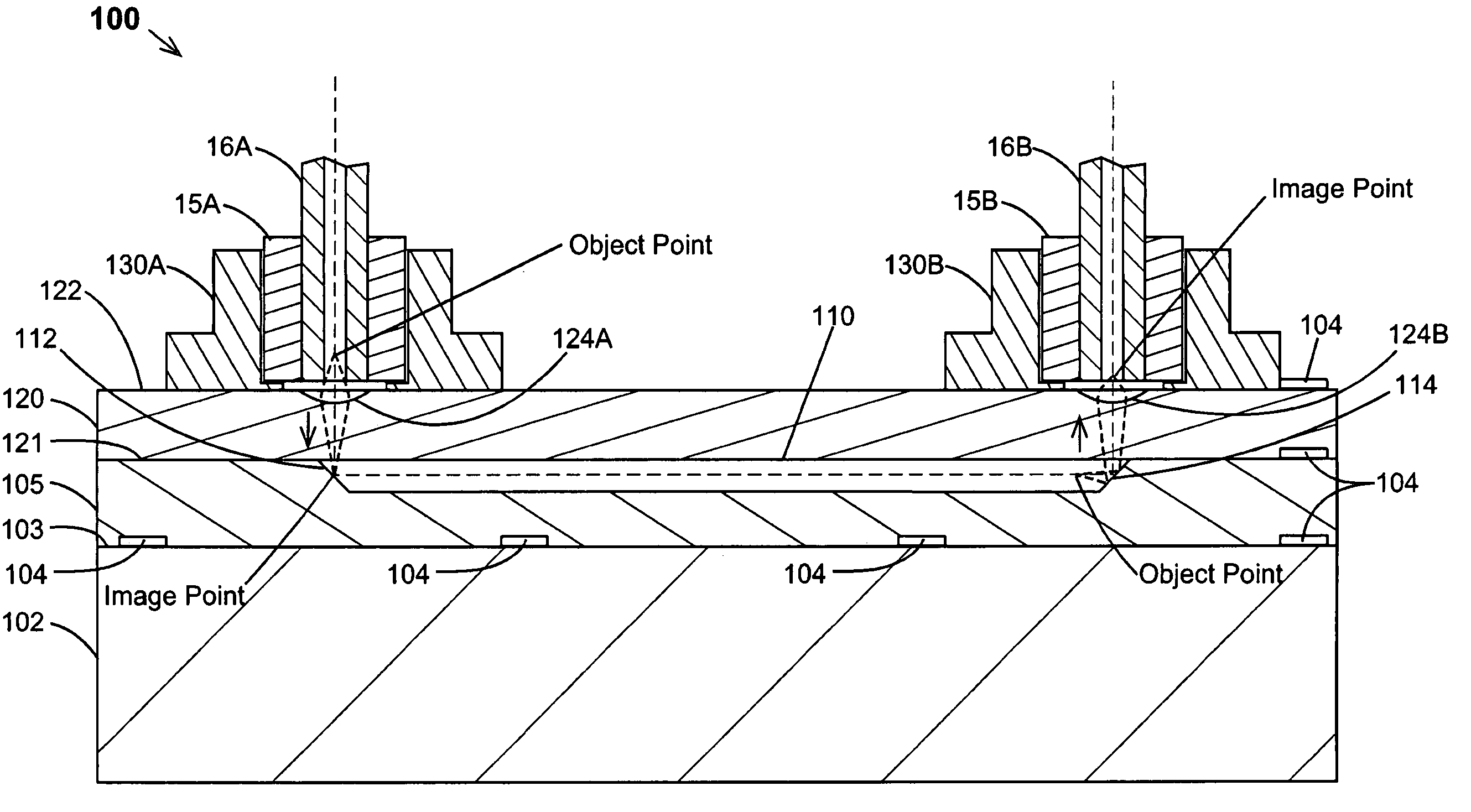
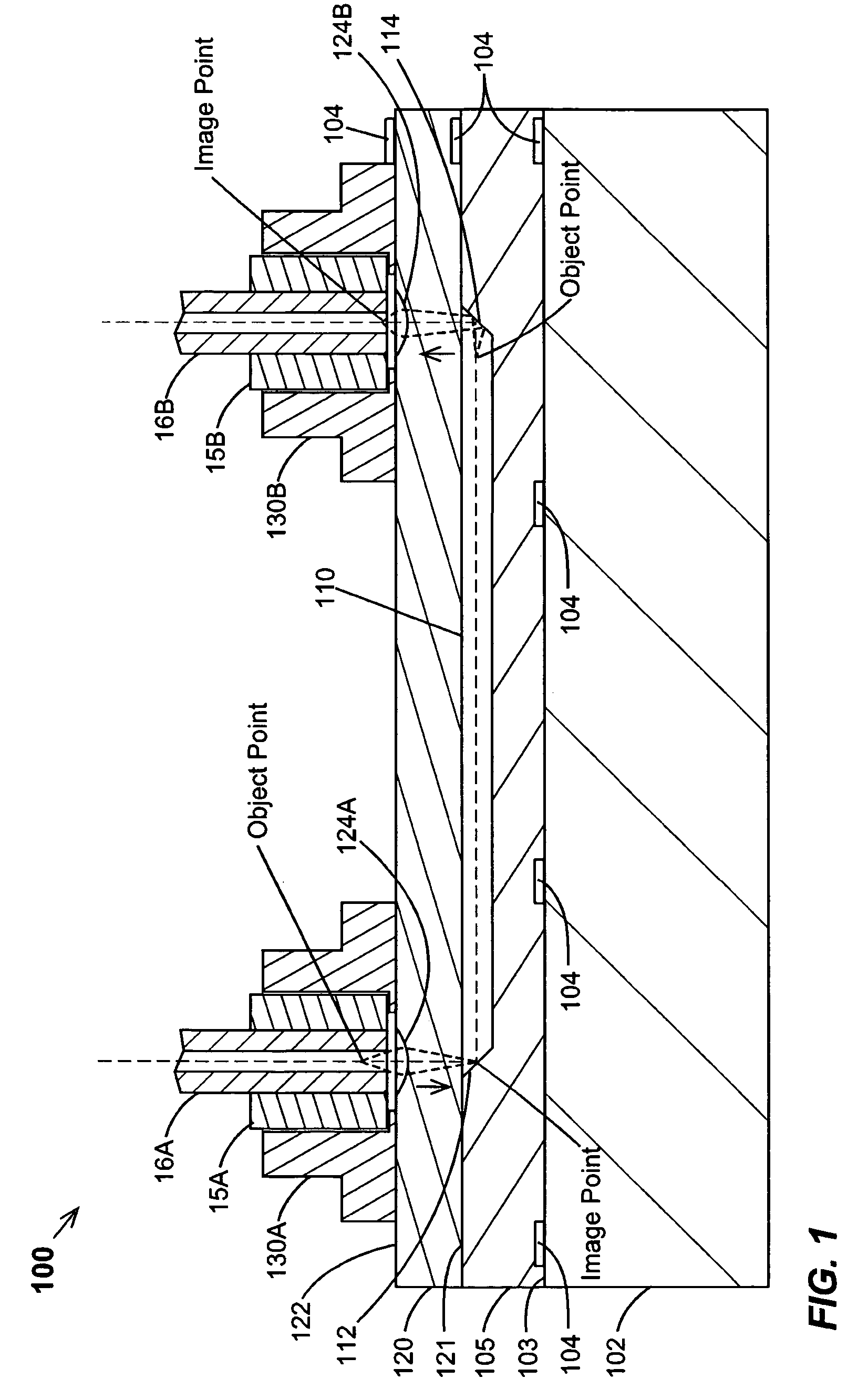
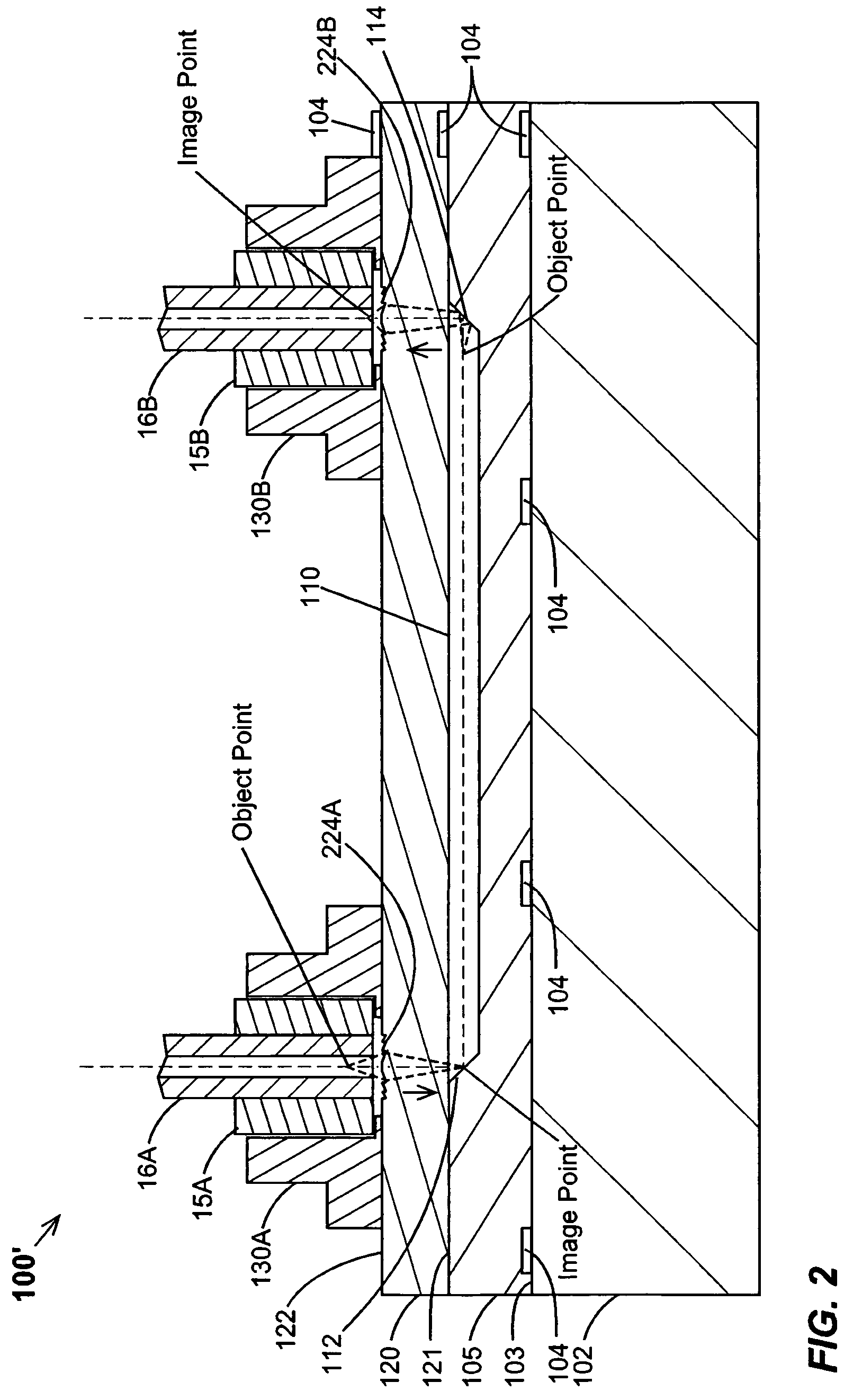
Optical backplanes with integrated optical couplers and methods of making the same
PatentInactiveUS7206472B2
Innovation
- The integration of focusing elements on the optical backplane, aligned with the core bodies of the waveguides, eliminates the need for optical fibers in the receptacle and microlenses, using angle-reflecting structures and alignment marks to ensure precise alignment and efficient light coupling.

WDMA free space broadcast technique for optical backplanes and interplanar communications
PatentInactiveUS6970649B2
Innovation
- A wavelength-locked loop system that uses a servo-control mechanism to align and track laser center wavelengths with filter passbands in real-time, enabling precise tuning of lasers and filters to minimize crosstalk and optical losses, allowing for scalable and cost-effective WDMA free space broadcast techniques compatible with existing electrical backplanes.


Standards and Protocols for High-Speed Optical Networks
The standardization landscape for high-speed optical networks supporting latency-free streaming applications is primarily governed by several key international bodies and their respective protocols. The Institute of Electrical and Electronics Engineers (IEEE) maintains critical standards including IEEE 802.3 Ethernet specifications, which define physical layer requirements for optical transceivers operating at speeds from 10 Gbps to 800 Gbps. These standards establish fundamental parameters for optical signal integrity, power consumption, and thermal management essential for backplane implementations.
The International Telecommunication Union (ITU-T) contributes complementary standards focusing on wavelength division multiplexing (WDM) technologies and optical transport networks. ITU-T G.694.1 specifies the spectral grids for WDM applications, while G.709 defines the optical transport hierarchy crucial for maintaining signal quality across optical backplanes. These standards ensure interoperability between different vendor equipment and establish baseline performance metrics for latency-sensitive applications.
OpenConfig and the Optical Internetworking Forum (OIF) have emerged as influential bodies driving next-generation optical networking protocols. The OIF's Common Electrical Interface (CEI) specifications define high-speed electrical interfaces that bridge optical and electronic domains within backplane architectures. Meanwhile, OpenConfig's YANG models provide standardized configuration and telemetry frameworks enabling real-time monitoring and optimization of optical network performance.
Protocol stack considerations for latency-free streaming require careful attention to both physical and data link layer specifications. The emergence of coherent optical technologies has necessitated new standards for digital signal processing algorithms and forward error correction schemes. Recent developments in the 400G and 800G Ethernet standards incorporate advanced modulation formats and reduced-latency encoding mechanisms specifically designed to minimize processing delays in streaming applications.
Industry consortiums such as the Ethernet Alliance and MSA (Multi-Source Agreement) groups continue to accelerate standardization efforts for emerging optical technologies. These collaborative frameworks facilitate rapid adoption of innovations like silicon photonics integration and co-packaged optics, which are becoming increasingly relevant for next-generation optical backplane designs targeting ultra-low latency requirements in data center and telecommunications environments.
The International Telecommunication Union (ITU-T) contributes complementary standards focusing on wavelength division multiplexing (WDM) technologies and optical transport networks. ITU-T G.694.1 specifies the spectral grids for WDM applications, while G.709 defines the optical transport hierarchy crucial for maintaining signal quality across optical backplanes. These standards ensure interoperability between different vendor equipment and establish baseline performance metrics for latency-sensitive applications.
OpenConfig and the Optical Internetworking Forum (OIF) have emerged as influential bodies driving next-generation optical networking protocols. The OIF's Common Electrical Interface (CEI) specifications define high-speed electrical interfaces that bridge optical and electronic domains within backplane architectures. Meanwhile, OpenConfig's YANG models provide standardized configuration and telemetry frameworks enabling real-time monitoring and optimization of optical network performance.
Protocol stack considerations for latency-free streaming require careful attention to both physical and data link layer specifications. The emergence of coherent optical technologies has necessitated new standards for digital signal processing algorithms and forward error correction schemes. Recent developments in the 400G and 800G Ethernet standards incorporate advanced modulation formats and reduced-latency encoding mechanisms specifically designed to minimize processing delays in streaming applications.
Industry consortiums such as the Ethernet Alliance and MSA (Multi-Source Agreement) groups continue to accelerate standardization efforts for emerging optical technologies. These collaborative frameworks facilitate rapid adoption of innovations like silicon photonics integration and co-packaged optics, which are becoming increasingly relevant for next-generation optical backplane designs targeting ultra-low latency requirements in data center and telecommunications environments.
Thermal Management in High-Performance Optical Systems
Thermal management represents one of the most critical engineering challenges in high-performance optical backplane systems designed for latency-free streaming applications. As optical components operate at increasingly higher data rates and power densities, the generation of heat becomes a significant factor that directly impacts system performance, reliability, and longevity. The challenge is particularly acute in streaming applications where continuous operation at peak performance levels is essential.
The primary heat sources in optical backplanes include laser diodes, photodetectors, optical amplifiers, and electronic driver circuits. Laser diodes, which serve as the fundamental light sources, exhibit temperature-dependent characteristics that can significantly affect their output power, wavelength stability, and modulation efficiency. Even minor temperature fluctuations can cause wavelength drift, leading to increased bit error rates and potential system failures in dense wavelength division multiplexing configurations.
Photodetectors and transimpedance amplifiers generate substantial heat during high-speed signal conversion processes. The thermal noise generated by these components can degrade signal-to-noise ratios, directly impacting the quality of streaming data transmission. Additionally, electronic driver circuits that control optical modulators and switches contribute to the overall thermal load, creating localized hot spots that require targeted cooling solutions.
Advanced thermal management strategies for optical backplanes encompass both passive and active cooling approaches. Passive solutions include optimized heat sink designs, thermal interface materials with enhanced conductivity, and strategic component placement to minimize thermal coupling between heat-generating elements. Active cooling systems employ precision temperature control using thermoelectric coolers, forced air circulation, and liquid cooling loops for high-density configurations.
Temperature monitoring and control systems play a crucial role in maintaining optimal operating conditions. Real-time thermal sensors provide feedback for dynamic thermal management algorithms that can adjust cooling parameters based on instantaneous heat loads and ambient conditions. These systems ensure that critical optical components remain within their specified temperature ranges while minimizing power consumption overhead.
The integration of thermal management solutions must consider the space constraints and mechanical requirements of optical backplane architectures. Cooling systems cannot interfere with optical signal paths or introduce vibrations that could affect fiber coupling stability. This necessitates innovative thermal design approaches that balance cooling effectiveness with system compactness and reliability requirements for streaming applications.
The primary heat sources in optical backplanes include laser diodes, photodetectors, optical amplifiers, and electronic driver circuits. Laser diodes, which serve as the fundamental light sources, exhibit temperature-dependent characteristics that can significantly affect their output power, wavelength stability, and modulation efficiency. Even minor temperature fluctuations can cause wavelength drift, leading to increased bit error rates and potential system failures in dense wavelength division multiplexing configurations.
Photodetectors and transimpedance amplifiers generate substantial heat during high-speed signal conversion processes. The thermal noise generated by these components can degrade signal-to-noise ratios, directly impacting the quality of streaming data transmission. Additionally, electronic driver circuits that control optical modulators and switches contribute to the overall thermal load, creating localized hot spots that require targeted cooling solutions.
Advanced thermal management strategies for optical backplanes encompass both passive and active cooling approaches. Passive solutions include optimized heat sink designs, thermal interface materials with enhanced conductivity, and strategic component placement to minimize thermal coupling between heat-generating elements. Active cooling systems employ precision temperature control using thermoelectric coolers, forced air circulation, and liquid cooling loops for high-density configurations.
Temperature monitoring and control systems play a crucial role in maintaining optimal operating conditions. Real-time thermal sensors provide feedback for dynamic thermal management algorithms that can adjust cooling parameters based on instantaneous heat loads and ambient conditions. These systems ensure that critical optical components remain within their specified temperature ranges while minimizing power consumption overhead.
The integration of thermal management solutions must consider the space constraints and mechanical requirements of optical backplane architectures. Cooling systems cannot interfere with optical signal paths or introduce vibrations that could affect fiber coupling stability. This necessitates innovative thermal design approaches that balance cooling effectiveness with system compactness and reliability requirements for streaming applications.
Unlock deeper insights with PatSnap Eureka Quick Research — get a full tech report to explore trends and direct your research. Try now!
Generate Your Research Report Instantly with AI Agent
Supercharge your innovation with PatSnap Eureka AI Agent Platform!