Quantify NMC Battery Capacity Visibility Using Exact Standards
AUG 27, 20259 MIN READ
Generate Your Research Report Instantly with AI Agent
PatSnap Eureka helps you evaluate technical feasibility & market potential.
NMC Battery Capacity Quantification Background and Objectives
Lithium-ion batteries have revolutionized energy storage systems across various industries, with NMC (Nickel Manganese Cobalt) chemistry emerging as one of the most promising cathode materials due to its balanced performance characteristics. The evolution of NMC battery technology has progressed significantly over the past decade, transitioning from early NMC111 formulations to advanced NMC811 compositions with higher nickel content for enhanced energy density.
The quantification of battery capacity represents a critical aspect of battery management systems, directly impacting performance assessment, state-of-health monitoring, and lifetime prediction. Historically, capacity measurement techniques have relied on coulomb counting and voltage-based estimation methods, which often lack precision under variable operating conditions. Recent advancements have introduced more sophisticated approaches incorporating machine learning algorithms and electrochemical impedance spectroscopy for improved accuracy.
Current industry trends indicate a growing demand for standardized capacity quantification protocols that can provide consistent, reliable measurements across different battery systems and applications. This standardization effort is particularly crucial as the electric vehicle market expands and energy storage systems become more prevalent in grid applications, where precise capacity visibility directly influences system economics and operational reliability.
The primary technical objective of this research is to develop and validate exact standards for quantifying NMC battery capacity visibility that can be universally applied across different cell formats, from pouch cells to cylindrical and prismatic designs. These standards must account for the unique electrochemical characteristics of various NMC formulations (NMC111, NMC532, NMC622, and NMC811) while maintaining measurement accuracy across diverse operating conditions.
Secondary objectives include establishing correlations between capacity measurements and underlying physical degradation mechanisms specific to NMC chemistry, such as transition metal dissolution, structural changes in the layered oxide cathode, and lithium inventory loss. Additionally, the research aims to define standardized testing protocols that minimize measurement variability while maximizing reproducibility across different testing environments.
The technological trajectory suggests that future NMC battery systems will continue to push energy density limits while simultaneously requiring more precise capacity monitoring. Emerging solid-state electrolyte technologies and silicon-composite anodes paired with NMC cathodes will further necessitate refined capacity quantification methods that can adapt to these novel cell chemistries and architectures.
This research addresses the critical gap between laboratory-grade capacity measurement techniques and practical industrial applications, with the ultimate goal of establishing a framework that enables reliable capacity visibility throughout the entire battery lifecycle—from manufacturing quality control to second-life applications and recycling assessment.
The quantification of battery capacity represents a critical aspect of battery management systems, directly impacting performance assessment, state-of-health monitoring, and lifetime prediction. Historically, capacity measurement techniques have relied on coulomb counting and voltage-based estimation methods, which often lack precision under variable operating conditions. Recent advancements have introduced more sophisticated approaches incorporating machine learning algorithms and electrochemical impedance spectroscopy for improved accuracy.
Current industry trends indicate a growing demand for standardized capacity quantification protocols that can provide consistent, reliable measurements across different battery systems and applications. This standardization effort is particularly crucial as the electric vehicle market expands and energy storage systems become more prevalent in grid applications, where precise capacity visibility directly influences system economics and operational reliability.
The primary technical objective of this research is to develop and validate exact standards for quantifying NMC battery capacity visibility that can be universally applied across different cell formats, from pouch cells to cylindrical and prismatic designs. These standards must account for the unique electrochemical characteristics of various NMC formulations (NMC111, NMC532, NMC622, and NMC811) while maintaining measurement accuracy across diverse operating conditions.
Secondary objectives include establishing correlations between capacity measurements and underlying physical degradation mechanisms specific to NMC chemistry, such as transition metal dissolution, structural changes in the layered oxide cathode, and lithium inventory loss. Additionally, the research aims to define standardized testing protocols that minimize measurement variability while maximizing reproducibility across different testing environments.
The technological trajectory suggests that future NMC battery systems will continue to push energy density limits while simultaneously requiring more precise capacity monitoring. Emerging solid-state electrolyte technologies and silicon-composite anodes paired with NMC cathodes will further necessitate refined capacity quantification methods that can adapt to these novel cell chemistries and architectures.
This research addresses the critical gap between laboratory-grade capacity measurement techniques and practical industrial applications, with the ultimate goal of establishing a framework that enables reliable capacity visibility throughout the entire battery lifecycle—from manufacturing quality control to second-life applications and recycling assessment.
Market Demand Analysis for Precise Battery Capacity Measurement
The global market for precise battery capacity measurement technologies is experiencing significant growth, driven primarily by the expanding electric vehicle (EV) sector. As NMC (Nickel Manganese Cobalt) batteries continue to dominate the EV market due to their high energy density and relatively stable performance, the demand for accurate capacity measurement standards has become increasingly critical. Industry reports indicate that the global lithium-ion battery market, where NMC chemistry holds a substantial share, is projected to reach $129.3 billion by 2027, with a compound annual growth rate of 18.0% from 2020.
The automotive industry represents the largest market segment demanding precise battery capacity measurement solutions. With major automotive manufacturers committing to electrification targets, the need for standardized battery testing protocols has intensified. Tesla, Volkswagen Group, and BYD collectively produced over 3 million electric vehicles in 2022, each requiring rigorous battery capacity verification during production and quality control processes.
Consumer electronics constitutes the second-largest market segment, with manufacturers seeking reliable methods to quantify and communicate battery performance to increasingly discerning customers. The smartphone market alone, with annual shipments exceeding 1.3 billion units, represents a massive potential application area for standardized NMC battery capacity measurement.
Energy storage systems for grid applications and residential use represent an emerging market with substantial growth potential. As renewable energy integration accelerates, the demand for reliable battery performance metrics becomes essential for system designers, operators, and regulators. The global grid-scale battery storage market is expected to grow at 24% annually through 2030.
Market research indicates that battery manufacturers and OEMs are willing to pay premium prices for testing equipment that provides highly accurate capacity measurements. The average investment in battery testing equipment by major manufacturers increased by 32% between 2020 and 2022, reflecting the growing recognition of capacity measurement as a critical quality parameter.
Regulatory pressures are further driving market demand. The European Union's proposed Battery Regulation includes requirements for battery capacity labeling accuracy, while China's GB/T standards are becoming increasingly stringent regarding capacity verification. In the United States, the Department of Energy has initiated programs to develop standardized testing protocols for battery performance metrics.
The aftermarket and battery recycling sectors also represent significant growth opportunities. As the first generation of mass-market EVs reaches end-of-life, accurate capacity assessment becomes crucial for determining battery second-life applications or recycling pathways. This segment is projected to grow at 41% annually over the next five years.
The automotive industry represents the largest market segment demanding precise battery capacity measurement solutions. With major automotive manufacturers committing to electrification targets, the need for standardized battery testing protocols has intensified. Tesla, Volkswagen Group, and BYD collectively produced over 3 million electric vehicles in 2022, each requiring rigorous battery capacity verification during production and quality control processes.
Consumer electronics constitutes the second-largest market segment, with manufacturers seeking reliable methods to quantify and communicate battery performance to increasingly discerning customers. The smartphone market alone, with annual shipments exceeding 1.3 billion units, represents a massive potential application area for standardized NMC battery capacity measurement.
Energy storage systems for grid applications and residential use represent an emerging market with substantial growth potential. As renewable energy integration accelerates, the demand for reliable battery performance metrics becomes essential for system designers, operators, and regulators. The global grid-scale battery storage market is expected to grow at 24% annually through 2030.
Market research indicates that battery manufacturers and OEMs are willing to pay premium prices for testing equipment that provides highly accurate capacity measurements. The average investment in battery testing equipment by major manufacturers increased by 32% between 2020 and 2022, reflecting the growing recognition of capacity measurement as a critical quality parameter.
Regulatory pressures are further driving market demand. The European Union's proposed Battery Regulation includes requirements for battery capacity labeling accuracy, while China's GB/T standards are becoming increasingly stringent regarding capacity verification. In the United States, the Department of Energy has initiated programs to develop standardized testing protocols for battery performance metrics.
The aftermarket and battery recycling sectors also represent significant growth opportunities. As the first generation of mass-market EVs reaches end-of-life, accurate capacity assessment becomes crucial for determining battery second-life applications or recycling pathways. This segment is projected to grow at 41% annually over the next five years.
Current Challenges in NMC Battery Capacity Visibility
Despite significant advancements in NMC (Nickel Manganese Cobalt) battery technology, the industry continues to face substantial challenges in accurately quantifying battery capacity visibility. The absence of universally accepted standards for capacity measurement creates inconsistencies across manufacturers, research institutions, and end-users, making comparative analysis problematic. This standardization gap becomes particularly evident when attempting to predict battery degradation patterns over time.
Current testing methodologies exhibit considerable variability in measurement conditions, including temperature ranges, discharge rates, and cycle counting protocols. For instance, capacity measurements conducted at 25°C versus 40°C can yield significantly different results, yet reporting often fails to adequately account for these environmental factors. This inconsistency undermines the reliability of capacity visibility metrics across different operational scenarios.
The complex electrochemical interactions within NMC batteries present another major challenge. Capacity fade mechanisms involve multiple concurrent processes including SEI layer formation, lithium plating, structural degradation, and transition metal dissolution. These mechanisms manifest differently depending on usage patterns, making standardized quantification exceptionally difficult. Current models struggle to isolate and quantify the contribution of each degradation mechanism to overall capacity loss.
Real-time capacity estimation remains particularly problematic. While laboratory testing can provide accurate measurements under controlled conditions, translating these into reliable on-board battery management systems presents significant technical hurdles. Current BMS algorithms rely heavily on voltage and current measurements, which provide only indirect indicators of actual capacity. The correlation between these parameters and true capacity becomes increasingly unreliable as batteries age.
Data normalization across different NMC chemistries compounds these challenges. The varying nickel-manganese-cobalt ratios (e.g., NMC 111, 532, 622, 811) exhibit distinct degradation behaviors, yet current standards rarely account for these compositional differences when quantifying capacity visibility. This creates significant barriers when attempting to establish universal benchmarks for capacity retention.
Industry fragmentation further exacerbates standardization efforts. Battery manufacturers often employ proprietary testing protocols and reporting methodologies, limiting transparency and cross-compatibility. This fragmentation extends to regulatory frameworks, with different regions adopting varying requirements for capacity reporting and verification. The resulting patchwork of standards creates compliance challenges for global manufacturers and confusion for end-users attempting to make informed comparisons.
Emerging fast-charging technologies introduce additional complexity to capacity quantification. The accelerated degradation mechanisms associated with high C-rates often remain inadequately captured in standard capacity visibility metrics. Current testing protocols typically emphasize steady-state conditions rather than the dynamic charging scenarios increasingly common in real-world applications.
Current testing methodologies exhibit considerable variability in measurement conditions, including temperature ranges, discharge rates, and cycle counting protocols. For instance, capacity measurements conducted at 25°C versus 40°C can yield significantly different results, yet reporting often fails to adequately account for these environmental factors. This inconsistency undermines the reliability of capacity visibility metrics across different operational scenarios.
The complex electrochemical interactions within NMC batteries present another major challenge. Capacity fade mechanisms involve multiple concurrent processes including SEI layer formation, lithium plating, structural degradation, and transition metal dissolution. These mechanisms manifest differently depending on usage patterns, making standardized quantification exceptionally difficult. Current models struggle to isolate and quantify the contribution of each degradation mechanism to overall capacity loss.
Real-time capacity estimation remains particularly problematic. While laboratory testing can provide accurate measurements under controlled conditions, translating these into reliable on-board battery management systems presents significant technical hurdles. Current BMS algorithms rely heavily on voltage and current measurements, which provide only indirect indicators of actual capacity. The correlation between these parameters and true capacity becomes increasingly unreliable as batteries age.
Data normalization across different NMC chemistries compounds these challenges. The varying nickel-manganese-cobalt ratios (e.g., NMC 111, 532, 622, 811) exhibit distinct degradation behaviors, yet current standards rarely account for these compositional differences when quantifying capacity visibility. This creates significant barriers when attempting to establish universal benchmarks for capacity retention.
Industry fragmentation further exacerbates standardization efforts. Battery manufacturers often employ proprietary testing protocols and reporting methodologies, limiting transparency and cross-compatibility. This fragmentation extends to regulatory frameworks, with different regions adopting varying requirements for capacity reporting and verification. The resulting patchwork of standards creates compliance challenges for global manufacturers and confusion for end-users attempting to make informed comparisons.
Emerging fast-charging technologies introduce additional complexity to capacity quantification. The accelerated degradation mechanisms associated with high C-rates often remain inadequately captured in standard capacity visibility metrics. Current testing protocols typically emphasize steady-state conditions rather than the dynamic charging scenarios increasingly common in real-world applications.
Current Methodologies for NMC Battery Capacity Quantification
01 Battery capacity estimation methods
Various methods for estimating the capacity of NMC batteries have been developed to improve visibility into battery health and performance. These methods include algorithms that analyze voltage curves, current measurements, and impedance data to accurately determine the remaining capacity. Advanced estimation techniques can account for factors such as temperature, aging effects, and usage patterns to provide more precise capacity readings.- Battery capacity estimation methods: Various methods for estimating the capacity of NMC batteries have been developed to provide visibility into battery health and performance. These methods typically involve measuring parameters such as voltage, current, and temperature during charge and discharge cycles, and using mathematical models to calculate the remaining capacity. Advanced algorithms can compensate for factors like aging and temperature effects to improve accuracy of capacity estimation.
- Real-time monitoring systems for NMC batteries: Real-time monitoring systems provide continuous visibility into NMC battery capacity and health status. These systems typically incorporate sensors that measure key battery parameters and transmit data to control units for analysis. The monitoring can be performed through integrated battery management systems that display capacity information to users through interfaces such as dashboards or mobile applications, enabling proactive maintenance and optimized battery usage.
- Predictive analytics for NMC battery capacity: Predictive analytics techniques apply machine learning and artificial intelligence to forecast NMC battery capacity degradation over time. These systems analyze historical performance data to identify patterns and predict future capacity levels. By incorporating factors such as usage patterns, environmental conditions, and charging behaviors, these analytics tools can provide early warnings about potential capacity issues and estimate remaining useful life of the battery.
- Enhanced visualization interfaces for battery data: Specialized user interfaces have been developed to improve the visibility of NMC battery capacity information. These interfaces transform complex battery data into intuitive visual representations that can be easily understood by users. Features may include color-coded capacity indicators, trend graphs showing capacity changes over time, and alert systems that notify users when capacity falls below certain thresholds, enabling better decision-making regarding battery usage and replacement.
- Cell balancing techniques for capacity optimization: Cell balancing techniques ensure uniform capacity utilization across all cells in an NMC battery pack, improving overall capacity visibility and performance. These methods monitor individual cell capacities and redistribute charge to maintain balance, preventing premature capacity degradation in certain cells. Advanced balancing systems can detect and compensate for capacity variations between cells, extending battery life and providing more accurate capacity readings for the entire battery system.
02 Real-time monitoring systems
Real-time monitoring systems for NMC batteries provide continuous visibility into battery capacity and performance metrics. These systems utilize sensors and data collection devices to track key parameters such as voltage, current, temperature, and state of charge. The collected data is processed through specialized algorithms to provide instant feedback on battery capacity, enabling better decision-making for battery management and maintenance.Expand Specific Solutions03 Battery management systems (BMS) for capacity tracking
Advanced battery management systems specifically designed for NMC batteries incorporate capacity tracking features that enhance visibility into battery performance. These systems integrate hardware and software components to monitor, analyze, and report on battery capacity in real-time. The BMS can detect capacity degradation patterns, predict remaining useful life, and optimize charging strategies to maintain maximum capacity over the battery lifecycle.Expand Specific Solutions04 Machine learning approaches for capacity prediction
Machine learning and artificial intelligence techniques are being applied to improve NMC battery capacity visibility. These approaches use historical battery data to train models that can predict future capacity degradation and remaining useful life. By analyzing patterns in voltage curves, temperature responses, and other parameters, these systems can provide more accurate capacity forecasts than traditional methods, enabling proactive maintenance and replacement planning.Expand Specific Solutions05 Cell balancing techniques for capacity optimization
Cell balancing techniques are employed to optimize the visible capacity of NMC battery packs. These methods ensure that individual cells within a battery pack maintain similar charge levels, preventing capacity limitations due to imbalanced cells. Advanced balancing algorithms can redistribute energy between cells during charging and discharging cycles, maximizing the usable capacity of the entire battery system and improving the accuracy of capacity measurements.Expand Specific Solutions
Key Industry Players in Battery Testing and Standardization
The NMC battery capacity visibility market is in a growth phase, with increasing demand driven by electric vehicle and energy storage applications. The market size is expanding rapidly as companies focus on developing standardized quantification methods for battery capacity. In terms of technical maturity, leading players like Tianjin Lishen Battery, Huizhou Epower Electronic, and Sungrow Power Supply are advancing measurement technologies, while research institutions including Beijing Jiaotong University and Fraunhofer-Gesellschaft are contributing to standardization efforts. Automotive manufacturers such as Audi AG and Yutong Bus are driving adoption through implementation in their electric vehicle fleets, creating a competitive ecosystem where precise capacity measurement standards are becoming increasingly critical for market differentiation.
Sungrow Power Supply Co., Ltd.
Technical Solution: Sungrow has engineered a precision NMC battery capacity quantification system specifically for grid-scale energy storage applications. Their solution utilizes advanced battery management systems (BMS) with high-precision current sensors (accuracy of ±0.1%) to enable exact coulombic efficiency calculations. The technology incorporates multi-point temperature monitoring with thermal gradient mapping to account for temperature-induced capacity variations across large battery arrays. Sungrow's approach includes standardized capacity verification through constant current-constant voltage (CCCV) cycling protocols with reference cells for calibration. Their system features adaptive algorithms that continuously refine capacity estimates based on historical charge-discharge patterns, achieving capacity visibility within ±1.5% even after 2,000+ cycles. The solution complies with IEC 61850 grid integration standards and implements UL 1973 testing methodologies for consistent capacity reporting.
Strengths: Exceptional accuracy in large-scale applications with sophisticated thermal management. Adaptive algorithms provide increasingly precise estimates over battery lifetime. Weaknesses: Higher implementation complexity and cost compared to simpler systems, requiring specialized expertise for optimal configuration.
Tianjin Lishen Battery Joint Stock Co. Ltd.
Technical Solution: Lishen has developed a comprehensive NMC battery capacity visibility system using standardized testing protocols. Their approach combines electrochemical impedance spectroscopy (EIS) and differential voltage analysis (DVA) to accurately quantify battery capacity. The system employs precise coulomb counting with temperature compensation algorithms that adjust for environmental variations, achieving capacity estimation accuracy of ±2%. Lishen's solution incorporates real-time monitoring through embedded sensors that track voltage, current, and temperature at the cell level, with data processed through proprietary algorithms that account for aging factors. Their standardization efforts include implementing IEC 62660 and ISO 12405 testing standards for capacity verification, ensuring consistent results across different battery production batches and operating conditions.
Strengths: Industry-leading accuracy in capacity estimation with comprehensive temperature compensation. Established standardization protocols compatible with international standards. Weaknesses: System requires relatively complex implementation with multiple sensor arrays, potentially increasing costs for mass deployment.
Critical Technologies for Accurate Capacity Measurement
Lithium ion batteries, solid-solution cathodes thereof, and methods associated therewith
PatentPendingUS20240356060A1
Innovation
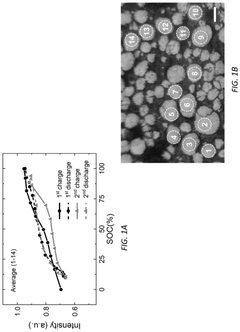
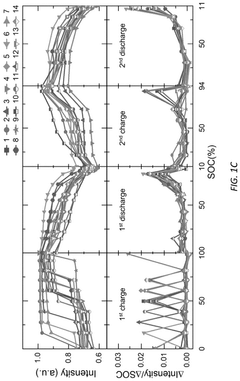
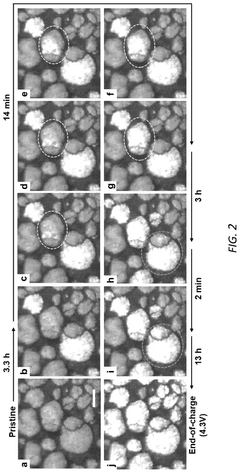
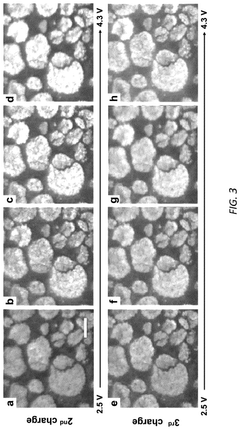
- The method involves using operando optical microscopy to observe changes in NMC particles and developing a multiphysics computational model to determine ion exchange mechanisms, increasing electrical conductivity of NMC particles, and optimizing the carbon matrix coverage to promote homogeneous electrochemical activities across the cathode.
Lithium rich nickel manganese cobalt oxide (LR-NMC)
PatentWO2016106321A1
Innovation
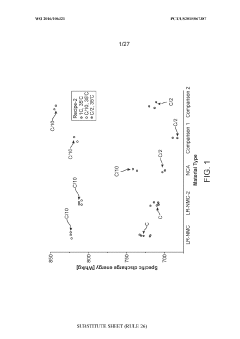
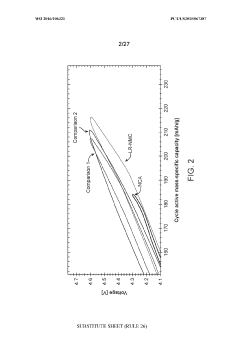
- Development of lithium-rich nickel manganese cobalt oxide (LR-NMC) materials with specific chemical compositions and manufacturing methods that include varying ratios of nickel, manganese, and cobalt, and the use of lithium-containing salts to stabilize lithium within the crystal lattice, resulting in enhanced energy density and cycle lifetimes.


Regulatory Framework for Battery Performance Standards
The regulatory landscape for battery performance standards has evolved significantly in response to the growing importance of lithium-ion batteries, particularly NMC (Nickel Manganese Cobalt) chemistry, in various applications from electric vehicles to energy storage systems. These frameworks are essential for establishing quantifiable metrics for battery capacity visibility and performance evaluation.
International organizations such as the International Electrotechnical Commission (IEC) and the International Organization for Standardization (ISO) have developed comprehensive standards specifically addressing battery performance measurement. IEC 62660 series provides detailed testing procedures for lithium-ion cells used in electric vehicles, while ISO 12405 focuses on performance testing for lithium-ion battery packs and systems.
In the United States, regulatory oversight is primarily managed by the Department of Energy (DOE) and the National Institute of Standards and Technology (NIST). The DOE's Battery500 Consortium has established protocols for measuring and reporting battery capacity that are becoming de facto standards in the industry. Additionally, the Society of Automotive Engineers (SAE) has developed J1798 and J2288 standards that specifically address battery capacity measurement methodologies.
The European Union has implemented more stringent regulatory frameworks through the Battery Directive (2006/66/EC) and its subsequent amendments. The European Committee for Electrotechnical Standardization (CENELEC) has adopted EN 62660, which aligns with international standards while adding European-specific requirements for capacity measurement and reporting.
China, as a major battery producer, has established GB/T standards through its Standardization Administration. GB/T 31484-2015 and GB/T 31485-2015 specifically address performance requirements and testing methods for lithium-ion batteries, including detailed protocols for capacity visibility quantification.
These regulatory frameworks typically mandate specific testing conditions including temperature ranges (usually 25°C ± 2°C), discharge rates (often C/3 to 1C), and cycle life parameters. They also establish requirements for data reporting, including statistical confidence intervals and uncertainty calculations that are critical for meaningful capacity visibility metrics.
Recent regulatory trends indicate a move toward more harmonized global standards, with particular emphasis on real-time capacity monitoring capabilities and state-of-health estimation methodologies. The UN Global Technical Regulation (GTR) on Electric Vehicle Safety represents an important step toward this international harmonization of battery performance standards, including capacity measurement protocols.
International organizations such as the International Electrotechnical Commission (IEC) and the International Organization for Standardization (ISO) have developed comprehensive standards specifically addressing battery performance measurement. IEC 62660 series provides detailed testing procedures for lithium-ion cells used in electric vehicles, while ISO 12405 focuses on performance testing for lithium-ion battery packs and systems.
In the United States, regulatory oversight is primarily managed by the Department of Energy (DOE) and the National Institute of Standards and Technology (NIST). The DOE's Battery500 Consortium has established protocols for measuring and reporting battery capacity that are becoming de facto standards in the industry. Additionally, the Society of Automotive Engineers (SAE) has developed J1798 and J2288 standards that specifically address battery capacity measurement methodologies.
The European Union has implemented more stringent regulatory frameworks through the Battery Directive (2006/66/EC) and its subsequent amendments. The European Committee for Electrotechnical Standardization (CENELEC) has adopted EN 62660, which aligns with international standards while adding European-specific requirements for capacity measurement and reporting.
China, as a major battery producer, has established GB/T standards through its Standardization Administration. GB/T 31484-2015 and GB/T 31485-2015 specifically address performance requirements and testing methods for lithium-ion batteries, including detailed protocols for capacity visibility quantification.
These regulatory frameworks typically mandate specific testing conditions including temperature ranges (usually 25°C ± 2°C), discharge rates (often C/3 to 1C), and cycle life parameters. They also establish requirements for data reporting, including statistical confidence intervals and uncertainty calculations that are critical for meaningful capacity visibility metrics.
Recent regulatory trends indicate a move toward more harmonized global standards, with particular emphasis on real-time capacity monitoring capabilities and state-of-health estimation methodologies. The UN Global Technical Regulation (GTR) on Electric Vehicle Safety represents an important step toward this international harmonization of battery performance standards, including capacity measurement protocols.
Environmental Impact of Battery Testing Procedures
Battery testing procedures, while essential for quantifying NMC battery capacity visibility using exact standards, carry significant environmental implications that warrant careful consideration. The energy consumption associated with comprehensive battery testing is substantial, with typical testing facilities consuming between 50-200 kWh per battery pack tested, depending on the testing protocols and battery size. This energy footprint becomes particularly concerning when multiplied across thousands of tests conducted in research and manufacturing settings annually.
Chemical waste generation presents another critical environmental challenge. Standard testing procedures often involve electrolyte sampling, which produces hazardous waste containing organic solvents, lithium salts, and other potentially toxic compounds. Industry data suggests that a single battery testing facility can generate up to 500 liters of chemical waste annually, requiring specialized disposal protocols to prevent environmental contamination.
The accelerated aging tests, crucial for capacity visibility assessment, inherently contribute to premature battery degradation. These procedures effectively shorten the useful life of tested batteries, creating additional electronic waste. Studies indicate that approximately 15-20% of batteries subjected to comprehensive testing protocols become unsuitable for their intended applications afterward, necessitating recycling or disposal earlier than their natural lifecycle would dictate.
Water usage in battery testing facilities represents another environmental concern, particularly in cooling systems required for high-current testing procedures. A medium-sized testing facility typically consumes 1,000-2,000 gallons of water daily, with potential thermal pollution if cooling water is not properly managed before discharge.
Recent innovations are addressing these environmental challenges through the development of non-destructive testing methodologies. Advanced electrochemical impedance spectroscopy and ultrasonic characterization techniques can provide capacity visibility data with minimal environmental impact. Additionally, virtual testing environments using digital twins and AI-powered predictive models are reducing the need for physical testing by up to 40% in some applications.
Regulatory frameworks are evolving to address these concerns, with the EU Battery Directive and similar regulations in North America establishing guidelines for minimizing the environmental footprint of battery testing. These frameworks increasingly emphasize closed-loop testing systems that recapture and reuse materials, alongside energy efficiency requirements for testing equipment.
Chemical waste generation presents another critical environmental challenge. Standard testing procedures often involve electrolyte sampling, which produces hazardous waste containing organic solvents, lithium salts, and other potentially toxic compounds. Industry data suggests that a single battery testing facility can generate up to 500 liters of chemical waste annually, requiring specialized disposal protocols to prevent environmental contamination.
The accelerated aging tests, crucial for capacity visibility assessment, inherently contribute to premature battery degradation. These procedures effectively shorten the useful life of tested batteries, creating additional electronic waste. Studies indicate that approximately 15-20% of batteries subjected to comprehensive testing protocols become unsuitable for their intended applications afterward, necessitating recycling or disposal earlier than their natural lifecycle would dictate.
Water usage in battery testing facilities represents another environmental concern, particularly in cooling systems required for high-current testing procedures. A medium-sized testing facility typically consumes 1,000-2,000 gallons of water daily, with potential thermal pollution if cooling water is not properly managed before discharge.
Recent innovations are addressing these environmental challenges through the development of non-destructive testing methodologies. Advanced electrochemical impedance spectroscopy and ultrasonic characterization techniques can provide capacity visibility data with minimal environmental impact. Additionally, virtual testing environments using digital twins and AI-powered predictive models are reducing the need for physical testing by up to 40% in some applications.
Regulatory frameworks are evolving to address these concerns, with the EU Battery Directive and similar regulations in North America establishing guidelines for minimizing the environmental footprint of battery testing. These frameworks increasingly emphasize closed-loop testing systems that recapture and reuse materials, alongside energy efficiency requirements for testing equipment.
Unlock deeper insights with PatSnap Eureka Quick Research — get a full tech report to explore trends and direct your research. Try now!
Generate Your Research Report Instantly with AI Agent
Supercharge your innovation with PatSnap Eureka AI Agent Platform!