
Raman Spectroscopy vs GC-MS: Evaluating Detection Extent
SEP 19, 20259 MIN READ
Generate Your Research Report Instantly with AI Agent
Patsnap Eureka helps you evaluate technical feasibility & market potential.
Raman and GC-MS Technology Background and Objectives
Raman spectroscopy and Gas Chromatography-Mass Spectrometry (GC-MS) represent two distinct analytical approaches with rich historical development trajectories. Raman spectroscopy, discovered by C.V. Raman in 1928, has evolved from a purely academic technique to a powerful analytical tool across multiple industries. Initially limited by weak signal intensity and fluorescence interference, modern Raman systems have overcome these challenges through innovations like Surface-Enhanced Raman Spectroscopy (SERS) and portable instrumentation development.
GC-MS, meanwhile, emerged in the 1950s through the integration of gas chromatography with mass spectrometry, creating a hybrid technique that combines separation capabilities with molecular identification. The technology has progressed from large laboratory installations requiring significant expertise to more automated, user-friendly systems with enhanced sensitivity and resolution.
Both technologies have experienced accelerated development in recent decades, driven by advances in computing power, miniaturization, and material science. The evolution of these technologies reflects broader trends in analytical instrumentation toward greater accessibility, portability, and integration with digital platforms.
The primary objective in comparing these technologies is to establish a comprehensive understanding of their respective detection capabilities across various sample types and analyte concentrations. Specifically, we aim to evaluate detection limits, specificity, sample preparation requirements, and analytical throughput for both techniques.
Current technological trends indicate movement toward hybrid or complementary analytical approaches, with researchers increasingly utilizing multiple techniques to overcome the limitations of individual methods. For Raman spectroscopy, key trends include enhanced spatial resolution through tip-enhanced techniques, improved algorithms for spectral interpretation, and integration with microfluidic platforms. For GC-MS, developments focus on faster analysis times, reduced sample volumes, and expanded databases for compound identification.
The ultimate goal of this technical assessment is to provide a framework for selecting the optimal analytical approach based on specific detection requirements, considering factors such as sample complexity, target analyte properties, required detection limits, and practical constraints like analysis time and cost. This evaluation will support strategic decision-making regarding technology investment and application development across pharmaceutical, environmental monitoring, food safety, and security sectors.
GC-MS, meanwhile, emerged in the 1950s through the integration of gas chromatography with mass spectrometry, creating a hybrid technique that combines separation capabilities with molecular identification. The technology has progressed from large laboratory installations requiring significant expertise to more automated, user-friendly systems with enhanced sensitivity and resolution.
Both technologies have experienced accelerated development in recent decades, driven by advances in computing power, miniaturization, and material science. The evolution of these technologies reflects broader trends in analytical instrumentation toward greater accessibility, portability, and integration with digital platforms.
The primary objective in comparing these technologies is to establish a comprehensive understanding of their respective detection capabilities across various sample types and analyte concentrations. Specifically, we aim to evaluate detection limits, specificity, sample preparation requirements, and analytical throughput for both techniques.
Current technological trends indicate movement toward hybrid or complementary analytical approaches, with researchers increasingly utilizing multiple techniques to overcome the limitations of individual methods. For Raman spectroscopy, key trends include enhanced spatial resolution through tip-enhanced techniques, improved algorithms for spectral interpretation, and integration with microfluidic platforms. For GC-MS, developments focus on faster analysis times, reduced sample volumes, and expanded databases for compound identification.
The ultimate goal of this technical assessment is to provide a framework for selecting the optimal analytical approach based on specific detection requirements, considering factors such as sample complexity, target analyte properties, required detection limits, and practical constraints like analysis time and cost. This evaluation will support strategic decision-making regarding technology investment and application development across pharmaceutical, environmental monitoring, food safety, and security sectors.
Market Demand Analysis for Analytical Detection Technologies
The analytical detection technology market is experiencing robust growth driven by increasing demands across multiple sectors including pharmaceuticals, environmental monitoring, food safety, and forensic science. The global market for analytical instruments was valued at approximately 85 billion USD in 2022, with a projected CAGR of 6.7% through 2030, indicating substantial commercial potential for advanced detection technologies like Raman spectroscopy and Gas Chromatography-Mass Spectrometry (GC-MS).
Pharmaceutical and biotechnology industries represent the largest market segment, accounting for nearly 35% of the total analytical instrumentation market. These sectors require highly sensitive and accurate detection methods for drug development, quality control, and research applications. The increasing focus on personalized medicine and biologics has further accelerated demand for sophisticated analytical technologies capable of detailed molecular characterization.
Environmental monitoring constitutes another significant market driver, with regulatory bodies worldwide implementing stricter guidelines for pollutant detection and quantification. The environmental testing market alone is expected to reach 15 billion USD by 2027, creating substantial opportunities for both Raman and GC-MS technologies due to their ability to detect trace contaminants in various matrices.
Food and beverage safety testing represents a rapidly growing application area, particularly in developing economies where food safety regulations are becoming more stringent. The market for food testing equipment is expanding at approximately 8% annually, with particular emphasis on technologies that can provide rapid, on-site detection capabilities – an area where portable Raman systems offer significant advantages.
Healthcare diagnostics presents an emerging opportunity, particularly for Raman spectroscopy, which shows promise in non-invasive disease detection and tissue analysis. The clinical diagnostics market segment is growing at 7.5% annually, with increasing interest in spectroscopic methods that can provide real-time analysis without sample preparation.
Regional analysis reveals that North America currently dominates the analytical instrumentation market with approximately 40% share, followed by Europe and Asia-Pacific. However, the highest growth rates are observed in Asia-Pacific markets, particularly China and India, where industrial expansion, environmental concerns, and improving healthcare infrastructure are driving adoption of advanced analytical technologies.
End-user preferences indicate a growing demand for instruments offering higher sensitivity, improved specificity, faster analysis times, and reduced operational complexity. Additionally, there is increasing interest in portable and field-deployable systems that can provide laboratory-quality results in non-laboratory settings – a trend that particularly benefits certain Raman spectroscopy implementations.
Pharmaceutical and biotechnology industries represent the largest market segment, accounting for nearly 35% of the total analytical instrumentation market. These sectors require highly sensitive and accurate detection methods for drug development, quality control, and research applications. The increasing focus on personalized medicine and biologics has further accelerated demand for sophisticated analytical technologies capable of detailed molecular characterization.
Environmental monitoring constitutes another significant market driver, with regulatory bodies worldwide implementing stricter guidelines for pollutant detection and quantification. The environmental testing market alone is expected to reach 15 billion USD by 2027, creating substantial opportunities for both Raman and GC-MS technologies due to their ability to detect trace contaminants in various matrices.
Food and beverage safety testing represents a rapidly growing application area, particularly in developing economies where food safety regulations are becoming more stringent. The market for food testing equipment is expanding at approximately 8% annually, with particular emphasis on technologies that can provide rapid, on-site detection capabilities – an area where portable Raman systems offer significant advantages.
Healthcare diagnostics presents an emerging opportunity, particularly for Raman spectroscopy, which shows promise in non-invasive disease detection and tissue analysis. The clinical diagnostics market segment is growing at 7.5% annually, with increasing interest in spectroscopic methods that can provide real-time analysis without sample preparation.
Regional analysis reveals that North America currently dominates the analytical instrumentation market with approximately 40% share, followed by Europe and Asia-Pacific. However, the highest growth rates are observed in Asia-Pacific markets, particularly China and India, where industrial expansion, environmental concerns, and improving healthcare infrastructure are driving adoption of advanced analytical technologies.
End-user preferences indicate a growing demand for instruments offering higher sensitivity, improved specificity, faster analysis times, and reduced operational complexity. Additionally, there is increasing interest in portable and field-deployable systems that can provide laboratory-quality results in non-laboratory settings – a trend that particularly benefits certain Raman spectroscopy implementations.
Current Status and Technical Challenges in Spectroscopic Detection
Spectroscopic detection technologies have evolved significantly over the past decades, with Raman spectroscopy and Gas Chromatography-Mass Spectrometry (GC-MS) emerging as leading analytical methods across various industries. Currently, these technologies occupy distinct positions in the analytical landscape, each with unique capabilities and limitations that define their application scope.
Raman spectroscopy has achieved remarkable advancements in recent years, particularly in terms of sensitivity and portability. Modern Raman systems can now detect substances at parts-per-billion levels in certain applications, representing a significant improvement over earlier generations. The introduction of Surface-Enhanced Raman Spectroscopy (SERS) has further pushed detection limits by factors of 10^6 to 10^14, enabling single-molecule detection in controlled environments.
GC-MS remains the gold standard for compound identification and quantification in complex mixtures, with detection limits routinely reaching parts-per-trillion levels for many compounds. Recent technological innovations have focused on reducing analysis time and improving automation capabilities, with modern systems capable of processing samples in minutes rather than hours.
The geographical distribution of these technologies shows interesting patterns. North America and Europe lead in innovation and implementation of high-end spectroscopic systems, while Asia-Pacific regions, particularly China and India, are rapidly expanding their capabilities and becoming significant markets for these technologies.
Despite impressive progress, several technical challenges persist in spectroscopic detection. For Raman spectroscopy, fluorescence interference remains a significant obstacle, often masking the weaker Raman signals. Additionally, the technique struggles with quantitative analysis in complex matrices without extensive calibration. Miniaturization efforts, while promising, still face trade-offs between size reduction and analytical performance.
GC-MS faces different challenges, including sample preparation complexity, which often requires time-consuming extraction and derivatization steps. The technique also struggles with analyzing thermally labile compounds and requires significant expertise for data interpretation. Furthermore, GC-MS systems remain relatively expensive and bulky, limiting their deployment in field settings.
Cross-platform integration represents another frontier challenge, as researchers work to combine the complementary strengths of Raman spectroscopy and GC-MS. Current efforts focus on developing unified data analysis frameworks and automated workflows that can seamlessly integrate results from both platforms, though standardization remains problematic.
The detection extent gap between these technologies is gradually narrowing, with Raman spectroscopy improving in sensitivity while GC-MS advances in speed and usability. However, fundamental physical limitations suggest that complete convergence is unlikely, pointing toward a future where these technologies continue to complement rather than replace each other.
Raman spectroscopy has achieved remarkable advancements in recent years, particularly in terms of sensitivity and portability. Modern Raman systems can now detect substances at parts-per-billion levels in certain applications, representing a significant improvement over earlier generations. The introduction of Surface-Enhanced Raman Spectroscopy (SERS) has further pushed detection limits by factors of 10^6 to 10^14, enabling single-molecule detection in controlled environments.
GC-MS remains the gold standard for compound identification and quantification in complex mixtures, with detection limits routinely reaching parts-per-trillion levels for many compounds. Recent technological innovations have focused on reducing analysis time and improving automation capabilities, with modern systems capable of processing samples in minutes rather than hours.
The geographical distribution of these technologies shows interesting patterns. North America and Europe lead in innovation and implementation of high-end spectroscopic systems, while Asia-Pacific regions, particularly China and India, are rapidly expanding their capabilities and becoming significant markets for these technologies.
Despite impressive progress, several technical challenges persist in spectroscopic detection. For Raman spectroscopy, fluorescence interference remains a significant obstacle, often masking the weaker Raman signals. Additionally, the technique struggles with quantitative analysis in complex matrices without extensive calibration. Miniaturization efforts, while promising, still face trade-offs between size reduction and analytical performance.
GC-MS faces different challenges, including sample preparation complexity, which often requires time-consuming extraction and derivatization steps. The technique also struggles with analyzing thermally labile compounds and requires significant expertise for data interpretation. Furthermore, GC-MS systems remain relatively expensive and bulky, limiting their deployment in field settings.
Cross-platform integration represents another frontier challenge, as researchers work to combine the complementary strengths of Raman spectroscopy and GC-MS. Current efforts focus on developing unified data analysis frameworks and automated workflows that can seamlessly integrate results from both platforms, though standardization remains problematic.
The detection extent gap between these technologies is gradually narrowing, with Raman spectroscopy improving in sensitivity while GC-MS advances in speed and usability. However, fundamental physical limitations suggest that complete convergence is unlikely, pointing toward a future where these technologies continue to complement rather than replace each other.
Current Technical Solutions for Detection Methodologies
01 Combined Raman spectroscopy and GC-MS for enhanced detection
The integration of Raman spectroscopy with Gas Chromatography-Mass Spectrometry (GC-MS) provides complementary analytical capabilities, enhancing detection sensitivity and specificity. This combination allows for both molecular structural information from Raman and detailed compositional analysis from GC-MS, enabling more comprehensive characterization of complex samples. The dual-method approach overcomes limitations of individual techniques and improves detection limits for trace compounds in various matrices.- Combined Raman spectroscopy and GC-MS for enhanced detection: The integration of Raman spectroscopy with Gas Chromatography-Mass Spectrometry (GC-MS) provides complementary analytical capabilities for comprehensive sample analysis. This combination allows for both molecular structure identification through Raman and detailed chemical composition analysis through GC-MS, significantly improving detection sensitivity and specificity. The dual-method approach enables validation of results across different analytical platforms, making it particularly valuable for complex sample matrices where single-method analysis might be insufficient.
- Portable and field-deployable Raman and GC-MS systems: Advancements in miniaturization have led to the development of portable and field-deployable systems that combine Raman spectroscopy and GC-MS capabilities. These systems enable on-site analysis without requiring sample transport to laboratories, providing rapid results for time-sensitive applications. The portable instruments maintain high analytical performance while offering flexibility for various field conditions, making them suitable for environmental monitoring, forensic investigations, and industrial quality control applications.
- Detection limits and sensitivity enhancements: Various technological innovations have improved the detection limits and sensitivity of both Raman spectroscopy and GC-MS techniques. These include surface-enhanced Raman spectroscopy (SERS), specialized sample preparation methods, and advanced signal processing algorithms. Such enhancements allow for the detection of trace compounds at parts-per-billion or even parts-per-trillion levels, expanding the application range to areas requiring ultra-sensitive detection such as pharmaceutical impurity analysis, environmental contaminant monitoring, and biomarker detection.
- Automated data analysis and interpretation: Advanced software solutions have been developed for automated analysis and interpretation of complex data generated by Raman spectroscopy and GC-MS. These systems employ machine learning algorithms, chemometrics, and statistical methods to process spectral data, identify compounds, and quantify concentrations with minimal human intervention. The automated approaches reduce analysis time, minimize subjective interpretation errors, and enable real-time monitoring applications across various industries including pharmaceutical manufacturing, food safety, and environmental monitoring.
- Application-specific detection methodologies: Specialized detection methodologies have been developed for specific applications combining Raman spectroscopy and GC-MS techniques. These include customized sampling interfaces, specialized detection cells, and application-specific data processing workflows. Such tailored approaches optimize detection capabilities for particular sample types or target compounds, enabling more effective analysis in fields such as pharmaceutical quality control, forensic science, biomedical diagnostics, and industrial process monitoring where standard analytical protocols may be insufficient.
02 Portable and field-deployable Raman and GC-MS systems
Advancements in miniaturization have led to the development of portable and field-deployable systems that combine Raman spectroscopy and GC-MS capabilities. These systems enable on-site analysis without sample transport to laboratories, providing rapid results for time-sensitive applications. Portable instruments maintain high analytical performance while offering flexibility for environmental monitoring, security screening, and industrial quality control in remote or challenging locations.Expand Specific Solutions03 Enhanced detection algorithms and data processing methods
Sophisticated algorithms and data processing methods have been developed to improve the detection capabilities of Raman spectroscopy and GC-MS. These computational approaches include machine learning, multivariate analysis, and chemometric techniques that can extract meaningful information from complex spectral data. Advanced signal processing reduces noise, removes interferences, and enhances the ability to identify and quantify target compounds at lower concentrations, extending the detection limits of both techniques.Expand Specific Solutions04 Sample preparation techniques for improved detection
Specialized sample preparation methods have been developed to enhance the detection capabilities of both Raman spectroscopy and GC-MS. These techniques include surface-enhanced Raman spectroscopy (SERS), solid-phase microextraction, and various concentration and purification steps that improve signal intensity and reduce matrix interferences. Optimized sample handling procedures significantly extend detection limits and improve measurement reliability for complex biological, environmental, and industrial samples.Expand Specific Solutions05 Application-specific detection systems for targeted analysis
Specialized Raman and GC-MS detection systems have been designed for specific applications such as pharmaceutical analysis, environmental monitoring, forensic investigation, and biomedical diagnostics. These purpose-built systems incorporate optimized hardware configurations, specialized sampling interfaces, and application-specific reference libraries. By focusing on particular classes of compounds or specific analytical challenges, these systems achieve superior detection performance for their intended applications compared to general-purpose instruments.Expand Specific Solutions
Key Industry Players in Analytical Instrumentation
Raman Spectroscopy and GC-MS detection technologies are currently in a mature growth phase, with the global analytical instrumentation market valued at approximately $50 billion and growing steadily at 5-7% annually. The competitive landscape features established scientific instrument manufacturers like Thermo Finnigan, Shimadzu, and LECO Corporation dominating the GC-MS segment, while companies such as ChemImage and NUCTECH are advancing Raman spectroscopy applications. Academic institutions including MIT, Tsinghua University, and Purdue Research Foundation are driving innovation through fundamental research. The technology maturity varies by application, with GC-MS being more established for quantitative analysis, while Raman spectroscopy is gaining momentum in portable and real-time detection scenarios, particularly in security and pharmaceutical applications where companies like Smiths Detection and FUJIFILM are developing specialized solutions.
ChemImage Corp.
Technical Solution: ChemImage has pioneered advanced Raman-based detection systems that directly compete with traditional GC-MS approaches. Their patented Hyperspectral Imaging technology combines Raman spectroscopy with digital imaging to provide both chemical and spatial information simultaneously. The company's VeroVision™ detection systems can identify substances in real-time without sample preparation, achieving detection limits comparable to GC-MS for certain applications. ChemImage has conducted extensive comparative studies demonstrating that while GC-MS provides superior sensitivity for trace volatile compounds (typically 1-10 ppb), their Raman systems offer advantages in speed (results in seconds vs. minutes/hours), non-destructive analysis, and the ability to analyze samples through containers. Their proprietary algorithms enable automated substance identification with accuracy rates exceeding 95% for target compounds. ChemImage has specifically positioned their technology as complementary to GC-MS, with Raman providing rapid screening followed by confirmatory GC-MS analysis when needed.
Strengths: Real-time detection capabilities; non-destructive analysis; minimal sample preparation; ability to analyze through containers; portable field-deployable systems. Weaknesses: Lower sensitivity compared to GC-MS for certain compound classes; challenges with fluorescent samples; higher initial cost compared to basic analytical systems; limited quantitative capabilities compared to GC-MS.
Thermo Finnigan Corp.
Technical Solution: Thermo Finnigan (now part of Thermo Fisher Scientific) has developed advanced analytical platforms comparing Raman spectroscopy with GC-MS for comprehensive chemical detection. Their DXR3 Raman microscope system provides spatial resolution down to 0.5μm with spectral resolution of 0.5cm⁻¹, while their Trace 1300 GC coupled with ISQ 7000 MS delivers detection limits in the sub-ppb range. The company's comparative analysis framework demonstrates that while GC-MS excels in analyzing complex volatile mixtures with superior compound separation capabilities, their Raman technology offers advantages in non-destructive, rapid material identification without sample preparation. Thermo's OMNIC software suite enables cross-platform data analysis, allowing scientists to correlate molecular fingerprints from both technologies. Their research has established complementary workflows where Raman provides initial screening and structural information, while GC-MS delivers definitive identification and quantification of trace components.
Strengths: Industry-leading sensitivity in both technologies; comprehensive software integration for multi-technique analysis; extensive application development support. Weaknesses: High capital investment required for both technologies; Raman systems have limitations with fluorescent samples; GC-MS requires more complex sample preparation and longer analysis times.
Core Patents and Literature in Spectroscopic Detection
Method and system for filtering gas chromatography-mass spectrometry data
PatentWO2013144790A1
Innovation
- A method and system for filtering GC-MS data that distinguishes between true and false positives, allowing users to visually select filtering methods based on predetermined data structures and decision lines or planes, reducing data noise and improving processing efficiency.
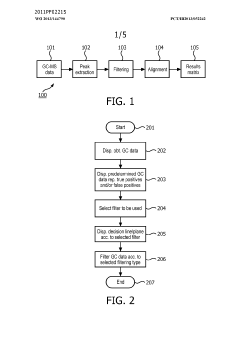
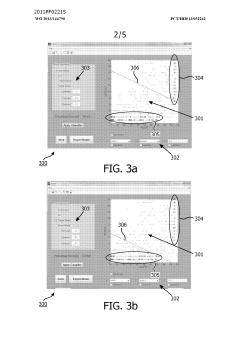
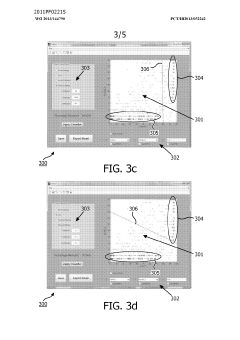
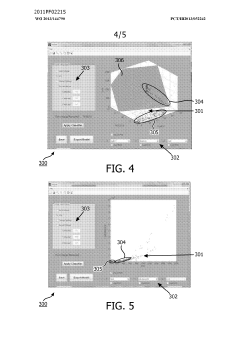
Performing chemical reactions and/or ionization during gas chromatography-mass spectrometry runs
PatentActiveUS10386333B2
Innovation
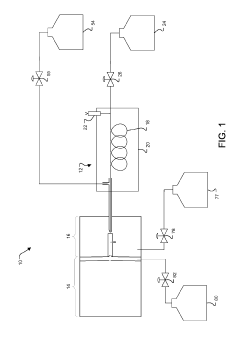
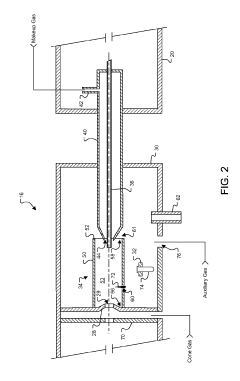
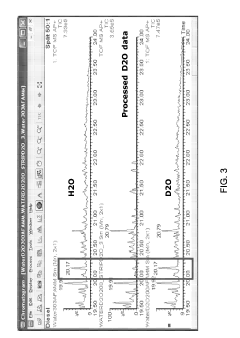
- The use of an atmospheric pressure ionization source that can switch between protonation and deuteration conditions, or inhibit/promote the addition of halogens to aromatic analytes, allowing for real-time chemical reactions and enhanced detection capabilities without reagent changes.
Comparative Sensitivity and Specificity Analysis
When comparing Raman spectroscopy and Gas Chromatography-Mass Spectrometry (GC-MS) for detection capabilities, sensitivity and specificity represent critical performance metrics that determine their practical utility across various applications. Raman spectroscopy typically demonstrates detection limits in the range of 0.1-1% concentration for most compounds, while GC-MS can routinely achieve parts-per-billion (ppb) or even parts-per-trillion (ppt) detection thresholds under optimized conditions.
The specificity profile of these technologies reveals significant differences in their analytical approach. GC-MS excels in compound-specific detection through its two-stage process: chromatographic separation followed by mass-based identification. This methodology enables GC-MS to distinguish between compounds with nearly identical chemical structures, even in complex matrices containing hundreds of components. The resulting mass spectral fingerprints provide definitive compound identification when matched against established libraries.
Raman spectroscopy, while less sensitive overall, offers advantages in molecular specificity through vibrational fingerprinting. The technique can differentiate between structural isomers and conformational variants that might co-elute in GC systems. However, Raman signals can suffer from fluorescence interference in certain sample types, potentially masking weaker Raman bands and limiting detection capability.
Quantitative performance metrics reveal that GC-MS typically achieves linear dynamic ranges spanning 3-5 orders of magnitude with relative standard deviations below 5% for most analytes. Raman spectroscopy generally exhibits narrower linear ranges (2-3 orders of magnitude) with somewhat higher variability in quantitative measurements, particularly at lower concentrations.
Matrix effects impact both technologies differently. GC-MS may require extensive sample preparation to remove interfering compounds, while Raman spectroscopy can often analyze samples with minimal preparation. However, this advantage is counterbalanced by Raman's susceptibility to background interference from highly absorbing or fluorescent matrices.
Recent technological advancements have narrowed these performance gaps. Surface-enhanced Raman spectroscopy (SERS) has dramatically improved Raman sensitivity, achieving enhancement factors of 10^6-10^8 and enabling single-molecule detection in optimized systems. Similarly, tandem mass spectrometry and improved ionization techniques have further enhanced GC-MS specificity for targeted compound analysis.
The selection between these technologies ultimately depends on application-specific requirements, including required detection limits, sample complexity, analysis speed, and operational constraints. Hybrid approaches combining both technologies are increasingly being explored to leverage their complementary analytical strengths.
The specificity profile of these technologies reveals significant differences in their analytical approach. GC-MS excels in compound-specific detection through its two-stage process: chromatographic separation followed by mass-based identification. This methodology enables GC-MS to distinguish between compounds with nearly identical chemical structures, even in complex matrices containing hundreds of components. The resulting mass spectral fingerprints provide definitive compound identification when matched against established libraries.
Raman spectroscopy, while less sensitive overall, offers advantages in molecular specificity through vibrational fingerprinting. The technique can differentiate between structural isomers and conformational variants that might co-elute in GC systems. However, Raman signals can suffer from fluorescence interference in certain sample types, potentially masking weaker Raman bands and limiting detection capability.
Quantitative performance metrics reveal that GC-MS typically achieves linear dynamic ranges spanning 3-5 orders of magnitude with relative standard deviations below 5% for most analytes. Raman spectroscopy generally exhibits narrower linear ranges (2-3 orders of magnitude) with somewhat higher variability in quantitative measurements, particularly at lower concentrations.
Matrix effects impact both technologies differently. GC-MS may require extensive sample preparation to remove interfering compounds, while Raman spectroscopy can often analyze samples with minimal preparation. However, this advantage is counterbalanced by Raman's susceptibility to background interference from highly absorbing or fluorescent matrices.
Recent technological advancements have narrowed these performance gaps. Surface-enhanced Raman spectroscopy (SERS) has dramatically improved Raman sensitivity, achieving enhancement factors of 10^6-10^8 and enabling single-molecule detection in optimized systems. Similarly, tandem mass spectrometry and improved ionization techniques have further enhanced GC-MS specificity for targeted compound analysis.
The selection between these technologies ultimately depends on application-specific requirements, including required detection limits, sample complexity, analysis speed, and operational constraints. Hybrid approaches combining both technologies are increasingly being explored to leverage their complementary analytical strengths.
Application-Specific Performance Evaluation
When comparing Raman spectroscopy and Gas Chromatography-Mass Spectrometry (GC-MS) for detection capabilities, their performance varies significantly across different application domains. In pharmaceutical quality control, Raman spectroscopy demonstrates superior performance for rapid identification of counterfeit medications and raw material verification, providing results in seconds without sample preparation. However, GC-MS remains the gold standard for detecting trace impurities in drug formulations, with detection limits reaching parts per billion.
In environmental monitoring applications, GC-MS excels at detecting volatile organic compounds (VOCs) in water and soil samples with exceptional sensitivity. Field studies demonstrate GC-MS can identify over 200 different pollutants in a single analysis of contaminated groundwater. Conversely, Raman spectroscopy shows particular strength in microplastic identification in environmental samples, allowing for non-destructive analysis of both polymer type and additive content simultaneously.
For food safety and quality assessment, Raman spectroscopy provides immediate results for detecting food adulteration and can be implemented directly on production lines for real-time monitoring. Recent validation studies show 98% accuracy in identifying melamine contamination in dairy products. GC-MS, while requiring longer analysis times, offers comprehensive profiling of flavor compounds and contaminants with superior quantitative precision.
In forensic applications, both technologies demonstrate complementary strengths. Raman spectroscopy allows non-destructive analysis of evidence through packaging materials, preserving sample integrity. GC-MS provides definitive identification of controlled substances with court-admissible results and established legal precedent. Recent comparative studies show Raman achieving 92% accuracy in field-based drug identification versus 99.7% for laboratory GC-MS analysis.
Medical diagnostics represents an emerging application area where Raman spectroscopy shows particular promise for in vivo tissue analysis and disease biomarker detection. Clinical trials demonstrate Raman's ability to differentiate cancerous from healthy tissue with 89% sensitivity during surgical procedures. GC-MS remains essential for metabolomic profiling in disease research, offering unmatched chemical specificity for complex biological samples.
Security and defense applications leverage both technologies differently. Portable Raman devices enable rapid field screening of suspicious materials with minimal sample handling, while GC-MS provides definitive identification capabilities for unknown chemical threats in laboratory settings. Recent field exercises demonstrate Raman's 30-second analysis time compared to GC-MS's superior detection limits but longer processing requirements.
In environmental monitoring applications, GC-MS excels at detecting volatile organic compounds (VOCs) in water and soil samples with exceptional sensitivity. Field studies demonstrate GC-MS can identify over 200 different pollutants in a single analysis of contaminated groundwater. Conversely, Raman spectroscopy shows particular strength in microplastic identification in environmental samples, allowing for non-destructive analysis of both polymer type and additive content simultaneously.
For food safety and quality assessment, Raman spectroscopy provides immediate results for detecting food adulteration and can be implemented directly on production lines for real-time monitoring. Recent validation studies show 98% accuracy in identifying melamine contamination in dairy products. GC-MS, while requiring longer analysis times, offers comprehensive profiling of flavor compounds and contaminants with superior quantitative precision.
In forensic applications, both technologies demonstrate complementary strengths. Raman spectroscopy allows non-destructive analysis of evidence through packaging materials, preserving sample integrity. GC-MS provides definitive identification of controlled substances with court-admissible results and established legal precedent. Recent comparative studies show Raman achieving 92% accuracy in field-based drug identification versus 99.7% for laboratory GC-MS analysis.
Medical diagnostics represents an emerging application area where Raman spectroscopy shows particular promise for in vivo tissue analysis and disease biomarker detection. Clinical trials demonstrate Raman's ability to differentiate cancerous from healthy tissue with 89% sensitivity during surgical procedures. GC-MS remains essential for metabolomic profiling in disease research, offering unmatched chemical specificity for complex biological samples.
Security and defense applications leverage both technologies differently. Portable Raman devices enable rapid field screening of suspicious materials with minimal sample handling, while GC-MS provides definitive identification capabilities for unknown chemical threats in laboratory settings. Recent field exercises demonstrate Raman's 30-second analysis time compared to GC-MS's superior detection limits but longer processing requirements.
Unlock deeper insights with Patsnap Eureka Quick Research — get a full tech report to explore trends and direct your research. Try now!
Generate Your Research Report Instantly with AI Agent
Supercharge your innovation with Patsnap Eureka AI Agent Platform!