Additive Manufacturing For Turbine Engines
SEP 23, 20254 MIN READ
Generate Your Research Report Instantly with AI Agent
Patsnap Eureka helps you evaluate technical feasibility & market potential.
Additive Manufacturing Technology Background And Goals
## Directory: 技术背景与目标
Additive manufacturing (AM), also known as 3D printing, has evolved significantly since its inception in the 1980s. Initially used for prototyping, AM has now expanded into various industries, including aerospace, where it offers significant advantages for turbine engine production. The primary goal is to leverage AM to enhance the performance, efficiency, and cost-effectiveness of turbine engines. This involves understanding the historical development of AM technologies, such as stereolithography (SLA), selective laser sintering (SLS), and direct metal laser sintering (DMLS), and their applications in producing complex, high-performance components. By exploring the evolution of AM, we aim to identify key trends and milestones that have shaped its current state and potential future advancements.
Additive Manufacturing Market Demand Analysis
The demand for additive manufacturing (AM) in turbine engines is driven by several factors:
**Market Growth**:
**Cost Efficiency**:
**Customization and Flexibility**:
**Technological Advancements**:
**Regulatory and Environmental Factors**:
**Industry Adoption**:
**Future Prospects**:
**Market Growth**:
- Increasing demand for fuel-efficient and lightweight engines in aerospace and energy sectors.
- Rising adoption of AM for producing complex, high-performance components.
**Cost Efficiency**:
- Reduction in material waste and production costs compared to traditional manufacturing methods.
- Lower inventory costs due to on-demand production capabilities.
**Customization and Flexibility**:
- Ability to produce customized parts tailored to specific engine requirements.
- Enhanced design flexibility, allowing for innovative geometries and optimized performance.
**Technological Advancements**:
- Continuous improvements in AM technologies, such as laser sintering and electron beam melting.
- Development of new materials suitable for high-temperature and high-stress environments.
**Regulatory and Environmental Factors**:
- Stricter emission regulations driving the need for more efficient engines.
- Growing emphasis on sustainability and reducing carbon footprint in manufacturing processes.
**Industry Adoption**:
- Major aerospace and energy companies investing in AM capabilities.
- Collaborations between AM technology providers and turbine engine manufacturers.
**Future Prospects**:
- Potential for further market expansion as AM technologies mature and become more cost-effective.
- Increased integration of AM in the production of critical turbine engine components.
Additive Manufacturing Technology Status And Challenges
### Additive Manufacturing Technology Status And Challenges
- **Current Status**:
Additive manufacturing (AM) for turbine engines is advancing rapidly, with significant improvements in material properties, precision, and production speed. Key players are developing specialized alloys and composites to enhance performance and durability.
- **Material Challenges**:
Developing materials that can withstand high temperatures and stresses in turbine engines remains a critical challenge. Research focuses on high-performance alloys and ceramic composites.
- **Process Optimization**:
Ensuring consistent quality and reliability in AM processes is essential. Challenges include controlling microstructure, reducing defects, and achieving repeatability.
- **Integration with Existing Systems**:
Integrating AM components with traditional manufacturing processes and ensuring compatibility with existing turbine engine designs is complex. This requires advanced design and simulation tools.
- **Regulatory and Certification Hurdles**:
Meeting stringent aerospace industry standards and obtaining certification for AM-produced parts is a significant barrier. This involves rigorous testing and validation processes.
- **Cost and Scalability**:
Reducing the cost of AM technologies and scaling up production to meet industry demands are ongoing challenges. Efforts are focused on improving efficiency and reducing material waste.
Additive Manufacturing Current Technical Solutions
01 Use of additive manufacturing for turbine blade production
Additive manufacturing techniques like SLM and EBM produce turbine blades with complex geometries and internal cooling channels, creating lightweight, high-strength components that enhance turbine engine efficiency and performance.- Use of additive manufacturing for turbine blade production: Additive manufacturing techniques like SLM and EBM produce turbine blades with complex geometries and internal cooling channels, creating lightweight, high-strength components that enhance turbine engine efficiency and performance.
- Integration of advanced materials in turbine engines: Advanced materials like superalloys and CMCs are integrated into turbine engines using additive manufacturing, offering superior thermal and mechanical properties for high-temperature, high-stress components, enhancing engine performance and durability.
- Optimization of turbine engine design through additive manufacturing: Additive manufacturing optimizes turbine engine designs by enabling complex shapes and optimized geometries, improving aerodynamics, reducing weight, and enhancing fuel efficiency. It also integrates cooling channels and other features difficult with traditional methods.
- Repair and maintenance of turbine engines using additive manufacturing: Additive manufacturing techniques like laser cladding and DED are used for repairing and maintaining turbine engine components, restoring worn or damaged parts, extending service life, and reducing downtime, offering a cost-effective maintenance solution.
- Development of hybrid manufacturing processes: Hybrid manufacturing combines additive and traditional subtractive methods to produce turbine engine components, leveraging both techniques for high precision and complex geometries, enhancing overall manufacturing quality and performance.
02 Integration of advanced materials in turbine engines
Advanced materials like superalloys and CMCs are integrated into turbine engines using additive manufacturing, offering superior thermal and mechanical properties for high-temperature, high-stress components, enhancing engine performance and durability.Expand Specific Solutions03 Optimization of turbine engine design through additive manufacturing
Additive manufacturing optimizes turbine engine designs by enabling complex shapes and optimized geometries, improving aerodynamics, reducing weight, and enhancing fuel efficiency. It also facilitates rapid prototyping and iterative testing.Expand Specific Solutions04 Repair and maintenance of turbine engines using additive manufacturing
Additive manufacturing techniques like laser cladding and DED are used for repairing and maintaining turbine engine components, restoring worn or damaged parts, extending service life, and reducing downtime, offering a cost-effective maintenance solution.Expand Specific Solutions05 Development of integrated turbine engine components
Additive manufacturing enables the development of integrated turbine engine components, combining multiple parts into a single piece, reducing assembly and welding needs, improving structural integrity, and reducing manufacturing complexity.Expand Specific Solutions
Additive Manufacturing Main Player Analysis
The competitive landscape for additive manufacturing in turbine engines features industry giants and specialized firms. The market is growing, driven by demand for efficient, lightweight components. Leading companies include United Technologies Corp., General Electric Company, and Siemens AG, with advanced capabilities. Emerging players like AECC Commercial Aircraft Engine Co., Ltd. and Sierra Turbines, Inc. are also making significant progress.
General Electric Company
Technical Solution: GE pioneers additive manufacturing for turbine engines, using 3D printing for complex, lightweight components. Their LEAP engine with 3D-printed fuel nozzles exemplifies their advancements.
Strength: Advanced technology and proven application. Weakness: High initial investment costs.
Safran Aircraft Engines SAS
Technical Solution: Safran uses additive manufacturing for lightweight, high-performance turbine components, focusing on fuel efficiency and emissions reduction. Their Silvercrest engine includes 3D-printed parts.
Strength: Focus on fuel efficiency and emissions reduction. Weakness: Early stages of widespread adoption.
Additive Manufacturing Key Technology Interpretation
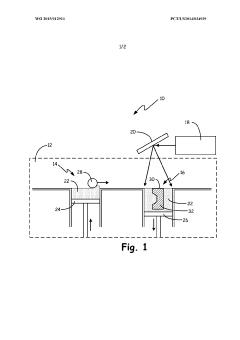
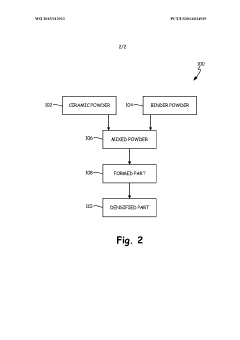
Additive manufacturing of ceramic turbine components by transient liquid phase bonding using metal or ceramic binders
PatentWO2015012911A2
Innovation
- Utilization of transient liquid phase bonding with metal or ceramic binders to densify ceramic turbine components.
- Layer-wise construction of ceramic turbine components using additive manufacturing techniques.
- Integration of digital modeling for precise control over the shape and dimensions of the turbine components.
Additive Manufacturing For Turbine Engines Material Analysis
Additive manufacturing (AM) for turbine engines focuses on material analysis to enhance performance and efficiency. Key materials include nickel-based superalloys, titanium alloys, and ceramic matrix composites, chosen for their high-temperature resistance and mechanical properties. AM enables complex geometries and lightweight structures, crucial for turbine efficiency. Challenges include ensuring material consistency, managing residual stresses, and achieving desired microstructures. Innovations in powder metallurgy, laser sintering, and electron beam melting are pivotal. Future research aims at optimizing material properties, improving process control, and integrating real-time monitoring to ensure reliability and performance in turbine engine applications.
Additive Manufacturing For Turbine Engines Regulatory Impact
Additive manufacturing (AM) for turbine engines is revolutionizing the aerospace industry by enabling complex geometries, reducing weight, and enhancing performance. Regulatory impacts are significant, as AM introduces new challenges in certification, quality assurance, and material standards. Regulatory bodies must adapt to ensure safety and reliability while fostering innovation. Compliance with evolving standards is crucial for market entry and competitiveness. Companies must invest in robust testing, documentation, and collaboration with regulatory agencies to navigate this landscape effectively. The regulatory environment will shape the adoption and advancement of AM in turbine engines, influencing design, production, and operational strategies.
Unlock deeper insights with Patsnap Eureka Quick Research — get a full tech report to explore trends and direct your research. Try now!
Generate Your Research Report Instantly with AI Agent
Supercharge your innovation with Patsnap Eureka AI Agent Platform!