Electrochemical Compression Involvement in Microgrid Technologies
APR 24, 20269 MIN READ
Generate Your Research Report Instantly with AI Agent
PatSnap Eureka helps you evaluate technical feasibility & market potential.
Electrochemical Compression in Microgrid Background and Objectives
The integration of electrochemical compression technologies within microgrid systems represents a critical advancement in distributed energy infrastructure, addressing the growing need for efficient energy storage and management solutions. As global energy systems transition toward renewable sources, microgrids have emerged as essential components for enhancing grid resilience, reducing transmission losses, and enabling localized energy independence. However, the intermittent nature of renewable energy sources necessitates sophisticated energy storage mechanisms that can efficiently capture, store, and release energy on demand.
Electrochemical compression technology has evolved significantly over the past two decades, originating from traditional electrochemical cell designs and advancing toward specialized applications in energy storage systems. This technology combines the principles of electrochemical energy conversion with mechanical compression processes, creating hybrid systems capable of achieving higher energy densities and improved efficiency compared to conventional storage methods. The development trajectory has been driven by the increasing demand for grid-scale energy storage solutions that can respond rapidly to fluctuating energy supply and demand patterns.
The primary objective of integrating electrochemical compression into microgrid technologies is to create a more robust and efficient energy management ecosystem. This integration aims to optimize energy storage capacity while minimizing system footprint and operational costs. The technology seeks to bridge the gap between short-term energy fluctuations and long-term storage requirements, providing both rapid response capabilities for grid stabilization and extended storage duration for energy security.
Current research focuses on developing scalable electrochemical compression systems that can seamlessly integrate with existing microgrid infrastructure. The technology aims to achieve energy conversion efficiencies exceeding 85% while maintaining operational stability across varying load conditions. Additionally, the integration objectives include enhancing system reliability, reducing maintenance requirements, and enabling autonomous operation capabilities that align with smart grid principles.
The strategic importance of this technological convergence extends beyond immediate energy storage benefits, encompassing broader implications for energy democratization and sustainable development. By enabling more efficient and compact energy storage solutions, electrochemical compression technology supports the proliferation of distributed energy resources and facilitates the transition toward carbon-neutral energy systems.
Electrochemical compression technology has evolved significantly over the past two decades, originating from traditional electrochemical cell designs and advancing toward specialized applications in energy storage systems. This technology combines the principles of electrochemical energy conversion with mechanical compression processes, creating hybrid systems capable of achieving higher energy densities and improved efficiency compared to conventional storage methods. The development trajectory has been driven by the increasing demand for grid-scale energy storage solutions that can respond rapidly to fluctuating energy supply and demand patterns.
The primary objective of integrating electrochemical compression into microgrid technologies is to create a more robust and efficient energy management ecosystem. This integration aims to optimize energy storage capacity while minimizing system footprint and operational costs. The technology seeks to bridge the gap between short-term energy fluctuations and long-term storage requirements, providing both rapid response capabilities for grid stabilization and extended storage duration for energy security.
Current research focuses on developing scalable electrochemical compression systems that can seamlessly integrate with existing microgrid infrastructure. The technology aims to achieve energy conversion efficiencies exceeding 85% while maintaining operational stability across varying load conditions. Additionally, the integration objectives include enhancing system reliability, reducing maintenance requirements, and enabling autonomous operation capabilities that align with smart grid principles.
The strategic importance of this technological convergence extends beyond immediate energy storage benefits, encompassing broader implications for energy democratization and sustainable development. By enabling more efficient and compact energy storage solutions, electrochemical compression technology supports the proliferation of distributed energy resources and facilitates the transition toward carbon-neutral energy systems.
Market Demand for Advanced Microgrid Energy Storage Solutions
The global microgrid market is experiencing unprecedented growth driven by increasing demand for energy independence, grid resilience, and renewable energy integration. Traditional energy storage solutions face significant limitations in meeting the complex requirements of modern microgrids, particularly in terms of energy density, response time, and operational flexibility. This gap has created substantial market opportunities for advanced energy storage technologies that can address these critical challenges.
Electrochemical compression technology represents a promising solution to address the growing need for efficient energy storage in microgrid applications. The technology offers unique advantages in terms of energy density and operational efficiency compared to conventional battery systems and mechanical storage solutions. Market demand is particularly strong in sectors requiring high reliability and rapid response capabilities, including critical infrastructure, industrial facilities, and remote communities.
The increasing penetration of renewable energy sources in microgrid systems has intensified the need for sophisticated energy storage solutions capable of managing intermittent power generation. Solar and wind integration challenges have created specific market requirements for storage systems that can provide both short-term power quality support and long-term energy management. Electrochemical compression technologies are well-positioned to meet these dual requirements through their ability to provide rapid response times while maintaining high energy storage capacity.
Commercial and industrial microgrid deployments represent the largest market segment driving demand for advanced energy storage solutions. These applications require systems capable of peak shaving, load shifting, and backup power provision while maintaining cost-effectiveness over extended operational periods. The ability of electrochemical compression systems to deliver high round-trip efficiency and extended cycle life makes them particularly attractive for these demanding applications.
Regulatory frameworks and government incentives are further accelerating market demand for advanced microgrid energy storage solutions. Grid modernization initiatives and renewable energy mandates are creating favorable conditions for innovative storage technologies. The emphasis on carbon reduction and energy security is driving investment in microgrid infrastructure, with energy storage being recognized as a critical enabling technology.
The market is also responding to increasing concerns about grid stability and power quality issues. Electrochemical compression involvement in microgrid technologies addresses these concerns by providing precise control over power delivery and energy management. This capability is particularly valuable in applications where power quality is critical, such as data centers, hospitals, and manufacturing facilities requiring uninterrupted power supply.
Electrochemical compression technology represents a promising solution to address the growing need for efficient energy storage in microgrid applications. The technology offers unique advantages in terms of energy density and operational efficiency compared to conventional battery systems and mechanical storage solutions. Market demand is particularly strong in sectors requiring high reliability and rapid response capabilities, including critical infrastructure, industrial facilities, and remote communities.
The increasing penetration of renewable energy sources in microgrid systems has intensified the need for sophisticated energy storage solutions capable of managing intermittent power generation. Solar and wind integration challenges have created specific market requirements for storage systems that can provide both short-term power quality support and long-term energy management. Electrochemical compression technologies are well-positioned to meet these dual requirements through their ability to provide rapid response times while maintaining high energy storage capacity.
Commercial and industrial microgrid deployments represent the largest market segment driving demand for advanced energy storage solutions. These applications require systems capable of peak shaving, load shifting, and backup power provision while maintaining cost-effectiveness over extended operational periods. The ability of electrochemical compression systems to deliver high round-trip efficiency and extended cycle life makes them particularly attractive for these demanding applications.
Regulatory frameworks and government incentives are further accelerating market demand for advanced microgrid energy storage solutions. Grid modernization initiatives and renewable energy mandates are creating favorable conditions for innovative storage technologies. The emphasis on carbon reduction and energy security is driving investment in microgrid infrastructure, with energy storage being recognized as a critical enabling technology.
The market is also responding to increasing concerns about grid stability and power quality issues. Electrochemical compression involvement in microgrid technologies addresses these concerns by providing precise control over power delivery and energy management. This capability is particularly valuable in applications where power quality is critical, such as data centers, hospitals, and manufacturing facilities requiring uninterrupted power supply.
Current State and Challenges of Electrochemical Compression
Electrochemical compression technology has emerged as a promising solution for hydrogen handling in energy systems, yet its integration into microgrid applications remains in the early developmental stages. Current electrochemical compressors primarily utilize proton exchange membrane (PEM) technology, which enables compression through electrochemical processes rather than mechanical means. This approach offers theoretical advantages including reduced noise, lower maintenance requirements, and improved efficiency at smaller scales compared to traditional mechanical compressors.
The global deployment of electrochemical compression systems is predominantly concentrated in North America and Europe, where research institutions and specialized manufacturers have established pilot projects and demonstration facilities. Leading companies such as HyET Hydrogen, Skyre, and Nuvera Fuel Cells have developed commercial-scale units, though widespread adoption remains limited. The technology has shown particular promise in laboratory settings and small-scale industrial applications, achieving compression ratios of up to 100:1 with efficiencies ranging from 70-85%.
However, significant technical challenges continue to impede broader implementation in microgrid environments. Membrane degradation represents a critical limitation, with current PEM materials experiencing performance decline after 2000-5000 operating hours under continuous compression cycles. The sensitivity to impurities in hydrogen feedstock poses another substantial obstacle, as trace contaminants can severely impact membrane performance and system longevity. Temperature management issues further complicate system integration, particularly in variable operating conditions typical of microgrid applications.
Economic barriers present equally formidable challenges, with current capital costs ranging from $15,000 to $25,000 per kilogram of hydrogen processing capacity. This cost structure significantly exceeds that of conventional mechanical compressors for larger-scale applications, limiting economic viability to niche applications where the unique advantages of electrochemical compression justify the premium pricing.
Manufacturing scalability constraints also restrict market penetration, as specialized membrane materials and precision manufacturing requirements limit production volumes and increase unit costs. The lack of standardized testing protocols and performance metrics further complicates technology assessment and comparison across different manufacturers and applications.
Integration challenges within microgrid architectures include power quality requirements, as electrochemical compressors demand stable DC power supplies that may conflict with the variable nature of renewable energy sources. Control system complexity increases when coordinating compression operations with fluctuating energy generation and storage demands typical in microgrid environments.
Despite these challenges, recent technological advances in membrane materials, including development of more durable polymer electrolytes and improved catalyst formulations, suggest potential pathways for addressing current limitations. Enhanced system designs incorporating advanced thermal management and impurity tolerance mechanisms are showing promise in extending operational lifespans and improving reliability for microgrid applications.
The global deployment of electrochemical compression systems is predominantly concentrated in North America and Europe, where research institutions and specialized manufacturers have established pilot projects and demonstration facilities. Leading companies such as HyET Hydrogen, Skyre, and Nuvera Fuel Cells have developed commercial-scale units, though widespread adoption remains limited. The technology has shown particular promise in laboratory settings and small-scale industrial applications, achieving compression ratios of up to 100:1 with efficiencies ranging from 70-85%.
However, significant technical challenges continue to impede broader implementation in microgrid environments. Membrane degradation represents a critical limitation, with current PEM materials experiencing performance decline after 2000-5000 operating hours under continuous compression cycles. The sensitivity to impurities in hydrogen feedstock poses another substantial obstacle, as trace contaminants can severely impact membrane performance and system longevity. Temperature management issues further complicate system integration, particularly in variable operating conditions typical of microgrid applications.
Economic barriers present equally formidable challenges, with current capital costs ranging from $15,000 to $25,000 per kilogram of hydrogen processing capacity. This cost structure significantly exceeds that of conventional mechanical compressors for larger-scale applications, limiting economic viability to niche applications where the unique advantages of electrochemical compression justify the premium pricing.
Manufacturing scalability constraints also restrict market penetration, as specialized membrane materials and precision manufacturing requirements limit production volumes and increase unit costs. The lack of standardized testing protocols and performance metrics further complicates technology assessment and comparison across different manufacturers and applications.
Integration challenges within microgrid architectures include power quality requirements, as electrochemical compressors demand stable DC power supplies that may conflict with the variable nature of renewable energy sources. Control system complexity increases when coordinating compression operations with fluctuating energy generation and storage demands typical in microgrid environments.
Despite these challenges, recent technological advances in membrane materials, including development of more durable polymer electrolytes and improved catalyst formulations, suggest potential pathways for addressing current limitations. Enhanced system designs incorporating advanced thermal management and impurity tolerance mechanisms are showing promise in extending operational lifespans and improving reliability for microgrid applications.
Existing Electrochemical Compression Solutions for Microgrids
01 Electrochemical compression systems and apparatus
Systems and apparatus designed for electrochemical compression processes, incorporating specialized components and configurations to achieve efficient compression through electrochemical mechanisms. These systems typically include electrodes, electrolytes, and control mechanisms optimized for compression applications.- Electrochemical compression systems and apparatus: Systems and apparatus designed for electrochemical compression processes, incorporating specialized components and configurations to achieve efficient compression through electrochemical mechanisms. These systems typically include electrodes, electrolytes, and control mechanisms to facilitate the compression process while maintaining optimal performance parameters.
- Methods and processes for electrochemical compression: Various methodologies and operational processes for implementing electrochemical compression, including specific procedural steps, operational parameters, and control strategies. These methods focus on optimizing the compression efficiency through precise control of electrochemical reactions and process conditions.
- Electrode configurations and materials for compression applications: Specialized electrode designs, materials, and configurations specifically developed for electrochemical compression applications. These innovations focus on improving electrode performance, durability, and efficiency in compression processes through advanced material selection and structural optimization.
- Control and monitoring systems for electrochemical compression: Advanced control mechanisms and monitoring systems designed to regulate and optimize electrochemical compression processes. These systems incorporate sensors, feedback loops, and automated control algorithms to maintain optimal operating conditions and ensure consistent performance.
- Integration and application of electrochemical compression technology: Integration approaches and practical applications of electrochemical compression technology in various industrial and commercial settings. These implementations focus on combining electrochemical compression with other systems and processes to achieve enhanced overall performance and efficiency.
02 Electrochemical compression methods and processes
Various methods and processes for implementing electrochemical compression, including operational parameters, control strategies, and optimization techniques. These approaches focus on the procedural aspects of achieving compression through electrochemical reactions and ion transport mechanisms.Expand Specific Solutions03 Materials and components for electrochemical compression
Specialized materials, electrodes, membranes, and other components specifically designed for electrochemical compression applications. These materials are engineered to withstand the operational conditions and provide optimal performance in compression processes.Expand Specific Solutions04 Control and monitoring systems for electrochemical compression
Advanced control systems, monitoring devices, and feedback mechanisms used to regulate and optimize electrochemical compression processes. These systems ensure stable operation, efficiency optimization, and safety management during compression operations.Expand Specific Solutions05 Applications and integration of electrochemical compression
Various applications and integration methods for electrochemical compression technology in different industrial and commercial contexts. These implementations demonstrate the practical use of electrochemical compression in energy systems, gas processing, and other specialized applications.Expand Specific Solutions
Key Players in Electrochemical Compression and Microgrid Industry
The electrochemical compression technology in microgrid applications represents an emerging sector within the broader energy storage and grid integration market, currently in its early development stage. The market demonstrates significant growth potential as utilities and industrial players seek advanced energy management solutions for renewable integration. Technology maturity varies considerably across participants, with established industrial giants like Robert Bosch GmbH, ABB Ltd., and State Grid Corp. of China leveraging their extensive power systems expertise, while specialized companies such as Adele Hydrogen SAS and Allegro Energy focus on innovative electrochemical solutions. Research institutions including MIT, Tsinghua University, and CEA are driving fundamental breakthroughs in electrochemical compression mechanisms. The competitive landscape shows a convergence of traditional power equipment manufacturers, emerging energy storage specialists, and automotive companies like Nissan Motor exploring grid-to-vehicle applications, indicating the technology's cross-industry relevance and substantial commercial potential.
Panasonic Intellectual Property Management Co. Ltd.
Technical Solution: Panasonic has developed integrated electrochemical compression systems that leverage their extensive battery and fuel cell expertise for microgrid applications. Their technology combines solid oxide electrolyzer cells with electrochemical hydrogen compression units, creating compact systems suitable for residential and commercial microgrid installations. The system operates at temperatures between 600-800°C, achieving high electrical-to-hydrogen conversion efficiencies of up to 95% while simultaneously compressing hydrogen to storage pressures of 350-700 bar. Panasonic's microgrid integration includes smart energy management systems that coordinate electrochemical compression with their lithium-ion battery storage solutions, enabling multi-modal energy storage strategies. The technology incorporates thermal management systems that utilize waste heat from compression processes for building heating or additional power generation, maximizing overall system efficiency within distributed energy networks.
Strengths: Strong consumer electronics and battery technology background, established manufacturing capabilities, integrated thermal management expertise. Weaknesses: Limited large-scale industrial experience, focus primarily on smaller residential applications, competition from specialized hydrogen companies.
Massachusetts Institute of Technology
Technical Solution: MIT has conducted pioneering research on electrochemical compression integration within microgrid systems, developing novel approaches that combine solid-state electrochemical cells with advanced control algorithms. Their research focuses on nanostructured electrode materials and ionic conducting membranes that enable efficient hydrogen compression at moderate temperatures and pressures. The technology demonstrates compression efficiencies exceeding 90% while operating at current densities up to 2 A/cm². MIT's microgrid integration approach utilizes machine learning algorithms to predict optimal compression cycles based on renewable energy patterns and hydrogen demand forecasting. Their experimental systems have shown successful integration with solar photovoltaic arrays and battery storage systems, creating hybrid energy storage solutions that leverage both electrochemical and mechanical energy storage principles for enhanced grid stability and energy security.
Strengths: Cutting-edge research capabilities, innovative material science expertise, strong academic-industry partnerships. Weaknesses: Early-stage technology readiness, limited commercial scalability, high development costs for practical implementation.
Core Patents in Electrochemical Compression Technologies
Electrochemical hydrogen compressor
PatentInactiveUS20040211679A1
Innovation
- An electrochemical hydrogen compression apparatus and process using a membrane electrolyte cell assembly with a proton-conducting electrolyte membrane, anode, and cathode, along with planar gas distribution and support plates, connected in series to achieve high-pressure differentials up to 12,000 psi, leveraging electrochemical reactions to oxidize and reduce hydrogen across the membrane.
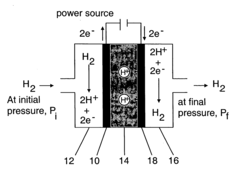
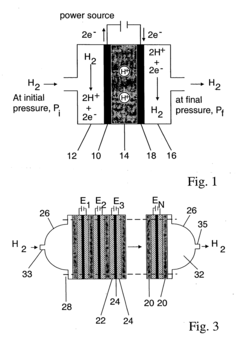
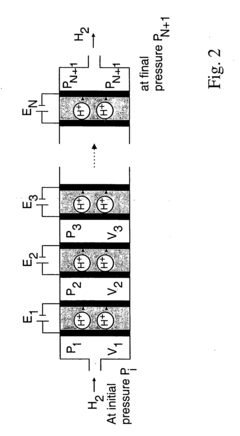
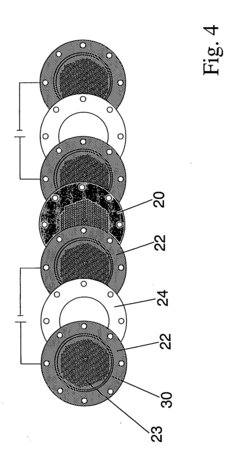
Device for electrochemical compression using PEM and aem
PatentWO2026050788A1
Innovation
- A device design incorporating semipermeable membranes with porous transport layers for capillary water transport, connected to a water reservoir, ensuring continuous membrane humidification without additional equipment, preventing drying out and flooding.


Grid Integration Standards and Policy Framework
The integration of electrochemical compression systems into microgrid infrastructures requires comprehensive adherence to established grid integration standards and robust policy frameworks. Current regulatory landscapes present both opportunities and challenges for deploying these advanced energy storage and compression technologies within distributed energy networks.
IEEE 1547 series standards serve as the foundational framework for interconnecting distributed energy resources, including electrochemical compression systems, to electric power systems. These standards establish critical requirements for voltage regulation, frequency response, and islanding protection that directly impact electrochemical compression deployment. The recent updates to IEEE 1547-2018 have expanded capabilities for advanced inverter functions, enabling better integration of electrochemical systems with grid-forming and grid-following operational modes.
IEC 61850 communication protocols provide essential interoperability standards for smart grid applications, facilitating seamless data exchange between electrochemical compression controllers and microgrid management systems. This standardization enables real-time monitoring, control, and optimization of compression operations within the broader microgrid context, ensuring coordinated response to grid conditions and energy demands.
Regulatory policies across different jurisdictions significantly influence electrochemical compression adoption in microgrids. The Federal Energy Regulatory Commission's Order 2222 in the United States has opened pathways for distributed energy resources, including advanced storage technologies, to participate in wholesale energy markets. Similarly, European Union directives under the Clean Energy Package have established frameworks supporting innovative energy storage solutions in distribution networks.
Safety and certification requirements present critical considerations for electrochemical compression integration. UL 1973 standards for stationary battery systems and UL 9540 for energy storage systems establish safety benchmarks that electrochemical compression technologies must meet. These certifications ensure operational safety while maintaining grid stability and protecting both equipment and personnel.
Policy incentives and regulatory barriers continue evolving to accommodate emerging technologies like electrochemical compression. Net metering policies, renewable energy credits, and storage deployment incentives create favorable conditions for microgrid integration, while outdated utility regulations may require modernization to fully realize the potential of these advanced compression technologies in distributed energy applications.
IEEE 1547 series standards serve as the foundational framework for interconnecting distributed energy resources, including electrochemical compression systems, to electric power systems. These standards establish critical requirements for voltage regulation, frequency response, and islanding protection that directly impact electrochemical compression deployment. The recent updates to IEEE 1547-2018 have expanded capabilities for advanced inverter functions, enabling better integration of electrochemical systems with grid-forming and grid-following operational modes.
IEC 61850 communication protocols provide essential interoperability standards for smart grid applications, facilitating seamless data exchange between electrochemical compression controllers and microgrid management systems. This standardization enables real-time monitoring, control, and optimization of compression operations within the broader microgrid context, ensuring coordinated response to grid conditions and energy demands.
Regulatory policies across different jurisdictions significantly influence electrochemical compression adoption in microgrids. The Federal Energy Regulatory Commission's Order 2222 in the United States has opened pathways for distributed energy resources, including advanced storage technologies, to participate in wholesale energy markets. Similarly, European Union directives under the Clean Energy Package have established frameworks supporting innovative energy storage solutions in distribution networks.
Safety and certification requirements present critical considerations for electrochemical compression integration. UL 1973 standards for stationary battery systems and UL 9540 for energy storage systems establish safety benchmarks that electrochemical compression technologies must meet. These certifications ensure operational safety while maintaining grid stability and protecting both equipment and personnel.
Policy incentives and regulatory barriers continue evolving to accommodate emerging technologies like electrochemical compression. Net metering policies, renewable energy credits, and storage deployment incentives create favorable conditions for microgrid integration, while outdated utility regulations may require modernization to fully realize the potential of these advanced compression technologies in distributed energy applications.
Environmental Impact Assessment of Electrochemical Systems
The environmental implications of electrochemical systems in microgrid applications present a complex landscape of both benefits and challenges that require comprehensive assessment. These systems, while offering significant potential for sustainable energy management, introduce various environmental considerations that must be carefully evaluated throughout their lifecycle.
Electrochemical compression technologies integrated within microgrids demonstrate substantial positive environmental impacts through enhanced energy efficiency and reduced carbon emissions. The ability to store and release energy with minimal losses significantly decreases reliance on fossil fuel-based backup power systems. Studies indicate that properly implemented electrochemical systems can reduce overall microgrid carbon footprints by 30-45% compared to conventional grid-tied systems, particularly when coupled with renewable energy sources.
However, the manufacturing phase of electrochemical components presents notable environmental concerns. The production of advanced battery systems and electrochemical compressors requires rare earth elements and specialized materials, often involving energy-intensive extraction and processing methods. Lithium, cobalt, and other critical materials used in these systems carry significant environmental burdens, including habitat disruption and water contamination risks in mining regions.
Operational environmental impacts vary considerably based on system design and deployment strategies. Electrochemical systems typically exhibit excellent efficiency profiles during normal operation, with minimal direct emissions or waste generation. The closed-loop nature of many electrochemical processes reduces environmental contamination risks compared to traditional mechanical compression systems that may leak refrigerants or hydraulic fluids.
End-of-life considerations represent a critical environmental challenge requiring proactive management strategies. The recycling infrastructure for advanced electrochemical components remains underdeveloped in many regions, potentially leading to improper disposal and environmental contamination. However, emerging recycling technologies show promise for recovering valuable materials and minimizing waste streams.
Life cycle assessments consistently demonstrate that despite manufacturing and disposal challenges, electrochemical systems in microgrid applications typically achieve net positive environmental outcomes over their operational lifespan, particularly when integrated with renewable energy sources and proper waste management protocols.
Electrochemical compression technologies integrated within microgrids demonstrate substantial positive environmental impacts through enhanced energy efficiency and reduced carbon emissions. The ability to store and release energy with minimal losses significantly decreases reliance on fossil fuel-based backup power systems. Studies indicate that properly implemented electrochemical systems can reduce overall microgrid carbon footprints by 30-45% compared to conventional grid-tied systems, particularly when coupled with renewable energy sources.
However, the manufacturing phase of electrochemical components presents notable environmental concerns. The production of advanced battery systems and electrochemical compressors requires rare earth elements and specialized materials, often involving energy-intensive extraction and processing methods. Lithium, cobalt, and other critical materials used in these systems carry significant environmental burdens, including habitat disruption and water contamination risks in mining regions.
Operational environmental impacts vary considerably based on system design and deployment strategies. Electrochemical systems typically exhibit excellent efficiency profiles during normal operation, with minimal direct emissions or waste generation. The closed-loop nature of many electrochemical processes reduces environmental contamination risks compared to traditional mechanical compression systems that may leak refrigerants or hydraulic fluids.
End-of-life considerations represent a critical environmental challenge requiring proactive management strategies. The recycling infrastructure for advanced electrochemical components remains underdeveloped in many regions, potentially leading to improper disposal and environmental contamination. However, emerging recycling technologies show promise for recovering valuable materials and minimizing waste streams.
Life cycle assessments consistently demonstrate that despite manufacturing and disposal challenges, electrochemical systems in microgrid applications typically achieve net positive environmental outcomes over their operational lifespan, particularly when integrated with renewable energy sources and proper waste management protocols.
Unlock deeper insights with PatSnap Eureka Quick Research — get a full tech report to explore trends and direct your research. Try now!
Generate Your Research Report Instantly with AI Agent
Supercharge your innovation with PatSnap Eureka AI Agent Platform!