

Three Phase Electric Power vs. DC: Voltage Precision Control
MAR 18, 20269 MIN READ
Generate Your Research Report Instantly with AI Agent
Patsnap Eureka helps you evaluate technical feasibility & market potential.
Three Phase vs DC Power Control Background and Objectives
The evolution of electrical power systems has been fundamentally shaped by the ongoing competition between three-phase alternating current (AC) and direct current (DC) technologies, particularly in applications requiring precise voltage control. This technological dichotomy emerged in the late 19th century during the "War of Currents" between Edison's DC systems and Tesla-Westinghouse AC systems, establishing a foundation that continues to influence modern power engineering decisions.
Three-phase AC systems gained initial dominance due to their superior transmission efficiency over long distances and the relative simplicity of voltage transformation using electromagnetic induction. The inherent characteristics of three-phase power, including constant power delivery and balanced load distribution, made it the standard for industrial applications and grid infrastructure. However, the sinusoidal nature of AC voltage presents inherent challenges for precision control applications, requiring complex power electronics and sophisticated control algorithms to achieve stable voltage regulation.
DC power systems, while initially limited by transmission constraints, have experienced a renaissance driven by advances in power semiconductor technology and the proliferation of electronic devices requiring stable DC supplies. Modern DC systems offer superior voltage precision control capabilities, with faster response times and reduced harmonic distortion compared to AC systems. The elimination of reactive power components and frequency-related phenomena in DC systems simplifies control strategies and enables more precise voltage regulation.
The contemporary landscape reveals distinct application domains where each technology demonstrates clear advantages. Three-phase AC systems continue to dominate in high-power industrial applications, motor drives, and utility-scale power distribution, where their mature infrastructure and cost-effectiveness provide compelling benefits. Conversely, DC systems are increasingly preferred in applications demanding exceptional voltage precision, such as data centers, renewable energy integration, electric vehicle charging, and sensitive electronic equipment.
Current technological objectives focus on bridging the performance gap between these systems through hybrid approaches and advanced control methodologies. Key development targets include improving AC voltage regulation precision through enhanced power electronics, developing more efficient AC-DC conversion systems, and creating intelligent power management systems that can dynamically optimize between AC and DC operation modes based on load requirements and precision demands.
The integration of smart grid technologies and renewable energy sources has further intensified the need for precise voltage control across both AC and DC domains, driving innovation in power conversion efficiency, control system responsiveness, and grid stability maintenance.
Three-phase AC systems gained initial dominance due to their superior transmission efficiency over long distances and the relative simplicity of voltage transformation using electromagnetic induction. The inherent characteristics of three-phase power, including constant power delivery and balanced load distribution, made it the standard for industrial applications and grid infrastructure. However, the sinusoidal nature of AC voltage presents inherent challenges for precision control applications, requiring complex power electronics and sophisticated control algorithms to achieve stable voltage regulation.
DC power systems, while initially limited by transmission constraints, have experienced a renaissance driven by advances in power semiconductor technology and the proliferation of electronic devices requiring stable DC supplies. Modern DC systems offer superior voltage precision control capabilities, with faster response times and reduced harmonic distortion compared to AC systems. The elimination of reactive power components and frequency-related phenomena in DC systems simplifies control strategies and enables more precise voltage regulation.
The contemporary landscape reveals distinct application domains where each technology demonstrates clear advantages. Three-phase AC systems continue to dominate in high-power industrial applications, motor drives, and utility-scale power distribution, where their mature infrastructure and cost-effectiveness provide compelling benefits. Conversely, DC systems are increasingly preferred in applications demanding exceptional voltage precision, such as data centers, renewable energy integration, electric vehicle charging, and sensitive electronic equipment.
Current technological objectives focus on bridging the performance gap between these systems through hybrid approaches and advanced control methodologies. Key development targets include improving AC voltage regulation precision through enhanced power electronics, developing more efficient AC-DC conversion systems, and creating intelligent power management systems that can dynamically optimize between AC and DC operation modes based on load requirements and precision demands.
The integration of smart grid technologies and renewable energy sources has further intensified the need for precise voltage control across both AC and DC domains, driving innovation in power conversion efficiency, control system responsiveness, and grid stability maintenance.
Market Demand for Precision Voltage Control Systems
The global market for precision voltage control systems is experiencing unprecedented growth driven by the increasing complexity of modern electrical infrastructure and the critical need for power quality management. Industrial facilities, data centers, and renewable energy installations are demanding higher levels of voltage stability to protect sensitive equipment and ensure operational continuity. The proliferation of electronic devices and automation systems has created a market environment where even minor voltage fluctuations can result in significant economic losses.
Three-phase AC systems dominate the industrial and commercial sectors, creating substantial demand for precision voltage control solutions that can handle complex load balancing and harmonic distortion issues. Manufacturing facilities require voltage regulation systems capable of maintaining tight tolerances across all three phases simultaneously, particularly in semiconductor fabrication, pharmaceutical production, and precision machining operations. The automotive industry's shift toward electric vehicle manufacturing has further intensified the need for sophisticated voltage control systems that can manage both AC and DC power requirements within the same facility.
DC voltage precision control systems are experiencing rapid market expansion, primarily driven by the growth of renewable energy installations and energy storage systems. Solar photovoltaic farms and wind energy facilities require precise DC voltage regulation to optimize power conversion efficiency and grid integration. The increasing adoption of battery energy storage systems across utility-scale and commercial applications has created a specialized market segment demanding high-precision DC voltage control capabilities.
Data centers represent a particularly lucrative market segment, where both AC and DC voltage precision control systems are essential for maintaining uptime and protecting critical IT infrastructure. The trend toward higher power densities and edge computing deployments is driving demand for more sophisticated voltage regulation solutions that can respond rapidly to dynamic load changes while maintaining exceptional accuracy.
The telecommunications sector continues to drive steady demand for DC voltage precision control systems, particularly as 5G network deployments accelerate globally. Base stations and network infrastructure require highly reliable DC power systems with precise voltage regulation to ensure consistent signal quality and network availability.
Emerging applications in electric vehicle charging infrastructure are creating new market opportunities for both AC and DC precision voltage control systems. Fast-charging stations require sophisticated power management capabilities to deliver precise voltage levels while managing grid impact and ensuring user safety.
Three-phase AC systems dominate the industrial and commercial sectors, creating substantial demand for precision voltage control solutions that can handle complex load balancing and harmonic distortion issues. Manufacturing facilities require voltage regulation systems capable of maintaining tight tolerances across all three phases simultaneously, particularly in semiconductor fabrication, pharmaceutical production, and precision machining operations. The automotive industry's shift toward electric vehicle manufacturing has further intensified the need for sophisticated voltage control systems that can manage both AC and DC power requirements within the same facility.
DC voltage precision control systems are experiencing rapid market expansion, primarily driven by the growth of renewable energy installations and energy storage systems. Solar photovoltaic farms and wind energy facilities require precise DC voltage regulation to optimize power conversion efficiency and grid integration. The increasing adoption of battery energy storage systems across utility-scale and commercial applications has created a specialized market segment demanding high-precision DC voltage control capabilities.
Data centers represent a particularly lucrative market segment, where both AC and DC voltage precision control systems are essential for maintaining uptime and protecting critical IT infrastructure. The trend toward higher power densities and edge computing deployments is driving demand for more sophisticated voltage regulation solutions that can respond rapidly to dynamic load changes while maintaining exceptional accuracy.
The telecommunications sector continues to drive steady demand for DC voltage precision control systems, particularly as 5G network deployments accelerate globally. Base stations and network infrastructure require highly reliable DC power systems with precise voltage regulation to ensure consistent signal quality and network availability.
Emerging applications in electric vehicle charging infrastructure are creating new market opportunities for both AC and DC precision voltage control systems. Fast-charging stations require sophisticated power management capabilities to deliver precise voltage levels while managing grid impact and ensuring user safety.
Current State and Challenges in AC/DC Voltage Control
The current landscape of AC and DC voltage precision control presents a complex array of technological achievements alongside persistent challenges that continue to drive innovation in power electronics. Three-phase AC systems have established dominance in industrial and utility applications due to their inherent advantages in power transmission efficiency and balanced load distribution. Modern three-phase voltage control systems achieve precision levels of ±0.1% through advanced digital signal processing and real-time feedback mechanisms.
Contemporary AC voltage control relies heavily on sophisticated power electronic converters, including voltage source inverters (VSI) and matrix converters, which utilize pulse width modulation (PWM) techniques to achieve precise voltage regulation. These systems incorporate advanced control algorithms such as space vector modulation and direct torque control, enabling rapid response times typically within microseconds. However, the complexity of three-phase systems introduces challenges in harmonic distortion management and requires extensive filtering solutions.
DC voltage control technology has experienced significant advancement with the proliferation of renewable energy systems and electric vehicle infrastructure. High-precision DC-DC converters now achieve voltage regulation accuracy better than ±0.05% through advanced topologies including isolated full-bridge converters and multi-level architectures. The integration of wide bandgap semiconductors, particularly silicon carbide (SiC) and gallium nitride (GaN) devices, has revolutionized switching frequencies and efficiency levels, reaching over 98% in many applications.
Despite these technological advances, several critical challenges persist across both AC and DC voltage control domains. Electromagnetic interference (EMI) remains a significant concern, particularly in high-frequency switching applications where conducted and radiated emissions can exceed regulatory limits. The thermal management of power electronic components continues to limit system performance, especially in high-power density applications where junction temperatures must be carefully controlled to prevent device failure.
Grid integration challenges have become increasingly prominent with the growing penetration of distributed energy resources. AC systems face difficulties in maintaining voltage stability during rapid load changes and renewable energy fluctuations, while DC microgrids struggle with standardization issues and protection coordination. The lack of universal DC voltage standards across different applications creates compatibility challenges and increases system complexity.
Control system stability represents another fundamental challenge, particularly in systems with high bandwidth requirements. The interaction between multiple control loops can lead to oscillatory behavior and reduced system robustness. Advanced control techniques such as model predictive control and adaptive algorithms are being developed to address these stability concerns, but implementation complexity and computational requirements remain significant barriers to widespread adoption.
Contemporary AC voltage control relies heavily on sophisticated power electronic converters, including voltage source inverters (VSI) and matrix converters, which utilize pulse width modulation (PWM) techniques to achieve precise voltage regulation. These systems incorporate advanced control algorithms such as space vector modulation and direct torque control, enabling rapid response times typically within microseconds. However, the complexity of three-phase systems introduces challenges in harmonic distortion management and requires extensive filtering solutions.
DC voltage control technology has experienced significant advancement with the proliferation of renewable energy systems and electric vehicle infrastructure. High-precision DC-DC converters now achieve voltage regulation accuracy better than ±0.05% through advanced topologies including isolated full-bridge converters and multi-level architectures. The integration of wide bandgap semiconductors, particularly silicon carbide (SiC) and gallium nitride (GaN) devices, has revolutionized switching frequencies and efficiency levels, reaching over 98% in many applications.
Despite these technological advances, several critical challenges persist across both AC and DC voltage control domains. Electromagnetic interference (EMI) remains a significant concern, particularly in high-frequency switching applications where conducted and radiated emissions can exceed regulatory limits. The thermal management of power electronic components continues to limit system performance, especially in high-power density applications where junction temperatures must be carefully controlled to prevent device failure.
Grid integration challenges have become increasingly prominent with the growing penetration of distributed energy resources. AC systems face difficulties in maintaining voltage stability during rapid load changes and renewable energy fluctuations, while DC microgrids struggle with standardization issues and protection coordination. The lack of universal DC voltage standards across different applications creates compatibility challenges and increases system complexity.
Control system stability represents another fundamental challenge, particularly in systems with high bandwidth requirements. The interaction between multiple control loops can lead to oscillatory behavior and reduced system robustness. Advanced control techniques such as model predictive control and adaptive algorithms are being developed to address these stability concerns, but implementation complexity and computational requirements remain significant barriers to widespread adoption.
Existing Voltage Precision Control Solutions
01 Voltage measurement and monitoring techniques in three-phase systems
Advanced voltage measurement techniques are employed to achieve high precision in three-phase electric power systems. These methods include digital sampling, signal processing algorithms, and real-time monitoring capabilities to accurately measure voltage levels across all three phases. The techniques compensate for harmonics, transients, and other disturbances that can affect measurement accuracy. Precision voltage monitoring enables better power quality assessment and system protection.- Voltage measurement and monitoring techniques in three-phase systems: Advanced voltage measurement techniques are employed to achieve high precision in three-phase electric power systems. These methods involve sophisticated sensing circuits, analog-to-digital converters, and signal processing algorithms to accurately measure voltage levels across all three phases. The techniques account for phase imbalances, harmonics, and transient conditions to provide reliable voltage measurements for monitoring and control purposes.
- DC voltage regulation and precision control: Precision voltage regulation in DC systems utilizes feedback control mechanisms, voltage reference circuits, and power conversion topologies to maintain stable output voltages. These systems incorporate error amplifiers, compensation networks, and high-resolution control circuits to minimize voltage deviations and improve steady-state accuracy. The regulation techniques are designed to handle load variations and input voltage fluctuations while maintaining precise output voltage levels.
- Power conversion between three-phase AC and DC systems: Power conversion systems facilitate the transformation between three-phase AC and DC power while maintaining voltage precision. These converters employ rectification, inversion, and filtering techniques with advanced control strategies to ensure accurate voltage conversion. The systems integrate pulse-width modulation, synchronous switching, and multi-level conversion topologies to achieve high conversion efficiency and voltage accuracy across different operating conditions.
- Voltage sensing and calibration methods: Precision voltage sensing incorporates calibration algorithms and compensation techniques to enhance measurement accuracy in both AC and DC systems. These methods address sensor non-linearities, temperature drift, and aging effects through digital calibration, self-correction routines, and reference voltage tracking. The sensing systems utilize high-precision components and adaptive algorithms to maintain measurement accuracy over extended operational periods.
- Digital control and monitoring systems for voltage precision: Digital control architectures provide enhanced voltage precision through microprocessor-based monitoring and control systems. These implementations feature real-time voltage tracking, predictive control algorithms, and communication interfaces for system integration. The digital systems enable precise voltage regulation through software-defined control parameters, adaptive response to system conditions, and comprehensive diagnostic capabilities for maintaining voltage accuracy in complex power distribution networks.
02 Voltage regulation and control systems for DC power systems
DC voltage regulation systems utilize feedback control mechanisms and power electronic converters to maintain precise voltage levels. These systems incorporate voltage sensing circuits, error amplifiers, and pulse-width modulation techniques to achieve tight voltage regulation. Advanced control algorithms compensate for load variations and input voltage fluctuations to ensure stable DC output voltage with minimal deviation from the target value.Expand Specific Solutions03 Phase voltage balancing and symmetry detection
Methods for detecting and correcting voltage imbalances in three-phase systems are critical for maintaining system precision and efficiency. These approaches monitor the voltage magnitude and phase angle of each phase to identify asymmetries. Compensation techniques including active filtering and load redistribution are employed to restore balanced conditions. Detection algorithms can identify both magnitude and angular deviations between phases.Expand Specific Solutions04 High-precision voltage conversion between AC and DC systems
Precision voltage conversion technologies enable accurate transformation between three-phase AC and DC power systems. These converters employ advanced switching techniques, multi-level topologies, and sophisticated control strategies to minimize conversion errors and maintain voltage accuracy. The systems incorporate precise voltage reference sources and calibration mechanisms to ensure consistent performance across varying operating conditions.Expand Specific Solutions05 Voltage sensing and calibration methods for improved accuracy
Enhanced voltage sensing technologies utilize precision instrumentation amplifiers, analog-to-digital converters with high resolution, and calibration procedures to achieve superior voltage measurement accuracy. These methods account for sensor drift, temperature effects, and aging to maintain long-term precision. Self-calibration routines and reference voltage standards are integrated to ensure measurement traceability and reliability in both three-phase and DC systems.Expand Specific Solutions
Key Players in Power Electronics and Control Industry
The three-phase electric power versus DC voltage precision control technology represents a mature market segment currently in the growth-to-maturity transition phase, driven by increasing demand for energy efficiency and precision in industrial applications. The global market demonstrates substantial scale, particularly in automotive electrification, industrial automation, and renewable energy sectors, with estimated values reaching billions annually. Technology maturity varies significantly across market players, with established leaders like ABB Ltd., Mitsubishi Electric Corp., and Schneider Electric demonstrating advanced capabilities in power conversion and control systems. Automotive giants including Nissan Motor, Samsung Electronics, and Porsche AG are driving innovation in electric vehicle applications, while industrial specialists such as Rockwell Automation and Hitachi Energy focus on precision control solutions. Emerging players like Delta Electronics and Ingeteam Power Technology are contributing specialized expertise in power electronics, indicating a competitive landscape where traditional electrical equipment manufacturers compete alongside automotive and technology companies, reflecting the technology's cross-industry applications and continued evolution toward higher precision and efficiency standards.
ABB Ltd.
Technical Solution: ABB has developed advanced voltage precision control solutions for both three-phase AC and DC power systems through their comprehensive power electronics portfolio. Their technology includes sophisticated inverter control algorithms that maintain voltage stability within ±0.1% accuracy across varying load conditions. The company's three-phase systems utilize space vector modulation (SVM) techniques combined with real-time feedback control to achieve superior voltage regulation compared to traditional PWM methods. For DC applications, ABB implements advanced switching topologies with high-frequency control loops that can respond to voltage variations within microseconds. Their integrated control platforms feature predictive algorithms that anticipate load changes and pre-adjust voltage levels accordingly, ensuring consistent power quality in industrial applications ranging from motor drives to renewable energy systems.
Strengths: Industry-leading voltage accuracy and comprehensive system integration capabilities. Weaknesses: Higher initial investment costs and complex system configuration requirements.
Huawei Technologies Co., Ltd.
Technical Solution: Huawei has developed innovative voltage precision control technologies for both three-phase AC and DC power systems, particularly focusing on renewable energy applications and telecommunications infrastructure. Their solution incorporates AI-driven control algorithms that achieve voltage stability within ±0.06% accuracy through intelligent load forecasting and proactive voltage regulation. The three-phase control system utilizes advanced grid-forming capabilities with virtual synchronous generator technology that provides excellent voltage and frequency stability in weak grid conditions. For DC applications, their technology employs high-efficiency switching converters with digital control loops that can maintain precise voltage levels across wide input voltage ranges. Their smart energy management platform integrates battery storage systems with sophisticated charge/discharge control algorithms that optimize voltage regulation while extending battery life. The system features advanced communication capabilities that enable remote monitoring and control through secure cloud-based interfaces.
Strengths: Advanced AI integration and excellent renewable energy system compatibility with strong communication capabilities. Weaknesses: Limited presence in traditional industrial markets and potential regulatory restrictions in some regions.
Core Innovations in Three Phase and DC Control Patents
Direct power control method for three-phase voltage type PWM rectifier
PatentActiveCN109713920A
Innovation
- By analyzing the angles and sectors of the three-phase voltage vectors, designing a Δp interval judger, selecting appropriate switching vectors to construct a new switching table, realizing fast or slow changes in active power and reactive power, and eliminating reactive power Out of control zone.


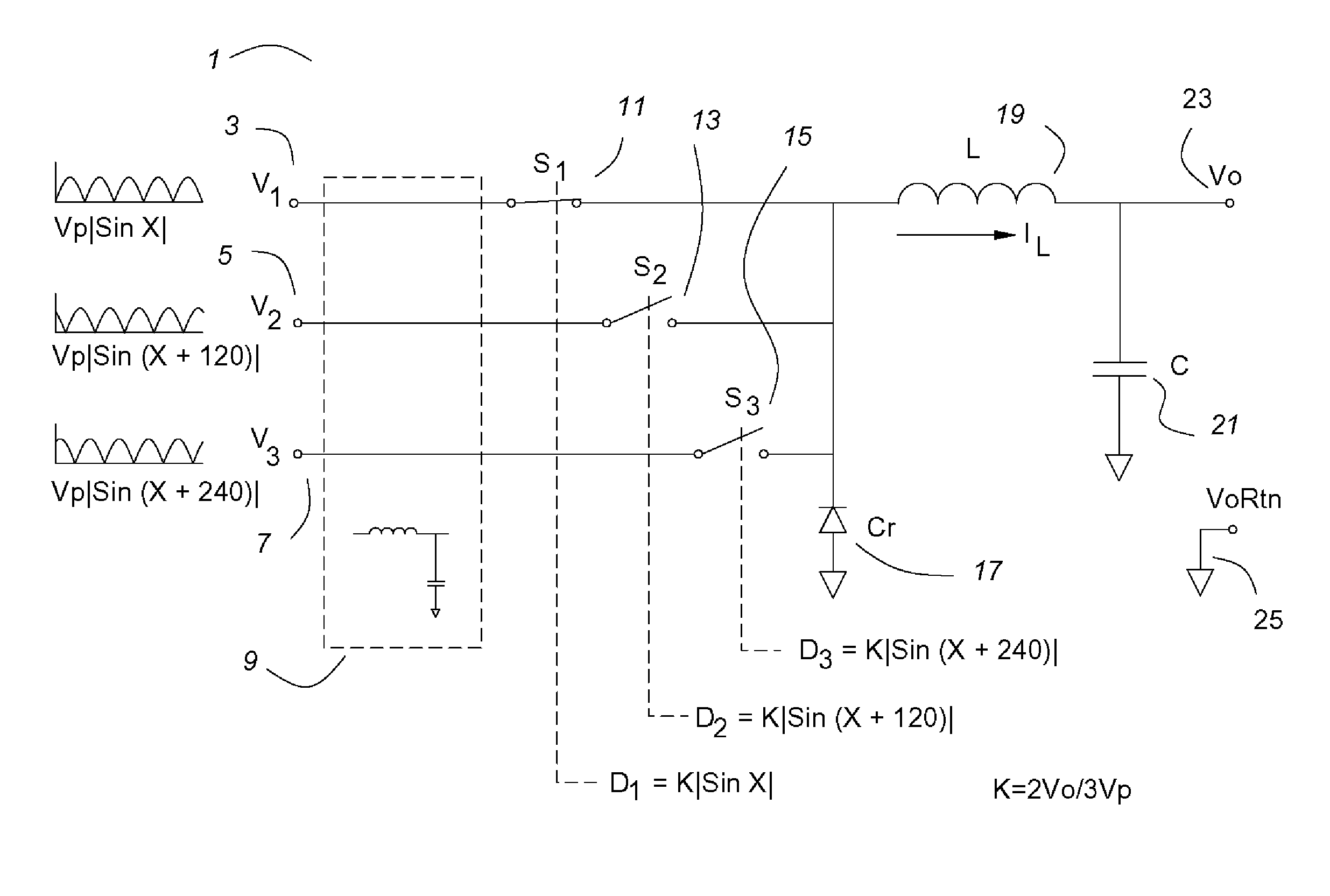
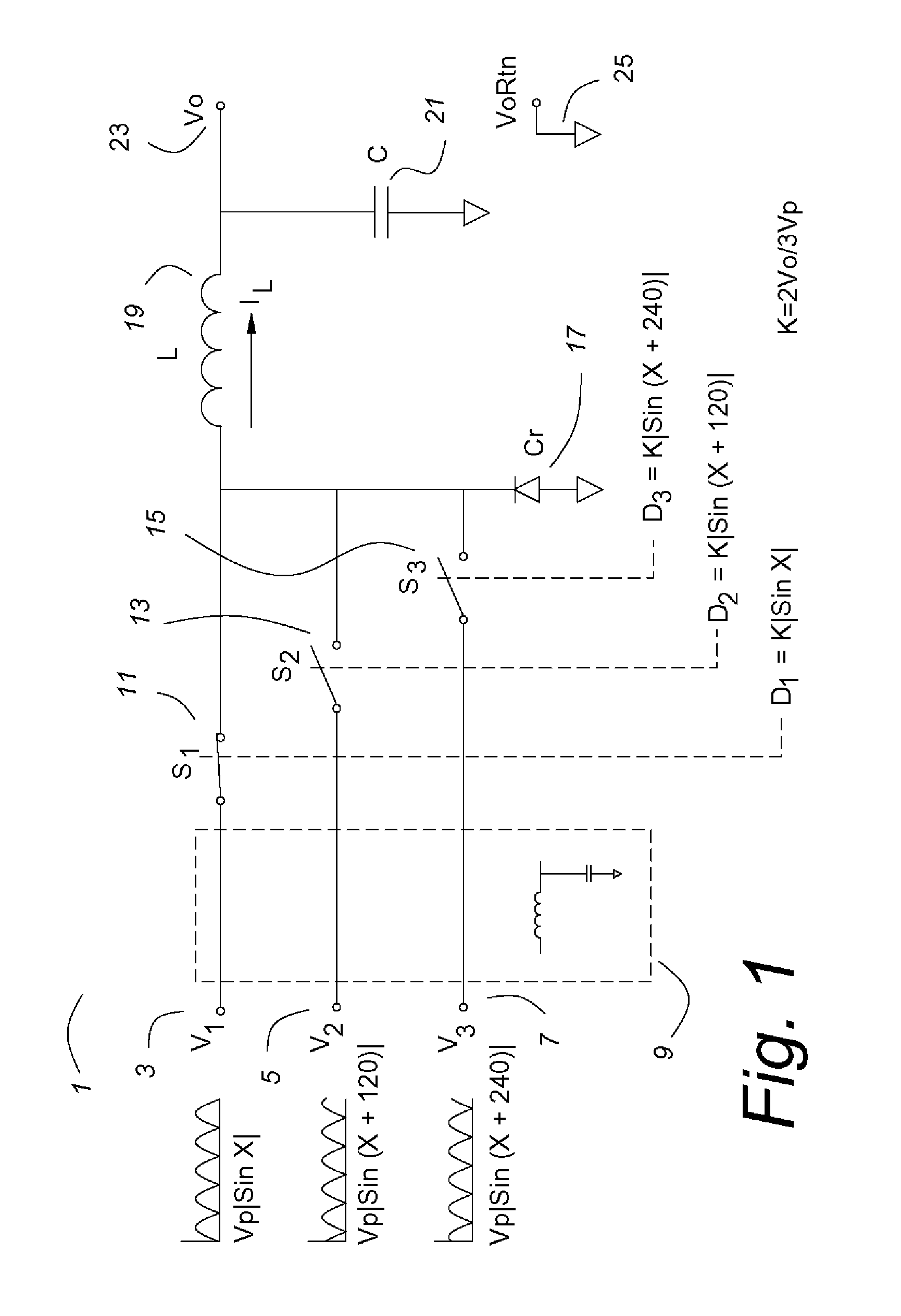
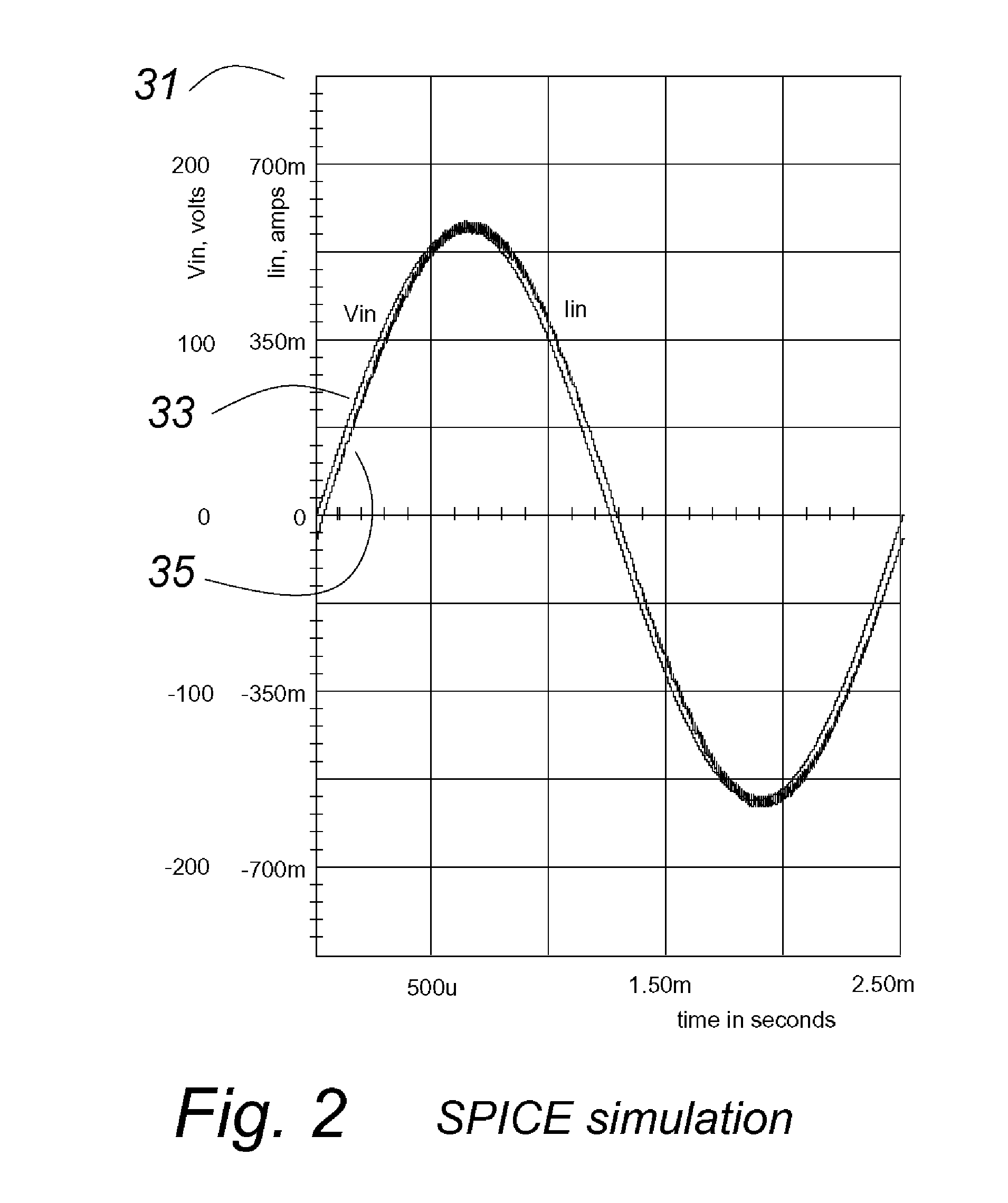
Three phase buck power converters having input current control
PatentInactiveUS7139180B1
Innovation
- A method and apparatus that control input currents without monitoring, using a single switching function in each phase to generate necessary voltage and currents, allowing a single inductor and capacitor to produce a high-quality dc output, with frequency response comparable to good dc-dc converters, and adaptable for both buck and boost converters.

Grid Integration Standards and Regulatory Framework
The integration of three-phase AC and DC power systems into modern electrical grids requires adherence to comprehensive regulatory frameworks that ensure safety, reliability, and interoperability. International standards organizations such as the International Electrotechnical Commission (IEC) and Institute of Electrical and Electronics Engineers (IEEE) have established fundamental guidelines governing voltage precision control across different power system architectures.
IEC 61000 series standards specifically address electromagnetic compatibility requirements for both AC and DC systems, establishing voltage quality parameters that directly impact precision control capabilities. These standards define acceptable voltage deviation limits, with three-phase systems typically allowing ±10% variation from nominal values, while DC systems often require tighter tolerances of ±5% for critical applications. The IEEE 1547 standard provides crucial interconnection requirements for distributed energy resources, establishing voltage regulation protocols that accommodate both AC and DC integration scenarios.
Regional regulatory bodies have developed complementary frameworks addressing grid integration challenges. The European Network of Transmission System Operators for Electricity (ENTSO-E) Grid Code establishes specific requirements for voltage control performance in three-phase systems, mandating response times and accuracy levels for grid-connected equipment. Similarly, the North American Electric Reliability Corporation (NERC) standards define voltage stability criteria that influence the design of precision control systems across different power architectures.
Emerging regulations increasingly focus on hybrid AC-DC grid configurations, recognizing the growing prevalence of DC microgrids and high-voltage direct current transmission systems. The IEC 62786 standard addresses distributed energy resource management systems, providing frameworks for coordinated voltage control between AC and DC domains. These standards emphasize the need for advanced control algorithms capable of maintaining voltage precision across system boundaries.
Compliance certification processes require extensive testing protocols that validate voltage precision control performance under various operating conditions. Type testing procedures defined in IEC 61850 ensure communication interoperability between different control systems, while functional safety standards such as IEC 61508 establish reliability requirements for critical voltage control functions in both three-phase and DC applications.
IEC 61000 series standards specifically address electromagnetic compatibility requirements for both AC and DC systems, establishing voltage quality parameters that directly impact precision control capabilities. These standards define acceptable voltage deviation limits, with three-phase systems typically allowing ±10% variation from nominal values, while DC systems often require tighter tolerances of ±5% for critical applications. The IEEE 1547 standard provides crucial interconnection requirements for distributed energy resources, establishing voltage regulation protocols that accommodate both AC and DC integration scenarios.
Regional regulatory bodies have developed complementary frameworks addressing grid integration challenges. The European Network of Transmission System Operators for Electricity (ENTSO-E) Grid Code establishes specific requirements for voltage control performance in three-phase systems, mandating response times and accuracy levels for grid-connected equipment. Similarly, the North American Electric Reliability Corporation (NERC) standards define voltage stability criteria that influence the design of precision control systems across different power architectures.
Emerging regulations increasingly focus on hybrid AC-DC grid configurations, recognizing the growing prevalence of DC microgrids and high-voltage direct current transmission systems. The IEC 62786 standard addresses distributed energy resource management systems, providing frameworks for coordinated voltage control between AC and DC domains. These standards emphasize the need for advanced control algorithms capable of maintaining voltage precision across system boundaries.
Compliance certification processes require extensive testing protocols that validate voltage precision control performance under various operating conditions. Type testing procedures defined in IEC 61850 ensure communication interoperability between different control systems, while functional safety standards such as IEC 61508 establish reliability requirements for critical voltage control functions in both three-phase and DC applications.
Energy Efficiency and Environmental Impact Assessment
Energy efficiency represents a critical differentiator between three-phase AC and DC voltage precision control systems, with implications extending far beyond operational costs. Three-phase AC systems demonstrate superior efficiency in power transmission over long distances, typically achieving 92-96% efficiency in industrial applications. The inherent balance of three-phase systems reduces neutral current and minimizes power losses, while sophisticated control algorithms enable precise voltage regulation with minimal energy waste. Modern three-phase inverters and motor drives incorporate advanced switching techniques that optimize power conversion efficiency while maintaining tight voltage control tolerances.
DC voltage precision control systems exhibit varying efficiency profiles depending on application context. In localized applications such as data centers and electric vehicle charging, DC systems can achieve efficiencies exceeding 98% by eliminating AC-DC conversion losses. However, DC transmission systems require complex voltage regulation circuits that may introduce additional power losses, particularly in high-precision control scenarios where multiple conversion stages are necessary.
The environmental impact assessment reveals significant differences between these technologies. Three-phase AC systems benefit from established grid infrastructure, reducing the need for extensive new installations and associated environmental disruption. The mature manufacturing ecosystem for AC components results in lower embodied carbon footprints and established recycling pathways. Additionally, three-phase systems' compatibility with renewable energy sources through grid-tie inverters facilitates sustainable energy integration.
DC systems present a mixed environmental profile. While they offer reduced electromagnetic interference and eliminate harmonic distortion issues common in AC systems, the manufacturing of high-precision DC control components often requires rare earth materials and specialized semiconductors with higher environmental extraction costs. However, DC systems' direct compatibility with solar panels and battery storage systems positions them favorably for distributed renewable energy applications.
Lifecycle environmental assessments indicate that three-phase AC systems typically demonstrate lower overall environmental impact in large-scale industrial applications, while DC systems show advantages in specific applications where direct renewable integration and minimal conversion losses are prioritized. The choice between technologies increasingly depends on the specific application context and long-term sustainability objectives.
DC voltage precision control systems exhibit varying efficiency profiles depending on application context. In localized applications such as data centers and electric vehicle charging, DC systems can achieve efficiencies exceeding 98% by eliminating AC-DC conversion losses. However, DC transmission systems require complex voltage regulation circuits that may introduce additional power losses, particularly in high-precision control scenarios where multiple conversion stages are necessary.
The environmental impact assessment reveals significant differences between these technologies. Three-phase AC systems benefit from established grid infrastructure, reducing the need for extensive new installations and associated environmental disruption. The mature manufacturing ecosystem for AC components results in lower embodied carbon footprints and established recycling pathways. Additionally, three-phase systems' compatibility with renewable energy sources through grid-tie inverters facilitates sustainable energy integration.
DC systems present a mixed environmental profile. While they offer reduced electromagnetic interference and eliminate harmonic distortion issues common in AC systems, the manufacturing of high-precision DC control components often requires rare earth materials and specialized semiconductors with higher environmental extraction costs. However, DC systems' direct compatibility with solar panels and battery storage systems positions them favorably for distributed renewable energy applications.
Lifecycle environmental assessments indicate that three-phase AC systems typically demonstrate lower overall environmental impact in large-scale industrial applications, while DC systems show advantages in specific applications where direct renewable integration and minimal conversion losses are prioritized. The choice between technologies increasingly depends on the specific application context and long-term sustainability objectives.
Unlock deeper insights with Patsnap Eureka Quick Research — get a full tech report to explore trends and direct your research. Try now!
Generate Your Research Report Instantly with AI Agent
Supercharge your innovation with Patsnap Eureka AI Agent Platform!