
Validate Electrode Design in Ion Selective Electrode for Optimal Response
MAR 8, 20268 MIN READ
Generate Your Research Report Instantly with AI Agent
Patsnap Eureka helps you evaluate technical feasibility & market potential.
Ion Selective Electrode Design Background and Objectives
Ion selective electrodes (ISEs) represent a cornerstone technology in analytical chemistry, enabling precise measurement of specific ion concentrations in complex solutions. The development of ISEs traces back to the early 20th century with the introduction of the glass pH electrode, which demonstrated the fundamental principle of selective ion detection through membrane potential changes. Over subsequent decades, the technology evolved from simple glass membranes to sophisticated polymer-based and solid-state designs, incorporating various ionophores and selective materials.
The evolution of ISE technology has been driven by increasing demands for accuracy, selectivity, and stability across diverse applications. Early developments focused primarily on pH measurement, but technological advances expanded capabilities to detect a wide range of ions including sodium, potassium, calcium, chloride, and numerous other species. Modern ISE designs incorporate advanced materials science, nanotechnology, and sophisticated membrane chemistry to achieve unprecedented levels of performance.
Current technological objectives center on optimizing electrode response characteristics through systematic design validation. The primary goal involves achieving optimal sensitivity, defined as the electrode's ability to produce measurable potential changes in response to target ion concentration variations. Selectivity represents another critical objective, ensuring minimal interference from competing ions in complex sample matrices. Response time optimization aims to reduce the duration required for stable potential readings, enhancing analytical throughput.
Stability and reproducibility constitute fundamental design targets, requiring electrodes to maintain consistent performance over extended periods and multiple measurement cycles. Long-term drift minimization ensures reliable measurements across the electrode's operational lifetime. Temperature compensation mechanisms represent an essential objective, enabling accurate measurements across varying environmental conditions.
The validation process encompasses comprehensive evaluation of electrode performance parameters including detection limits, linear response ranges, and interference coefficients. Design optimization targets the integration of advanced membrane materials, reference electrode configurations, and signal conditioning electronics to achieve superior analytical performance. These objectives collectively drive the development of next-generation ISE technologies capable of meeting increasingly stringent analytical requirements across pharmaceutical, environmental, clinical, and industrial applications.
The evolution of ISE technology has been driven by increasing demands for accuracy, selectivity, and stability across diverse applications. Early developments focused primarily on pH measurement, but technological advances expanded capabilities to detect a wide range of ions including sodium, potassium, calcium, chloride, and numerous other species. Modern ISE designs incorporate advanced materials science, nanotechnology, and sophisticated membrane chemistry to achieve unprecedented levels of performance.
Current technological objectives center on optimizing electrode response characteristics through systematic design validation. The primary goal involves achieving optimal sensitivity, defined as the electrode's ability to produce measurable potential changes in response to target ion concentration variations. Selectivity represents another critical objective, ensuring minimal interference from competing ions in complex sample matrices. Response time optimization aims to reduce the duration required for stable potential readings, enhancing analytical throughput.
Stability and reproducibility constitute fundamental design targets, requiring electrodes to maintain consistent performance over extended periods and multiple measurement cycles. Long-term drift minimization ensures reliable measurements across the electrode's operational lifetime. Temperature compensation mechanisms represent an essential objective, enabling accurate measurements across varying environmental conditions.
The validation process encompasses comprehensive evaluation of electrode performance parameters including detection limits, linear response ranges, and interference coefficients. Design optimization targets the integration of advanced membrane materials, reference electrode configurations, and signal conditioning electronics to achieve superior analytical performance. These objectives collectively drive the development of next-generation ISE technologies capable of meeting increasingly stringent analytical requirements across pharmaceutical, environmental, clinical, and industrial applications.
Market Demand for Advanced ISE Applications
The global market for ion selective electrodes demonstrates robust growth driven by expanding applications across multiple industrial sectors. Environmental monitoring represents the largest application segment, where ISEs enable real-time detection of pollutants, heavy metals, and nutrient levels in water bodies. Regulatory compliance requirements for water quality assessment continue to drive demand for more accurate and reliable electrode designs.
Healthcare and clinical diagnostics constitute another significant market driver, with ISEs playing crucial roles in blood gas analysis, electrolyte monitoring, and point-of-care testing devices. The increasing prevalence of chronic diseases requiring continuous monitoring has amplified the need for miniaturized, high-performance electrodes with enhanced selectivity and stability.
Industrial process control applications are experiencing accelerated adoption of advanced ISE technologies. Chemical manufacturing, pharmaceutical production, and food processing industries require precise ion concentration monitoring to maintain product quality and process efficiency. These applications demand electrodes capable of operating under harsh conditions while maintaining measurement accuracy over extended periods.
The agricultural sector presents emerging opportunities for ISE applications in precision farming and soil analysis. Smart irrigation systems and nutrient management platforms increasingly rely on ISE-based sensors to optimize crop yields and reduce environmental impact. This trend is particularly pronounced in regions facing water scarcity and soil degradation challenges.
Technological convergence with Internet of Things platforms and wireless sensor networks is creating new market segments for ISE applications. Remote monitoring capabilities and data analytics integration are becoming essential requirements, driving demand for electrodes with enhanced digital connectivity and long-term operational reliability.
Market growth is further supported by increasing awareness of environmental sustainability and the need for continuous monitoring systems in smart cities initiatives. Water treatment facilities, waste management systems, and urban environmental monitoring networks represent substantial growth opportunities for advanced ISE technologies with optimized electrode designs.
Healthcare and clinical diagnostics constitute another significant market driver, with ISEs playing crucial roles in blood gas analysis, electrolyte monitoring, and point-of-care testing devices. The increasing prevalence of chronic diseases requiring continuous monitoring has amplified the need for miniaturized, high-performance electrodes with enhanced selectivity and stability.
Industrial process control applications are experiencing accelerated adoption of advanced ISE technologies. Chemical manufacturing, pharmaceutical production, and food processing industries require precise ion concentration monitoring to maintain product quality and process efficiency. These applications demand electrodes capable of operating under harsh conditions while maintaining measurement accuracy over extended periods.
The agricultural sector presents emerging opportunities for ISE applications in precision farming and soil analysis. Smart irrigation systems and nutrient management platforms increasingly rely on ISE-based sensors to optimize crop yields and reduce environmental impact. This trend is particularly pronounced in regions facing water scarcity and soil degradation challenges.
Technological convergence with Internet of Things platforms and wireless sensor networks is creating new market segments for ISE applications. Remote monitoring capabilities and data analytics integration are becoming essential requirements, driving demand for electrodes with enhanced digital connectivity and long-term operational reliability.
Market growth is further supported by increasing awareness of environmental sustainability and the need for continuous monitoring systems in smart cities initiatives. Water treatment facilities, waste management systems, and urban environmental monitoring networks represent substantial growth opportunities for advanced ISE technologies with optimized electrode designs.
Current ISE Design Challenges and Performance Limitations
Ion selective electrodes face significant design challenges that directly impact their analytical performance and practical applicability. The fundamental limitation stems from the complex interplay between membrane composition, electrode geometry, and electrochemical interface properties, which collectively determine the electrode's selectivity, sensitivity, and stability characteristics.
Membrane selectivity represents one of the most critical design constraints in ISE development. Traditional ion-selective membranes often suffer from interference from competing ions, particularly in complex sample matrices. The selectivity coefficient, which quantifies the electrode's preference for the target ion over interfering species, remains suboptimal for many commercially available electrodes. This limitation becomes particularly pronounced when analyzing samples containing high concentrations of interfering ions or when detecting trace levels of target analytes.
Response time and signal stability constitute another major performance bottleneck. Many ISE designs exhibit sluggish response kinetics, requiring several minutes to reach steady-state potential readings. This slow response is often attributed to inadequate ion transport kinetics within the membrane phase or poor electrical contact between the membrane and internal reference system. Additionally, signal drift over time compromises measurement accuracy, particularly in continuous monitoring applications.
The narrow linear dynamic range of conventional ISEs limits their versatility across different analytical scenarios. Most electrodes demonstrate optimal performance within a restricted concentration window, typically spanning 2-3 orders of magnitude. Beyond this range, the electrode response deviates from ideal Nernstian behavior, resulting in reduced sensitivity and measurement precision.
Temperature dependence and pH sensitivity further complicate ISE performance optimization. Electrode potential varies significantly with temperature changes, requiring complex compensation algorithms or controlled measurement conditions. Similarly, pH fluctuations can alter membrane properties and interfere with ion recognition mechanisms, particularly for electrodes targeting weakly charged species.
Manufacturing reproducibility and long-term stability present ongoing challenges for ISE commercialization. Batch-to-batch variations in membrane composition and electrode assembly procedures result in inconsistent performance characteristics. Moreover, membrane degradation, reference electrode contamination, and mechanical wear limit the operational lifespan of ISE devices.
Detection limit constraints restrict ISE applications in trace analysis scenarios. While some specialized electrodes achieve nanomolar detection limits, most commercial ISEs are limited to micromolar or higher concentrations due to background noise, membrane leakage, and interference effects.
Membrane selectivity represents one of the most critical design constraints in ISE development. Traditional ion-selective membranes often suffer from interference from competing ions, particularly in complex sample matrices. The selectivity coefficient, which quantifies the electrode's preference for the target ion over interfering species, remains suboptimal for many commercially available electrodes. This limitation becomes particularly pronounced when analyzing samples containing high concentrations of interfering ions or when detecting trace levels of target analytes.
Response time and signal stability constitute another major performance bottleneck. Many ISE designs exhibit sluggish response kinetics, requiring several minutes to reach steady-state potential readings. This slow response is often attributed to inadequate ion transport kinetics within the membrane phase or poor electrical contact between the membrane and internal reference system. Additionally, signal drift over time compromises measurement accuracy, particularly in continuous monitoring applications.
The narrow linear dynamic range of conventional ISEs limits their versatility across different analytical scenarios. Most electrodes demonstrate optimal performance within a restricted concentration window, typically spanning 2-3 orders of magnitude. Beyond this range, the electrode response deviates from ideal Nernstian behavior, resulting in reduced sensitivity and measurement precision.
Temperature dependence and pH sensitivity further complicate ISE performance optimization. Electrode potential varies significantly with temperature changes, requiring complex compensation algorithms or controlled measurement conditions. Similarly, pH fluctuations can alter membrane properties and interfere with ion recognition mechanisms, particularly for electrodes targeting weakly charged species.
Manufacturing reproducibility and long-term stability present ongoing challenges for ISE commercialization. Batch-to-batch variations in membrane composition and electrode assembly procedures result in inconsistent performance characteristics. Moreover, membrane degradation, reference electrode contamination, and mechanical wear limit the operational lifespan of ISE devices.
Detection limit constraints restrict ISE applications in trace analysis scenarios. While some specialized electrodes achieve nanomolar detection limits, most commercial ISEs are limited to micromolar or higher concentrations due to background noise, membrane leakage, and interference effects.
Current Electrode Design Validation Methods
01 Ion-selective membrane composition and structure
Ion-selective electrodes utilize specialized membrane compositions to achieve selective response to target ions. These membranes typically incorporate ionophores, plasticizers, and polymer matrices that provide selective permeability and binding sites for specific ions. The membrane structure and composition directly influence the electrode's selectivity, sensitivity, and response characteristics.- Ion-selective membrane composition and structure: Ion-selective electrodes utilize specialized membrane compositions to achieve selective response to target ions. These membranes typically incorporate ionophores, plasticizers, and polymer matrices that provide selective permeability and binding sites for specific ions. The membrane structure and composition directly influence the electrode's selectivity, sensitivity, and response characteristics.
- Electrode response time and stability optimization: The response time and stability of ion-selective electrodes are critical performance parameters that can be optimized through various design approaches. These include controlling membrane thickness, adjusting internal filling solutions, and incorporating stabilizing agents. Improved response characteristics enable faster measurements and more reliable long-term performance in analytical applications.
- Interference reduction and selectivity enhancement: Methods for reducing interference from non-target ions and enhancing selectivity involve the use of specific ionophores, membrane additives, and electrode configurations. These approaches minimize cross-sensitivity to interfering ions and improve the accuracy of measurements in complex sample matrices. Selectivity coefficients can be optimized through careful selection of membrane components.
- Calibration and signal processing methods: Advanced calibration techniques and signal processing algorithms are employed to improve the accuracy and linearity of ion-selective electrode responses. These methods include multi-point calibration, temperature compensation, and digital signal processing to correct for drift and non-ideal behavior. Proper calibration procedures ensure reliable quantitative measurements across wide concentration ranges.
- Novel electrode designs and miniaturization: Recent developments in ion-selective electrode technology include miniaturized designs, solid-state configurations, and integration with microfluidic systems. These innovations enable portable analytical devices, reduced sample volumes, and improved ease of use. Novel electrode architectures also address challenges related to durability, maintenance, and field deployment.
02 Electrode response time and stability optimization
The response time and stability of ion-selective electrodes are critical performance parameters that can be optimized through various design approaches. These include controlling membrane thickness, adjusting internal filling solutions, and incorporating stabilizing agents. Improved response characteristics enable faster measurements and more reliable long-term performance in analytical applications.Expand Specific Solutions03 Interference reduction and selectivity enhancement
Methods for reducing interference from non-target ions and enhancing selectivity involve the use of specific ionophores, membrane additives, and electrode configurations. These approaches minimize cross-sensitivity to interfering ions while maintaining high sensitivity to the target analyte, thereby improving the accuracy and reliability of measurements in complex sample matrices.Expand Specific Solutions04 Calibration and signal processing methods
Advanced calibration techniques and signal processing algorithms are employed to improve the accuracy and linearity of ion-selective electrode responses. These methods include multi-point calibration, temperature compensation, and digital signal processing to correct for drift and non-ideal electrode behavior, enabling more precise quantitative measurements across wide concentration ranges.Expand Specific Solutions05 Miniaturization and integration technologies
Modern ion-selective electrodes incorporate miniaturization and integration technologies to enable portable and automated analytical systems. These developments include micro-fabricated electrodes, solid-state designs, and integration with electronic readout circuits. Such advances facilitate point-of-care testing, continuous monitoring applications, and multi-analyte detection systems.Expand Specific Solutions
Key Players in ISE and Electrochemical Sensor Industry
The ion selective electrode (ISE) market represents a mature technology sector experiencing steady growth driven by expanding applications in environmental monitoring, clinical diagnostics, and industrial process control. The industry has evolved from early research phases into commercial maturity, with market size reaching several hundred million dollars globally and projected continued expansion due to increasing demand for real-time analytical solutions. Technology maturity varies significantly across market players, with established companies like Horiba Ltd., Metrohm AG, and FUJIFILM Corp. demonstrating advanced electrode design capabilities and comprehensive product portfolios. Emerging players such as Guangzhou Yuxin Sensor Technology and Unisense A/S are driving innovation in specialized applications and microsensor technologies. Academic institutions including Zhejiang University, Tokyo University of Science, and Sichuan University contribute fundamental research advancing electrode materials and design optimization, while companies like A&T Corp. and Canon Medical Systems focus on integrating ISE technology into broader analytical platforms for enhanced performance and market penetration.
Horiba Ltd.
Technical Solution: Horiba has developed advanced ion selective electrode validation systems incorporating multi-parameter calibration protocols and automated response optimization algorithms. Their electrode design validation approach utilizes proprietary membrane composition analysis combined with real-time impedance spectroscopy to ensure optimal selectivity coefficients. The company's validation framework includes temperature compensation mechanisms, drift correction algorithms, and automated quality control procedures that can detect electrode degradation patterns. Their systems feature integrated data logging capabilities with statistical analysis tools for response time optimization and long-term stability assessment. The validation process incorporates machine learning algorithms to predict electrode performance under various environmental conditions and sample matrices.
Strengths: Comprehensive automated validation systems with advanced data analytics capabilities. Weaknesses: High cost implementation and complex system integration requirements.
Hitachi High-Tech America, Inc.
Technical Solution: Hitachi High-Tech has developed comprehensive electrode validation systems integrating advanced analytical instrumentation with automated testing protocols. Their validation approach combines electron microscopy characterization with electrochemical impedance spectroscopy for complete electrode surface analysis. The company's methodology includes automated response time measurement, selectivity coefficient determination, and interference testing across multiple ion species. Their validation framework incorporates machine learning algorithms for predictive maintenance and performance optimization, with real-time monitoring capabilities for electrode degradation detection. The system features integrated data management platforms with statistical analysis tools for comprehensive electrode performance evaluation and quality assurance protocols.
Strengths: Advanced analytical instrumentation integration with comprehensive characterization capabilities. Weaknesses: High equipment costs and specialized technical expertise requirements.
Core Innovations in ISE Electrode Optimization
Ion-selective electrodes
PatentInactiveEP1751531A1
Innovation
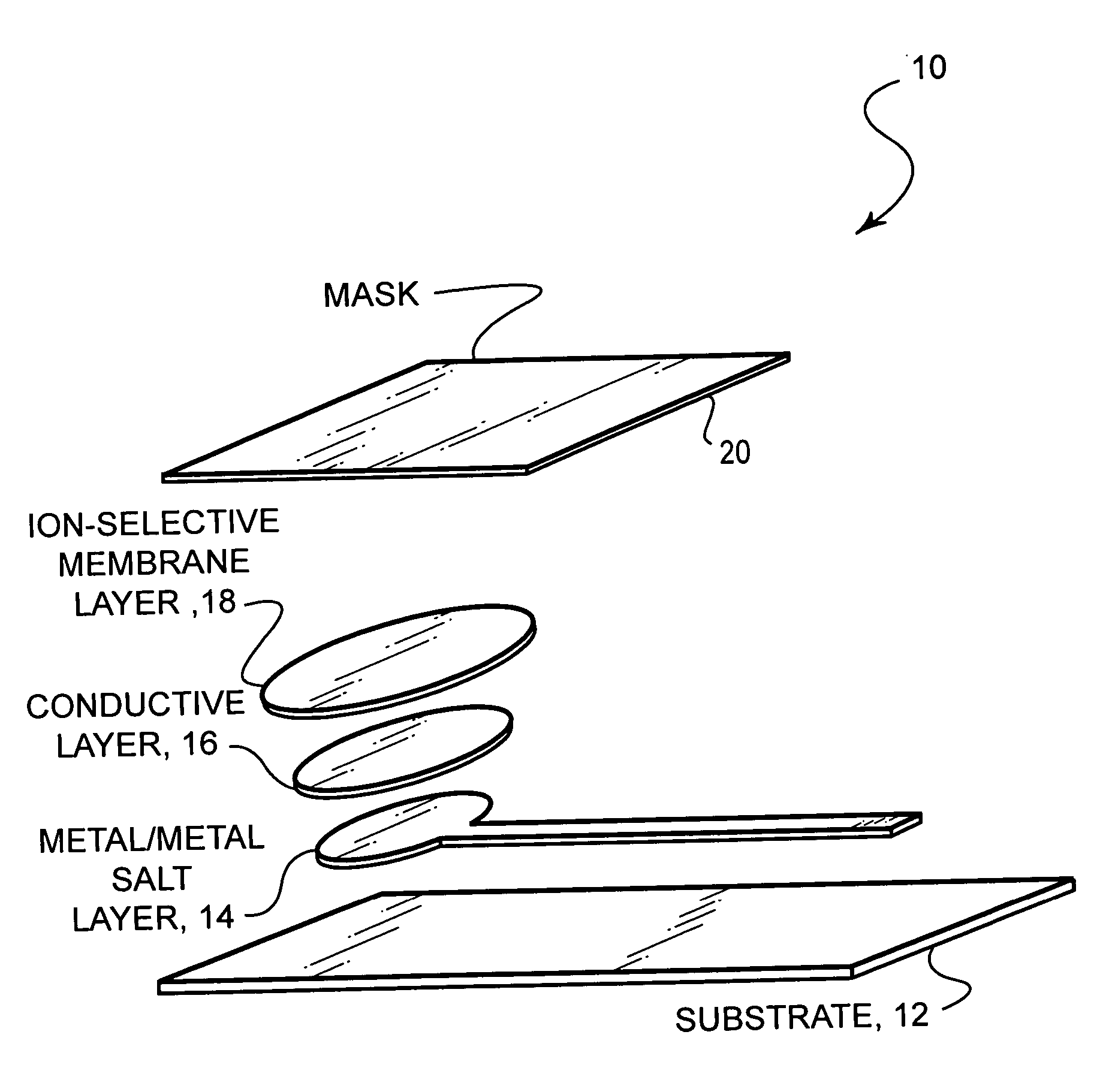
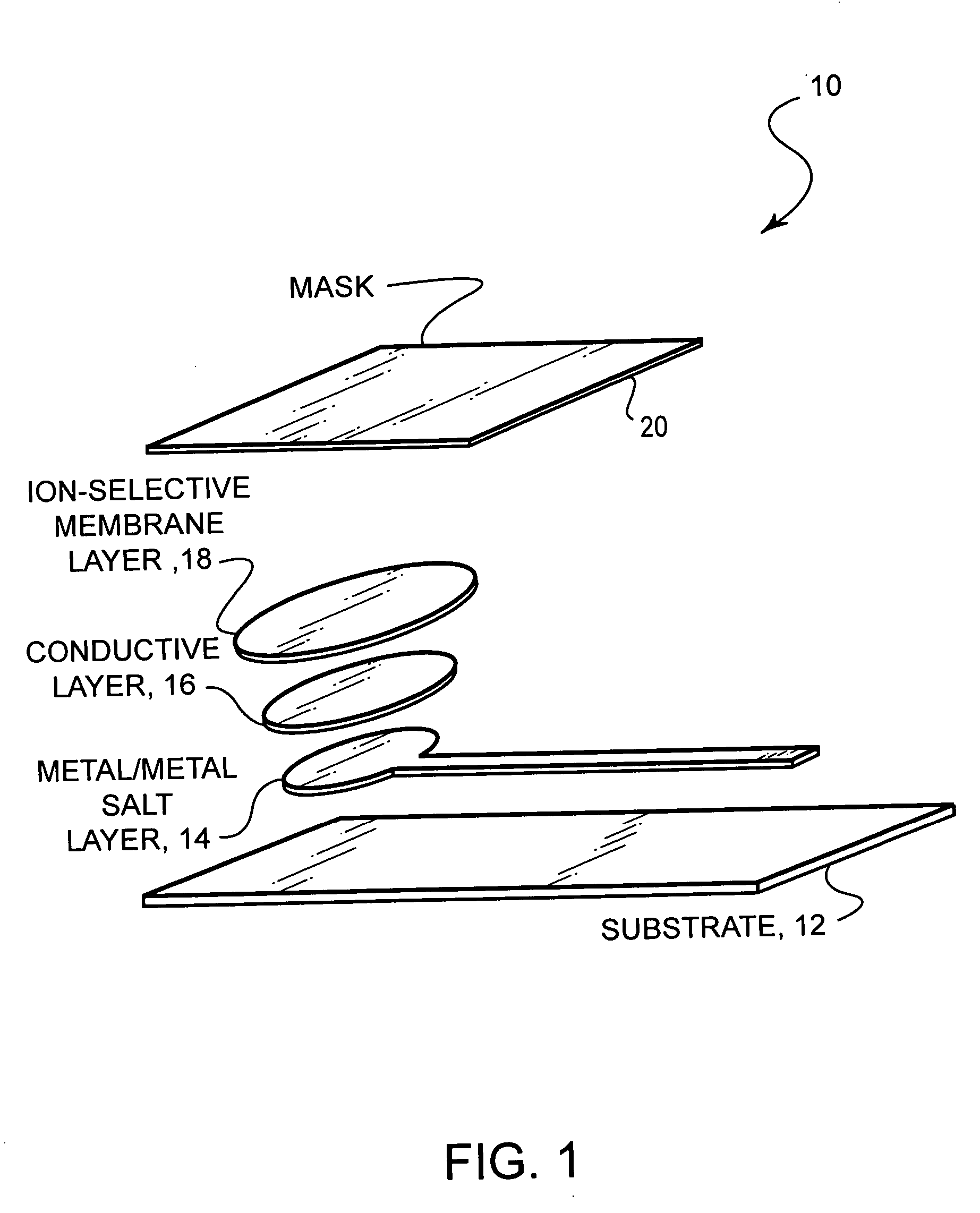
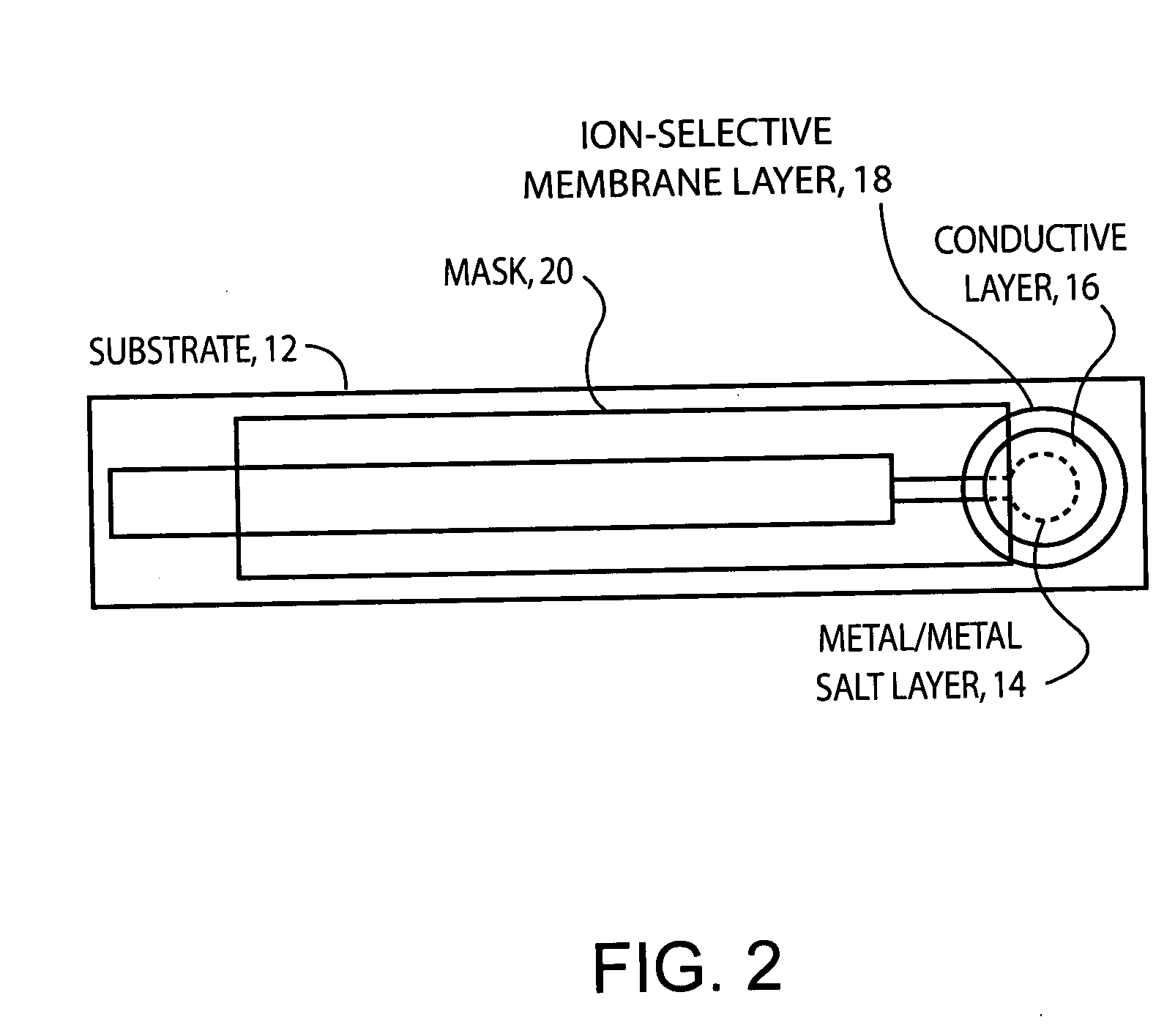
- A stable, multi-layer ion-selective electrode design featuring a water-impermeable substrate, an electrically conductive metal/metal salt layer, a hydrophobic conductive layer with ions for rapid potential establishment, an ion-selective layer, and a water-impermeable barrier layer, eliminating the need for calibration and reducing equilibration time.
Ion-selective electrodes
PatentInactiveUS20050191428A1
Innovation
- A stable, compact ion-selective electrode design featuring a water-impermeable substrate, an electrically conductive metal/metal salt layer, a hydrophobic conductive layer with ions for stable potential, an ion-selective layer, and a water-impermeable barrier layer to prevent exposure to aqueous solutions, eliminating the need for calibration and reducing equilibration time.

Quality Standards for Electrochemical Sensors
Quality standards for electrochemical sensors, particularly ion selective electrodes (ISEs), represent a critical framework that ensures consistent performance, reliability, and accuracy across diverse applications. These standards encompass multiple dimensions including analytical performance criteria, manufacturing specifications, and operational validation protocols that collectively define the benchmark for acceptable sensor behavior.
The International Union of Pure and Applied Chemistry (IUPAC) has established fundamental guidelines for ISE performance evaluation, defining key parameters such as detection limit, linear range, selectivity coefficients, and response time. These specifications typically require detection limits in the micromolar to nanomolar range, linear responses spanning at least three orders of magnitude, and response times under 30 seconds for 90% signal stabilization. Additionally, slope requirements mandate near-Nernstian behavior with deviations not exceeding ±5% from theoretical values.
Manufacturing quality standards focus on electrode construction consistency, membrane composition uniformity, and reference electrode stability. ISO 14644 cleanroom standards often apply to sensor fabrication environments, ensuring contamination-free production processes. Material specifications require high-purity ionophores, plasticizers, and polymer matrices with documented batch-to-batch variability limits typically below 2% for critical components.
Calibration and validation protocols constitute another essential quality dimension, requiring multi-point calibration procedures with certified reference materials traceable to international standards. Quality control measures mandate regular performance verification using standard solutions, with acceptance criteria typically including slope stability within ±2 mV/decade over specified time periods and baseline drift limitations below 0.5 mV/hour.
Environmental testing standards ensure sensor reliability across operational conditions, including temperature cycling from -10°C to 60°C, humidity exposure up to 95% relative humidity, and electromagnetic compatibility testing per IEC 61326 standards. These comprehensive quality frameworks ultimately enable consistent sensor performance validation and support regulatory compliance across pharmaceutical, environmental, and industrial applications.
The International Union of Pure and Applied Chemistry (IUPAC) has established fundamental guidelines for ISE performance evaluation, defining key parameters such as detection limit, linear range, selectivity coefficients, and response time. These specifications typically require detection limits in the micromolar to nanomolar range, linear responses spanning at least three orders of magnitude, and response times under 30 seconds for 90% signal stabilization. Additionally, slope requirements mandate near-Nernstian behavior with deviations not exceeding ±5% from theoretical values.
Manufacturing quality standards focus on electrode construction consistency, membrane composition uniformity, and reference electrode stability. ISO 14644 cleanroom standards often apply to sensor fabrication environments, ensuring contamination-free production processes. Material specifications require high-purity ionophores, plasticizers, and polymer matrices with documented batch-to-batch variability limits typically below 2% for critical components.
Calibration and validation protocols constitute another essential quality dimension, requiring multi-point calibration procedures with certified reference materials traceable to international standards. Quality control measures mandate regular performance verification using standard solutions, with acceptance criteria typically including slope stability within ±2 mV/decade over specified time periods and baseline drift limitations below 0.5 mV/hour.
Environmental testing standards ensure sensor reliability across operational conditions, including temperature cycling from -10°C to 60°C, humidity exposure up to 95% relative humidity, and electromagnetic compatibility testing per IEC 61326 standards. These comprehensive quality frameworks ultimately enable consistent sensor performance validation and support regulatory compliance across pharmaceutical, environmental, and industrial applications.
Environmental Impact of ISE Manufacturing
The manufacturing of ion selective electrodes presents significant environmental challenges that require careful consideration throughout the production lifecycle. Traditional ISE manufacturing processes often involve the use of hazardous chemicals, including organic solvents for membrane preparation, heavy metals for reference electrodes, and various plasticizers that can pose environmental risks if not properly managed.
The production of ISE membranes typically requires polyvinyl chloride (PVC) as the base material, combined with plasticizers such as dioctyl phthalate or nitrophenyl octyl ether. These compounds can contribute to volatile organic compound (VOC) emissions during manufacturing and may persist in the environment if released. Additionally, the synthesis of ionophores and ion exchangers often involves complex organic chemistry processes that generate chemical waste streams requiring specialized treatment.
Water consumption represents another critical environmental factor in ISE manufacturing. The production process demands high-purity water for cleaning, rinsing, and quality control procedures. Wastewater generated during manufacturing may contain residual chemicals, requiring advanced treatment systems to meet environmental discharge standards. The energy-intensive purification processes further contribute to the overall environmental footprint.
Packaging and transportation of ISEs also contribute to environmental impact through material consumption and carbon emissions. The need for protective packaging to maintain electrode integrity during shipping often involves non-recyclable materials, while the global distribution network generates significant transportation-related emissions.
Recent industry initiatives focus on developing greener manufacturing approaches, including solvent-free membrane preparation techniques, biodegradable plasticizers, and closed-loop water systems. Some manufacturers are exploring alternative materials such as bio-based polymers and implementing lean manufacturing principles to minimize waste generation. Life cycle assessment studies indicate that optimizing electrode design for longer operational lifespans can significantly reduce the per-use environmental impact, making design validation crucial not only for performance but also for sustainability considerations.
The production of ISE membranes typically requires polyvinyl chloride (PVC) as the base material, combined with plasticizers such as dioctyl phthalate or nitrophenyl octyl ether. These compounds can contribute to volatile organic compound (VOC) emissions during manufacturing and may persist in the environment if released. Additionally, the synthesis of ionophores and ion exchangers often involves complex organic chemistry processes that generate chemical waste streams requiring specialized treatment.
Water consumption represents another critical environmental factor in ISE manufacturing. The production process demands high-purity water for cleaning, rinsing, and quality control procedures. Wastewater generated during manufacturing may contain residual chemicals, requiring advanced treatment systems to meet environmental discharge standards. The energy-intensive purification processes further contribute to the overall environmental footprint.
Packaging and transportation of ISEs also contribute to environmental impact through material consumption and carbon emissions. The need for protective packaging to maintain electrode integrity during shipping often involves non-recyclable materials, while the global distribution network generates significant transportation-related emissions.
Recent industry initiatives focus on developing greener manufacturing approaches, including solvent-free membrane preparation techniques, biodegradable plasticizers, and closed-loop water systems. Some manufacturers are exploring alternative materials such as bio-based polymers and implementing lean manufacturing principles to minimize waste generation. Life cycle assessment studies indicate that optimizing electrode design for longer operational lifespans can significantly reduce the per-use environmental impact, making design validation crucial not only for performance but also for sustainability considerations.
Unlock deeper insights with Patsnap Eureka Quick Research — get a full tech report to explore trends and direct your research. Try now!
Generate Your Research Report Instantly with AI Agent
Supercharge your innovation with Patsnap Eureka AI Agent Platform!