
Bonded and fixed bite plate
An occlusal plate and retention technology, applied in the medical field, can solve problems such as tooth germ damage and oral trauma, and achieve the effect of reducing joint pressure, less irritation, and good biocompatibility
Patent Information
- Authority / Receiving Office
- CN · China
- Patent Type
- Applications(China)
- Current Assignee / Owner
- Publication Date
- 2017-10-31
Smart Images
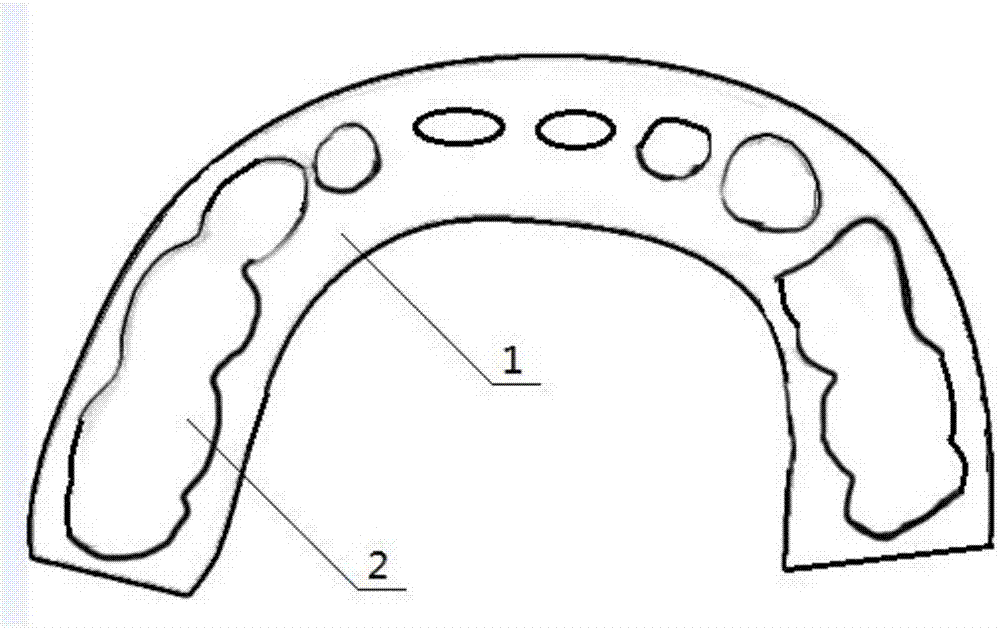
Figure 1 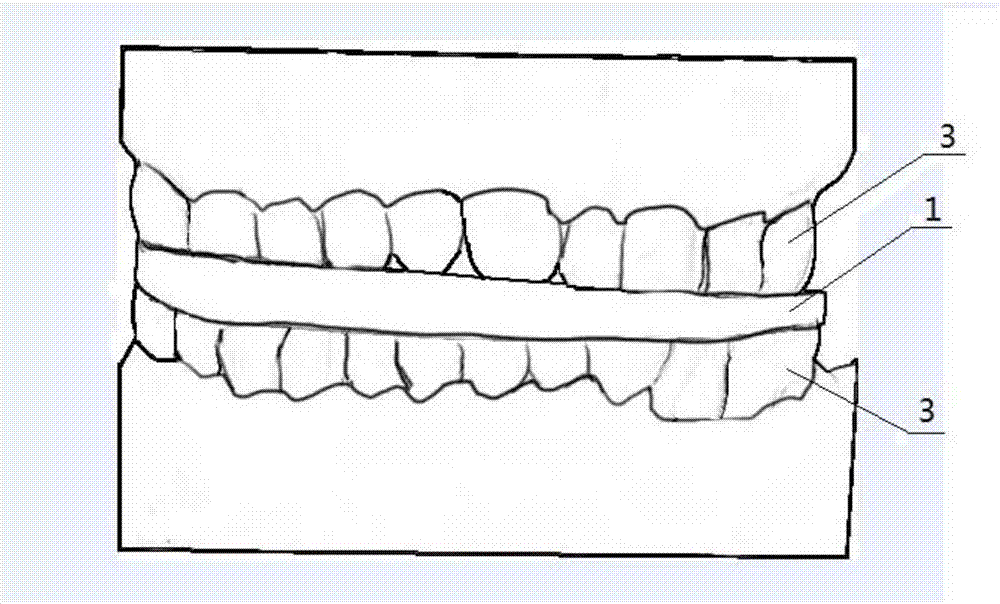
Figure 2
Abstract
Description
technical field
[0001] The invention relates to the field of medical technology, in particular to a bonded and retained dental splint. Background technique
[0002] Temporomandibular joint ankylosis and condylar idiopathic resorption are the two most common diseases in the temporomandibular joint area, which are difficult to treat and have high risks, and these patients are often accompanied by jaw deformities. These conditions are generally treated with temporomandibular joint reconstruction surgery. In joint reconstruction surgery, it is necessary to position the patient's occlusion to stabilize the position of the patient's mandible, thereby completing the reconstruction of the temporomandibular joint.
[0003] The traditional method of stabilizing the occlusion is to obtain the patient's dentition model before the operation, and make the occlusal plate according to the final occlusal position of the patient's jaw. However, patients with temporomandibular joint ankylosi...
Examples
Embodiment Construction
[0017] The present invention will be further described in detail below with reference to the accompanying drawings and in combination with specific embodiments.
[0018] The embodiment of the present invention is a bonding-retained occlusal splint, in this embodiment:
[0019] like figure 1 and figure 2 As shown, the bonded and retained occlusal plate 1 forms a depression 2 inwardly, covering the occlusal surface of the patient's upper and lower jaw dentition 3. A gap is left, and the gap is filled with adhesive, and the occlusal plate is bonded and fixed to the patient's tooth surface through the adhesive. Through the bonding and retention design of the occlusal plate, the occlusal plate can be fixed on the patient’s tooth surface without trauma, which saves the cumbersome operation of using steel wires or screws for the occlusal plate in the prior art, and saves operation time. It is simple and convenient, and especially avoids the risk of damaging the tooth germs of inf...