
Method of correcting printer spectrum characterization model
A spectral feature and printer technology, applied in color/spectral feature measurement, printing, computer parts, etc., can solve the problems of waste of consumables such as ink and paper, reduced accuracy of spectral characterization models, and inconformity with energy conservation and environmental protection. Effects of waste and inconvenience, compensation for loss of accuracy
Patent Information
- Authority / Receiving Office
- CN · China
- Patent Type
- Applications(China)
- Current Assignee / Owner
- Publication Date
- 2011-09-14
- Estimated Expiration
- Not applicable · inactive patent
Smart Images
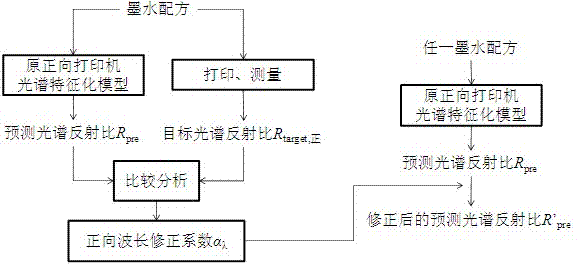
Figure 1 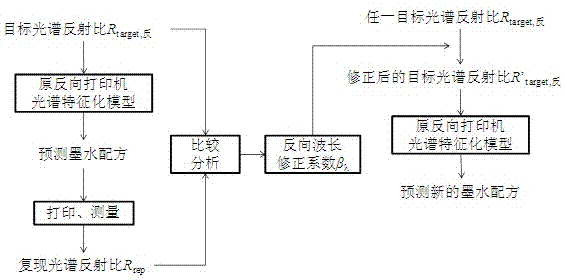
Figure 2 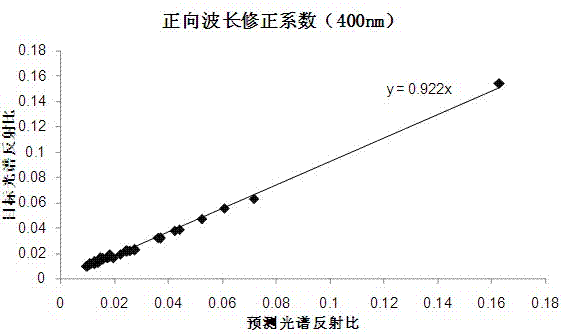
Figure 3
Abstract
Description
technical field
[0001] The invention relates to a method for correcting a spectral characterization model of a printer, in particular to a method for correcting a reduction in the precision of a spectral characterization model caused by printing environment changes such as different inks, papers, temperature and air humidity. Background technique
[0002] Printer spectral characterization models typically include both positive and negative directions. The forward spectral characterization model refers to the establishment of the relationship between the device-related ink formulation (such as digital device drive values of cyan, magenta, yellow, and black) and the device-independent spectral reflectance; conversely, it is called Characterize the model for the inverse spectrum. Since one often expects a certain color to be available through printing, the reverse model is generally more practical. The establishment of printer spectral characterization models often requires...
Examples
Embodiment
[0031] Taking a CMYK (cyan, magenta, yellow, black) four-ink printer as an example, the specific implementation method of the above characterization model correction method is described. It should be noted that the present invention is not limited to four-ink printers, and is applicable to correction of spectrum-based characterization models of various multi-ink printers.
[0032] The establishment of a printer spectral characterization model based on a certain printing environment is a prerequisite for model correction. There are two types of forward spectral characterization models for printers: model method and empirical method. The model method is to simulate the coloring mechanism of the equipment through a physical model, and establish the corresponding relationship between the ink formula and the spectral reflectance, such as the Kubelka-Munk model, the Clapper-Yule model, the Neugebauer model, and the Cellular Yule-Nielsen Neugebauer model. Orientation models are ofte...