
Catalyst for synthesis of methyl methacrylate by formaldehyde and methyl propionate and preparation method of catalyst
A technology of methyl methacrylate and methyl propionate, which is applied in the field of catalysts for synthesizing methyl methacrylate, can solve the problems of low reaction activity, achieve simple preparation methods, improve physical and chemical properties, improve selectivity and Yield effect
Patent Information
- Authority / Receiving Office
- CN · China
- Patent Type
- Patents(China)
- Current Assignee / Owner
- Publication Date
- 2014-09-17
Smart Images
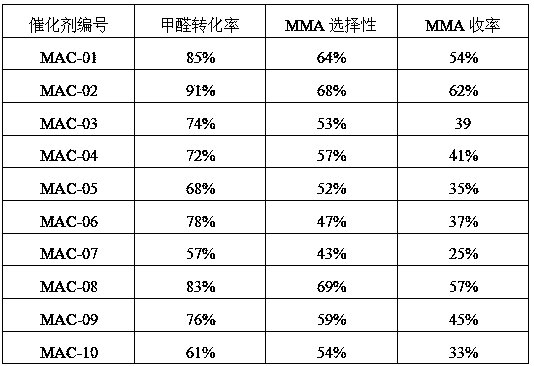
Figure 1 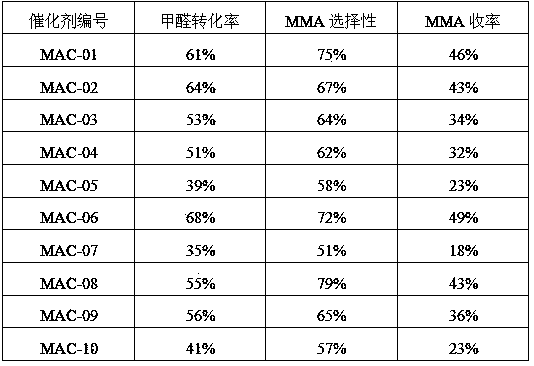
Figure 2 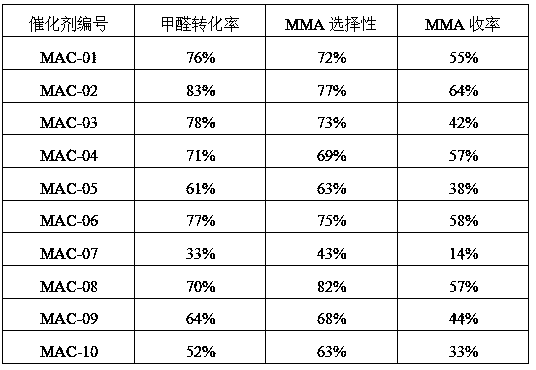
Figure 3
Abstract
Description
technical field
[0001] The invention relates to a catalyst for synthesizing methyl methacrylate, in particular to a catalyst for directly synthesizing methyl methacrylate from formaldehyde and methyl propionate and a preparation method thereof. Background technique
[0002] Methyl methacrylate (MMA) is an important organic chemical raw material, mainly used to produce plexiglass (polymethyl methacrylate, PMMA), and also used to manufacture other resins, plastics, coatings, adhesives, lubricants It is widely used as agent, sizing agent for wood and cork, impregnating agent for motor coils, paper polishing agent, printing and dyeing auxiliaries and insulating potting materials, etc.
[0003] At present, there have been many patent literature reports for the catalyst research on the synthesis of methyl methacrylate by formaldehyde and methyl propionate at home and abroad, and the performance of catalysts with Cs, Na, K, Rb, etc. as the main active components has been studied. ...
Examples
Embodiment 1
[0033] The catalyst of this embodiment consists of 20% active component, 5% coagent and 75% carrier. The active component is cesium acetate with a content of 20% of cesium oxide in the catalyst, the active agent is silver nitrate with a content of 5% of silver oxide, and the carrier is composed of 88% silicon dioxide, 10% activated alumina and 2% composition of zirconia. The preparation method is as follows:
[0034] (1) Weigh 36.3g of cesium acetate and dissolve it in deionized water to make an aqueous solution;
[0035] (2) Weigh nano-SiO 2 88g, pseudo-boehmite 14g, ZrO 2 2g, after mixing evenly, add the solution prepared in step (1) for kneading, extruding, drying at 100°C for 4 hours, and calcining at 500°C for 4 hours to obtain a catalyst precursor;
[0036] (3) Weigh 7.7gAgNO 3 , add deionized water to dissolve and make a solution;
[0037] (4) Weigh 100 g of the catalyst precursor prepared in step (2) and immerse in the aqueous solution prepared in step (3), immer...
Embodiment 2
[0039] The catalyst of this embodiment consists of 15% active component, 2% coagent and 83% carrier. The active component is cesium nitrate equivalent to 15% cesium oxide content in the catalyst, the active auxiliary agent is silver nitrate equivalent to 2% silver oxide content, and the carrier is composed of 89% silicon dioxide, 10% activated alumina and 1% composition of zirconia. The preparation method is as follows:
[0040] (1) Weigh 49.98g CsNO 3 Add deionized water to dissolve and make an aqueous solution;
[0041] (2) Weigh nano-SiO 2 178g, pseudoboehmite 28g, ZrO 2 2g, after mixing evenly, add the solution prepared in step (1) for kneading, extruding, drying at 100°C for 4 hours, and calcining at 500°C for 4 hours to obtain a catalyst precursor;
[0042] (3) Weigh 3.0gAgNO 3 , add deionized water to dissolve and make a solution;
[0043] (4) Weigh 100 g of the catalyst precursor prepared in step (2) and immerse in the aqueous solution prepared in step (3), immers...
Embodiment 3~5
[0045] The catalyzer of embodiment 3~5 is made up of 10% active ingredient, 1% coagent and 89% carrier. The active component is cesium nitrate equivalent to 10% cesium oxide in the catalyst, and the active additives are silver nitrate and SbCl 3 1. Niobium oxalate, calculated as oxide, the mass percentage is 1.0%, and the carrier is composed of 75% silicon dioxide, 20% activated alumina and 5% zirconia. The preparation method is as follows:
[0046] (1) Weigh 46.6gCsNO 3 Add deionized water to dissolve and make an aqueous solution;
[0047] (2) Weigh nano-SiO 2 225g, pseudo-boehmite 86g, ZrO 2 15g, after mixing evenly, add the solution prepared in step (1) for kneading, extruding, drying at 100°C for 6 hours, and calcining at 400°C for 4 hours to obtain a catalyst precursor;
[0048] (3) Weigh 1.2gAgNO respectively 3 , 1.3gSbCl 3 Dissolve 1.5g niobium oxalate in water to make 3 solutions;
[0049] (4) Weigh 80g of the catalyst precursor prepared in step (2), immerse in...