
T-fitting
A technology of three-way pipe and main pipe, which is applied in the direction of pipe connection arrangement, pipe/pipe joint/pipe fitting, household components, etc., to achieve the effect of improving pressure resistance
Patent Information
- Authority / Receiving Office
- CN · China
- Patent Type
- Applications(China)
- Current Assignee / Owner
- Publication Date
- 2013-04-03
- Estimated Expiration
- Not applicable · inactive patent
Smart Images
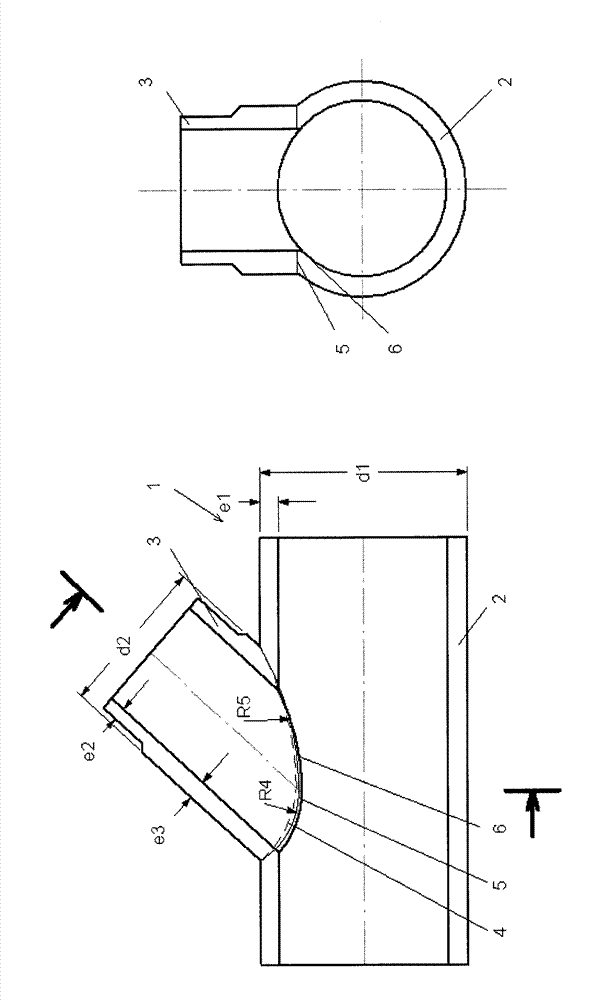
Figure 1 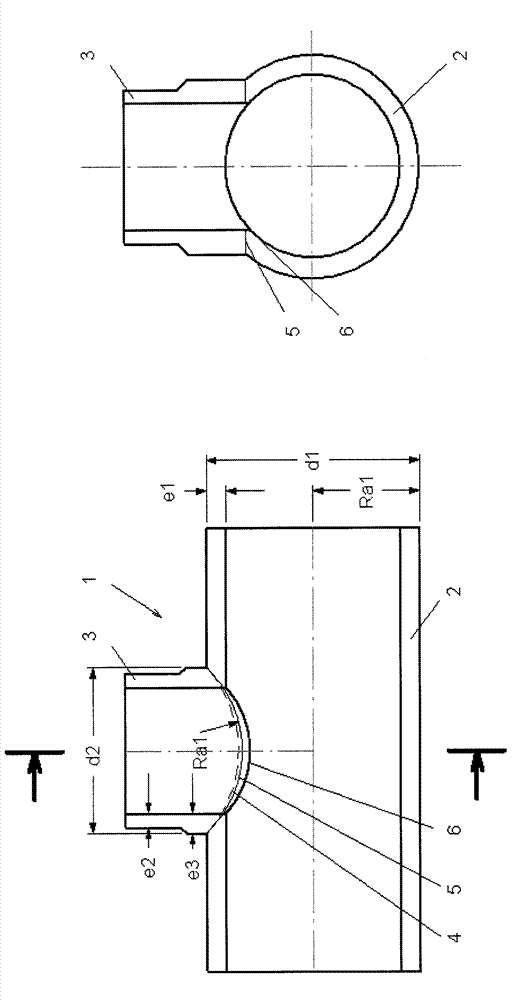
Figure 2 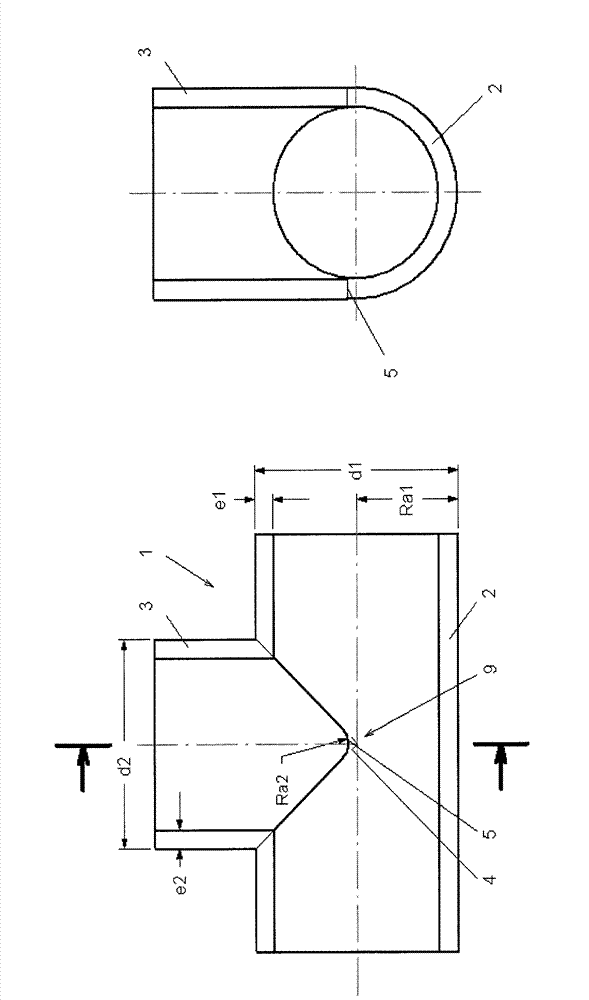
Figure 3
Abstract
Description
technical field
[0001] The present invention relates to a thermoplastic welded tee and a method for making the same. Background technique
[0002] Tees are used in piping systems to create pipe outlets or branches. Thermoplastics are increasingly used in piping construction for reasons of weight and corrosion. Fluids such as gas, water, waste water or indeed chemicals are preferably conveyed in such piping.
[0003] Various methods for producing plastic tees are known from the prior art.
[0004] Typically, the tee is manufactured using injection molding. This method is especially suitable for piping systems or tees that do not exceed a certain size. The reason for this is that, on the one hand, the method is not economically feasible unless a certain number of units of tees are manufactured, which is rarely the case for larger sizes; , also reaches the feasibility frontier. Injection molding is suitable for large sizes only to a limited extent.
[0005] US 5,551,733 ...
Examples
Embodiment Construction
[0046] figure 1 A welded tee 1 is shown with a branch 3 extending at a 90° angle to the main pipe 2 or joined perpendicularly to the main pipe 2 . The diameter d2 of the branch pipe 3 does not match the diameter d1 of the main pipe 2 . Thus, in figure 1 It is shown that tubes 2, 3 having different diameters d1, d2 are welded together. In order to form a good weld, it is advantageous that the wall thicknesses e1 , e3 are approximately equal in the region of the weld, resulting in the same joint pressure conditions. Furthermore, the widened wall thickness leads to increased strength. It is therefore advantageous to make the wall thickness of the pipes to be joined together or to adapt it, for example by increasing the wall thickness e3 in the branch pipe 3, as figure 1 shown. The theoretical line of intersection 4 that would appear when joining the two pipes 2, 3 together is at figure 1 is shown by dashed line 4. The approximate intersecting line 5 is obtained from the pr...