
zoom lens
A zoom lens and lens group technology, applied in the field of zoom lenses, can solve the problem of inability to take into account the freedom of optical design and manufacturing costs, and achieve the effects of good optical characteristics, reduced production costs, and reduced use quantity
Patent Information
- Authority / Receiving Office
- CN · China
- Patent Type
- Patents(China)
- Current Assignee / Owner
- Publication Date
- 2016-01-06
Smart Images
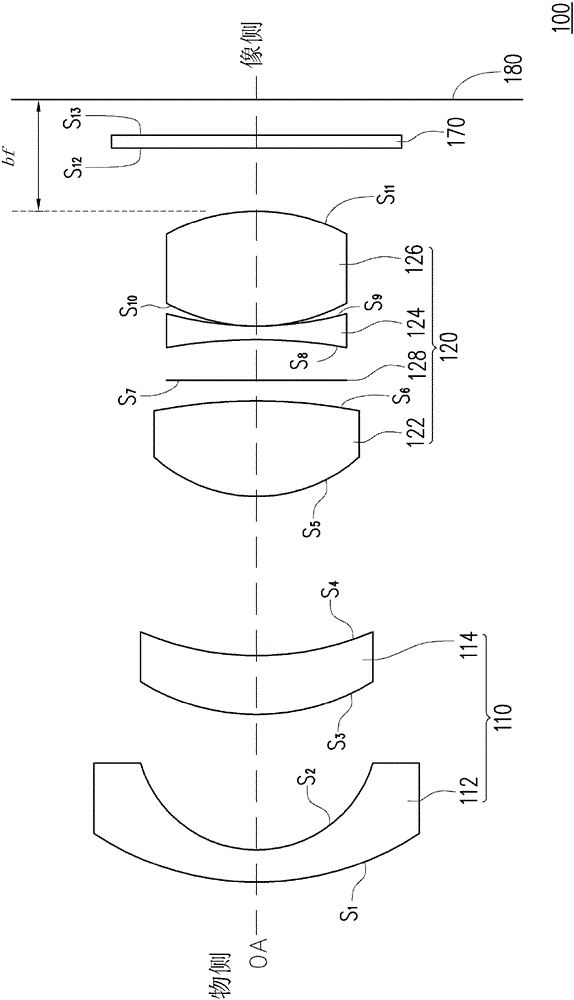
Figure 1 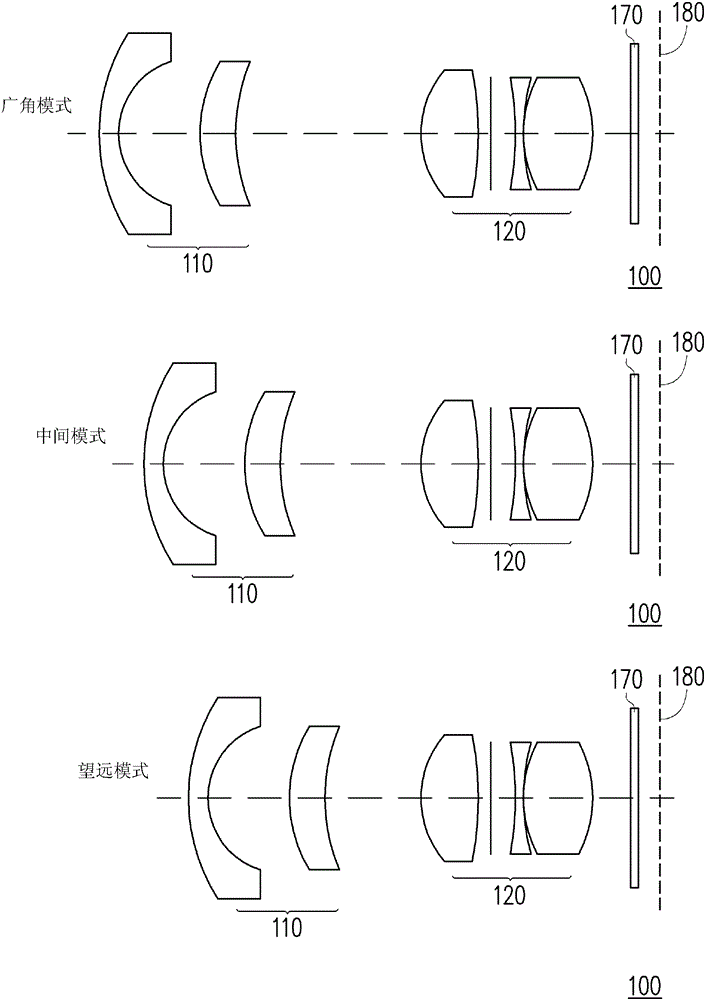
Figure 2 
Figure 3
Abstract
Description
technical field
[0001] The present invention relates to a lens, and in particular to a zooming lens. Background technique
[0002] With the advancement of technology, many video or camera equipment have been developed, such as projectors, digital video cameras (Digital Video Camera, DVC), digital cameras and other imaging devices.
[0003] A zoom lens is one of the important components of such imaging devices. By moving different lens groups in the zoom lens, the focal length of the zoom lens changes accordingly, which can increase the application flexibility of the zoom lens. Traditionally, most zoom lenses use multiple groups of actions to perform zooming operations.
[0004] However, a zoom lens employing multiple groups of motion requires the use of multiple optical components. Because the zoom lens contains too many optical components, the optical length of the zoom lens cannot be shortened, and the price cannot be reduced. On the other hand, if the number of optica...
Examples
no. 1 example
[0020] Figure 1A It is a schematic diagram of the zoom lens according to the first embodiment of the present invention. Please refer to Figure 1A , all optical components of the zoom lens 100 are arranged between the object side and the image side along the optical axis OA. The zoom lens 100 includes in sequence from the object side to the image side: a first lens group 110 and a second lens group 120 . The first lens group 110 has negative optical power (i.e. negative refractive power). The first lens group 110 includes in sequence from the object side to the image side: a negative meniscus lens 112 and a positive meniscus lens 114. The convex surface of the negative meniscus lens 112 faces the object side. The convex surface of the positive meniscus lens 114 faces the object side. The second lens group 120 has positive optical power (ie, positive refractive power). The second lens group 120 includes in sequence from the object side to the image side: a positive convex len...
no. 2 example
[0077] image 3 It is a schematic diagram of the zoom lens according to the second embodiment of the present invention. Please refer to image 3 , zoom lens 300 with Figure 1A The zoom lens 100 in has a similar structure.
[0078] Similarly, image 3 The zoom lens 300 includes in sequence from the object side to the image side: a first lens group 310 and a second lens group 320 . The first lens group 310 has negative optical power (i.e. negative refractive power). The first lens group 310 includes in sequence from the object side to the image side: a negative meniscus lens 312 and a positive meniscus lens 314. The convex surface of the negative meniscus lens 312 faces the object side. The convex surface of the positive meniscus lens 314 faces the object side. The second lens group 320 has positive optical power (ie, positive refractive power). The second lens group 320 includes in sequence from the object side to the image side: a positive convex lens 322 , a negative bicon...
no. 3 example
[0100] Figure 5 It is a schematic diagram of the zoom lens according to the third embodiment of the present invention. Please refer to Figure 5 , zoom lens 500 with Figure 1A The zoom lens 100 in has a similar structure.
[0101] Similarly, Figure 5 The zoom lens 500 includes in sequence from the object side to the image side: a first lens group 510 and a second lens group 520 . The first lens group 510 has negative optical power (i.e. negative refractive power). The first lens group 510 includes in sequence from the object side to the image side: a negative meniscus lens 512 and a positive meniscus lens 514. The convex surface of the negative meniscus lens 512 faces the object side. The convex surface of the positive meniscus lens 514 faces the object side. The second lens group 520 has positive optical power (ie, positive refractive power). The second lens group 520 includes in sequence from the object side to the image side: a positive convex lens 522 , a negative b...