
Cube unit deformation decomposition method meeting complete orthogonality and mechanical equilibrium conditions
A technology with complete orthogonal and balanced conditions, applied in special data processing applications, instruments, electrical digital data processing, etc.
Patent Information
- Authority / Receiving Office
- CN · China
- Patent Type
- Applications(China)
- Current Assignee / Owner
- Publication Date
- 2016-06-15
Smart Images
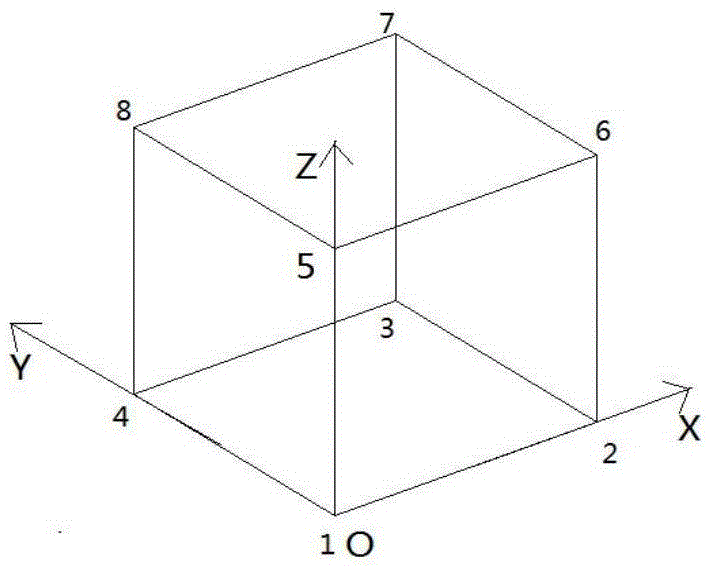
Figure 1 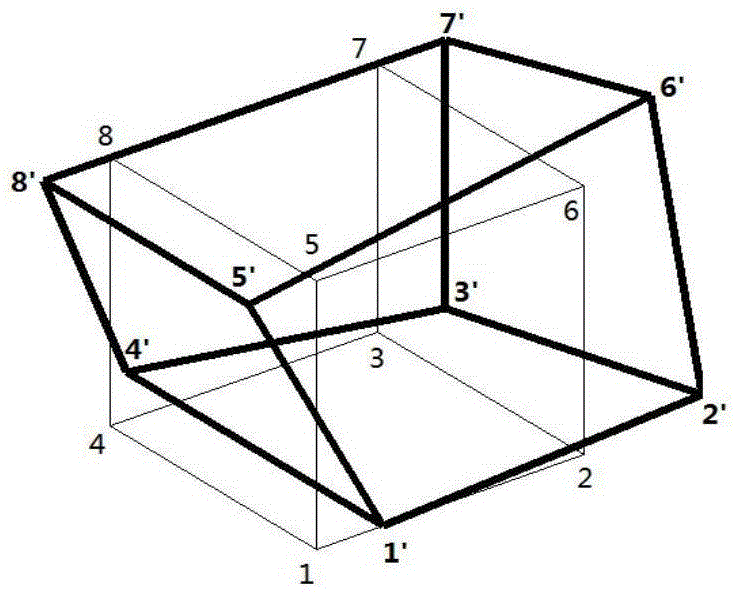
Figure 2 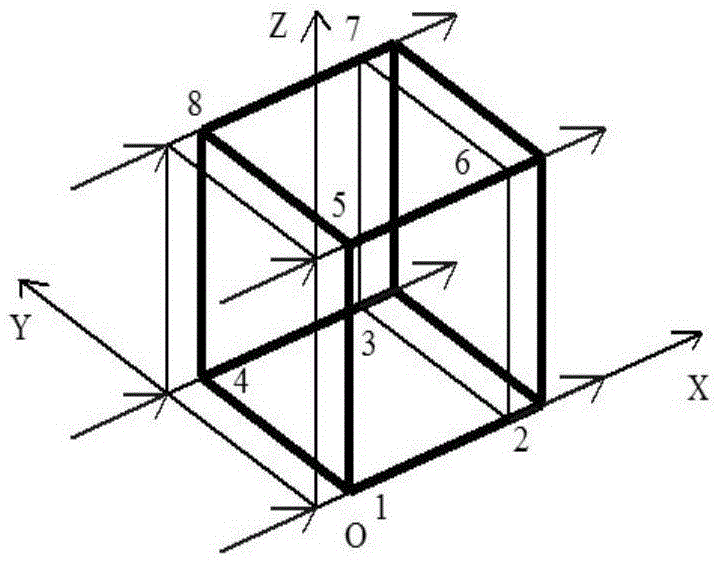
Figure 3
Abstract
Description
technical field
[0001] The invention relates to a recognition method for spatial structure deformation and mode shape. Background technique
[0002] At present, with the help of commercial finite element software, laboratory tests, simulation or on-site testing, etc., the deformation, stress, and strain of various engineering structures under the action of the environment can be accurately analyzed; the deformation here is the structure in the The comprehensive response under the external action, the stress and strain here are the reaction values on the micro-elements of the structure.
[0003] However, on the one hand, structural designers are more concerned about the ratio of ductile deformation to brittle deformation in structural deformation; because brittle deformation should be avoided as much as possible in design. On the other hand, the response value of the micro-element may be difficult to describe the deformation essence of the macrostructure; for example, the ...
Examples
Embodiment Construction
[0131] Theoretical derivation of the invention: Williams [1] etc. think that the motion and deformation of the block can be regarded as the superposition of the motion and deformation of the rigid body of the block under certain conditions. Zhang Canhui [2] It is pointed out that in the case of small deformation, the spatial deformation of the eight-node square element can be decomposed into 3 rigid body linear displacements, 3 rigid body rotational displacements, 3 tension and compression deformations, 6 bending deformations, 3 shear deformations, 3 There are 24 basic forms of reverse bending deformation and 3 torsional shear deformations.
[0132] references:
[0133] [1] Williams JR, Hocking G, Mustoe GGW. The theoretical basis of the discrete element method [C]. Proceeding of the Numeta 1985 Conference, 1985: 897-906.
[0134] [2] Canhui Zhang, Suong V. Hoa. A systematic and quantitative method to determine the optimal assumed stress fields for hybrid stress finite elem...