
High performance fluidized bed
A fluidized bed, high-performance technology, used in hearth furnaces, lighting and heating equipment, drying, etc., can solve problems such as product moisture increase, positive pressure at the packaging outlet, dusting phenomenon, etc., to improve drying. Qualification rate, efficiency improvement, damage prevention effect
Patent Information
- Authority / Receiving Office
- CN · China
- Current Assignee / Owner
- Publication Date
- 2017-01-04
- Estimated Expiration
- Not applicable · inactive patent
Smart Images
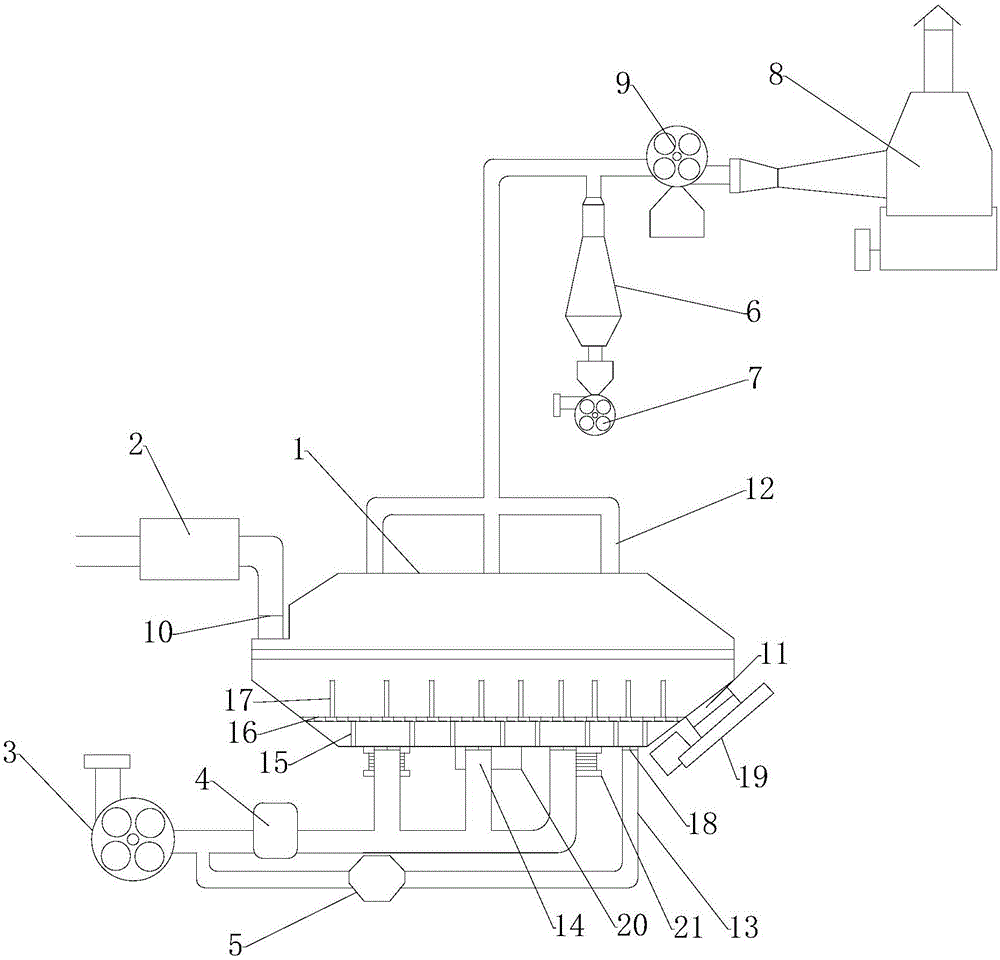
Figure 1
Abstract
Description
technical field
[0001] The invention belongs to the field of chemical industry, in particular to a high-performance fluidized bed. Background technique
[0002] Fluidized bed is mainly used for drying and cooling of granular materials and powder materials. The material to be dried is added to the fluidized bed body through the feeder, and the material entering the fluidized bed is in contact with the hot air above the air distribution plate, and after being uniformly and fully mixed, the material particles in the fluidized bed are blown up Suspended in a boiling state, dehydrated and dried, qualified products are discharged from the outlet of the fluidized bed, and the dusty gas is purified by the dust removal device and discharged into the atmosphere by the exhaust fan. The existing fluidized bed generally consists of three sections, and the position of the lower agglomeration is generally set at the end of the fluidized bed, which will cause positive pressure at the outle...
Examples
Embodiment Construction
[0020] It should be noted that, in the case of no conflict, the embodiments of the present invention and the features in the embodiments can be combined with each other.
[0021] In describing the present invention, it should be understood that the terms "center", "longitudinal", "transverse", "upper", "lower", "front", "rear", "left", "right", " The orientations or positional relationships indicated by "vertical", "horizontal", "top", "bottom", "inner" and "outer" are based on the orientations or positional relationships shown in the drawings, and are only for the convenience of describing the present invention and Simplified descriptions, rather than indicating or implying that the device or element referred to must have a particular orientation, be constructed and operate in a particular orientation, and thus should not be construed as limiting the invention. In addition, the terms "first", "second", etc. are used for descriptive purposes only, and should not be understood ...