
Wind deflection prevention jumper cross arm of 1000kV tension tower
A cross-arm and jumper technology, applied in the field of transmission line poles and towers, can solve the problems of angle steel bearing capacity damage or instability, safety production accidents, etc.
Patent Information
- Authority / Receiving Office
- CN · China
- Patent Type
- Applications(China)
- Current Assignee / Owner
- Publication Date
- 2020-02-11
Smart Images
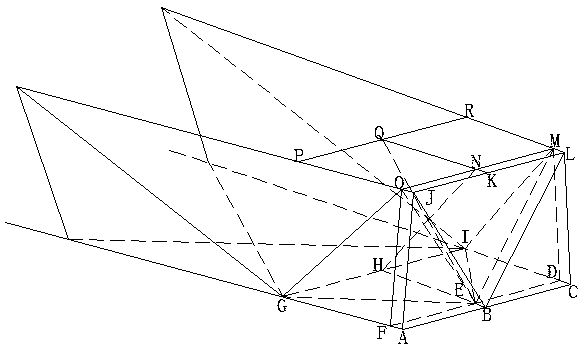
Figure 1 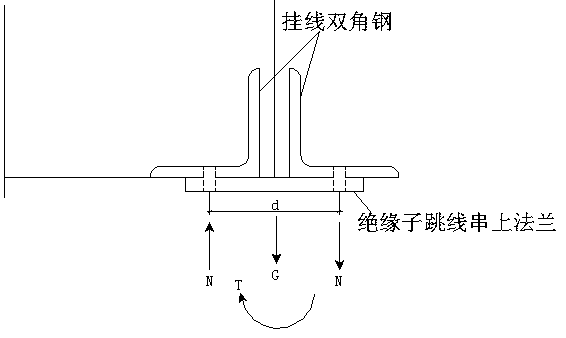
Figure 2 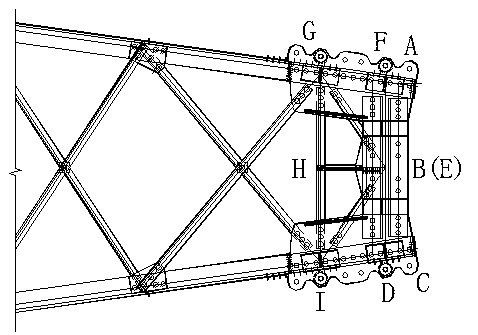
Figure 3
Abstract
Description
technical field
[0001] The invention relates to a jumper crossarm for a tension tower of an extra-high voltage transmission line, in particular to a jumper crossarm for a 1000kV tension tower against wind deflection, which is especially suitable for a transmission line tower in a strong wind area on an extra-high voltage transmission line. Background technique
[0002] In transmission lines, many transmission poles and towers are installed in areas with strong winds and strong winds. At this time, in order to avoid the insulator jumper string being affected by the wind and causing deviation, and further causing flashover trips and other problems, windproof yaw hanging is widely used in 220kV transmission lines. A point device is used to solve this problem, so as to effectively reduce the windage range of jumpers or wires, and avoid flashover tripping; The way of weight makes the jumper string of insulators stable enough under the set wind level without wind deflection exceed...
Examples
Embodiment Construction
[0017] Best practice:
[0018] Refer to attached Figure 1-Figure 6 , 1000kV tension tower wind deflection jumper cross arm, including front upper horizontal angle steel JP, rear upper horizontal angle steel LR, front lower horizontal angle steel AG and rear lower horizontal angle steel CI, between front upper and lower horizontal angle steels and rear upper, There are several supporting slanting rods evenly distributed between the lower horizontal angle steels. The four horizontal angle steels have ACLJ as the outer end, and the direction in which the other end is connected to the tower body is the inner side. An outer truss ACLJ is installed at the outer ends of the four transverse angle steels, and an inner truss FDMO is also included, which is located on the side of the outer truss ACLJ close to the main pole and connected with the outer ends of the four transverse angle steels. The trusses are arranged side by side in parallel and are equipped with vertical V-shaped webs...