
A detection method for unbalanced defect samples based on convolutional neural network
A convolutional neural network and detection method technology, applied in neural learning methods, biological neural network models, neural architectures, etc., can solve problems such as less defect data collected, low proportion of defective products, and inability to model training, and achieve low cost. , Improve the detection performance, the method is simple and easy to implement
Patent Information
- Authority / Receiving Office
- CN · China
- Patent Type
- Patents(China)
- Current Assignee / Owner
- Publication Date
- 2020-12-18
Smart Images
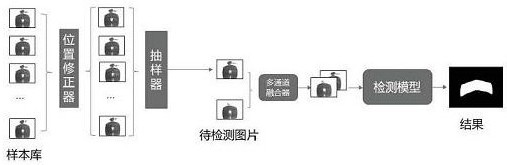
Figure 1
Abstract
Description
technical field
[0001] The invention relates to the technical field of defect detection and recognition, in particular to a method for detecting unbalanced defect samples based on a convolutional neural network. Background technique
[0002] Convolutional Neural Networks (CNN) is a type of Feedforward Neural Networks (Feedforward Neural Networks) that includes convolution calculations and has a deep structure. It is one of the representative algorithms for deep learning. Convolutional neural network has the ability of representation learning, and can perform shift-invariant classification on input information according to its hierarchical structure, so it is also called "Shift-Invariant Artificial Neural Networks". , SIANN). The research on convolutional neural networks began in the 1980s and 1990s. Time-delay networks and LeNet-5 were the earliest convolutional neural networks. After the 21st century, with the development of deep learning theory Proposed and improved numer...
Examples
Embodiment 1
[0039] see figure 1 As shown, a detection method of unbalanced defect samples based on convolutional neural network includes the following steps:
[0040] (1) Pre-collection data: Two types of data need to be collected: one is the original defect data of the product, the technicians determine the possible defect types according to the production situation of the product, and the collectors use photography equipment to collect as much variety as possible according to the defect types The previous data, and make the original image of the training set;
[0041] The second is non-defective data produced in the production environment, which can be collected in large quantities; special attention should be paid to the fact that the environment variables should be completely consistent when collecting the two types of data;
[0042] Specifically, the above-mentioned defect data accounts for 30% of the total data, and the non-defect data accounts for 70% of the total data;
[0043] ...