
Fault detection for iterative learning control of time-varying systems
An iterative learning control and fault detection technology, which is applied in manufacturing tools, measuring devices, material defect testing, etc., and can solve problems such as poor performance conservative learning algorithms and unstable ILC algorithms.
Patent Information
- Authority / Receiving Office
- CN · China
- Patent Type
- Applications(China)
- Current Assignee / Owner
- Publication Date
- 2022-08-05
Smart Images
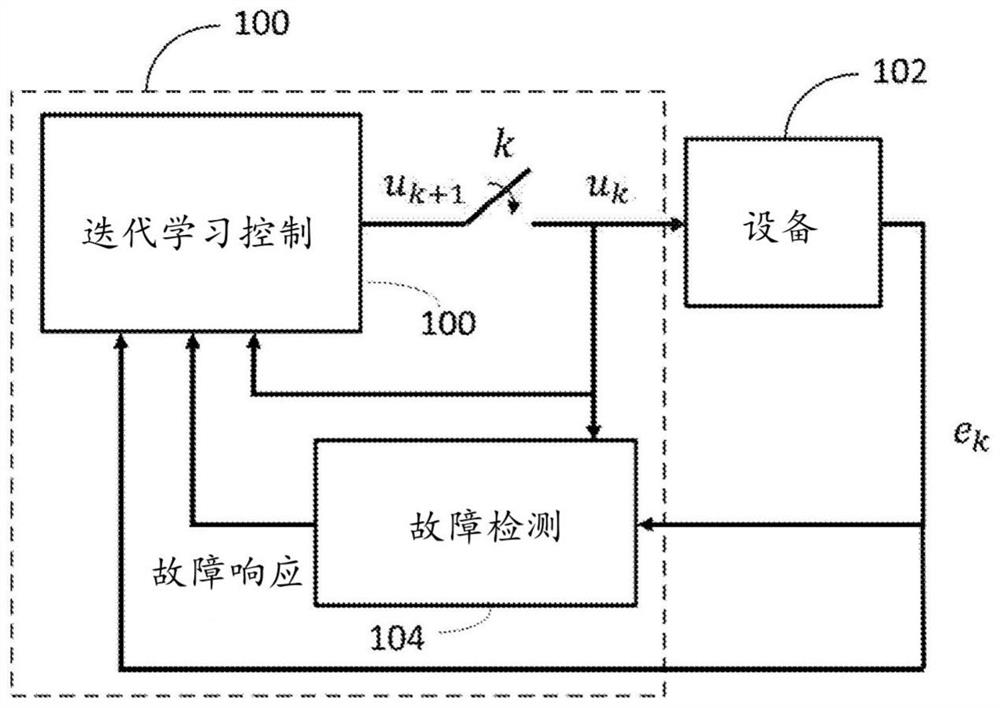
Figure 1 
Figure 2 
Figure 3
Abstract
Description
Background technique
[0001] Iterative Learning Control (ILC) is a control method that is particularly suitable for processes that are repetitive in nature. When applying ILC in practice, the algorithm should be set up to ensure that 1) the system will remain stable, and 2) the performance specifications will be met. However, these goals may conflict with each other, especially when the plant model contains uncertainty and / or iteratively changing dynamics.
[0002] Recent studies have examined the convergence and robustness properties of ILC algorithms applied to iteratively varying or non-repetitive systems. More specifically, previous research developed an optimal design procedure for ILCs that balances system performance with robust stability criteria. However, a limitation of this approach is that satisfying the robust stability criterion requires knowledge of the upper bound on the uncertainty of the input and output operators. In some applications, the upper bound may ...
Examples
Embodiment Construction
[0025] refer to figure 1 , the ILC controller 100 controls the device 102 according to an aspect of the present invention. Device 102 may include a potentially non-repetitive system. The ILC controller 100 includes an ILC algorithm 106 and a fault detection algorithm 104 . The fault detection algorithm 104 detects when the ILC algorithm 106 applied to the device 102 either 1) violates assumptions for guaranteeing asymptotic stability or 2) fails to meet predefined performance specifications or both. If operating conduction or stability requirements are not met, the fault detection algorithm 104 generates a fault detection signal indicative of a fault condition.
[0026] Assuming U and Y are Banach spaces with suitable norm, use || · || to denote the vector and induced operator norm in the appropriate space. In some embodiments, the class of ILC systems includes linear time-invariant systems of the form:
[0027]
[0028] where y k ∈ Y is the output signal, u k ∈U is t...