
Textile printing method
a printing method and printing technology, applied in the direction of dyeing process, textiles and paper, printing, etc., can solve the problems of difficult fixation of resin to polyester, insufficient permeation of ink into cloth, and insufficient fastness to wash or rub printed images on cloth, etc., to achieve stably eject the ink composition and high fastness
Patent Information
- Authority / Receiving Office
- US · United States
- Patent Type
- Patents(United States)
- Current Assignee / Owner
- Publication Date
- 2019-07-02
Smart Images
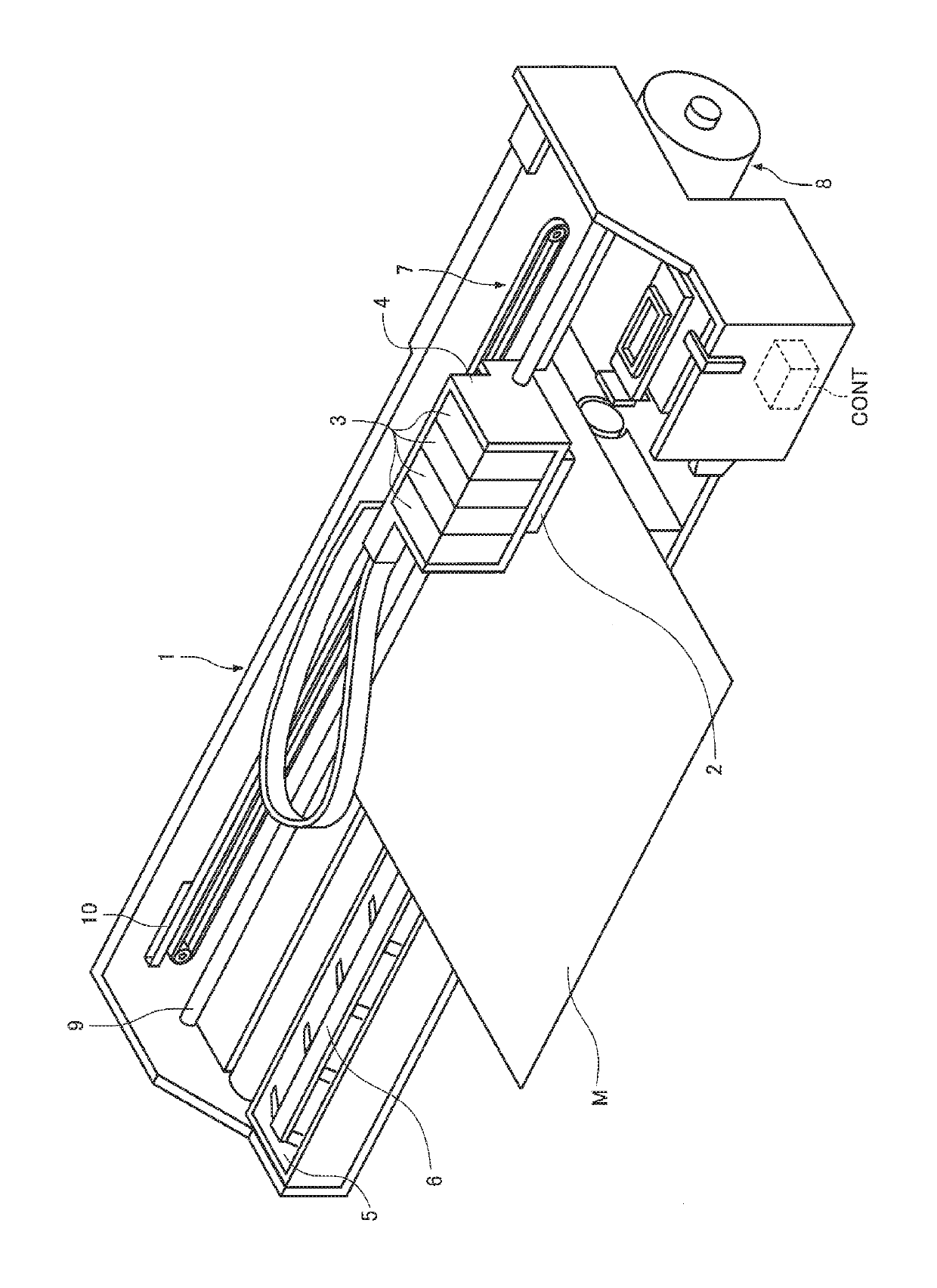
Figure 1
Abstract
Description
BACKGROUND
[0001] 1. Technical Field
[0002] The present invention relates to a textile printing method.
[0003] 2. Related Art
[0004] A textile printing method has been known for printing images on cloth, such as textile fabrics, knitting, and nonwoven fabrics. In recent years, an ink jet printing method has been studied as a textile printing method from the viewpoint of efficiently using textile printing ink compositions (hereinafter often simply referred to as ink). In an ink jet textile printing method incorporating the ink jet method, ink is applied onto a cloth by being ejected through a nozzle of an ink jet head, thus forming an ink coating on the cloth.
[0005] The ink used in such an ink jet textile printing method may contain a coloring material, such as a pigment or a dye, a dispersant (surfactant), and a solvent, such as water or an organic solvent. Pigments are generally superior to dyes in terms of color fastness of the printed image to light and other properties, and there is disc...
Examples
Embodiment Construction
[0036]Some embodiments of the invention will now be described. The following embodiments will be described by way of example. The invention is not limited to the following embodiments, and various modifications may be made within the scope and spirit of the invention. Not all the components disclosed in the following embodiments are required for the invention.
1. Textile Printing Method
[0037]The textile printing method according to an embodiment of the invention includes heating a cloth, and applying an ink composition onto the heated cloth by ejecting the ink composition from an ink jet head. The ink composition contains resin fine particles and has a viscosity of 4.5 mPa·s or less at 40° C. and a surface tension of 28 mN / m or less at 40° C. Also, the textile printing apparatus according to an embodiment of the invention is configured to perform the textile printing method.
[0038]Before describing the process steps of the textile printing method in detail, the structure of the textil...