
Shared pixels rendering display
a technology of shared pixels and rendering display, applied in the field of shared pixels rendering display, can solve the problems of significant cost increase and even higher unit cost of driving ic, and achieve the effect of reducing the number of driving ic, reducing the number of pixels used, and reducing the resolution
Patent Information
- Authority / Receiving Office
- US · United States
- Patent Type
- Applications(United States)
- Current Assignee / Owner
- Publication Date
- 2006-07-20
- Estimated Expiration
- Not applicable · inactive patent
Smart Images
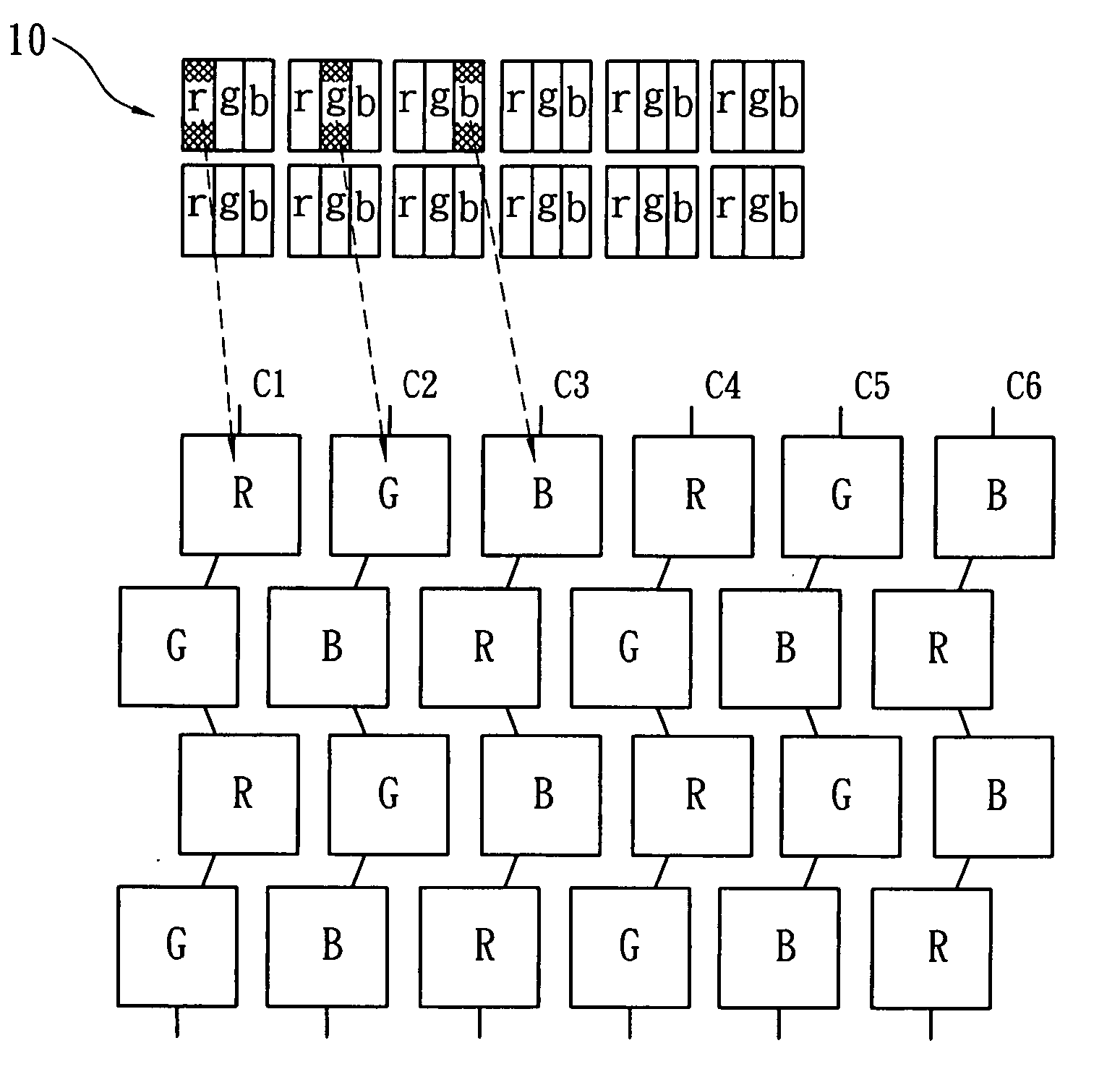
Figure 1 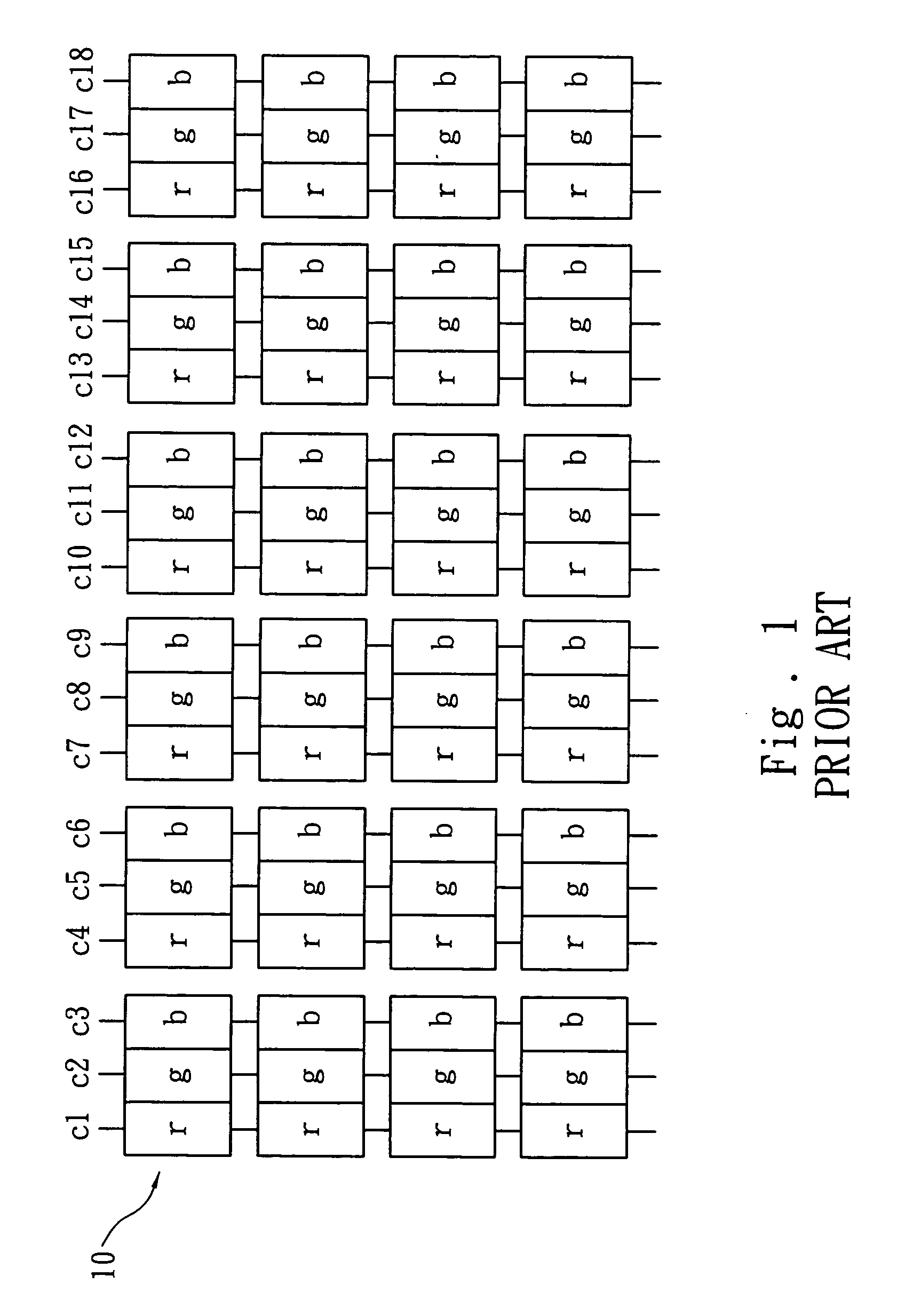
Figure 2 
Figure 3
Abstract
Description
FIELD OF THE INVENTION
[0001] The present invention relates to a shared pixels rendering display to provide an image display technique of transforming high resolution to low resolution to reduce the required number of driving IC for the display devices. BACKGROUND OF THE INVENTION
[0002] Human vision is a sense generated in the brain resulting from light of different wavelengths hitting the retina. Color sense is the basic function in the visual system. It is very important to detect images and physical objects. The wavelength of visible light to human eyes ranges from 390 to 780 nm. There are generally 120 to 180 discernable colors, including seven main colors of purple, blue, cyan, green, yellow, orange and red. Color discerning is the main function of visual cells. As the visual cells concentrate in the center of the retina, it has the most powerful color discerning capability. The discerning power of green, red, yellow and blue gradually decreases from the center of the retina t...
Examples
first embodiment
[0022] Refer to FIG. 3 for pixel sampling according to the invention. Retrieve respectively a sub-pixel r, a sub-pixel g, and a sub-pixel b from three original pixels 10 that are arranged in a stripe manner. Place the retrieved sub-pixels respectively on the locations of a mating pixel R, pixel G and pixel B of the color filter. The pixels R, G and B are laid in a triangular manner, namely the pixels R, G and B are stacked in a triangle. In the conventional approach nine channels (c1-c9) are needed to retrieve the sub-pixel r, sub-pixel g, and sub-pixel b from the three original pixels 10, this embodiment needs only three channels (C1-C3).
second embodiment
[0023] Refer to FIG. 4 for pixel sampling according to the invention. Retrieve respectively four sub-pixels r, g, g and b from two original pixels 10 that are arranged in a stripe manner. Place the retrieved sub-pixels respectively on the locations of a mating pixel R, pixel G and pixel B of the color filter. The pixels R, G and B are laid in upper, lower, left and right manner with different colors in a stripe fashion. The pixels are laid in stripe by a large width and a small width alternately (at a ratio of 1:2). In the conventional approach six channels (c1-c6) are needed to retrieve the four sub-pixels r, g, and b from two the original pixels 10, this embodiment needs only four channels (C1-C4). According the sampling method of this embodiment, on color number selection for color sense, a portion of luminous points of the pixels R and B are lost. However, all the luminous points of the green light (G) which is less sensitive to human vision are maintained.
[0024] Refer to FIG. 5...