
Implant with critical ratio of load bearing surface area to central opening area
Patent Information
- Authority / Receiving Office
- US · United States
- Current Assignee / Owner
- Publication Date
- 2012-06-21
Smart Images
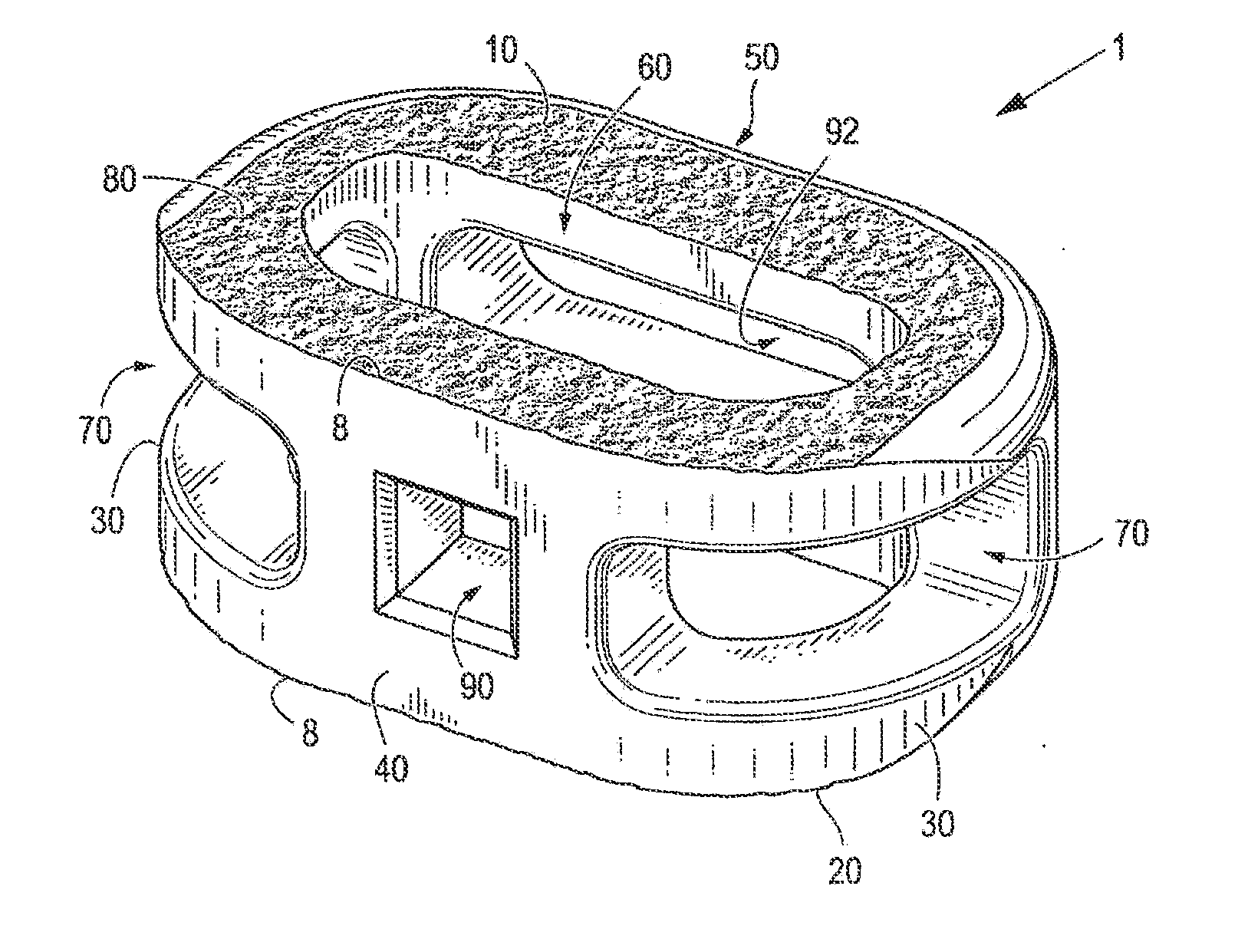
Figure 1 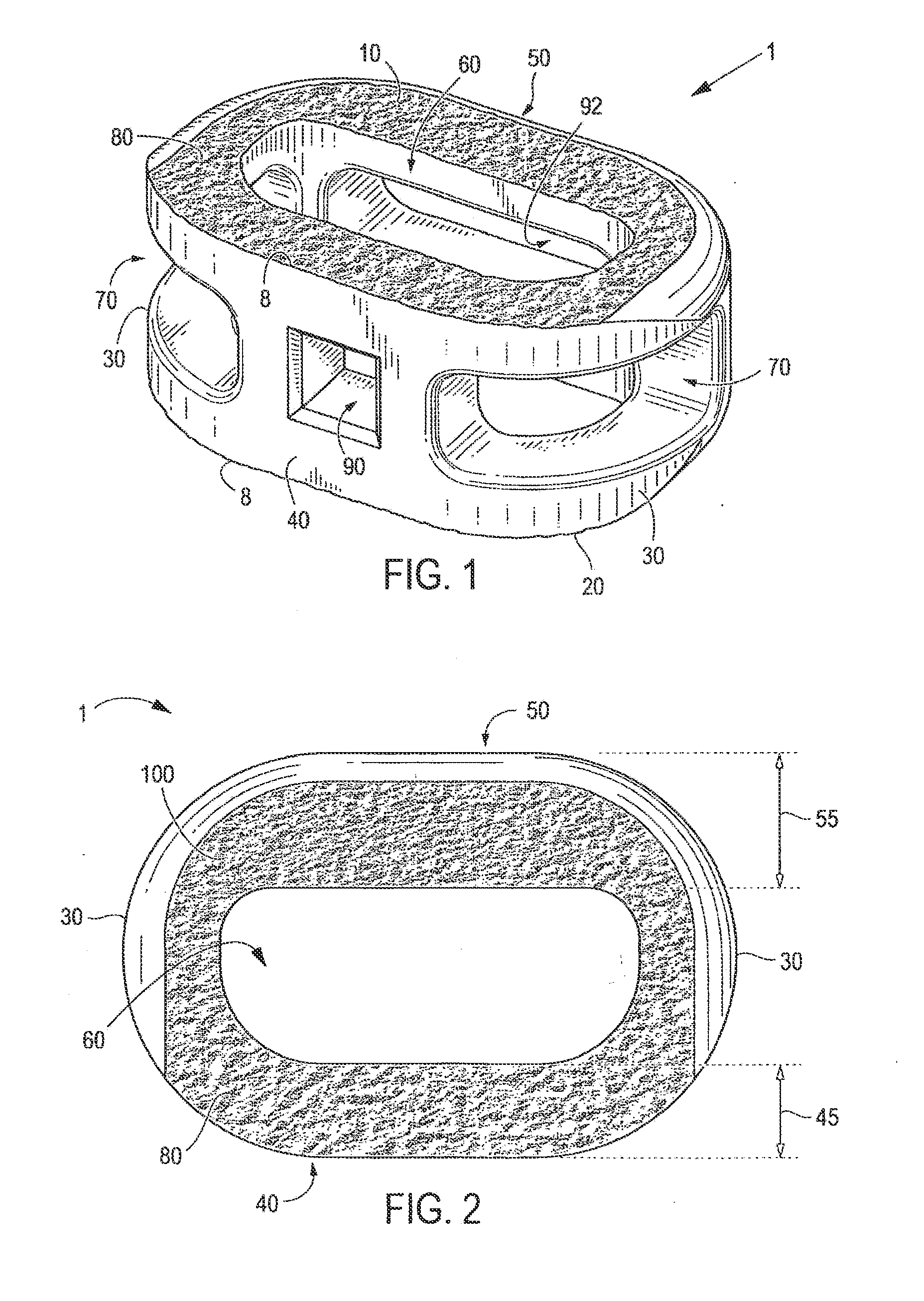
Figure 2 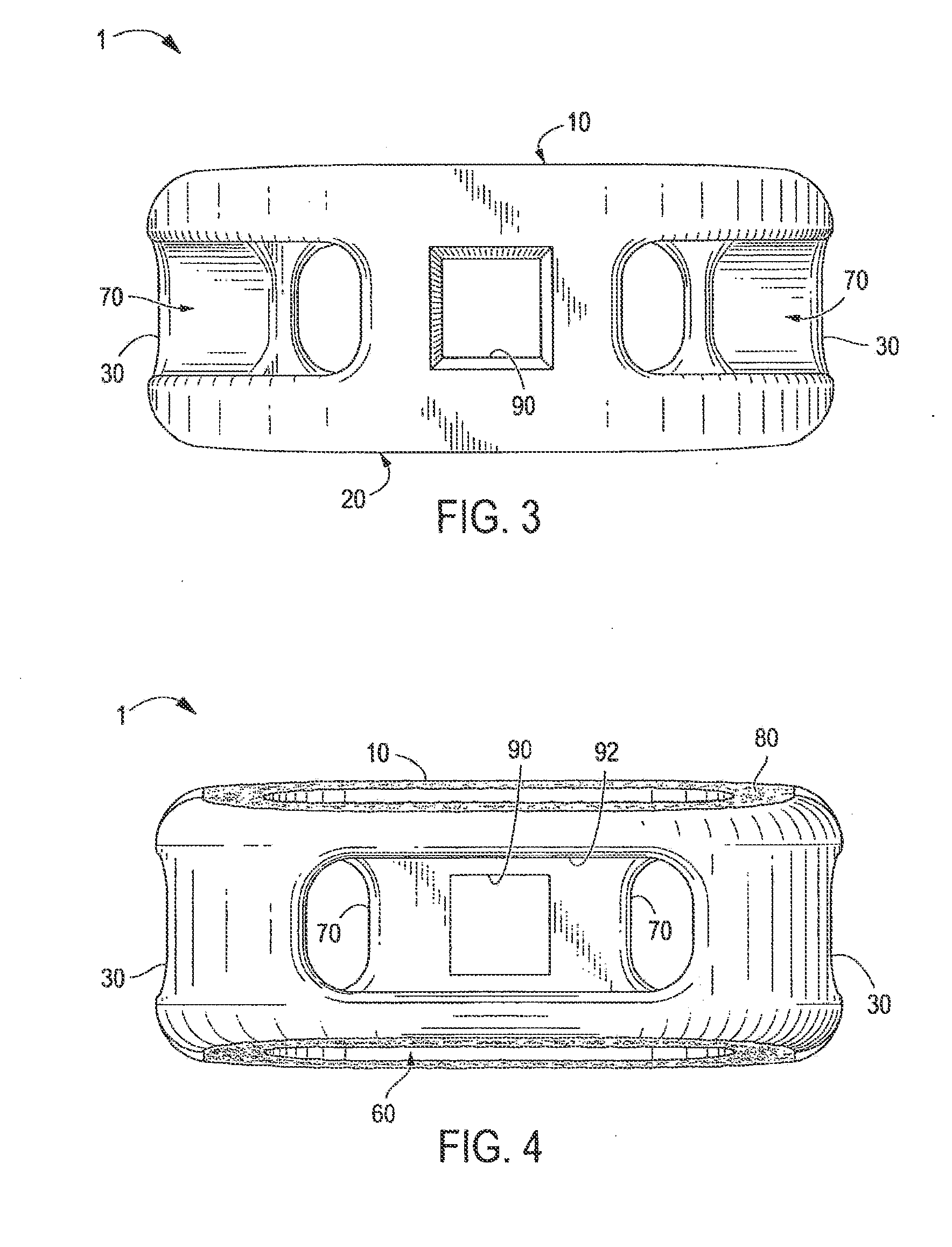
Figure 3
Abstract
Description
CROSS-REFERENCE TO RELATED APPLICATIONS
[0001] This patent application is a continuation-in-part of pending U.S. patent application Ser. No. 12 / 151,198 filed on May 5, 2008 titled “Composite Interbody Spinal Implant Having Openings of Predetermined Size and Shape” which is a continuation-in-part of application Ser. No. 11 / 123,359, filed on May 6, 2005 titled “Anterior Interbody Spinal Implant”, now U.S. Pat. No. 7,662,186, both of which are incorporated by reference herein.TECHNICAL FIELD
[0002] The present invention relates generally to interbody spinal implants and methods of using such implants and, more particularly, to an implant having one or more openings of predetermined sizes and shapes to achieve design trade offs depending upon a particular application.BACKGROUND OF THE INVENTION
[0003] In the simplest terms, the spine is a column made of vertebrae and discs. The vertebrae provide the support and structure of the spine while the spinal discs, located between the vertebrae, act ...
Examples
Embodiment Construction
[0074]Certain embodiments of the present invention may be especially suited for placement between adjacent human vertebral bodies. The implants of the present invention may be used in procedures such as Anterior Lumbar Interbody Fusion (ALIF), Posterior Lumbar Interbody Fusion (PLIF), Transforaminal Lumbar Interbody Fusion (TLIF), and cervical fusion. Certain embodiments do not extend beyond the outer dimensions of the vertebral bodies.
[0075]The ability to achieve spinal fusion is directly related to the available vascular contact area over which fusion is desired, the quality and quantity of the fusion mass, and the stability of the interbody spinal implant. Interbody spinal implants, as now taught, allow for improved seating over the apophyseal rim of the vertebral body. Still further, interbody spinal implants, as now taught, better utilize this vital surface area over which fusion may occur and may better bear the considerable biomechanical loads presented through the spinal col...