
Method for producing a motor vehicle component and motor vehicle component
Patent Information
- Authority / Receiving Office
- US · United States
- Current Assignee / Owner
- Publication Date
- 2014-06-12
- Estimated Expiration
- Not applicable · inactive patent
Smart Images
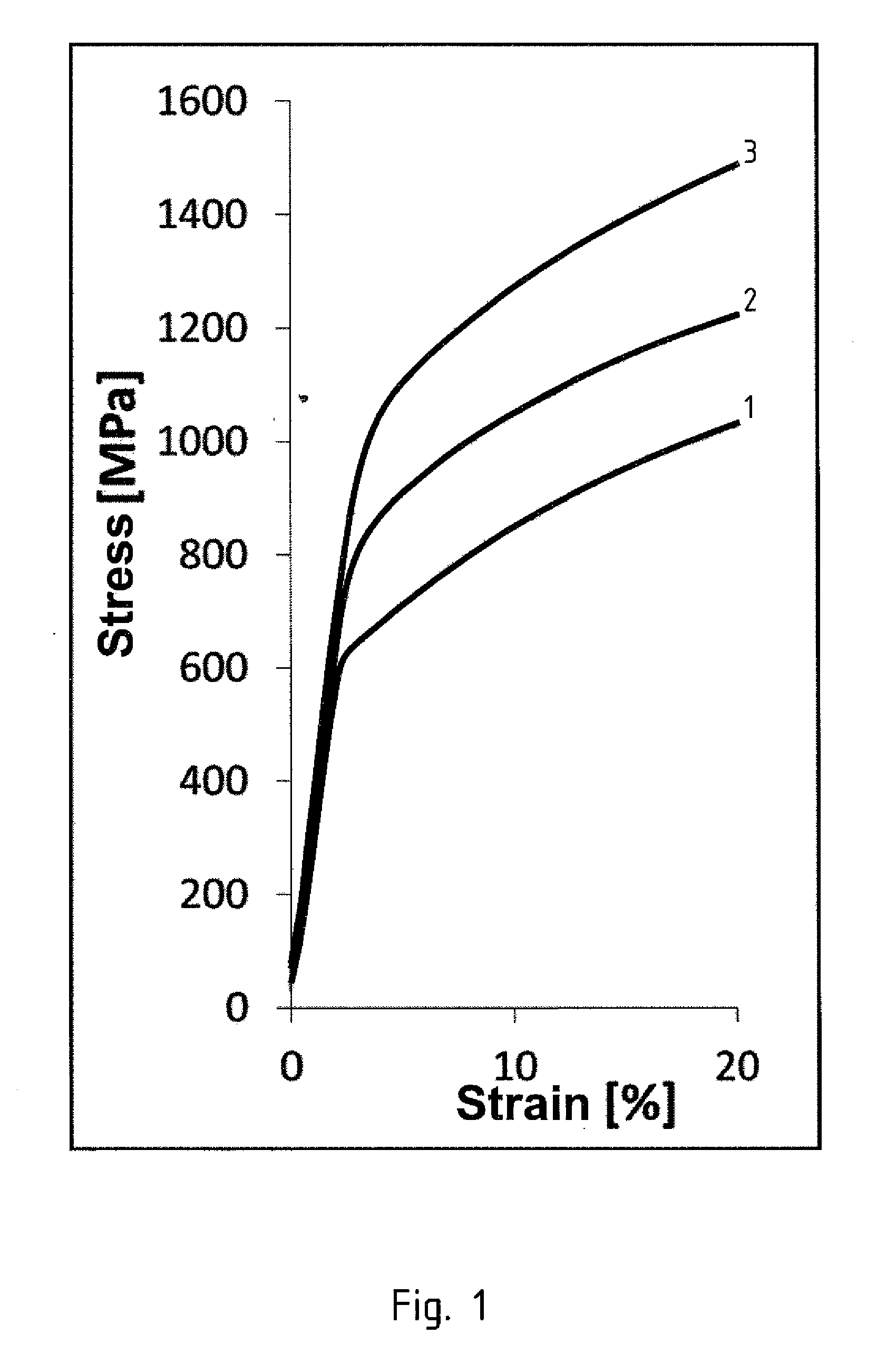
Figure 1
Abstract
Description
CROSS-REFERENCES TO RELATED APPLICATIONS
[0001] This application claims the priority of German Patent Application, Serial No. 10 2012 111 959.7, filed Dec. 7, 2012, pursuant to 35 U.S.C. 119(a)-(d), the disclosure of which is incorporated herein by reference.BACKGROUND OF THE INVENTION
[0002] The present invention relates to a method for producing a motor vehicle component and to a motor vehicle component.
[0003] The following discussion of related art is provided to assist the reader in understanding the advantages of the invention, and is not to be construed as an admission that this related art is prior art to this invention.
[0004] From the state of the art it is known to produce self-supporting motor vehicle bodies from metallic components. For this, motor vehicle columns, sills, roof pillars but also longitudinal or transverse members are initially produced and then joined to subassemblies and subsequently to the complete motor vehicle body.
[0005] To meet the demand for a motor vehicle...
Examples
Embodiment Construction
[0039]Throughout all the Figures, same or corresponding elements are generally indicated by same reference numerals. These depicted embodiments are to be understood as illustrative of the invention and not as limiting in any way. It should also be understood that the drawings are not necessarily to scale and that the embodiments are sometimes illustrated by graphic symbols, phantom lines, diagrammatic representations and fragmentary views. In certain instances, details which are not necessary for an understanding of the present invention or which render other details difficult to perceive may have been omitted.
[0040]Turning now to the drawing, and in particular to FIG. 1, there is shown a stress-strain diagram of a steel formed according to the invention wherein three different cold forming temperatures were selected. It can be seen that the lower the cold forming temperature was selected the more the tensile strength increases. Thus, the steel of the curve 1 was formed at room temp...