
Novel adamantane derivative compound
a technology of adamantane and derivative compounds, applied in the field of new adamantane derivative compounds, can solve the problems of insufficient cosmetic effects of minoxidil, hair growth caused by minoxidil, etc., and achieve the effects of stimulating hair growth, inhibiting androgen, and excellent anti-alopecia
Patent Information
- Authority / Receiving Office
- US · United States
- Patent Type
- Applications(United States)
- Current Assignee / Owner
- Publication Date
- 2017-10-05
Smart Images
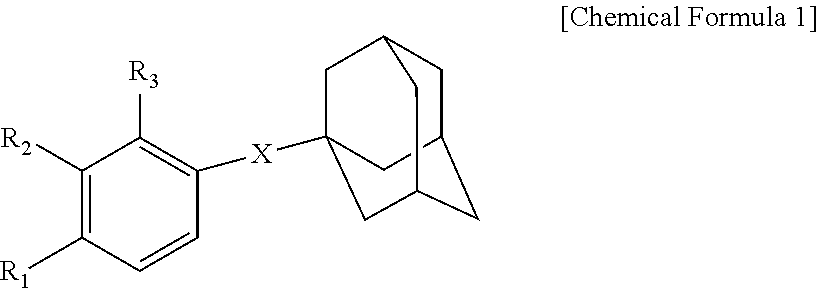
Figure 1 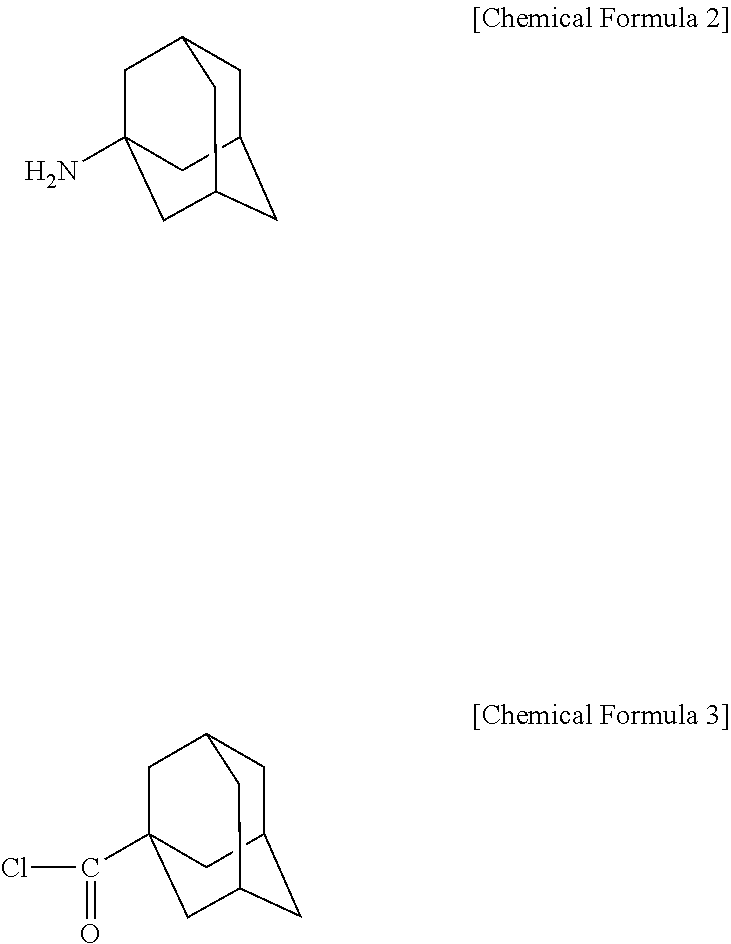
Figure 2 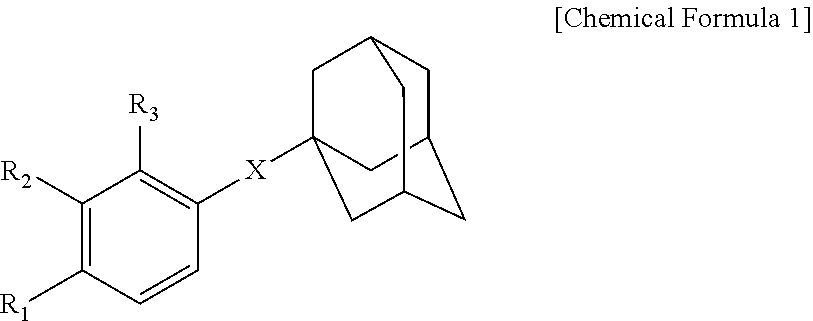
Figure 3
Abstract
Description
TECHNICAL FIELD
[0001] The present disclosure relates to a novel adamantane derivative compound and use thereof for inhibiting androgen.BACKGROUND ART
[0002] As males and females suffering from hereditary or environmental alopecia increase in the modern society that values beauty, various studies have been conducted actively all over the world to develop a method for treating alopecia and stimulating hair growth.
[0003] Human hairs exist in a number of about 100-150 thousands and each hair repeats growth and atrophy through a different cycle. Hairs repeat a three-step cycle including the anagen in which hair growth occurs, the catagen in which hairs, after the completion of the anagen, undergo slow-down in metabolic process while maintaining its shape, and the telogen in which hair papillae shrink and follicles gradually shrink, resulting in push-up of hair roots and reduction of follicles. Such a cycle and life of hairs may be varied with various conditions, including nourishment, medica...
Examples
example 2
[Example 2] Preparation of Adamantan-1-carboxylic acid-(3-methoxy-4-nitrophenyl)-amide
[0090]
[0091]Example 1 is repeated to obtain 71 mg (yield 42%) of the target product as white solid, except that 3-methoxy-4-nitroaniline is used instead of 3-methyl-4-nitroaniline. The NMR results of the product are shown below. It can be seen from the NMR results that the product is adamantan-1-carboxylic acid-(3-methoxy-4-nitrophenyl)-amide.
[0092]1H NMR (300 MHz, CDCl3, δ): 7.97 (d, 1H, J=2.1 Hz), 7.93 (d, 1H, J=9.0 Hz), 7.51 (s, 1H), 6.76 (dd, 1H, J=2.1 and J=9.0 Hz), 3.98 (s, 3H), 2.13 (s, 3H), 2.04-1.90 (m, 6H), 1.83-1.72 (m, 6H).
example 3
[Example 3] Preparation of Adamantan-1-carboxylic acid-(3-chloro-4-nitrophenyl)-amide
[0093]
[0094]Example 1 is repeated to obtain 94 mg (yield 79%) of the target product as yellow solid, except that 3-chloro-4-nitroaniline is used instead of 3-methyl-4-nitroaniline. The NMR results of the product are shown below. It can be seen from the NMR results that the product is adamantan-1-carboxylic acid-(3-chloro-4-nitrophenyl)-amide.
[0095]1H NMR (300 MHz, CDCl3, δ): 7.97-7.92 (m, 2H), 7.54 (dd, 1H, J=2.1 and J=9.0 Hz), 7.52 (s, 1H), 2.12 (s, 3H), 1.96-1.94 (m, 6H), 1.83-1.71 (m, 6H).
example 4
[Example 4] Preparation of Adamantan-1-carboxylic acid-(2-chloro-4-nitrophenyl)-amide
[0096]
[0097]Example 1 is repeated to obtain 101 mg (yield 61%) of the target product as yellow solid, except that 2-chloro-4-nitroaniline is used instead of 3-methyl-4-nitroaniline. The NMR results of the product are shown below. It can be seen from the NMR results that the product is adamantan-1-carboxylic acid-(2-chloro-4-nitrophenyl)-amide.
[0098]1H NMR (300 MHz, CDCl3, δ): 8.72 (d, 1H, J=9.0 Hz), 8.29-8.28 (m, 2H), 8.16 (dd, 1H, J=2.7 and J=9.3 Hz), 2.14 (s, 3H), 2.00-1.90 (m, 6H), 1.84-1.73 (m, 6H).