
Sensor for optically detecting foreign bodies particularly raindrops on a glass pane
a technology for optical detection and foreign bodies, applied in the direction of optical radiation measurement, vehicle cleaning, instruments, etc., can solve the problems of high cost, high cost, complex, etc., and achieve the effect of improving vibration resistance, and reducing the number of shards
Patent Information
- Authority / Receiving Office
- US · United States
- Patent Type
- Patents(United States)
- Current Assignee / Owner
- Publication Date
- 2005-05-17
- Estimated Expiration
- Not applicable · inactive patent
Smart Images
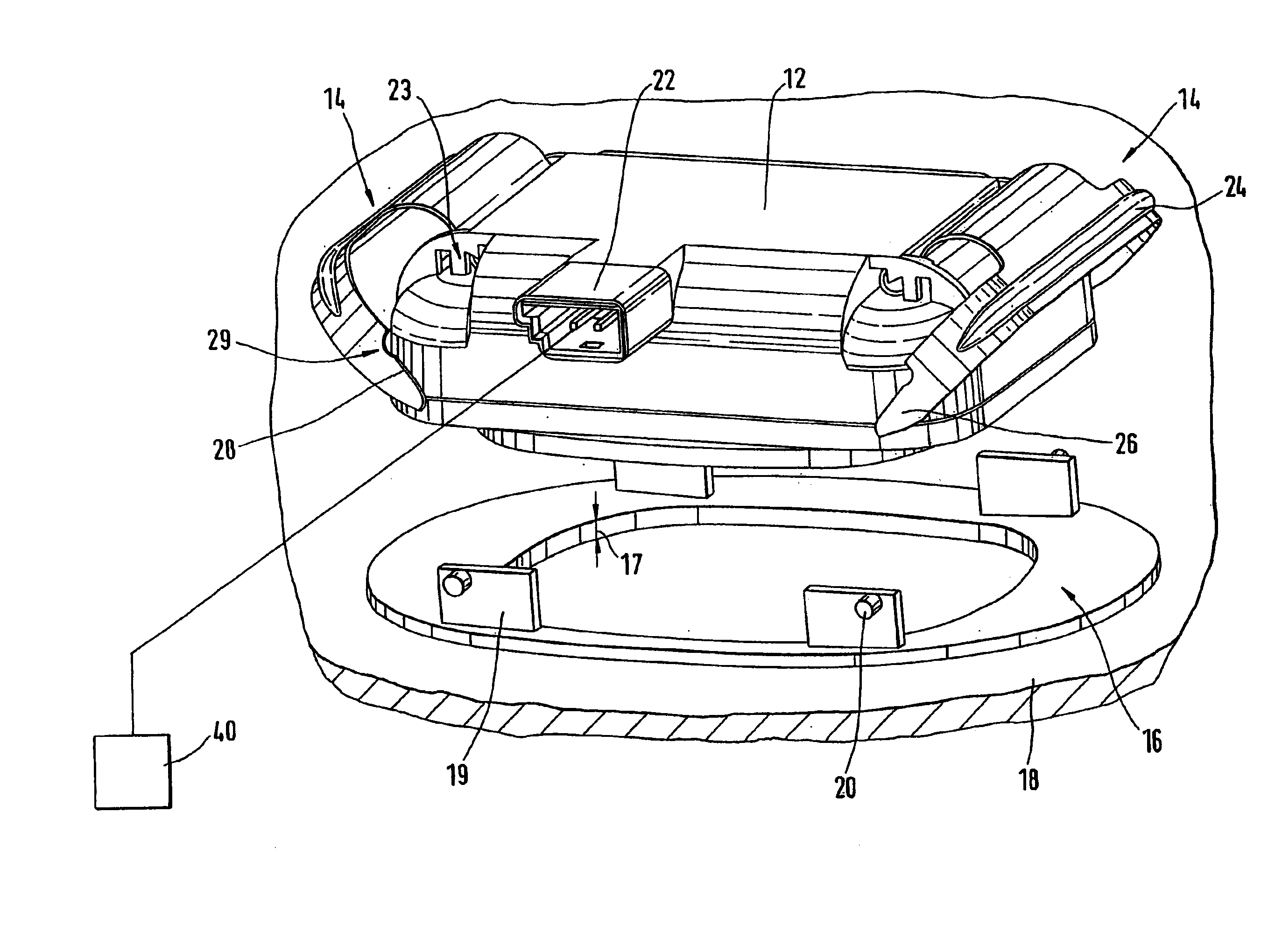
Figure 1 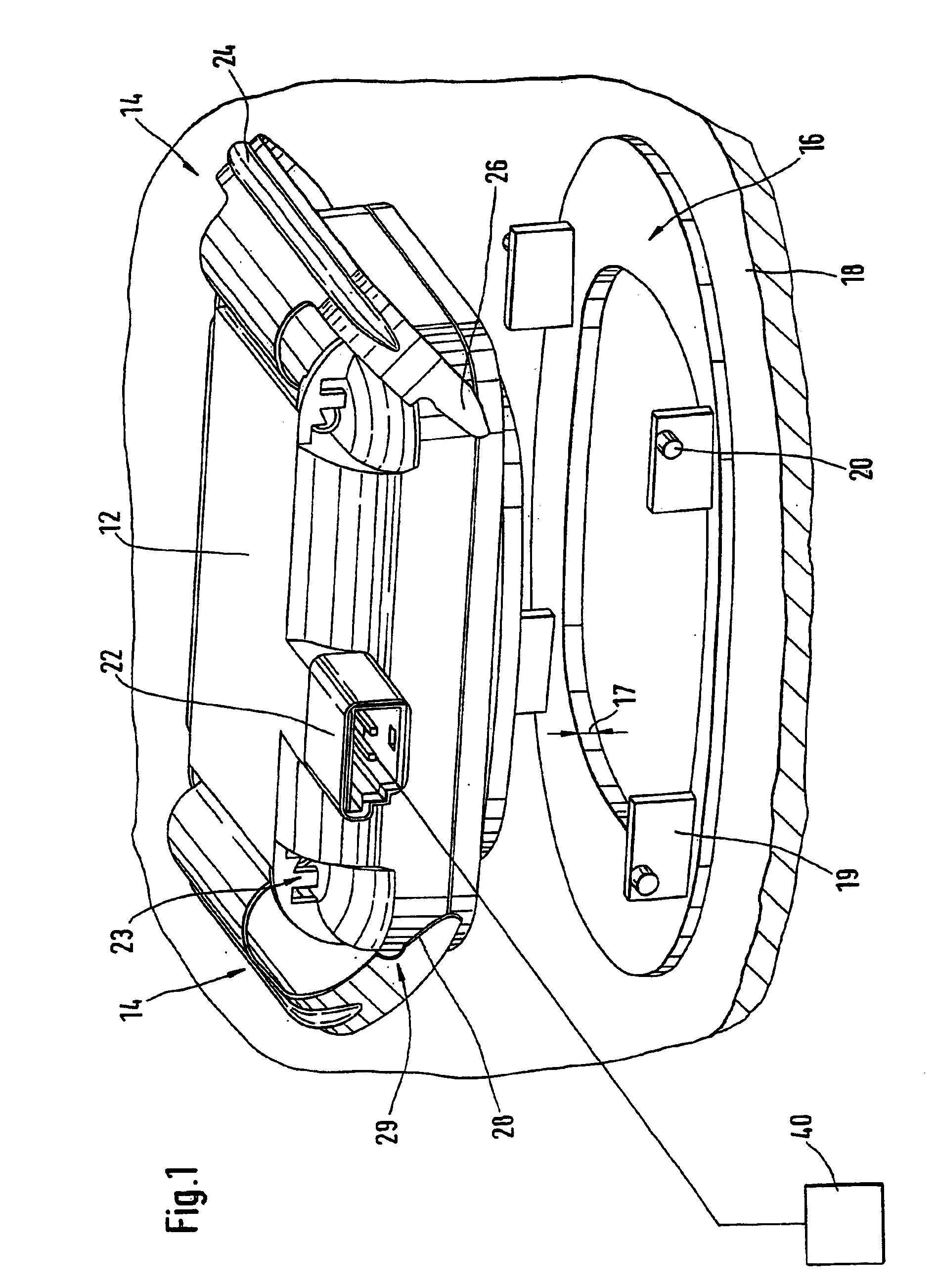
Figure 2 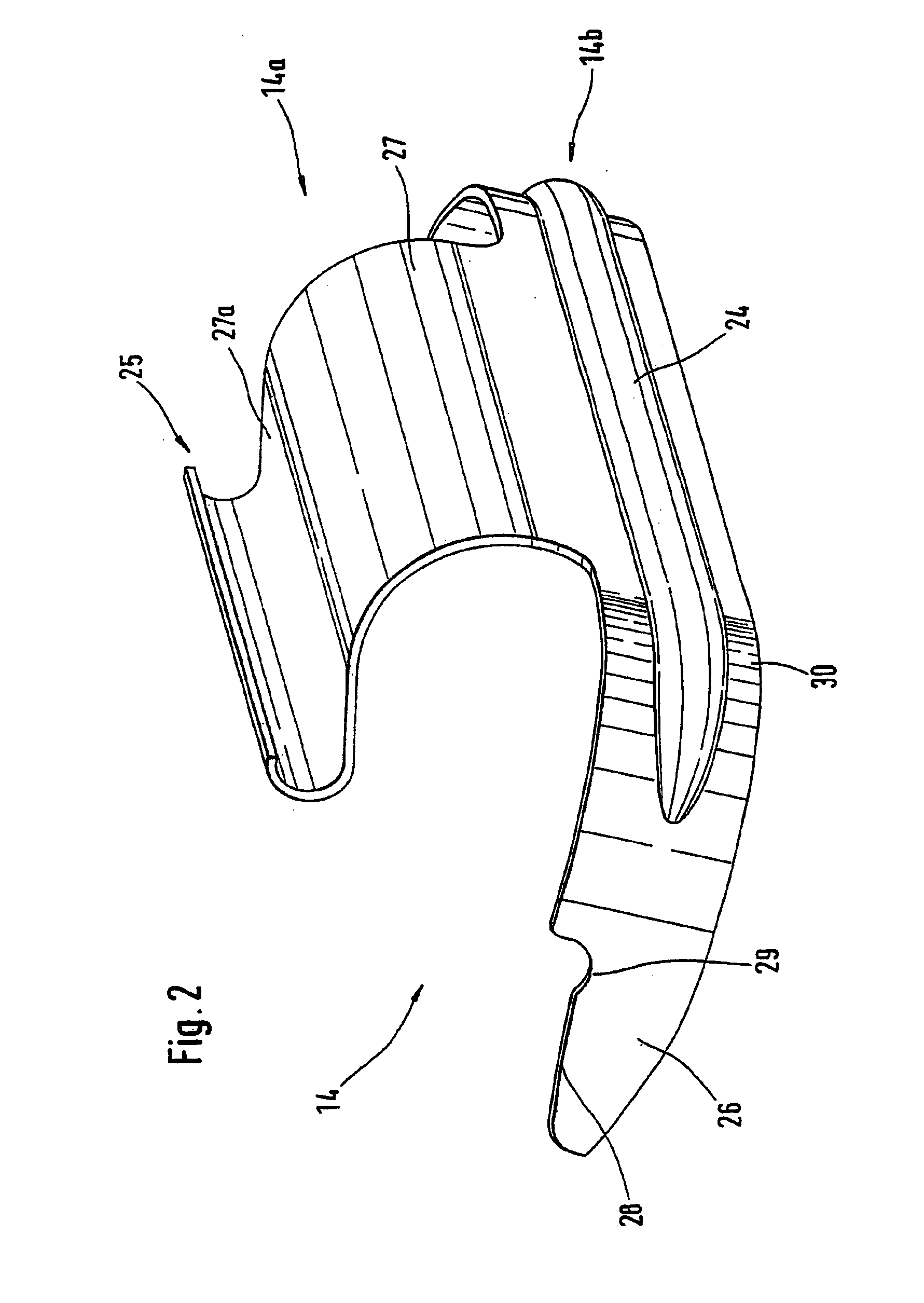
Figure 3
Abstract
Description
BACKGROUND OF THE INVENTION
[0001] The invention is based on a sensor DE 44 10 217 A1 has already disclosed a sensor with a number of housing parts. In this sensor, a fastening device is glued to a window. Two sliders, which are guided in an outer housing part and function as a fastening means, allow the outer housing part to engage with the fastening device. The sensor elements are affixed to an inner housing part, which is pressed against the window by means of a spring force acting on the outer housing part. This type of fastening, however, is complex, expensive, malfunction-prone, and therefore connected with high costs.SUMMARY OF THE INVENTION
[0002] In accordance with the present invention, a sensor is proposed, for a sensor for optical detection of foreign bodies, in particular raindrops, on a window, in particular on the windshield of a motor vehicle, having a sensor element that can be coupled to the inside of the window, having at least one fastening device to be fastened, to ...
Examples
Embodiment Construction
[0019]FIG. 1 shows a sensor 10 according to the invention, including a housing part 12, two fastening parts 14, and a fastening device 16.
[0020]The fastening device 16 is embodied as a plate-shaped part with a recess in the center so that it can receive the housing part 12 in a collar-like fashion. On the side, the fastening device 16 has tabs 19 on which pins 20 are provided, which extend latterly outward. The tabs 19 extend essentially perpendicular to the window 18, as a result of which the pins 20 extend approximately parallel to the window 18. The fastening device 16 is embodied of one piece and is glued to the inside of a window 18.
[0021]The housing part 12 is comprised of a shell-shaped plastic part whose sides are provided with pocket-like formations 23, which extend parallel to the window 18 and can receive the fastening parts 14. Likewise, the housing part 12 has a socket 22, which serves as a communications interface of a sensor element 21 (FIG. 5) with a set of evaluatio...