

Low bit-rate audio coding systems and methods that use expanding quantizers with arithmetic coding
a low bitrate and coding system technology, applied in the field of digital audio coding systems and methods, can solve the problems of huffman coding having serious limitations, unable to represent all signal components with sufficient quantization accuracy, and generally not providing beneficial effects of compressing quantizers
Patent Information
- Authority / Receiving Office
- US · United States
- Patent Type
- Patents(United States)
- Current Assignee / Owner
- Publication Date
- 2006-05-09
- Estimated Expiration
- Not applicable · inactive patent
Smart Images
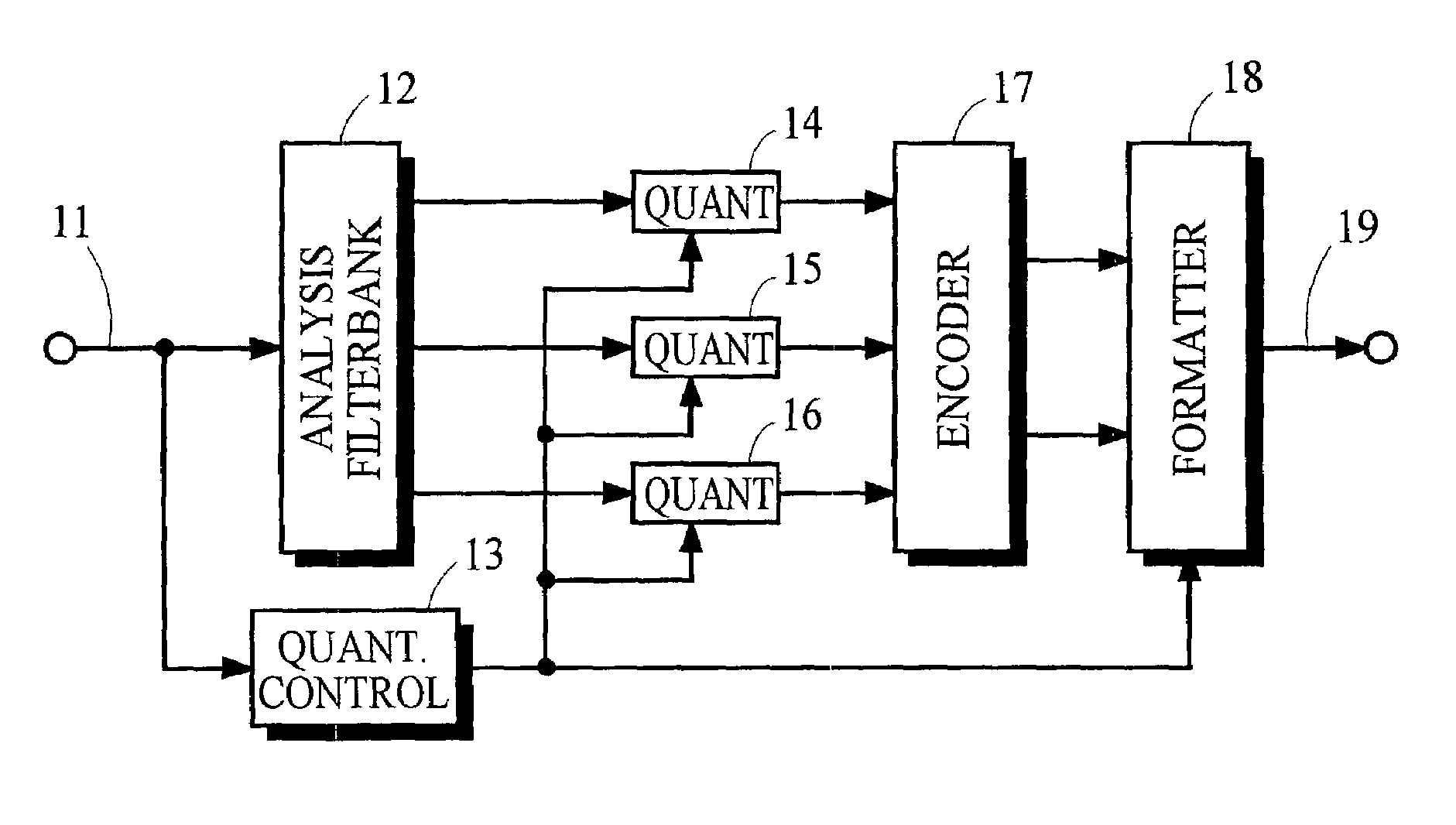
Figure 1 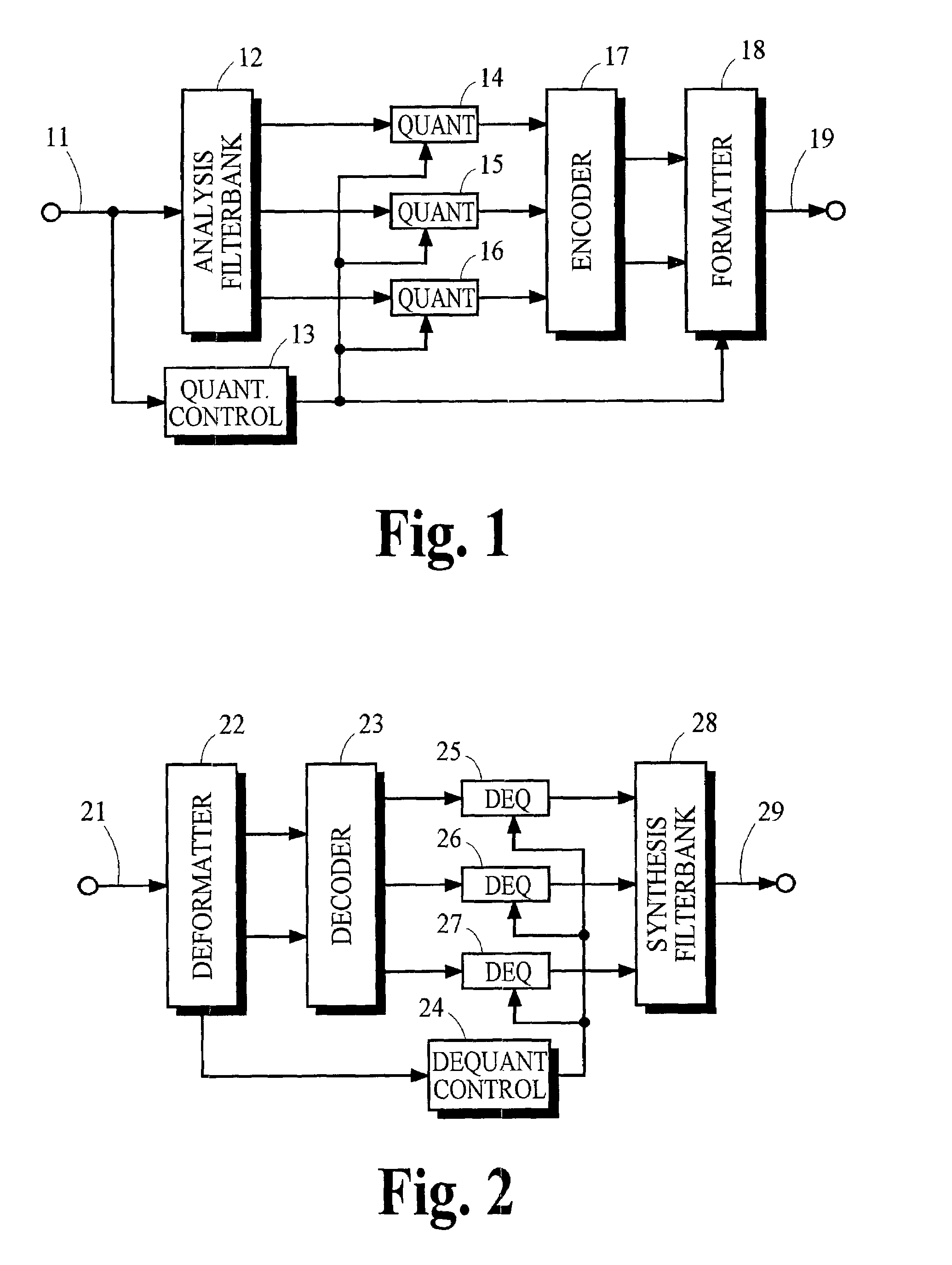
Figure 2 
Figure 3
Abstract
Description
TECHNICAL FIELD
[0001] The present invention is related generally to digital audio coding systems and methods, and is related more specifically to improving the perceived quality of the audio signals obtained from very low bit-rate audio coding systems and methods.BACKGROUND ART
[0002] Audio coding systems are used to encode an audio signal into an encoded signal that is suitable for transmission or storage, and then subsequently receive or retrieve the encoded signal and decode it to obtain a version of the original audio signal for playback. Perceptual audio coding systems attempt to encode an audio signal into an encoded signal that has lower information capacity requirements than the original audio signal, and then subsequently decode the encoded signal to provide an output that is perceptually indistinguishable from the original audio signal. One example of a perceptual audio coding technique is described in Bosi et al., “ISO / IEC MPEG-2 Advanced Audio Coding.” J. AES, vol. 45, no. ...
Examples
Embodiment Construction
A. Transmitter
1. Overview
[0029]FIG. 1 illustrates one implementation of an audio encoding transmitter that can incorporate various aspects of the present invention. In this implementation, analysis filterbank 12 receives from the path 11 audio information representing an audio signal and, in response, provides digital information that represents frequency subbands of the audio signal. The digital information in each of the frequency subbands is quantized by a respective quantizer 14, 15, 16 and passed to the encoder 17. The encoder 17 generates an encoded representation of the quantized information, which is passed to the formatter 18. In one implementation, the quantization functions in quantizers 14, 15, 16 are adapted in response to quantizing control information received from the quantizer controller 13, which generates the quantizing control information in response to the audio information received from the path 11. The formatter 18 assembles the encoded representation of the q...