
Generated torque control method for leg body exercise assistive apparatus
a technology of assistive equipment and generated torque, which is applied in the direction of program control, gymnastic exercise, instruments, etc., can solve the problem of the difference between the actual leg motion pattern and the motion pattern assumed by the person, and achieve the effect of preventing the attachment of a sensor and high degree of freedom
Patent Information
- Authority / Receiving Office
- US · United States
- Patent Type
- Patents(United States)
- Current Assignee / Owner
- Publication Date
- 2007-10-09
- Estimated Expiration
- Not applicable · inactive patent
Smart Images
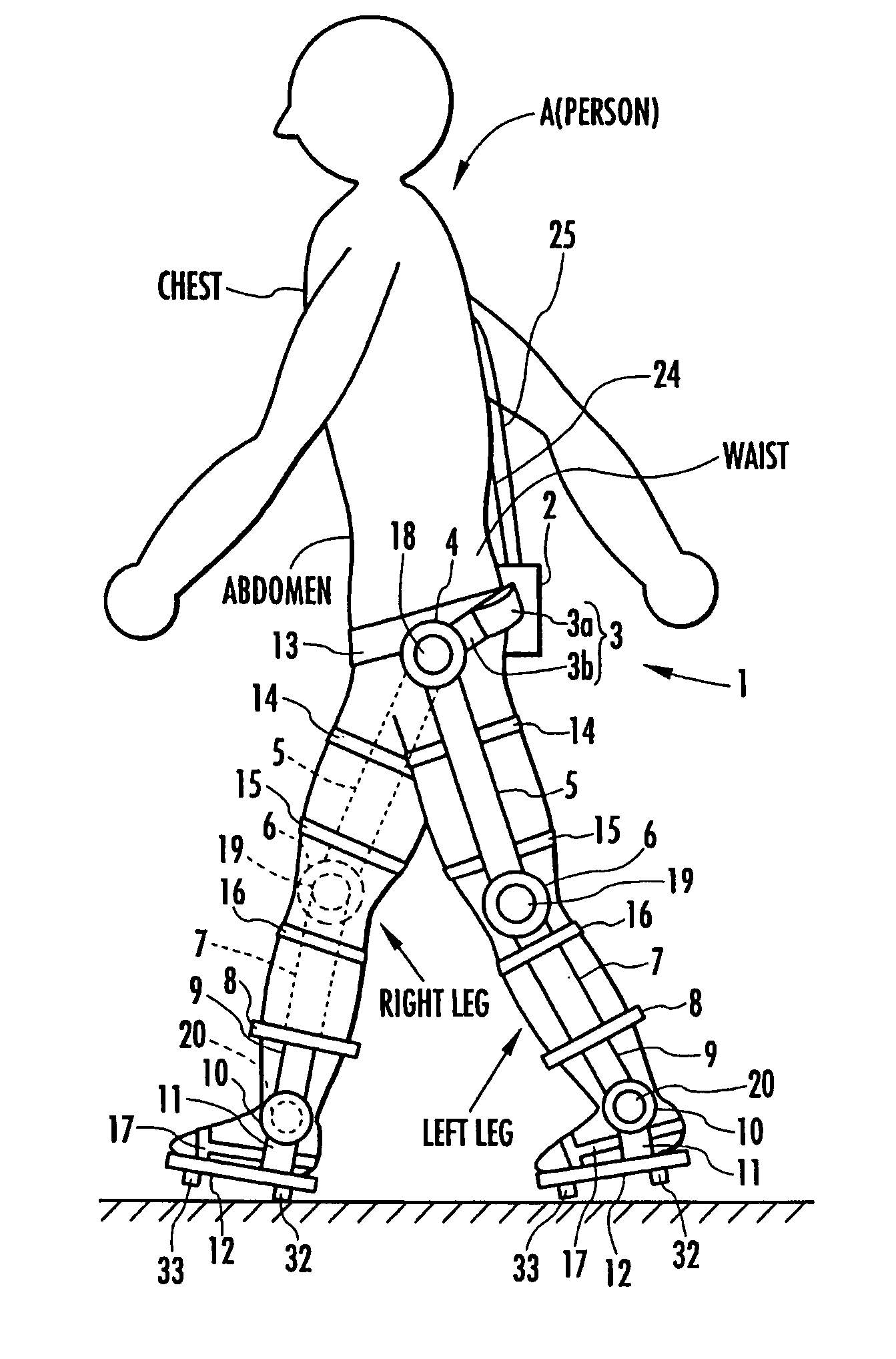
Figure 1 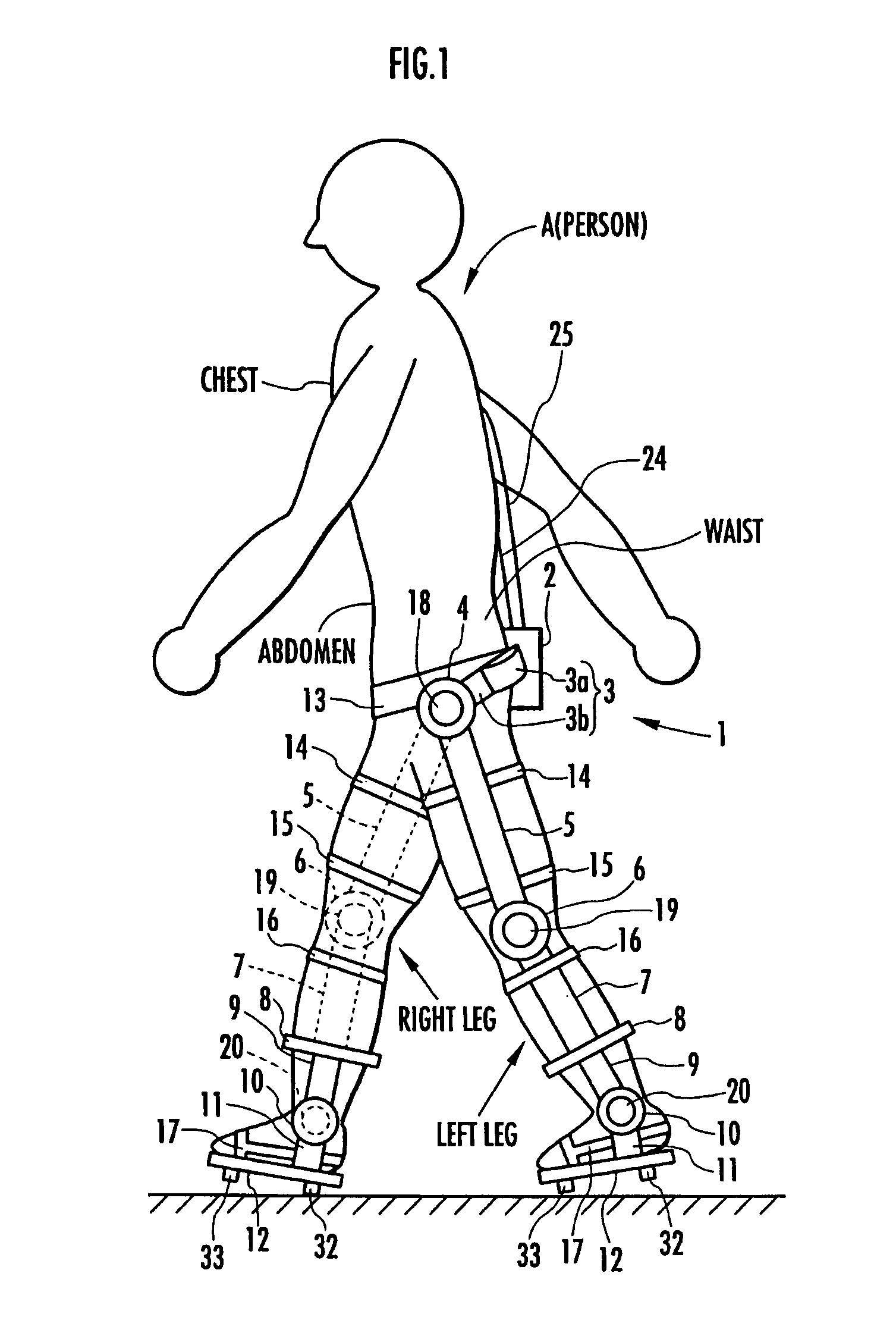
Figure 2 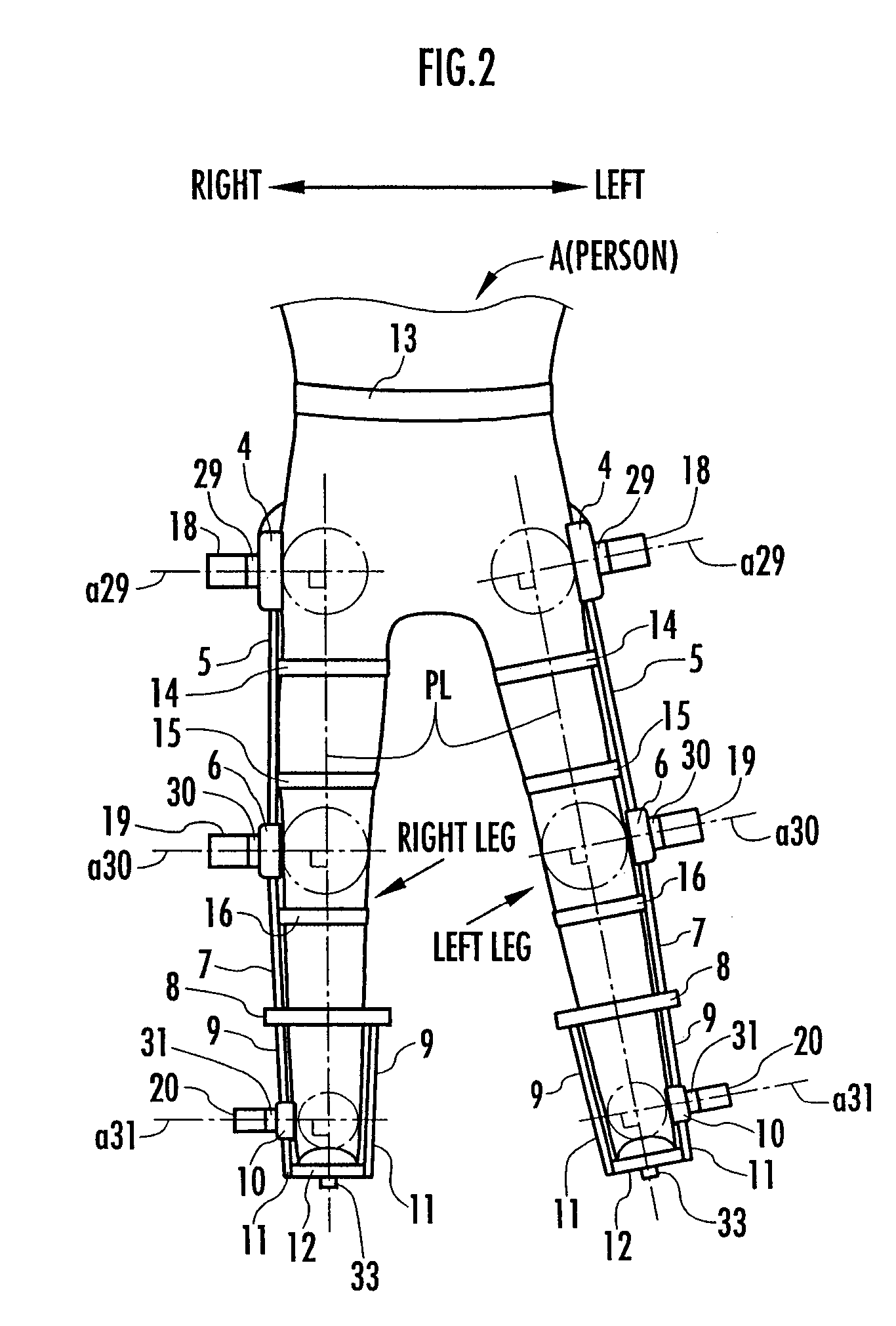
Figure 3
Abstract
Description
FIELD OF THE INVENTION
[0001] The present invention relates to a generated torque control method for a leg body exercise assistive apparatus, which is attached to the legs of a person.BACKGROUND ART
[0002] Conventionally, as this type of assistive apparatus, there is an already known apparatus disclosed in Japanese Patent Laid-Open No. 2003-220102 (hereinafter, referred to as “patent document 1”). The assistive apparatus of the patent document 1 includes moment generators on the hip joint, the knee joint, and the ankle joint of each leg of a person, with the moment generators connected to a foot supporting portion for supporting the foot of the person via beams. Moreover, it includes a sensor for detecting a force and moment acting between the foot supporting portion and the ground, a sensor for detecting a tilt angle of a beam, a sensor for detecting a force acting between the assistive apparatus and the person. On the basis of detected outputs of these sensors, a force to be generated...
Examples
first embodiment
[0049]An embodiment (a first embodiment) of the present invention will be described below by using FIG. 1 to FIG. 19. This embodiment is intended for the first and second features of the present invention. FIG. 1 shows a state where a person A is wearing a leg body exercise assistive apparatus 1 according to this embodiment, by means of a lateral view. FIG. 2 shows a lower part of the body of the person A wearing the leg body exercise assistive apparatus 1, by means of a front view. In FIG. 2, the hip joint, the knee joint, and the ankle joint of each leg of the person A are illustrated in chain-and-dash line circles, respectively, for purposes of the description.
[0050]In these FIG. 1 and FIG. 2, the leg body exercise assistive apparatus 1 (hereinafter, simply referred to as the assistive apparatus 1) includes a sensor box 2 attached to the back of the waist of the person A, a waist link member 3 extended from the sensor box 2 to the place of the hip joint of each leg of the person ...
second embodiment
[0228]While the electric motor 20 is provided in the ankle joint region 10 of the assistive apparatus 1 in the above embodiment, it is possible to omit the electric motor 20 for the ankle joint region 10. In this instance, if the ankle joint region 10 between the foot link member 11 and the second crus link member 9 is formed by a free joint or other rotatable object, the joint moment M(P_crus orthosis) of the knee joint region 6 and the joint moment M(P_thigh orthosis) of the hip joint region 4 may be calculated with the right-hand side of the formula (40) set to “zero” in calculating the joint moments of the assistive apparatus 1. Other things may be the same as in the aforementioned embodiment. The modification described here is referred to as a
third embodiment
[0229]Moreover, for example, if an elastic member such as a spring is disposed between the foot orthosis portion 12 and the second crus link member 9 of the assistive apparatus 1, in other words, if an elastic member 70 such as a spring is disposed between the foot element S9 and the crus element S8 as shown in FIG. 20 when the assistive apparatus 1 is represented in the form of a rigid link model, M(P_foot orthosis) of the formula (40) may be calculated by using a data table or a predetermined arithmetic expression from the detected value of the rotation angle of the ankle joint region 10 and then the knee joint moment M(P_crus orthosis) of the knee joint region 6 and the joint moment M(P_thigh orthosis) of the hip joint region 4 may be calculated by using M(P_foot orthosis). Other things may be the same as those of the aforementioned embodiment. The modification described here is referred to as a
[0230]Verification of effectiveness of the present invention will be described below w...