
Compound archery bow construction and methods of making and operating the bow
a technology of compound archery and construction methods, applied in the field of compound archery bow construction and methods of making and operating the bow, can solve the problems of unbalanced torque and flex stress on the upper and lower limbs of the bow, and the noise of the game, so as to achieve a better balanced bow, less torqueing stress, and more accurate
Patent Information
- Authority / Receiving Office
- US · United States
- Current Assignee / Owner
- Publication Date
- 2007-12-18
- Estimated Expiration
- Not applicable · inactive patent
Smart Images
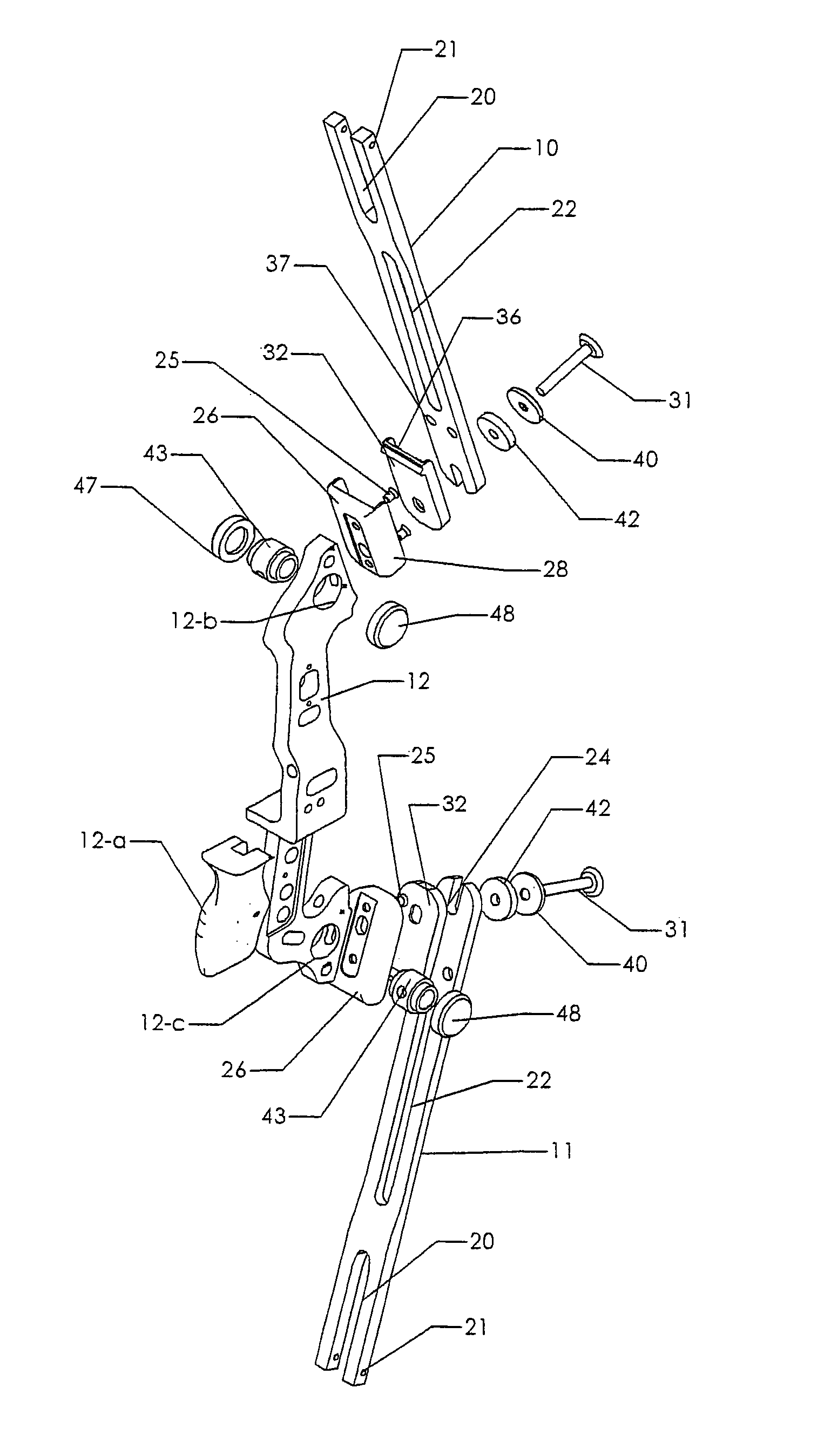
Figure 1 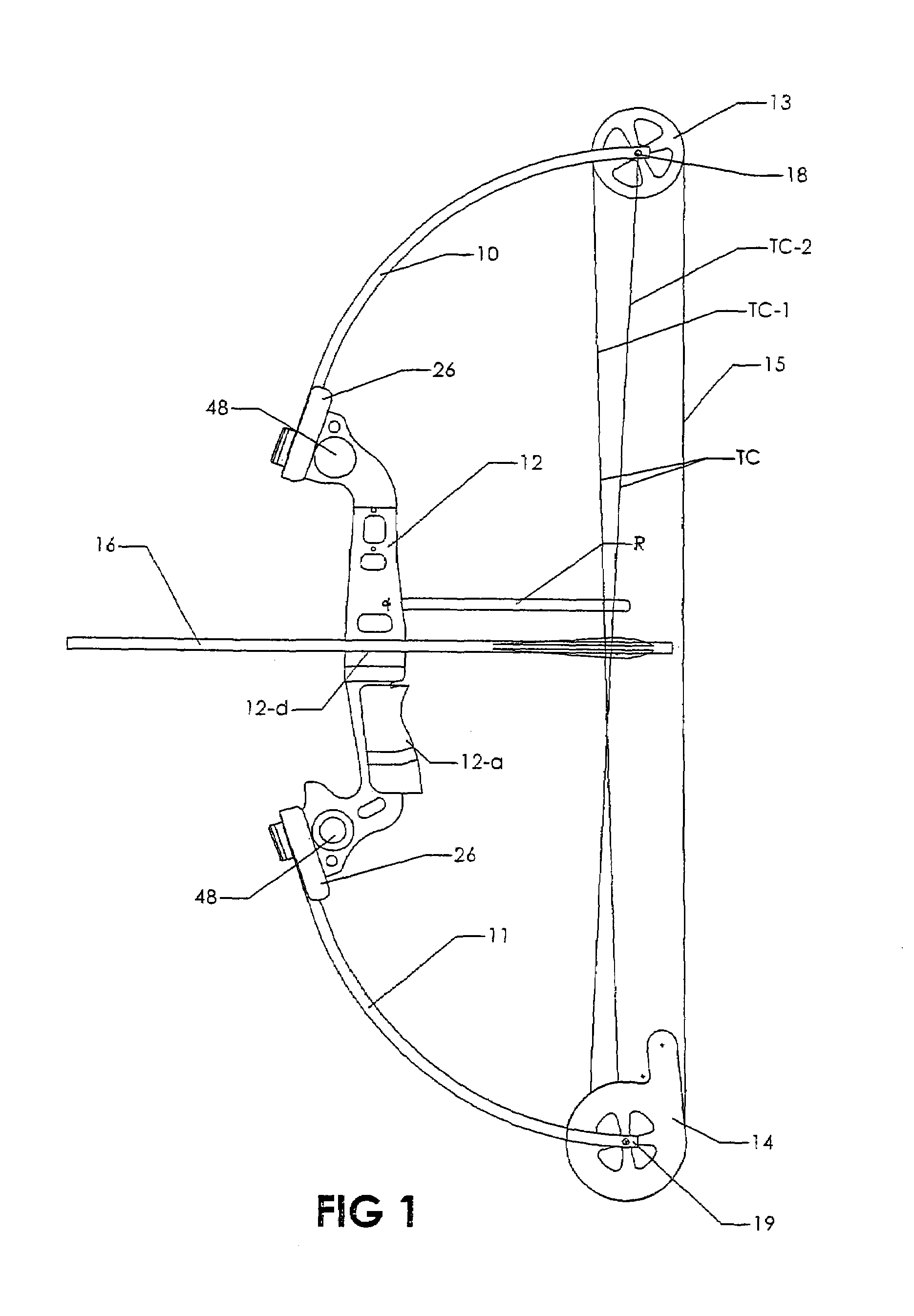
Figure 2 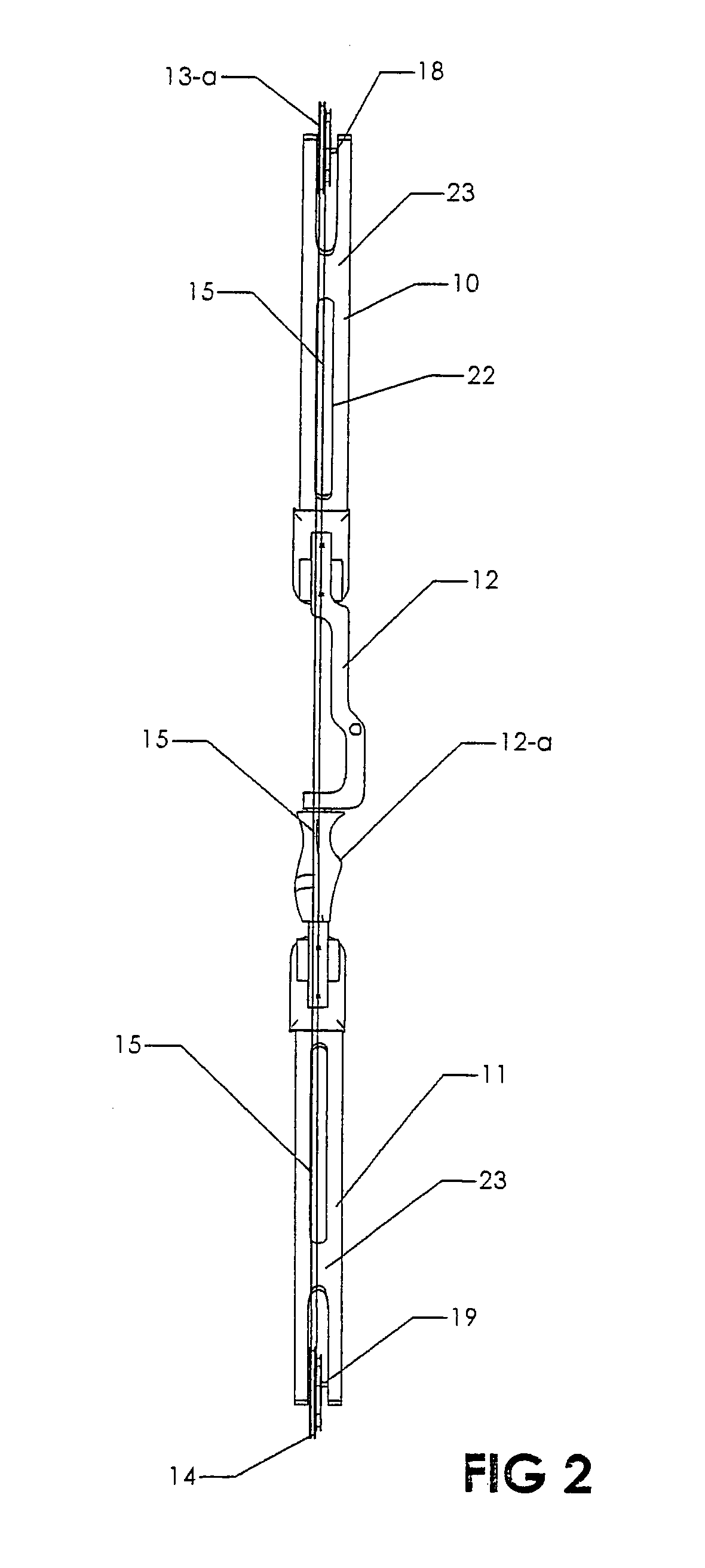
Figure 3
Abstract
Description
RELATED APPLICATIONS
[0001] This invention is entitled to the priority of U.S. provisional application Ser. No. 60 / 261,851 filed Jan. 15, 2001, and is a division of Ser. No. 10 / 047,644, filed Jan. 15, 2002, now U.S. Pat. No. 6,718,963, and is a division of Ser. No. 10 / 822,889 filed Apr. 13, 2004 now U.S. Pat. No. 6,941,937. The invention relates to archery bows and more particularly to compound archery bows utilizing separable limb and riser components.BACKGROUND OF THE INVENTION
[0002] One of the problems with achieving accuracy has been the recoil vibration occurring as the arrow is released from the bow, which has resulted also in undue noise that startles the game. Another factor affecting accuracy is the alignment of the bow string which in the past has not provided the balance desired. To the best of my knowledge, the arrow released by prior art compound bows has not been vertically centered with the result that the torque and flex stresses on the bow upper and lower limbs has not...
Examples
Embodiment Construction
[0028]Referring more particularly to the accompanying drawings, and in the first instance to FIG. 1 thereof, the bow assembly comprises generally upper and lower resilient limbs generally designated 10 and 11 joined in the manner to be disclosed to a rigid riser, generally designated 12, which can be fashioned of aluminum or other suitable material. Revolvable mechanical advantage creating pulley members 13 and 14 are mounted laterally centrally at the outer ends of the limbs 10 and 11. The members 13 and 14 may comprise regular idler pulleys or eccentric pulleys and in FIG. 1 a regular pulley is shown at 13 and an eccentric pulley at 14. They operate in the usual manner to mount the bow string 15 shown in FIG. 1, which in the embodiment shown is part of the conventional tension cable system generally designated TC which extends between the opposite ends of the bow in the usual manner. The cables TC-1 and TC-2 of the conventional cable system, pass through spaced apart openings in a...