
Safety lock mechanism for folding knives
a safety lock and folding knife technology, applied in the field of folding knives, can solve the problems of unintended deployment and closure of the knife blade from an open position, and presenting a safety hazard to users, so as to achieve the effect of preventing unintended movement of the knife blad
Patent Information
- Authority / Receiving Office
- US · United States
- Patent Type
- Patents(United States)
- Current Assignee / Owner
- Publication Date
- 2011-07-19
Smart Images
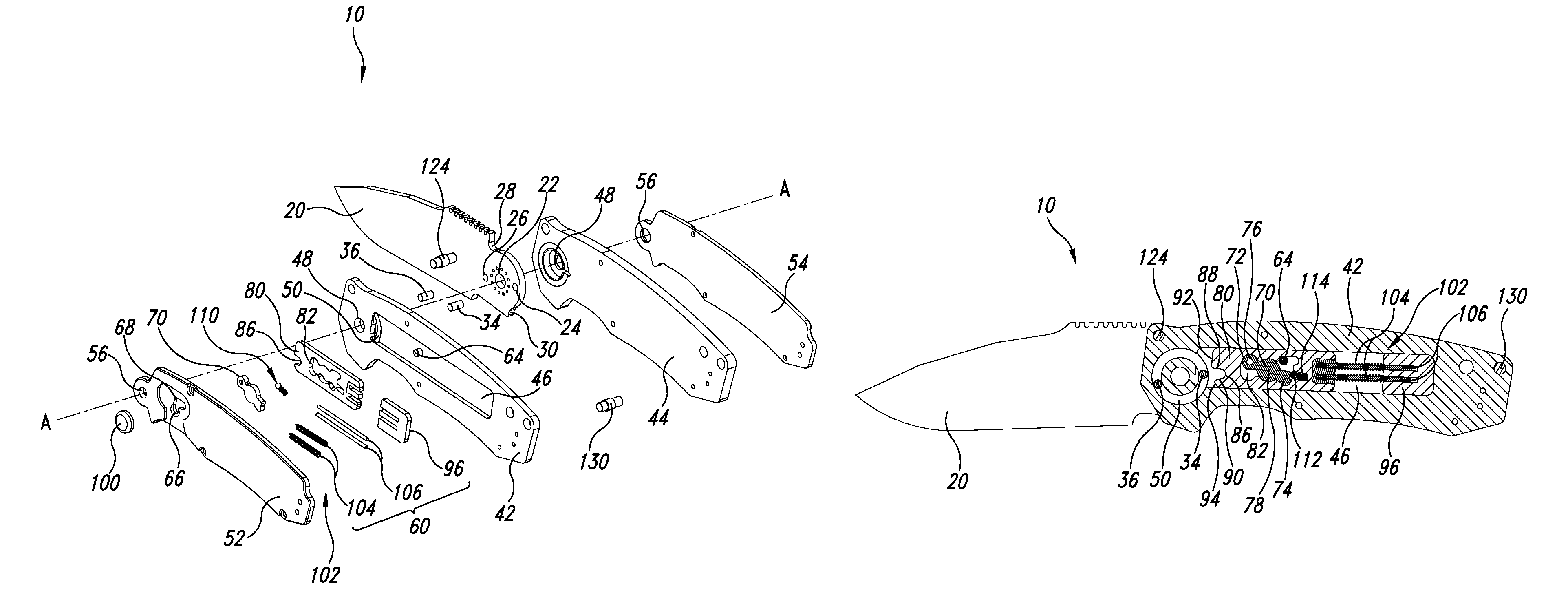
Figure 1 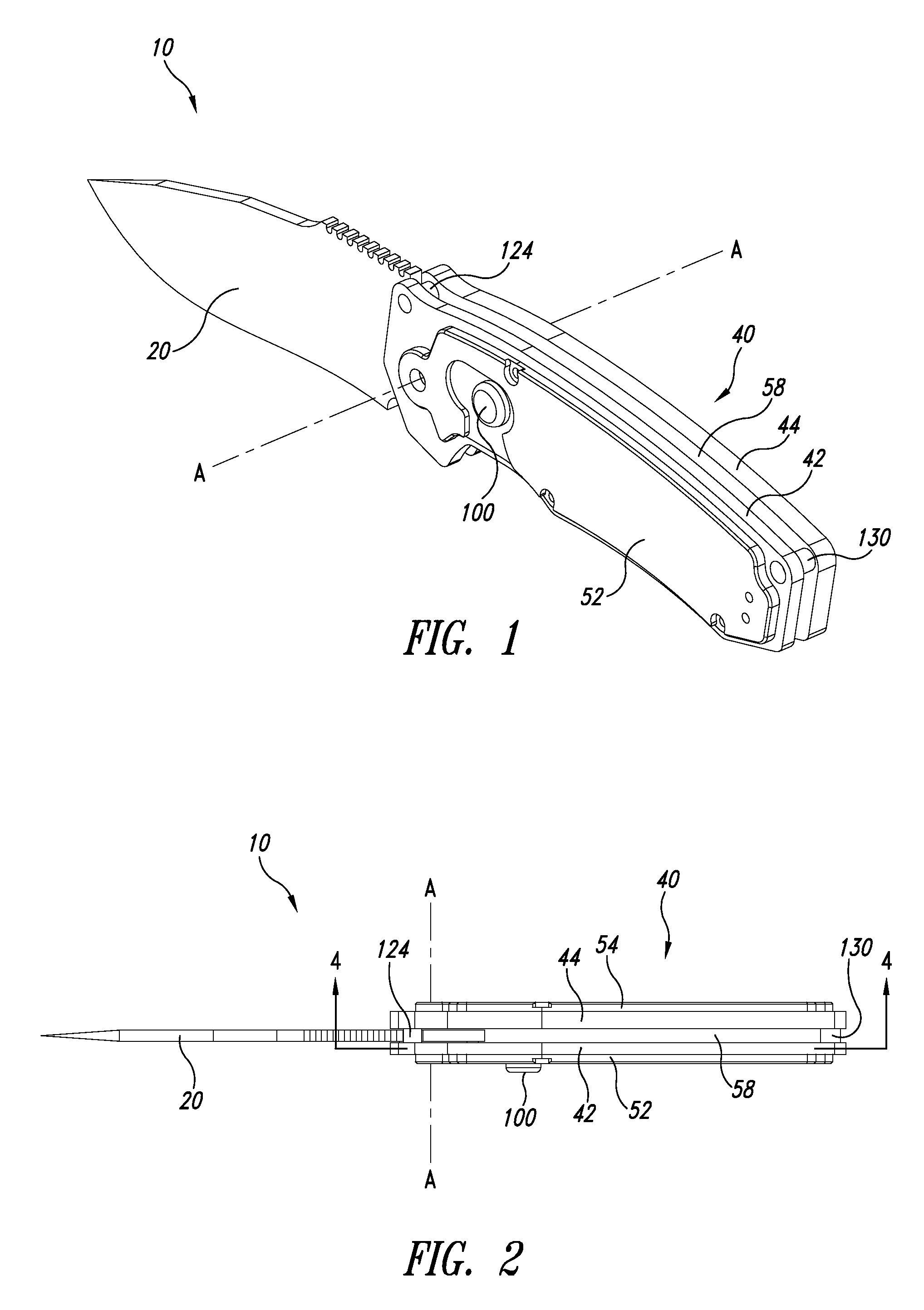
Figure 2 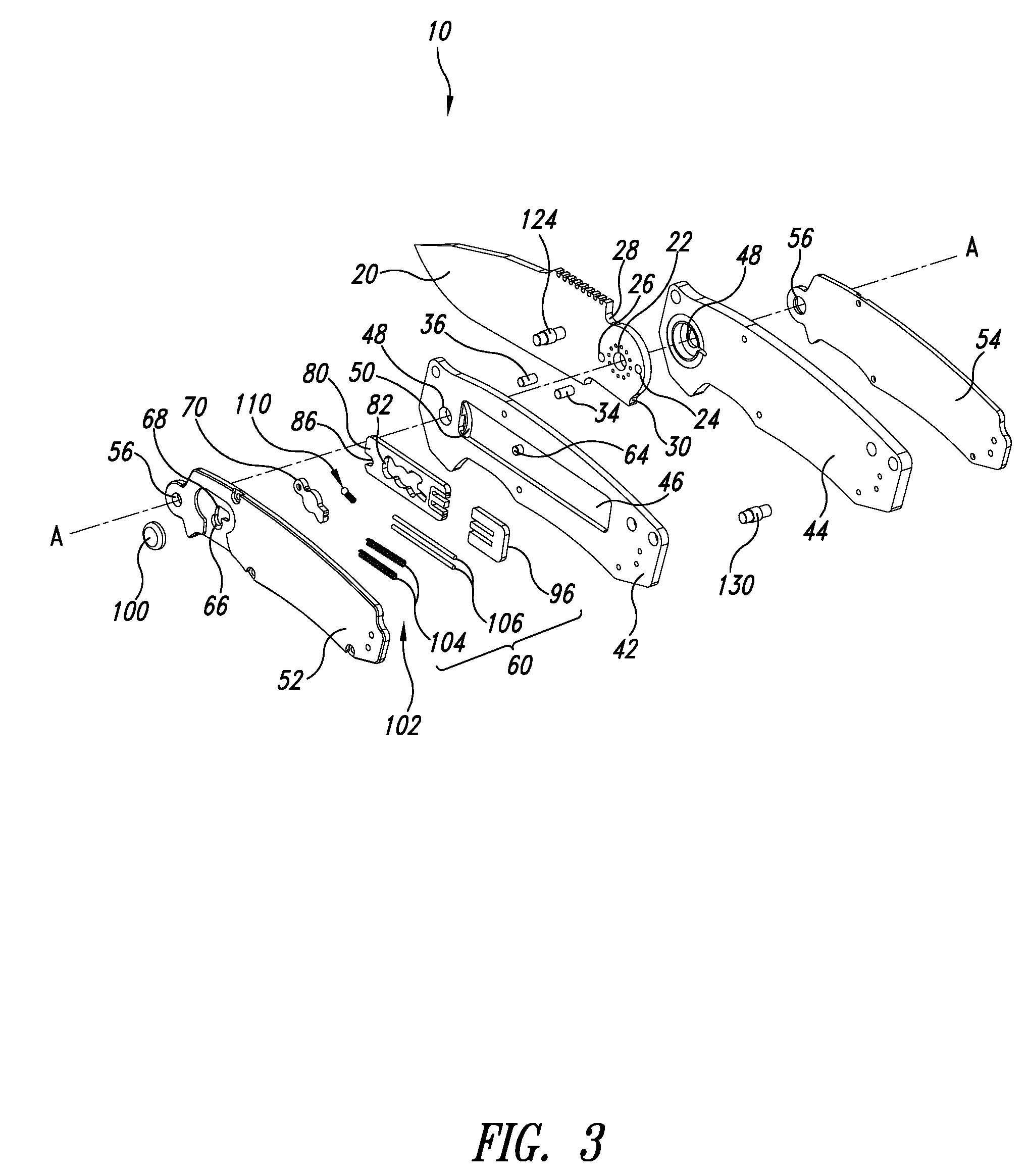
Figure 3
Abstract
Description
BACKGROUND
[0001] 1. Technical Field
[0002] This disclosure generally relates to folding knives, and in particular to folding knives having safety lock mechanisms.
[0003] 2. Description of the Related Art
[0004] Folding knives enjoy wide popularity, particularly among sportsmen, campers, hikers, and many others engaged in outdoor activities. Common elements to folding knives include a handle and a blade pivotally connected to an end of the handle so that the blade pivots with respect to the handle between an open position in which the blade is extended away from the handle, and a closed position in which the blade is at least partially received within the handle. Many folding knives also include a locking mechanism to maintain the blade in the open position and / or the closed position. A locking mechanism is particularly advantageous with folding knives having an assisted opening mechanism and automatic knives. Examples of folding knives, including folding knives with locking mechanisms, may...
Examples
Embodiment Construction
[0016]For the purposes of clarity and ease of comprehension, directional terms such as, for example, top, bottom, right, and left may be used in describing embodiments, and will be with reference to elements as they appear on the figures. Where elements are described using terms such as inner or outer, this is with respect to a central plane of the knife, i.e., a plane that lies parallel to, and substantially centered between, the first and second frame members. Thus, a side of an element that lies closer to that center plane than another side of the element may be described as the inner side of the element.
[0017]Elements that are, in the illustrated embodiment, substantially identical will be identified by identical reference numbers. Where it is necessary to distinguish between such identical elements in the description, letters will be used. Fasteners, which may be screws, rivets, pins, or other suitable devices such as are well known in the art, are not illustrated for purposes ...