
Efficient address caching for packet telephony services
a packet telephony and address caching technology, applied in the field of packet telephony, can solve the problems of subscribers incurring long delays before their calls are completed, itsps may not be willing to have the centralized database release their subscriber records to non-trusted parties, and it is difficult for each itsp to hold a complete copy of the database, so as to improve the efficiency and security of access, the effect of reducing the number of cache hits
Patent Information
- Authority / Receiving Office
- US · United States
- Patent Type
- Patents(United States)
- Current Assignee / Owner
- Publication Date
- 2012-08-28
Smart Images
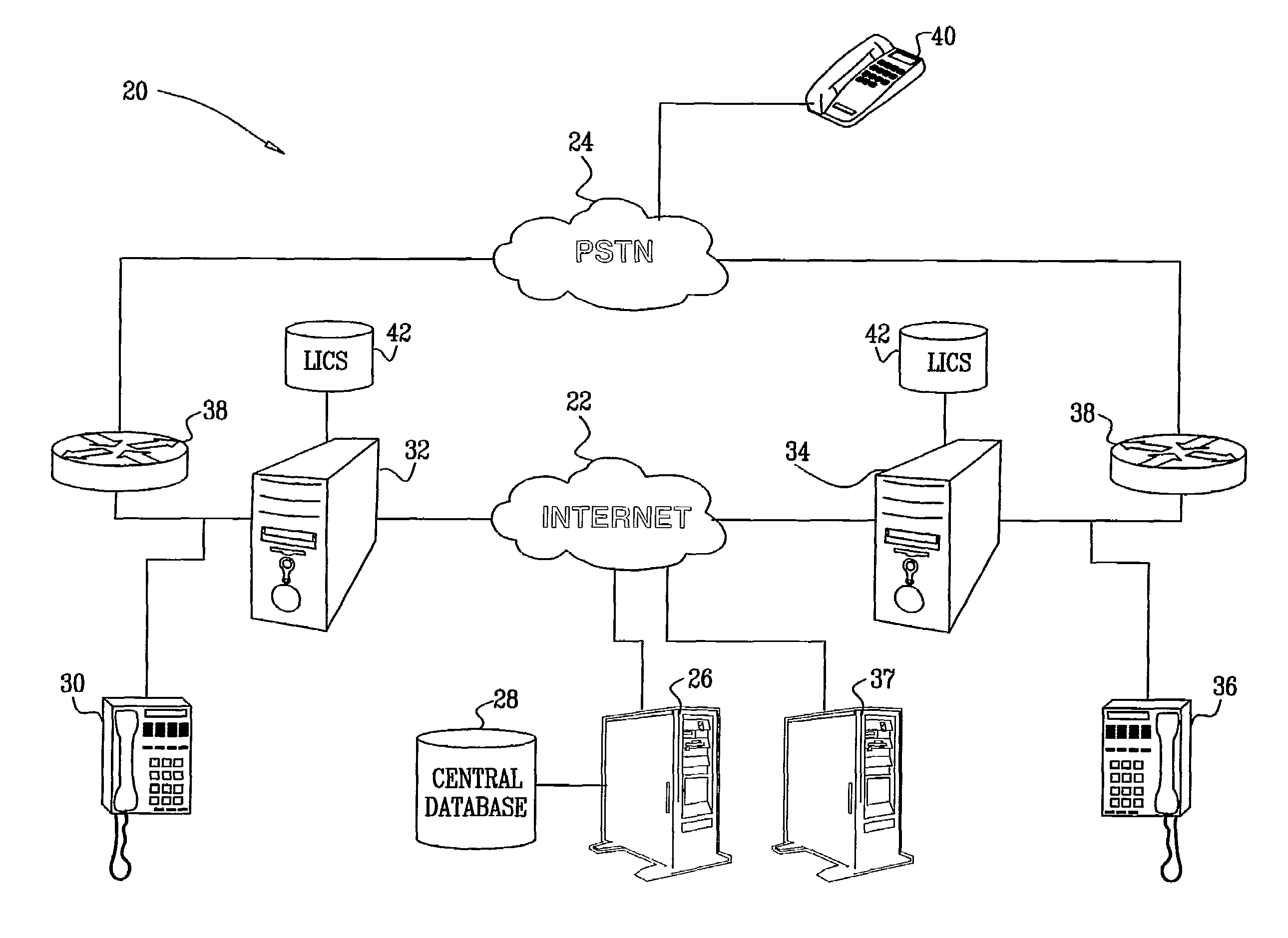
Figure 1 
Figure 2 
Figure 3
Abstract
Description
CROSS-REFERENCE TO RELATED APPLICATION
[0001] This application claims the benefit of International Patent Application No. PCT / IL2006 / 000608 filed on May 23, 2005 designating the United States of America, which claims the benefit of and priority to U.S. Provisional Patent Application 60 / 684,154, filed May 23, 2005, which is incorporated herein by reference.FIELD OF THE INVENTION
[0002] The present invention relates generally to packet telephony, and specifically to methods and systems for storing and accessing subscriber addresses for packet telephony services.BACKGROUND OF THE INVENTION
[0003] Internet telephony service providers (ITSPs) offer their subscribers Voice over Internet Protocol (VoIP) service with the “look and feel” of plain old telephone service (POTS). ITSPs provision their subscribers with Direct Inward Dial (DID) numbers in the standard format of conventional telephone numbers, as mandated by Recommendation E.164 of the International Telecommunications Union (ITU-T). ITSP...
Examples
Embodiment Construction
System Overview
[0043]FIG. 1 is a block diagram that schematically illustrates a system 20 for Internet-based telephony, in accordance with an embodiment of the present invention. The system permits Internet telephony users to place calls over either a packet network 22, such as the public Internet, or a PSTN 24, depending on the destination telephone number of each call. This inter-network functionality is supported by a central database 28 containing records indicating the correspondence between E.164 telephone numbers and packet network addresses, in the form of URIs that can be placed directly into a SIP message for routing. The central database is accessible via a central server 26, which is typically maintained by a trusted central authority. In the description that follows, for the sake of simplicity, it will be assumed that database 28 stores records in ENUM format and may be accessed over network 22 using DNS protocols. Alternatively, other data formats and protocols may be ...