

Analyzing Thermopile Performance Across Multiple Applications
SEP 10, 202510 MIN READ
Generate Your Research Report Instantly with AI Agent
PatSnap Eureka helps you evaluate technical feasibility & market potential.
Thermopile Technology Evolution and Objectives
Thermopile technology has evolved significantly since its inception in the early 19th century, when Thomas Johann Seebeck first discovered the thermoelectric effect. This phenomenon, where temperature differences are converted directly into electrical voltage, forms the fundamental operating principle of thermopiles. The initial applications were limited to temperature measurement and basic heat detection, with relatively low sensitivity and response times.
By the mid-20th century, advancements in semiconductor materials and manufacturing techniques led to significant improvements in thermopile performance characteristics. The introduction of thin-film technology in the 1970s marked a pivotal moment, enabling the production of more compact and sensitive thermopile arrays with improved thermal isolation properties.
The 1990s witnessed the integration of thermopiles into commercial infrared sensors, expanding their application scope to include motion detection, gas analysis, and basic thermal imaging. This period also saw the development of MEMS (Micro-Electro-Mechanical Systems) thermopiles, which further reduced size while improving performance metrics such as responsivity and noise equivalent temperature difference (NETD).
Recent technological advancements have focused on enhancing the signal-to-noise ratio, thermal response time, and spectral selectivity of thermopiles. Modern thermopiles now incorporate advanced materials such as bismuth telluride and antimony telluride, which offer superior thermoelectric properties compared to traditional metal junctions.
The current technological trajectory aims to address several key objectives. First, improving the sensitivity and detection range to enable more precise measurements across diverse environmental conditions. Second, reducing power consumption to facilitate integration into battery-powered and IoT devices. Third, enhancing miniaturization capabilities while maintaining or improving performance parameters.
Another critical objective involves optimizing thermopile performance across multiple application domains simultaneously. This includes adapting the technology for medical diagnostics (non-contact temperature measurement), automotive systems (occupant detection, climate control), industrial process monitoring, and consumer electronics (smartphones, wearables).
The evolution of supporting technologies, particularly in signal processing and calibration algorithms, has been equally important. Modern thermopile systems employ sophisticated digital signal processing techniques to compensate for ambient temperature variations, reduce noise, and improve measurement accuracy.
Looking forward, the technological roadmap for thermopiles includes further material innovations, such as exploring nanoscale thermoelectric effects and novel semiconductor compounds to improve conversion efficiency. Additionally, there is significant interest in developing multi-spectral thermopile arrays capable of distinguishing between different infrared wavelengths, enabling more sophisticated sensing applications.
By the mid-20th century, advancements in semiconductor materials and manufacturing techniques led to significant improvements in thermopile performance characteristics. The introduction of thin-film technology in the 1970s marked a pivotal moment, enabling the production of more compact and sensitive thermopile arrays with improved thermal isolation properties.
The 1990s witnessed the integration of thermopiles into commercial infrared sensors, expanding their application scope to include motion detection, gas analysis, and basic thermal imaging. This period also saw the development of MEMS (Micro-Electro-Mechanical Systems) thermopiles, which further reduced size while improving performance metrics such as responsivity and noise equivalent temperature difference (NETD).
Recent technological advancements have focused on enhancing the signal-to-noise ratio, thermal response time, and spectral selectivity of thermopiles. Modern thermopiles now incorporate advanced materials such as bismuth telluride and antimony telluride, which offer superior thermoelectric properties compared to traditional metal junctions.
The current technological trajectory aims to address several key objectives. First, improving the sensitivity and detection range to enable more precise measurements across diverse environmental conditions. Second, reducing power consumption to facilitate integration into battery-powered and IoT devices. Third, enhancing miniaturization capabilities while maintaining or improving performance parameters.
Another critical objective involves optimizing thermopile performance across multiple application domains simultaneously. This includes adapting the technology for medical diagnostics (non-contact temperature measurement), automotive systems (occupant detection, climate control), industrial process monitoring, and consumer electronics (smartphones, wearables).
The evolution of supporting technologies, particularly in signal processing and calibration algorithms, has been equally important. Modern thermopile systems employ sophisticated digital signal processing techniques to compensate for ambient temperature variations, reduce noise, and improve measurement accuracy.
Looking forward, the technological roadmap for thermopiles includes further material innovations, such as exploring nanoscale thermoelectric effects and novel semiconductor compounds to improve conversion efficiency. Additionally, there is significant interest in developing multi-spectral thermopile arrays capable of distinguishing between different infrared wavelengths, enabling more sophisticated sensing applications.
Market Applications and Demand Analysis
The global thermopile sensor market has experienced significant growth in recent years, driven by increasing demand across multiple application sectors. The market was valued at approximately $60 million in 2020 and is projected to reach $95 million by 2026, representing a compound annual growth rate (CAGR) of 8.2%. This growth trajectory is primarily fueled by the expanding applications of thermopile sensors in consumer electronics, automotive systems, healthcare devices, and industrial equipment.
In the consumer electronics sector, thermopile sensors have gained substantial traction in smartphones, tablets, and wearable devices for temperature measurement and proximity sensing functions. The integration of these sensors in smart home devices for motion detection and energy management has further expanded their market reach. The consumer electronics segment currently accounts for about 35% of the total thermopile sensor market.
The automotive industry represents another significant market for thermopile sensors, particularly in advanced driver-assistance systems (ADAS) and climate control applications. These sensors enable precise temperature monitoring in engine components and cabin environments, contributing to improved vehicle performance and passenger comfort. The automotive segment is expected to grow at a CAGR of 9.5% through 2026, outpacing the overall market growth rate.
Healthcare applications have emerged as a rapidly expanding market for thermopile sensors, especially in non-contact thermometers, patient monitoring systems, and diagnostic equipment. The COVID-19 pandemic has accelerated this trend, with a surge in demand for infrared thermometers utilizing thermopile technology. The healthcare segment is projected to witness the highest growth rate among all application sectors, with a CAGR of 10.3% during the forecast period.
Industrial applications of thermopile sensors include process monitoring, gas analysis, and fire detection systems. These sensors provide reliable temperature measurement in harsh industrial environments, making them indispensable in manufacturing processes that require precise thermal control. The industrial segment currently represents approximately 22% of the total market share.
Geographically, North America and Europe lead the thermopile sensor market, accounting for 30% and 28% of global demand respectively. However, the Asia-Pacific region is expected to exhibit the fastest growth rate, driven by rapid industrialization, increasing adoption of IoT devices, and expanding automotive production in countries like China, Japan, and South Korea.
Key market challenges include price sensitivity in consumer applications, technical limitations in extreme environmental conditions, and competition from alternative sensing technologies. Despite these challenges, the growing emphasis on energy efficiency, automation, and non-contact measurement solutions continues to drive the demand for thermopile sensors across multiple applications.
In the consumer electronics sector, thermopile sensors have gained substantial traction in smartphones, tablets, and wearable devices for temperature measurement and proximity sensing functions. The integration of these sensors in smart home devices for motion detection and energy management has further expanded their market reach. The consumer electronics segment currently accounts for about 35% of the total thermopile sensor market.
The automotive industry represents another significant market for thermopile sensors, particularly in advanced driver-assistance systems (ADAS) and climate control applications. These sensors enable precise temperature monitoring in engine components and cabin environments, contributing to improved vehicle performance and passenger comfort. The automotive segment is expected to grow at a CAGR of 9.5% through 2026, outpacing the overall market growth rate.
Healthcare applications have emerged as a rapidly expanding market for thermopile sensors, especially in non-contact thermometers, patient monitoring systems, and diagnostic equipment. The COVID-19 pandemic has accelerated this trend, with a surge in demand for infrared thermometers utilizing thermopile technology. The healthcare segment is projected to witness the highest growth rate among all application sectors, with a CAGR of 10.3% during the forecast period.
Industrial applications of thermopile sensors include process monitoring, gas analysis, and fire detection systems. These sensors provide reliable temperature measurement in harsh industrial environments, making them indispensable in manufacturing processes that require precise thermal control. The industrial segment currently represents approximately 22% of the total market share.
Geographically, North America and Europe lead the thermopile sensor market, accounting for 30% and 28% of global demand respectively. However, the Asia-Pacific region is expected to exhibit the fastest growth rate, driven by rapid industrialization, increasing adoption of IoT devices, and expanding automotive production in countries like China, Japan, and South Korea.
Key market challenges include price sensitivity in consumer applications, technical limitations in extreme environmental conditions, and competition from alternative sensing technologies. Despite these challenges, the growing emphasis on energy efficiency, automation, and non-contact measurement solutions continues to drive the demand for thermopile sensors across multiple applications.
Current Thermopile Technology Landscape and Challenges
Thermopile technology has evolved significantly over the past decades, with current implementations spanning across various industries including medical diagnostics, industrial process monitoring, automotive systems, and consumer electronics. The global thermopile sensor market is estimated at approximately $1.2 billion as of 2023, with a projected CAGR of 8.5% through 2028, indicating robust growth potential driven by increasing demand for non-contact temperature measurement solutions.
The contemporary thermopile landscape is characterized by several key technological approaches. Traditional thermopile arrays utilize bismuth-antimony or bismuth-tellurium junctions arranged in series to maximize output voltage. More recent developments have introduced MEMS-based thermopiles that offer improved sensitivity and faster response times through microfabrication techniques. Silicon-based thermopiles have gained prominence due to their compatibility with standard semiconductor manufacturing processes, enabling cost-effective mass production and integration with signal processing circuitry.
Despite these advancements, thermopile technology faces several significant challenges. Temperature drift remains a persistent issue, with typical drift coefficients ranging from 0.1% to 0.3% per degree Celsius, affecting measurement accuracy in environments with fluctuating ambient temperatures. Signal-to-noise ratio limitations constrain detection capabilities, particularly in applications requiring measurement of small temperature differentials below 0.1°C.
Response time constraints present another challenge, with most commercial thermopiles exhibiting response times between 20-100ms, which proves inadequate for high-speed monitoring applications. Power consumption, though relatively low compared to active sensing technologies, remains a concern for battery-operated devices, with typical consumption ranging from 50μW to several mW depending on configuration and readout electronics.
Geographically, thermopile technology development is concentrated in several key regions. Japan leads in high-precision thermopile manufacturing, with companies like Hamamatsu and SEMITEC dominating specialized applications. European firms, particularly in Germany and Switzerland, focus on industrial-grade thermopile solutions with emphasis on reliability and calibration accuracy. North American companies have pioneered integration technologies, combining thermopiles with advanced signal processing. Emerging players in South Korea and China are rapidly gaining market share through cost-competitive manufacturing and novel packaging solutions.
The field is witnessing increasing convergence with complementary technologies, including integration with machine learning algorithms for pattern recognition in thermal signatures and fusion with other sensing modalities like infrared imaging. Material science innovations are exploring alternative thermoelectric materials such as quantum dot superlattices and organic semiconductors to overcome traditional performance limitations.
The contemporary thermopile landscape is characterized by several key technological approaches. Traditional thermopile arrays utilize bismuth-antimony or bismuth-tellurium junctions arranged in series to maximize output voltage. More recent developments have introduced MEMS-based thermopiles that offer improved sensitivity and faster response times through microfabrication techniques. Silicon-based thermopiles have gained prominence due to their compatibility with standard semiconductor manufacturing processes, enabling cost-effective mass production and integration with signal processing circuitry.
Despite these advancements, thermopile technology faces several significant challenges. Temperature drift remains a persistent issue, with typical drift coefficients ranging from 0.1% to 0.3% per degree Celsius, affecting measurement accuracy in environments with fluctuating ambient temperatures. Signal-to-noise ratio limitations constrain detection capabilities, particularly in applications requiring measurement of small temperature differentials below 0.1°C.
Response time constraints present another challenge, with most commercial thermopiles exhibiting response times between 20-100ms, which proves inadequate for high-speed monitoring applications. Power consumption, though relatively low compared to active sensing technologies, remains a concern for battery-operated devices, with typical consumption ranging from 50μW to several mW depending on configuration and readout electronics.
Geographically, thermopile technology development is concentrated in several key regions. Japan leads in high-precision thermopile manufacturing, with companies like Hamamatsu and SEMITEC dominating specialized applications. European firms, particularly in Germany and Switzerland, focus on industrial-grade thermopile solutions with emphasis on reliability and calibration accuracy. North American companies have pioneered integration technologies, combining thermopiles with advanced signal processing. Emerging players in South Korea and China are rapidly gaining market share through cost-competitive manufacturing and novel packaging solutions.
The field is witnessing increasing convergence with complementary technologies, including integration with machine learning algorithms for pattern recognition in thermal signatures and fusion with other sensing modalities like infrared imaging. Material science innovations are exploring alternative thermoelectric materials such as quantum dot superlattices and organic semiconductors to overcome traditional performance limitations.
Current Thermopile Implementation Solutions
01 Material selection for thermopile performance enhancement
The choice of materials significantly impacts thermopile performance. Specific semiconductor materials and alloys can improve the Seebeck coefficient and thermal conductivity, leading to higher voltage output and sensitivity. Advanced material combinations and doping techniques can optimize the thermoelectric properties, resulting in more efficient energy conversion and better temperature measurement capabilities.- Material selection for thermopile performance enhancement: The choice of materials significantly impacts thermopile performance. Specific semiconductor materials and alloys can improve the Seebeck coefficient and thermal conductivity, leading to higher voltage output and sensitivity. Advanced material combinations and doping techniques can optimize the thermoelectric properties, resulting in better energy conversion efficiency and temperature measurement accuracy.
- Structural design optimization for thermopiles: The physical structure and arrangement of thermopile elements affect overall performance. Optimized junction designs, improved thermal isolation techniques, and strategic placement of hot and cold junctions can enhance sensitivity and response time. Advanced fabrication methods allow for more efficient thermopile structures with reduced thermal mass and improved signal-to-noise ratios.
- Integration of thermopiles in sensing applications: Thermopiles can be effectively integrated into various sensing applications to measure temperature differences, radiation, and heat flow. Implementation techniques include specialized packaging, calibration methods, and signal processing algorithms that enhance measurement accuracy. These integration approaches enable thermopiles to perform reliably in diverse environments and applications such as infrared detection and thermal imaging.
- Thermopile performance in energy harvesting applications: Thermopiles can convert temperature gradients into usable electrical energy. Design considerations for energy harvesting applications include maximizing power output, optimizing load matching, and enhancing conversion efficiency. Specialized configurations and circuit designs help capture thermal energy from various sources, making thermopiles valuable for self-powered systems and waste heat recovery.
- Advanced manufacturing techniques for thermopiles: Manufacturing processes significantly impact thermopile performance characteristics. Techniques such as thin-film deposition, microfabrication, and precision assembly methods can improve thermoelectric properties and device reliability. Modern fabrication approaches enable miniaturization while maintaining or enhancing sensitivity, allowing for more compact and efficient thermopile designs with improved thermal response characteristics.
02 Structural design optimization for thermopiles
The physical arrangement and structural design of thermopile elements greatly influence performance metrics. Optimized junction configurations, improved thermal isolation techniques, and strategic placement of hot and cold junctions can enhance sensitivity and response time. Advanced fabrication methods allow for more precise control over thermopile geometry, resulting in better thermal gradient management and overall performance.Expand Specific Solutions03 Integration of thermopiles in sensing applications
Thermopiles can be effectively integrated into various sensing applications to measure temperature, radiation, and heat flow. Implementation techniques include specialized packaging, calibration methods, and signal processing algorithms that enhance measurement accuracy. These integration approaches enable thermopiles to function reliably in diverse environments while maintaining high sensitivity and precision.Expand Specific Solutions04 Thermopile performance in energy harvesting systems
Thermopiles can be utilized for energy harvesting applications by converting temperature differentials into usable electrical power. Design considerations for energy harvesting include maximizing power output, optimizing load matching, and enhancing conversion efficiency. Specialized configurations and circuit designs help capture thermal energy from various sources, making thermopiles valuable components in self-powered systems and waste heat recovery applications.Expand Specific Solutions05 Environmental and operational factors affecting thermopile performance
Environmental conditions and operational parameters significantly impact thermopile performance. Factors such as ambient temperature fluctuations, humidity, and mechanical stress can affect measurement accuracy and long-term stability. Compensation techniques, protective packaging, and calibration methods are employed to mitigate these effects and ensure reliable performance across varying conditions and extended operational lifetimes.Expand Specific Solutions
Key Industry Players and Competitive Analysis
The thermopile technology market is currently in a growth phase, with applications expanding across automotive, consumer electronics, medical, and industrial sectors. The market size is projected to reach significant value due to increasing demand for non-contact temperature sensing solutions. From a technological maturity perspective, established players like Texas Instruments, Exergen, and Robert Bosch have developed advanced thermopile solutions with high accuracy and reliability. Meanwhile, research institutions such as Southeast University, Zhejiang University, and Xi'an Jiaotong University are pushing boundaries in theoretical advancements. Companies like Apple, LG Electronics, and Nissan are integrating thermopile technology into consumer products and vehicles, while specialized manufacturers such as Flusso and Alps Alpine focus on miniaturization and performance optimization for emerging applications.
Stichting IMEC Nederland
Technical Solution: IMEC Nederland has pioneered advanced MEMS-based thermopile sensor technology with unprecedented miniaturization capabilities. Their approach utilizes silicon-on-insulator (SOI) wafer technology to create ultra-thin suspended membrane structures with exceptional thermal isolation properties. IMEC's thermopile sensors incorporate novel thermoelectric materials with enhanced Seebeck coefficients, achieving higher voltage output per degree temperature difference than conventional materials. Their fabrication process enables high-density thermopile arrays with individual pixel sizes below 50μm, allowing for higher spatial resolution thermal imaging. IMEC has developed specialized vacuum packaging techniques that maintain thermal isolation while ensuring long-term reliability. Their thermopile technology includes integrated reference temperature sensors and calibration circuits that compensate for ambient temperature variations and aging effects. For research applications, IMEC offers customizable optical filter integration to target specific infrared wavelength bands.
Strengths: Industry-leading miniaturization enabling integration into space-constrained applications; excellent thermal response time due to optimized membrane structures. Weaknesses: Higher manufacturing complexity leading to increased production costs; requires specialized interface electronics to maximize performance benefits.
Texas Instruments Incorporated
Technical Solution: Texas Instruments has developed comprehensive thermopile sensor solutions featuring integrated signal processing capabilities. Their thermopile technology incorporates low-noise amplification circuits and precision analog-to-digital converters directly within the sensor package, enabling high-resolution temperature measurements. TI's thermopile sensors utilize proprietary thin-film deposition techniques to create thermocouples with optimized Seebeck coefficients, maximizing voltage output per degree of temperature difference. Their sensors feature digitally-controlled gain adjustment to accommodate varying measurement distances and target emissivity values. TI has implemented advanced factory calibration procedures that store compensation parameters in on-chip EEPROM, allowing for automatic correction of sensor-to-sensor variations. For industrial applications, TI's thermopile solutions include specialized interface protocols (I²C, SPI) with programmable alarm thresholds and interrupt capabilities, enabling autonomous operation in process control systems.
Strengths: Excellent system integration capabilities with comprehensive development tools and reference designs; wide operating temperature range suitable for diverse applications. Weaknesses: Higher power consumption than passive thermopile implementations; performance in rapidly changing thermal environments can be challenging without additional algorithmic compensation.
Core Thermopile Sensing Innovations
Device and method for temperature correction using a proximity sensor in a non-contact thermopile thermometer
PatentWO2016145319A1
Innovation
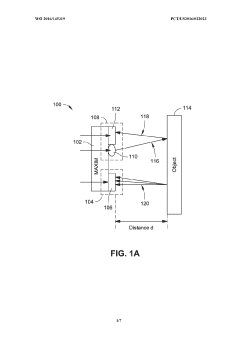
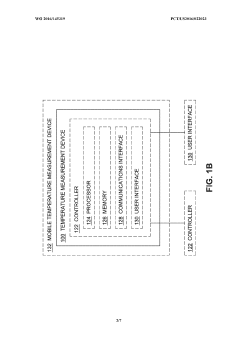
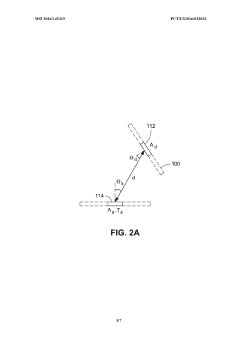
- A temperature measurement device equipped with a thermopile temperature sensor and a proximity sensor, where the proximity sensor detects the distance between the thermopile and the object, and a controller uses this information to correct the temperature measurement by accounting for the received radiation and distance, providing an accurate reading.

MEMS-based wafer level packaging for thermo-electric IR detectors
PatentActiveUS20160163942A1
Innovation
- A wafer-level thermal sensor package is developed using MEMS processes, featuring a thermopile stack with a dielectric membrane, thermoelectric layers, and a cap wafer assembly that creates a hermetically sealed vacuum environment, reducing thermal conductivity and protecting fragile membranes, while minimizing thermal gradients and package effects.


Material Science Advancements for Thermopile Sensors
Recent advancements in material science have significantly enhanced thermopile sensor performance across various applications. Traditional thermopile sensors faced limitations in sensitivity, response time, and thermal stability, which restricted their widespread adoption. However, innovative material compositions and novel fabrication techniques have revolutionized these devices, enabling their deployment in increasingly demanding environments.
The development of new thermoelectric materials with higher Seebeck coefficients has been pivotal in improving thermopile sensitivity. Bismuth telluride (Bi₂Te₃) compounds, modified with selenium and antimony dopants, have demonstrated superior figure-of-merit (ZT) values exceeding 1.5 at room temperature, representing a substantial improvement over conventional materials. These enhanced materials generate greater voltage outputs for the same temperature differential, enabling more precise measurements in applications ranging from medical diagnostics to industrial process monitoring.
Nanoscale engineering of thermopile materials has emerged as another breakthrough area. Quantum confinement effects in nanostructured thermoelectric materials have led to reduced thermal conductivity while maintaining electrical conductivity, thereby increasing the ZT value. Specifically, superlattice structures and quantum dot arrays have shown promising results, with thermal conductivity reductions of up to 60% compared to bulk materials.
Thin-film deposition techniques have evolved to allow precise control over material composition and layer thickness. Atomic layer deposition (ALD) and molecular beam epitaxy (MBE) enable the creation of thermopile structures with nanometer-scale precision, resulting in more uniform performance characteristics and improved manufacturing yields. These techniques have facilitated the integration of thermopile sensors into miniaturized devices, including wearable health monitors and IoT sensors.
Flexible substrate materials represent another frontier in thermopile sensor development. Polyimide and parylene-based substrates with embedded thermopile arrays maintain functionality while conforming to curved surfaces, opening new application possibilities in biomedical implants and structural health monitoring. These flexible thermopiles have demonstrated remarkable resilience, maintaining performance characteristics after thousands of bending cycles.
Encapsulation materials have also advanced significantly, with new ceramic-polymer composites offering superior protection against environmental factors while minimizing thermal mass. These materials provide effective barriers against moisture and corrosive agents while allowing rapid heat transfer to the sensing elements, resulting in response times up to 40% faster than previous generations of thermopile sensors.
The integration of 2D materials like graphene and transition metal dichalcogenides into thermopile structures represents the cutting edge of material science in this field. These materials offer exceptional electrical properties and can be produced as atomically thin layers, potentially enabling thermopile sensors with unprecedented spatial resolution and response characteristics for next-generation thermal imaging and energy harvesting applications.
The development of new thermoelectric materials with higher Seebeck coefficients has been pivotal in improving thermopile sensitivity. Bismuth telluride (Bi₂Te₃) compounds, modified with selenium and antimony dopants, have demonstrated superior figure-of-merit (ZT) values exceeding 1.5 at room temperature, representing a substantial improvement over conventional materials. These enhanced materials generate greater voltage outputs for the same temperature differential, enabling more precise measurements in applications ranging from medical diagnostics to industrial process monitoring.
Nanoscale engineering of thermopile materials has emerged as another breakthrough area. Quantum confinement effects in nanostructured thermoelectric materials have led to reduced thermal conductivity while maintaining electrical conductivity, thereby increasing the ZT value. Specifically, superlattice structures and quantum dot arrays have shown promising results, with thermal conductivity reductions of up to 60% compared to bulk materials.
Thin-film deposition techniques have evolved to allow precise control over material composition and layer thickness. Atomic layer deposition (ALD) and molecular beam epitaxy (MBE) enable the creation of thermopile structures with nanometer-scale precision, resulting in more uniform performance characteristics and improved manufacturing yields. These techniques have facilitated the integration of thermopile sensors into miniaturized devices, including wearable health monitors and IoT sensors.
Flexible substrate materials represent another frontier in thermopile sensor development. Polyimide and parylene-based substrates with embedded thermopile arrays maintain functionality while conforming to curved surfaces, opening new application possibilities in biomedical implants and structural health monitoring. These flexible thermopiles have demonstrated remarkable resilience, maintaining performance characteristics after thousands of bending cycles.
Encapsulation materials have also advanced significantly, with new ceramic-polymer composites offering superior protection against environmental factors while minimizing thermal mass. These materials provide effective barriers against moisture and corrosive agents while allowing rapid heat transfer to the sensing elements, resulting in response times up to 40% faster than previous generations of thermopile sensors.
The integration of 2D materials like graphene and transition metal dichalcogenides into thermopile structures represents the cutting edge of material science in this field. These materials offer exceptional electrical properties and can be produced as atomically thin layers, potentially enabling thermopile sensors with unprecedented spatial resolution and response characteristics for next-generation thermal imaging and energy harvesting applications.
Environmental Impact and Sustainability Considerations
Thermopile sensors represent a significant advancement in thermal detection technology with considerable environmental and sustainability implications. The manufacturing processes of thermopile devices typically require fewer toxic materials compared to alternative sensing technologies, resulting in reduced environmental contamination during production phases. Additionally, thermopiles operate without requiring cooling systems, which eliminates the need for environmentally harmful refrigerants often found in competing thermal detection technologies.
Energy efficiency stands as one of the most compelling environmental benefits of thermopile technology. These sensors consume minimal power—often in the microwatt range—making them ideal components for energy-efficient systems. When deployed in building automation systems for occupancy detection and climate control, thermopiles contribute to substantial energy savings by enabling precise temperature regulation and reducing unnecessary heating or cooling of unoccupied spaces.
The longevity of thermopile sensors further enhances their sustainability profile. With typical operational lifespans exceeding 10 years and minimal performance degradation over time, these devices significantly reduce electronic waste compared to sensors requiring frequent replacement. Their solid-state construction with no moving parts contributes to this durability advantage, minimizing maintenance requirements and associated resource consumption.
In waste management applications, thermopiles enable more efficient sorting and processing of recyclable materials through non-contact temperature measurement, improving recycling rates and reducing landfill usage. The automotive industry's adoption of thermopile-based systems for engine monitoring has led to improved fuel efficiency and reduced emissions through more precise combustion control.
Looking toward future sustainability improvements, research is advancing on bio-based substrate materials for thermopile construction that could further reduce their environmental footprint. Additionally, end-of-life considerations are being addressed through design modifications that facilitate easier separation of components for recycling.
The carbon footprint analysis of thermopile-equipped systems demonstrates significant advantages over conventional alternatives. Life cycle assessments indicate that the emissions associated with manufacturing thermopiles are typically offset within the first year of operation through energy savings in their application environments. This favorable environmental profile positions thermopile technology as an important contributor to sustainable development goals across multiple industries.
Energy efficiency stands as one of the most compelling environmental benefits of thermopile technology. These sensors consume minimal power—often in the microwatt range—making them ideal components for energy-efficient systems. When deployed in building automation systems for occupancy detection and climate control, thermopiles contribute to substantial energy savings by enabling precise temperature regulation and reducing unnecessary heating or cooling of unoccupied spaces.
The longevity of thermopile sensors further enhances their sustainability profile. With typical operational lifespans exceeding 10 years and minimal performance degradation over time, these devices significantly reduce electronic waste compared to sensors requiring frequent replacement. Their solid-state construction with no moving parts contributes to this durability advantage, minimizing maintenance requirements and associated resource consumption.
In waste management applications, thermopiles enable more efficient sorting and processing of recyclable materials through non-contact temperature measurement, improving recycling rates and reducing landfill usage. The automotive industry's adoption of thermopile-based systems for engine monitoring has led to improved fuel efficiency and reduced emissions through more precise combustion control.
Looking toward future sustainability improvements, research is advancing on bio-based substrate materials for thermopile construction that could further reduce their environmental footprint. Additionally, end-of-life considerations are being addressed through design modifications that facilitate easier separation of components for recycling.
The carbon footprint analysis of thermopile-equipped systems demonstrates significant advantages over conventional alternatives. Life cycle assessments indicate that the emissions associated with manufacturing thermopiles are typically offset within the first year of operation through energy savings in their application environments. This favorable environmental profile positions thermopile technology as an important contributor to sustainable development goals across multiple industries.
Unlock deeper insights with PatSnap Eureka Quick Research — get a full tech report to explore trends and direct your research. Try now!
Generate Your Research Report Instantly with AI Agent
Supercharge your innovation with PatSnap Eureka AI Agent Platform!