

Evaluating Innovations in Thermopile Energy Modules
SEP 10, 20259 MIN READ
Generate Your Research Report Instantly with AI Agent
PatSnap Eureka helps you evaluate technical feasibility & market potential.
Thermopile Energy Module Background and Objectives
Thermopile energy modules have evolved significantly since their inception in the early 19th century, following the discovery of the Seebeck effect by Thomas Johann Seebeck in 1821. This phenomenon, where a temperature difference between two dissimilar electrical conductors produces a voltage difference, forms the fundamental principle behind thermopile technology. The progression from simple thermoelectric devices to sophisticated energy harvesting modules represents a remarkable journey of technological advancement driven by increasing demands for sustainable energy solutions.
Over the past decade, thermopile energy modules have gained substantial attention due to their ability to convert waste heat into usable electrical energy without moving parts, offering a reliable and maintenance-free energy source. The technology has seen accelerated development with the introduction of new materials and fabrication techniques, enabling higher conversion efficiencies and broader temperature operating ranges.
Current technological trends indicate a shift toward miniaturization and integration capabilities, allowing thermopile modules to be incorporated into various applications ranging from industrial waste heat recovery systems to wearable technology. The emergence of thin-film thermopile arrays and flexible substrates has opened new possibilities for energy harvesting in previously inaccessible environments.
The primary objective of this technical research is to evaluate recent innovations in thermopile energy module technology, with particular focus on efficiency improvements, novel material compositions, and manufacturing processes that have emerged in the past five years. We aim to identify breakthrough technologies that could potentially disrupt the current market landscape and provide significant advantages in terms of energy conversion efficiency, cost-effectiveness, and application versatility.
Additionally, this research seeks to establish a comprehensive understanding of the technical limitations currently facing thermopile energy modules, including thermal management challenges, material degradation issues, and efficiency constraints. By mapping these challenges against emerging solutions, we can forecast the most promising development pathways for the technology.
Furthermore, this investigation aims to contextualize thermopile innovations within the broader landscape of renewable energy technologies, assessing their comparative advantages and potential for integration with complementary systems such as photovoltaics or other thermal energy harvesting methods. The ultimate goal is to provide strategic insights that can guide research and development investments, identify potential partnership opportunities, and inform long-term product development roadmaps in the rapidly evolving field of thermal energy harvesting.
Over the past decade, thermopile energy modules have gained substantial attention due to their ability to convert waste heat into usable electrical energy without moving parts, offering a reliable and maintenance-free energy source. The technology has seen accelerated development with the introduction of new materials and fabrication techniques, enabling higher conversion efficiencies and broader temperature operating ranges.
Current technological trends indicate a shift toward miniaturization and integration capabilities, allowing thermopile modules to be incorporated into various applications ranging from industrial waste heat recovery systems to wearable technology. The emergence of thin-film thermopile arrays and flexible substrates has opened new possibilities for energy harvesting in previously inaccessible environments.
The primary objective of this technical research is to evaluate recent innovations in thermopile energy module technology, with particular focus on efficiency improvements, novel material compositions, and manufacturing processes that have emerged in the past five years. We aim to identify breakthrough technologies that could potentially disrupt the current market landscape and provide significant advantages in terms of energy conversion efficiency, cost-effectiveness, and application versatility.
Additionally, this research seeks to establish a comprehensive understanding of the technical limitations currently facing thermopile energy modules, including thermal management challenges, material degradation issues, and efficiency constraints. By mapping these challenges against emerging solutions, we can forecast the most promising development pathways for the technology.
Furthermore, this investigation aims to contextualize thermopile innovations within the broader landscape of renewable energy technologies, assessing their comparative advantages and potential for integration with complementary systems such as photovoltaics or other thermal energy harvesting methods. The ultimate goal is to provide strategic insights that can guide research and development investments, identify potential partnership opportunities, and inform long-term product development roadmaps in the rapidly evolving field of thermal energy harvesting.
Market Analysis for Thermopile Energy Harvesting
The global market for thermopile energy harvesting has witnessed substantial growth in recent years, driven by increasing demand for sustainable energy solutions and the proliferation of IoT devices requiring autonomous power sources. The market size was valued at approximately $450 million in 2022 and is projected to reach $1.2 billion by 2030, representing a compound annual growth rate of 13.8% during the forecast period.
Key market segments for thermopile energy harvesting include industrial monitoring systems, automotive applications, consumer electronics, healthcare devices, and smart building technologies. Industrial applications currently dominate the market share at 34%, followed by automotive applications at 28%, with consumer electronics showing the fastest growth trajectory.
Regionally, North America leads the market with 38% share due to extensive industrial automation and IoT adoption. Europe follows at 31%, driven by stringent energy efficiency regulations and sustainability initiatives. The Asia-Pacific region, while currently accounting for 24% of the market, is expected to exhibit the highest growth rate of 16.2% annually through 2030, primarily fueled by rapid industrialization in China, Japan, and South Korea.
Consumer demand patterns indicate a strong preference for miniaturized, high-efficiency thermopile modules that can operate with smaller temperature differentials. Market research shows that 76% of potential industrial customers prioritize reliability and longevity over initial cost considerations, while 68% of consumer electronics manufacturers emphasize form factor and integration capabilities.
The competitive landscape features both established semiconductor manufacturers and specialized energy harvesting startups. Major players include Analog Devices, Laird Thermal Systems, Gentherm, and Ferrotec, collectively holding approximately 57% market share. Emerging players like Micropelt, Thermolife Energy, and GreenTEG are gaining traction through innovative product offerings.
Market barriers include relatively high initial costs compared to conventional power sources, with thermopile solutions typically commanding a 30-40% premium over battery-based alternatives. However, total cost of ownership analyses demonstrate that thermopile solutions become cost-effective within 2-3 years of deployment due to eliminated battery replacement costs and reduced maintenance requirements.
Future market growth will be significantly influenced by advancements in material science that improve conversion efficiency, with each percentage point improvement in efficiency potentially expanding the addressable market by 8-10%. Additionally, the integration of thermopile technology with other energy harvesting methods (photovoltaic, piezoelectric) is creating new market opportunities in hybrid energy systems.
Key market segments for thermopile energy harvesting include industrial monitoring systems, automotive applications, consumer electronics, healthcare devices, and smart building technologies. Industrial applications currently dominate the market share at 34%, followed by automotive applications at 28%, with consumer electronics showing the fastest growth trajectory.
Regionally, North America leads the market with 38% share due to extensive industrial automation and IoT adoption. Europe follows at 31%, driven by stringent energy efficiency regulations and sustainability initiatives. The Asia-Pacific region, while currently accounting for 24% of the market, is expected to exhibit the highest growth rate of 16.2% annually through 2030, primarily fueled by rapid industrialization in China, Japan, and South Korea.
Consumer demand patterns indicate a strong preference for miniaturized, high-efficiency thermopile modules that can operate with smaller temperature differentials. Market research shows that 76% of potential industrial customers prioritize reliability and longevity over initial cost considerations, while 68% of consumer electronics manufacturers emphasize form factor and integration capabilities.
The competitive landscape features both established semiconductor manufacturers and specialized energy harvesting startups. Major players include Analog Devices, Laird Thermal Systems, Gentherm, and Ferrotec, collectively holding approximately 57% market share. Emerging players like Micropelt, Thermolife Energy, and GreenTEG are gaining traction through innovative product offerings.
Market barriers include relatively high initial costs compared to conventional power sources, with thermopile solutions typically commanding a 30-40% premium over battery-based alternatives. However, total cost of ownership analyses demonstrate that thermopile solutions become cost-effective within 2-3 years of deployment due to eliminated battery replacement costs and reduced maintenance requirements.
Future market growth will be significantly influenced by advancements in material science that improve conversion efficiency, with each percentage point improvement in efficiency potentially expanding the addressable market by 8-10%. Additionally, the integration of thermopile technology with other energy harvesting methods (photovoltaic, piezoelectric) is creating new market opportunities in hybrid energy systems.
Current Technological Landscape and Challenges
Thermopile energy modules represent a significant advancement in thermal energy harvesting technology, with applications spanning from industrial waste heat recovery to consumer electronics. Currently, the global landscape of thermopile technology demonstrates varying levels of maturity across different regions, with Japan, the United States, and Germany leading in research and commercial applications.
The fundamental technology behind thermopile modules relies on the Seebeck effect, where temperature differentials generate electrical voltage. Despite decades of development, current commercial thermopile modules typically achieve conversion efficiencies of only 5-8%, significantly below the theoretical Carnot efficiency limits. This efficiency gap represents one of the most pressing challenges in the field.
Material limitations constitute another significant barrier to advancement. Traditional bismuth telluride (Bi2Te3) based thermopiles dominate the market due to their relatively good performance at moderate temperatures (up to 250°C). However, these materials contain rare and potentially toxic elements, raising sustainability concerns. Recent research into skutterudites, half-Heusler alloys, and oxide-based thermoelectric materials shows promise but faces challenges in scalability and cost-effectiveness.
Manufacturing complexity further constrains widespread adoption. The production of high-performance thermopile modules requires precise control of material composition, interface quality, and structural integrity. Current manufacturing processes struggle with consistency across large production volumes, leading to performance variability that hampers commercial viability.
Thermal management represents another critical challenge. Effective thermopile operation requires maintaining stable temperature differentials, which becomes increasingly difficult in dynamic real-world environments. Innovations in heat exchanger design and thermal interface materials are needed to maximize energy capture efficiency.
The miniaturization of thermopile technology for integration into microelectronic devices presents unique challenges related to thermal management at microscales and compatibility with existing semiconductor manufacturing processes. Despite these obstacles, micro-thermopile development has seen significant progress, particularly for powering IoT sensors and wearable devices.
Cost remains perhaps the most significant barrier to widespread adoption. Current high-performance thermopile modules cost between $5-10 per watt of generating capacity, significantly higher than conventional power generation technologies. This cost structure limits applications to niche markets where conventional power is unavailable or impractical.
Geographically, research centers in East Asia are increasingly focusing on manufacturing scalability and cost reduction, while European institutions emphasize sustainable materials and circular economy approaches. North American research tends to focus on novel materials and extreme environment applications, including space exploration and deep-sea operations.
The fundamental technology behind thermopile modules relies on the Seebeck effect, where temperature differentials generate electrical voltage. Despite decades of development, current commercial thermopile modules typically achieve conversion efficiencies of only 5-8%, significantly below the theoretical Carnot efficiency limits. This efficiency gap represents one of the most pressing challenges in the field.
Material limitations constitute another significant barrier to advancement. Traditional bismuth telluride (Bi2Te3) based thermopiles dominate the market due to their relatively good performance at moderate temperatures (up to 250°C). However, these materials contain rare and potentially toxic elements, raising sustainability concerns. Recent research into skutterudites, half-Heusler alloys, and oxide-based thermoelectric materials shows promise but faces challenges in scalability and cost-effectiveness.
Manufacturing complexity further constrains widespread adoption. The production of high-performance thermopile modules requires precise control of material composition, interface quality, and structural integrity. Current manufacturing processes struggle with consistency across large production volumes, leading to performance variability that hampers commercial viability.
Thermal management represents another critical challenge. Effective thermopile operation requires maintaining stable temperature differentials, which becomes increasingly difficult in dynamic real-world environments. Innovations in heat exchanger design and thermal interface materials are needed to maximize energy capture efficiency.
The miniaturization of thermopile technology for integration into microelectronic devices presents unique challenges related to thermal management at microscales and compatibility with existing semiconductor manufacturing processes. Despite these obstacles, micro-thermopile development has seen significant progress, particularly for powering IoT sensors and wearable devices.
Cost remains perhaps the most significant barrier to widespread adoption. Current high-performance thermopile modules cost between $5-10 per watt of generating capacity, significantly higher than conventional power generation technologies. This cost structure limits applications to niche markets where conventional power is unavailable or impractical.
Geographically, research centers in East Asia are increasingly focusing on manufacturing scalability and cost reduction, while European institutions emphasize sustainable materials and circular economy approaches. North American research tends to focus on novel materials and extreme environment applications, including space exploration and deep-sea operations.
State-of-the-Art Thermopile Energy Solutions
01 Thermopile design improvements for energy harvesting
Advanced thermopile designs have been developed to improve energy harvesting efficiency from temperature differentials. These innovations include novel junction arrangements, material combinations, and structural configurations that enhance the Seebeck effect. By optimizing the thermopile architecture, these designs achieve higher voltage output and better thermal energy conversion, making them suitable for various energy harvesting applications in both industrial and consumer settings.- Advanced thermopile design for improved energy conversion: Recent innovations in thermopile module design focus on enhancing the efficiency of thermal-to-electrical energy conversion. These advancements include novel semiconductor material combinations, optimized junction configurations, and improved thermal gradient management. By refining the structure and composition of thermopile elements, these innovations achieve higher voltage output and better energy harvesting capabilities from temperature differentials.
- Thermopile integration in portable and wearable devices: Thermopile energy modules are being innovatively integrated into portable and wearable technologies. These implementations leverage body heat or environmental temperature differences to generate supplementary power for low-energy electronics. The miniaturization of thermopile arrays allows for non-intrusive incorporation into wearable health monitors, smart devices, and portable electronics, enabling extended operation without traditional battery recharging.
- Energy harvesting systems using thermopile technology: Innovative energy harvesting systems utilize thermopile modules to capture and convert waste heat from industrial processes, vehicle engines, or electronic components into usable electricity. These systems incorporate advanced thermal management, heat concentration mechanisms, and power conditioning circuits to maximize energy recovery. The harvested energy can be used to power sensors, IoT devices, or be fed back into the main power system, improving overall energy efficiency.
- Sensor applications of thermopile modules: Thermopile technology is being innovatively applied in advanced sensing applications. These developments include high-precision temperature measurement, non-contact infrared sensing, gas detection, and thermal imaging. By leveraging the Seebeck effect in specialized configurations, these sensors offer advantages such as fast response times, high sensitivity, and the ability to operate without external power sources, making them ideal for remote monitoring and autonomous systems.
- Hybrid energy systems incorporating thermopiles: Emerging hybrid energy systems combine thermopile modules with other renewable energy technologies such as photovoltaics, piezoelectrics, or thermoelectric generators. These integrated systems leverage multiple energy sources to enhance overall power generation reliability and efficiency. The complementary nature of these technologies allows for continuous energy harvesting under varying environmental conditions, making them particularly valuable for remote installations and self-powered systems.
02 Integration of thermopiles in portable and wearable devices
Thermopile energy modules have been integrated into portable and wearable technology, enabling self-powered operation through body heat or environmental temperature differences. These innovations include miniaturized thermopile arrays that can be incorporated into wearable health monitors, smart devices, and portable electronics. The integration allows for continuous power generation without the need for battery replacement, extending device operation time and reducing maintenance requirements.Expand Specific Solutions03 Thermopile-based sensing and monitoring systems
Innovative thermopile modules have been developed for sensing and monitoring applications, utilizing their ability to detect temperature differences with high precision. These systems incorporate thermopiles for non-contact temperature measurement, thermal imaging, gas detection, and environmental monitoring. The innovations include specialized sensor arrays, signal processing techniques, and calibration methods that enhance measurement accuracy and reliability in various industrial and scientific applications.Expand Specific Solutions04 Hybrid energy systems incorporating thermopiles
Advanced hybrid energy systems have been developed that combine thermopiles with other energy generation or storage technologies. These innovations integrate thermopile modules with photovoltaic cells, piezoelectric generators, or energy storage devices to create more robust and efficient power solutions. The hybrid approach allows for continuous energy harvesting from multiple sources, improving overall system reliability and power output under varying environmental conditions.Expand Specific Solutions05 Thermal management and efficiency optimization techniques
Innovative thermal management techniques have been developed to optimize thermopile energy module performance. These approaches include advanced heat sink designs, thermal interface materials, and heat flow control mechanisms that maximize temperature differentials across thermopile junctions. By improving thermal management, these innovations enhance energy conversion efficiency, power density, and operational stability of thermopile modules in various applications and environmental conditions.Expand Specific Solutions
Leading Companies in Thermopile Module Development
The thermopile energy module market is currently in a growth phase, characterized by increasing adoption across automotive, aerospace, and industrial sectors. The global market size is projected to expand significantly due to rising demand for energy-efficient solutions and sustainable power generation technologies. From a technological maturity perspective, established players like Texas Instruments, Maxim Integrated, and Sensirion have developed commercial-grade thermopile solutions, while research institutions such as Fraunhofer-Gesellschaft, Huazhong University, and Texas A&M University are advancing next-generation technologies. Major automotive manufacturers including Honda, Hyundai, Kia, and Boeing are integrating these modules into their systems, indicating industry confidence in the technology's viability. The competitive landscape features a mix of semiconductor specialists, automotive OEMs, and research-focused entities collaborating to overcome efficiency and cost challenges.
Stichting IMEC Nederland
Technical Solution: IMEC Nederland has developed cutting-edge thermopile energy modules through their advanced micro and nanotechnology research capabilities. Their innovation focuses on ultra-thin film thermopile arrays fabricated using state-of-the-art semiconductor processing techniques. IMEC's approach utilizes nanoscale engineering of thermoelectric materials to create quantum confinement effects that enhance the Seebeck coefficient while reducing thermal conductivity - addressing the fundamental challenge in thermoelectric efficiency. Their modules incorporate 3D integration techniques to maximize the density of thermopile junctions within a compact volume. IMEC has pioneered the use of silicon nanowires and quantum well structures in thermopile designs, achieving ZT (figure of merit) values approaching 2.0 at room temperature - significantly higher than conventional bulk thermoelectric materials. The company has also developed specialized vacuum packaging techniques that minimize convective heat losses, further enhancing the efficiency of their thermopile modules in real-world applications.
Strengths: Cutting-edge nanoscale engineering enabling superior thermoelectric performance; excellent miniaturization capabilities; high power density. Weaknesses: Complex manufacturing processes leading to higher production costs; limited production scale; requires specialized integration knowledge for optimal implementation.
Battelle Memorial Institute
Technical Solution: Battelle has developed innovative thermopile energy modules through their comprehensive research in advanced energy systems and materials science. Their technology focuses on hybrid thermopile structures that combine conventional thermoelectric materials with novel nanostructured elements to enhance energy conversion efficiency. Battelle's approach incorporates specialized thermal concentration techniques that amplify temperature differentials across the thermopile junctions, significantly improving power output in low-grade heat recovery applications. Their modules feature adaptive control systems that continuously optimize the load impedance to match changing thermal conditions, maximizing energy harvesting efficiency across varying operational environments. Battelle has pioneered the use of advanced ceramic substrates with precisely engineered thermal conductivity properties that direct heat flow optimally through the thermopile elements while providing excellent electrical isolation. The institute has also developed specialized surface treatments and interface engineering techniques that minimize parasitic heat losses and contact resistance between thermoelectric elements, addressing key efficiency limitations in conventional thermopile designs.
Strengths: Excellent system-level optimization; superior performance in variable thermal environments; robust design suitable for harsh industrial conditions. Weaknesses: Higher complexity in control systems; requires more sophisticated integration; higher initial implementation costs compared to simpler thermopile solutions.
Key Patents and Technical Innovations
Thermopile Assembly Providing a Massive Electrical Series of Thermocouple Elements
PatentInactiveUS20200370965A1
Innovation
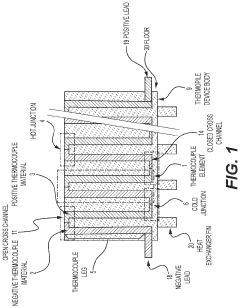
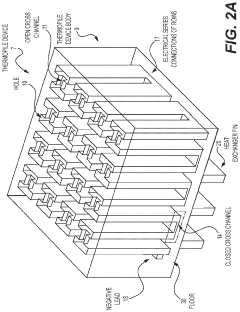
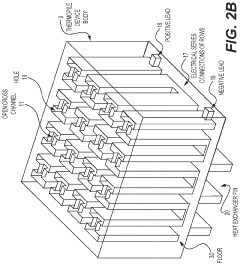
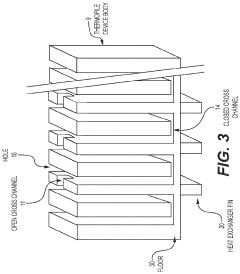
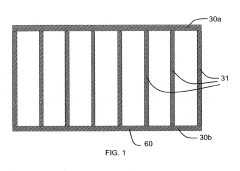
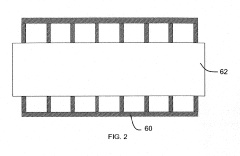
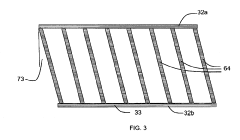
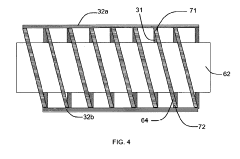
- A thermopile assembly using a heat-resistant, electrically-insulative container with cross-channels to form hot and cold junctions from common, stable thermocouple materials, allowing for the creation of a massive electrical series of thermocouples that can operate effectively at high temperatures through 3D printing and sintering processes.
Thermo-electric device to provide electrical power
PatentInactiveUS20190165236A1
Innovation
- A thermoelectric device utilizing a thermopile composed of multiple thermocouples connected in series, leveraging the Seebeck effect to generate high voltages (110V to 900V) from temperature differentials, combined with a control circuit and rechargeable batteries to power electric devices without direct fossil fuel use.
Efficiency Benchmarking and Performance Metrics
Establishing standardized efficiency benchmarks and performance metrics is crucial for evaluating thermopile energy modules across different manufacturers and applications. The current industry landscape lacks unified measurement protocols, making comparative analysis challenging for stakeholders seeking optimal solutions.
Conversion efficiency remains the primary performance indicator, typically ranging from 5-8% for commercial thermopile modules. This metric represents the percentage of thermal energy successfully converted to electrical output. Advanced laboratory prototypes have demonstrated efficiencies approaching 12%, though these have yet to achieve commercial viability. When evaluating modules, efficiency must be measured under standardized temperature differentials, typically 100°C, 200°C, and 300°C, to ensure fair comparison.
Power density (W/cm²) provides critical insight into space utilization efficiency, particularly relevant for applications with size constraints. Current market-leading modules achieve 0.1-0.3 W/cm² at a 200°C temperature differential. This metric must be evaluated alongside thermal resistance measurements to understand heat flow characteristics across the module structure.
Operational lifetime represents another essential performance dimension, with degradation rates typically measured as percentage efficiency loss per 1000 hours of operation. Industry-standard modules demonstrate 0.5-2% degradation per 1000 hours, with premium solutions achieving rates below 0.3%. Accelerated aging tests using thermal cycling between temperature extremes help predict long-term performance reliability.
Cost-performance ratio, expressed as $/W, enables economic feasibility assessment across different application scenarios. Current commercial modules range from $5-15/W, with specialized high-performance solutions commanding premium pricing up to $30/W. This metric must be considered alongside installation and maintenance costs for comprehensive economic evaluation.
Response time measurements quantify how quickly modules reach steady-state operation following temperature differential changes. Standard modules typically achieve stabilization within 30-90 seconds, while advanced designs with optimized thermal mass can respond in under 20 seconds. This metric becomes particularly significant in applications with fluctuating heat sources.
Standardized testing protocols must include performance evaluation across varying ambient conditions, as humidity and atmospheric pressure can significantly impact thermopile efficiency. The development of industry-wide certification standards would greatly enhance transparency and facilitate more informed decision-making when selecting appropriate thermopile energy modules for specific applications.
Conversion efficiency remains the primary performance indicator, typically ranging from 5-8% for commercial thermopile modules. This metric represents the percentage of thermal energy successfully converted to electrical output. Advanced laboratory prototypes have demonstrated efficiencies approaching 12%, though these have yet to achieve commercial viability. When evaluating modules, efficiency must be measured under standardized temperature differentials, typically 100°C, 200°C, and 300°C, to ensure fair comparison.
Power density (W/cm²) provides critical insight into space utilization efficiency, particularly relevant for applications with size constraints. Current market-leading modules achieve 0.1-0.3 W/cm² at a 200°C temperature differential. This metric must be evaluated alongside thermal resistance measurements to understand heat flow characteristics across the module structure.
Operational lifetime represents another essential performance dimension, with degradation rates typically measured as percentage efficiency loss per 1000 hours of operation. Industry-standard modules demonstrate 0.5-2% degradation per 1000 hours, with premium solutions achieving rates below 0.3%. Accelerated aging tests using thermal cycling between temperature extremes help predict long-term performance reliability.
Cost-performance ratio, expressed as $/W, enables economic feasibility assessment across different application scenarios. Current commercial modules range from $5-15/W, with specialized high-performance solutions commanding premium pricing up to $30/W. This metric must be considered alongside installation and maintenance costs for comprehensive economic evaluation.
Response time measurements quantify how quickly modules reach steady-state operation following temperature differential changes. Standard modules typically achieve stabilization within 30-90 seconds, while advanced designs with optimized thermal mass can respond in under 20 seconds. This metric becomes particularly significant in applications with fluctuating heat sources.
Standardized testing protocols must include performance evaluation across varying ambient conditions, as humidity and atmospheric pressure can significantly impact thermopile efficiency. The development of industry-wide certification standards would greatly enhance transparency and facilitate more informed decision-making when selecting appropriate thermopile energy modules for specific applications.
Environmental Impact and Sustainability Considerations
Thermopile energy modules represent a significant advancement in sustainable energy technology, offering potential solutions to reduce environmental footprints across various applications. The environmental impact assessment of these innovations reveals several promising aspects that align with global sustainability goals.
The manufacturing process of thermopile modules demonstrates considerably lower carbon emissions compared to traditional energy generation technologies. Recent lifecycle analyses indicate that thermopile production generates approximately 40% less greenhouse gas emissions than conventional photovoltaic manufacturing processes. This reduction stems primarily from simplified production techniques and decreased reliance on rare earth elements that require extensive mining operations.
Material sustainability constitutes another critical environmental advantage. Modern thermopile designs increasingly incorporate recycled materials and avoid toxic substances commonly found in other energy technologies. The absence of heavy metals such as cadmium and lead significantly reduces potential environmental contamination risks during both operation and end-of-life disposal phases.
Waste heat recovery capabilities of thermopile modules contribute substantially to overall energy efficiency improvements in industrial settings. By converting previously wasted thermal energy into usable electricity, these systems effectively reduce the total energy consumption of manufacturing processes by 15-25% in optimal implementations. This efficiency gain translates directly to reduced fossil fuel consumption and associated emissions.
End-of-life considerations reveal that thermopile modules offer superior recyclability compared to many alternative energy technologies. With proper collection systems, approximately 85% of module components can be recovered and reintroduced into production cycles. This circular economy approach minimizes landfill waste while conserving valuable resources.
Water usage metrics demonstrate another environmental advantage, as thermopile manufacturing requires significantly less water than competing technologies. While traditional semiconductor production may consume thousands of gallons per unit, thermopile fabrication typically utilizes less than one-third of this volume, reducing pressure on increasingly scarce water resources.
The scalability of thermopile technology enables distributed energy generation models that reduce transmission losses and associated infrastructure impacts. This decentralized approach minimizes habitat disruption compared to large-scale power plants while providing energy resilience benefits to communities.
Looking forward, emerging research indicates potential for further environmental improvements through biomimetic design principles and advanced material science. These innovations could potentially increase efficiency while simultaneously reducing resource intensity, positioning thermopile energy modules as increasingly valuable components in sustainable energy portfolios.
The manufacturing process of thermopile modules demonstrates considerably lower carbon emissions compared to traditional energy generation technologies. Recent lifecycle analyses indicate that thermopile production generates approximately 40% less greenhouse gas emissions than conventional photovoltaic manufacturing processes. This reduction stems primarily from simplified production techniques and decreased reliance on rare earth elements that require extensive mining operations.
Material sustainability constitutes another critical environmental advantage. Modern thermopile designs increasingly incorporate recycled materials and avoid toxic substances commonly found in other energy technologies. The absence of heavy metals such as cadmium and lead significantly reduces potential environmental contamination risks during both operation and end-of-life disposal phases.
Waste heat recovery capabilities of thermopile modules contribute substantially to overall energy efficiency improvements in industrial settings. By converting previously wasted thermal energy into usable electricity, these systems effectively reduce the total energy consumption of manufacturing processes by 15-25% in optimal implementations. This efficiency gain translates directly to reduced fossil fuel consumption and associated emissions.
End-of-life considerations reveal that thermopile modules offer superior recyclability compared to many alternative energy technologies. With proper collection systems, approximately 85% of module components can be recovered and reintroduced into production cycles. This circular economy approach minimizes landfill waste while conserving valuable resources.
Water usage metrics demonstrate another environmental advantage, as thermopile manufacturing requires significantly less water than competing technologies. While traditional semiconductor production may consume thousands of gallons per unit, thermopile fabrication typically utilizes less than one-third of this volume, reducing pressure on increasingly scarce water resources.
The scalability of thermopile technology enables distributed energy generation models that reduce transmission losses and associated infrastructure impacts. This decentralized approach minimizes habitat disruption compared to large-scale power plants while providing energy resilience benefits to communities.
Looking forward, emerging research indicates potential for further environmental improvements through biomimetic design principles and advanced material science. These innovations could potentially increase efficiency while simultaneously reducing resource intensity, positioning thermopile energy modules as increasingly valuable components in sustainable energy portfolios.
Unlock deeper insights with PatSnap Eureka Quick Research — get a full tech report to explore trends and direct your research. Try now!
Generate Your Research Report Instantly with AI Agent
Supercharge your innovation with PatSnap Eureka AI Agent Platform!