

Optimal Thermopile Positioning for Maximum Utilization
SEP 10, 20259 MIN READ
Generate Your Research Report Instantly with AI Agent
PatSnap Eureka helps you evaluate technical feasibility & market potential.
Thermopile Technology Background and Objectives
Thermopile technology has evolved significantly since its inception in the early 19th century, based on the Seebeck effect discovered by Thomas Johann Seebeck in 1821. This effect describes how a temperature difference between two dissimilar electrical conductors produces a voltage difference. The thermopile, essentially an electronic device that converts thermal energy into electrical energy, consists of multiple thermocouples connected in series or parallel to increase the output signal.
Over the past decades, thermopile technology has transitioned from simple temperature measurement applications to sophisticated thermal imaging and energy harvesting solutions. The miniaturization trend has been particularly notable, with modern thermopiles being integrated into microelectromechanical systems (MEMS), enabling their incorporation into compact consumer electronics and industrial monitoring equipment.
The current technological landscape shows a growing emphasis on enhancing thermopile sensitivity, response time, and energy conversion efficiency. Recent advancements include the development of thin-film thermopiles with improved thermal isolation and novel material combinations that maximize the Seebeck coefficient while minimizing thermal conductivity.
The primary objective in thermopile positioning optimization is to maximize the temperature gradient across the device, as this directly correlates with voltage output and overall efficiency. This involves strategic placement relative to heat sources and sinks, consideration of thermal radiation patterns, and minimization of thermal interference from surrounding components.
Another critical goal is to enhance the signal-to-noise ratio by reducing thermal noise and optimizing the physical arrangement of thermopile arrays. This becomes particularly challenging in environments with fluctuating ambient temperatures or multiple heat sources, where discriminating between target thermal signals and background noise requires sophisticated positioning strategies.
The industry is increasingly focused on developing adaptive positioning systems that can dynamically adjust thermopile orientation in response to changing thermal conditions. This represents a shift from static positioning approaches to more intelligent, responsive configurations that maximize energy harvesting or sensing capabilities across varying operational scenarios.
Looking forward, the technological trajectory points toward integrated systems where thermopile positioning is optimized through computational modeling and real-time feedback mechanisms. The ultimate aim is to achieve positioning configurations that can extract the maximum possible energy from available thermal gradients while maintaining reliability and longevity of the thermopile components.
Over the past decades, thermopile technology has transitioned from simple temperature measurement applications to sophisticated thermal imaging and energy harvesting solutions. The miniaturization trend has been particularly notable, with modern thermopiles being integrated into microelectromechanical systems (MEMS), enabling their incorporation into compact consumer electronics and industrial monitoring equipment.
The current technological landscape shows a growing emphasis on enhancing thermopile sensitivity, response time, and energy conversion efficiency. Recent advancements include the development of thin-film thermopiles with improved thermal isolation and novel material combinations that maximize the Seebeck coefficient while minimizing thermal conductivity.
The primary objective in thermopile positioning optimization is to maximize the temperature gradient across the device, as this directly correlates with voltage output and overall efficiency. This involves strategic placement relative to heat sources and sinks, consideration of thermal radiation patterns, and minimization of thermal interference from surrounding components.
Another critical goal is to enhance the signal-to-noise ratio by reducing thermal noise and optimizing the physical arrangement of thermopile arrays. This becomes particularly challenging in environments with fluctuating ambient temperatures or multiple heat sources, where discriminating between target thermal signals and background noise requires sophisticated positioning strategies.
The industry is increasingly focused on developing adaptive positioning systems that can dynamically adjust thermopile orientation in response to changing thermal conditions. This represents a shift from static positioning approaches to more intelligent, responsive configurations that maximize energy harvesting or sensing capabilities across varying operational scenarios.
Looking forward, the technological trajectory points toward integrated systems where thermopile positioning is optimized through computational modeling and real-time feedback mechanisms. The ultimate aim is to achieve positioning configurations that can extract the maximum possible energy from available thermal gradients while maintaining reliability and longevity of the thermopile components.
Market Analysis for Thermopile Applications
The global thermopile market has experienced significant growth in recent years, driven by increasing demand for non-contact temperature measurement solutions across various industries. The market size was valued at approximately 1.2 billion USD in 2022 and is projected to reach 1.8 billion USD by 2027, representing a compound annual growth rate of 8.5%. This growth trajectory is primarily fueled by the expanding applications of thermopile sensors in consumer electronics, automotive systems, healthcare devices, and industrial equipment.
In the consumer electronics sector, thermopile sensors are increasingly being integrated into smartphones, tablets, and wearable devices for temperature monitoring and infrared sensing capabilities. This segment accounts for nearly 35% of the total thermopile market, with major manufacturers focusing on miniaturization and enhanced sensitivity to meet the demands of portable device manufacturers.
The automotive industry represents another significant market for thermopile applications, particularly in advanced driver-assistance systems (ADAS) and climate control systems. The optimal positioning of thermopiles in vehicles enables precise temperature monitoring of critical components and enhances passenger comfort through improved climate control. This segment is expected to witness the fastest growth rate of approximately 10% annually through 2027.
Healthcare applications of thermopiles have gained substantial traction, especially following the COVID-19 pandemic, which highlighted the importance of non-contact temperature measurement devices. Medical-grade thermopile sensors are now standard components in digital thermometers, thermal imaging systems, and patient monitoring devices. The healthcare segment currently represents about 20% of the global thermopile market.
Industrial applications, including process monitoring, fire detection systems, and building automation, constitute approximately 25% of the market. In these applications, optimal thermopile positioning is crucial for accurate temperature measurement and energy efficiency. The industrial segment is characterized by demand for high-durability thermopiles capable of functioning in harsh environments.
Geographically, North America and Europe currently lead the thermopile market, accounting for 30% and 28% of global revenue respectively. However, the Asia-Pacific region is emerging as the fastest-growing market, driven by rapid industrialization, increasing adoption of IoT technologies, and expanding electronics manufacturing capabilities in countries like China, Japan, and South Korea.
Market challenges include price sensitivity, especially in consumer applications, and competition from alternative temperature sensing technologies. Nevertheless, the continuous innovation in thermopile design, including improvements in sensor positioning for maximum utilization, is expected to sustain market growth and expand application possibilities across various industries.
In the consumer electronics sector, thermopile sensors are increasingly being integrated into smartphones, tablets, and wearable devices for temperature monitoring and infrared sensing capabilities. This segment accounts for nearly 35% of the total thermopile market, with major manufacturers focusing on miniaturization and enhanced sensitivity to meet the demands of portable device manufacturers.
The automotive industry represents another significant market for thermopile applications, particularly in advanced driver-assistance systems (ADAS) and climate control systems. The optimal positioning of thermopiles in vehicles enables precise temperature monitoring of critical components and enhances passenger comfort through improved climate control. This segment is expected to witness the fastest growth rate of approximately 10% annually through 2027.
Healthcare applications of thermopiles have gained substantial traction, especially following the COVID-19 pandemic, which highlighted the importance of non-contact temperature measurement devices. Medical-grade thermopile sensors are now standard components in digital thermometers, thermal imaging systems, and patient monitoring devices. The healthcare segment currently represents about 20% of the global thermopile market.
Industrial applications, including process monitoring, fire detection systems, and building automation, constitute approximately 25% of the market. In these applications, optimal thermopile positioning is crucial for accurate temperature measurement and energy efficiency. The industrial segment is characterized by demand for high-durability thermopiles capable of functioning in harsh environments.
Geographically, North America and Europe currently lead the thermopile market, accounting for 30% and 28% of global revenue respectively. However, the Asia-Pacific region is emerging as the fastest-growing market, driven by rapid industrialization, increasing adoption of IoT technologies, and expanding electronics manufacturing capabilities in countries like China, Japan, and South Korea.
Market challenges include price sensitivity, especially in consumer applications, and competition from alternative temperature sensing technologies. Nevertheless, the continuous innovation in thermopile design, including improvements in sensor positioning for maximum utilization, is expected to sustain market growth and expand application possibilities across various industries.
Current Positioning Challenges and Limitations
The current positioning of thermopiles faces significant challenges that limit their efficiency and overall performance. Traditional thermopile arrangements often follow standardized patterns that fail to account for the unique thermal characteristics of specific applications. This one-size-fits-all approach results in suboptimal energy harvesting and reduced sensitivity in thermal detection systems. The positioning limitations are particularly evident in confined spaces where geometric constraints force compromises in thermopile placement, leading to thermal interference and reduced signal quality.
Temperature gradient inconsistencies represent another major challenge in thermopile positioning. When thermopiles are placed in areas with unpredictable or fluctuating temperature differentials, their output becomes unstable and unreliable. This issue is exacerbated in environments with multiple heat sources or complex thermal landscapes, where identifying the optimal positioning becomes exponentially more difficult without sophisticated modeling tools.
Material interface problems further complicate optimal positioning efforts. The thermal conductivity disparities between thermopiles and their mounting substrates create thermal resistance boundaries that impede efficient heat transfer. These junction points often become bottlenecks in the thermal energy pathway, reducing the effective temperature differential that can be utilized by the thermopile array.
Environmental variability presents an ongoing challenge for fixed thermopile installations. Systems optimized for specific conditions may perform poorly when ambient temperatures shift outside the designed parameters. This lack of adaptability in positioning strategy means that many thermopile implementations operate below their theoretical efficiency for significant portions of their operational lifetime.
Spatial orientation limitations also impact thermopile performance. The three-dimensional nature of heat flow means that thermopiles positioned in a planar arrangement may miss substantial thermal energy moving in perpendicular vectors. Current positioning methodologies rarely account for this multi-directional thermal energy flow, resulting in missed harvesting opportunities.
Scaling challenges emerge when attempting to optimize thermopile positioning across different system sizes. Solutions that work effectively at laboratory scale often encounter unforeseen complications when implemented in full-scale industrial applications. The non-linear relationship between system size and optimal thermopile positioning creates significant engineering challenges for consistent performance across varied implementations.
Measurement and validation difficulties compound these positioning challenges. Without precise real-time temperature mapping capabilities, engineers must rely on theoretical models and limited empirical data when determining thermopile placement. This information gap leads to conservative positioning strategies that prioritize reliability over maximum utilization, further limiting the technology's potential.
Temperature gradient inconsistencies represent another major challenge in thermopile positioning. When thermopiles are placed in areas with unpredictable or fluctuating temperature differentials, their output becomes unstable and unreliable. This issue is exacerbated in environments with multiple heat sources or complex thermal landscapes, where identifying the optimal positioning becomes exponentially more difficult without sophisticated modeling tools.
Material interface problems further complicate optimal positioning efforts. The thermal conductivity disparities between thermopiles and their mounting substrates create thermal resistance boundaries that impede efficient heat transfer. These junction points often become bottlenecks in the thermal energy pathway, reducing the effective temperature differential that can be utilized by the thermopile array.
Environmental variability presents an ongoing challenge for fixed thermopile installations. Systems optimized for specific conditions may perform poorly when ambient temperatures shift outside the designed parameters. This lack of adaptability in positioning strategy means that many thermopile implementations operate below their theoretical efficiency for significant portions of their operational lifetime.
Spatial orientation limitations also impact thermopile performance. The three-dimensional nature of heat flow means that thermopiles positioned in a planar arrangement may miss substantial thermal energy moving in perpendicular vectors. Current positioning methodologies rarely account for this multi-directional thermal energy flow, resulting in missed harvesting opportunities.
Scaling challenges emerge when attempting to optimize thermopile positioning across different system sizes. Solutions that work effectively at laboratory scale often encounter unforeseen complications when implemented in full-scale industrial applications. The non-linear relationship between system size and optimal thermopile positioning creates significant engineering challenges for consistent performance across varied implementations.
Measurement and validation difficulties compound these positioning challenges. Without precise real-time temperature mapping capabilities, engineers must rely on theoretical models and limited empirical data when determining thermopile placement. This information gap leads to conservative positioning strategies that prioritize reliability over maximum utilization, further limiting the technology's potential.
Current Positioning Methodologies and Solutions
01 Optimal positioning of thermopiles in sensing devices
Thermopiles need to be strategically positioned within sensing devices to maximize detection accuracy and sensitivity. The positioning should consider factors such as the direction of incident radiation, potential interference sources, and the specific application requirements. Proper positioning ensures optimal signal-to-noise ratio and measurement precision in applications like temperature sensing, motion detection, and thermal imaging.- Optimal positioning of thermopiles in sensing devices: Proper positioning of thermopiles in sensing devices is crucial for accurate temperature measurement. The positioning should consider factors such as heat flow patterns, potential interference sources, and the specific application requirements. Strategic placement can enhance sensitivity, reduce noise, and improve overall measurement accuracy. Optimal positioning may involve placing thermopiles at specific angles or distances from heat sources to maximize the temperature differential detection.
- Thermopile arrays for enhanced spatial resolution: Arranging thermopiles in arrays allows for enhanced spatial resolution in temperature sensing applications. These arrays can be configured in various patterns to cover larger areas or to provide more detailed thermal mapping. The positioning of individual thermopiles within the array affects the overall performance, with considerations for overlap, spacing, and orientation being important design factors. Array configurations can be optimized for specific applications such as medical imaging, industrial process monitoring, or environmental sensing.
- Thermopile integration in semiconductor devices: Integrating thermopiles into semiconductor devices requires careful positioning to ensure compatibility with other components and manufacturing processes. The placement must consider thermal isolation requirements, electrical connections, and physical constraints of the semiconductor package. Proper positioning can minimize thermal crosstalk between the thermopile and other circuit elements while maximizing sensitivity to the target heat source. Advanced packaging techniques may be employed to optimize the thermopile position within integrated circuits.
- Thermopile positioning for environmental and industrial applications: In environmental and industrial applications, thermopile positioning must account for harsh conditions, vibration, and specific measurement requirements. The placement may need to balance accessibility for maintenance with protection from environmental factors. For applications such as combustion monitoring, gas analysis, or process control, thermopiles may need to be positioned at strategic points to capture representative temperature data. The mounting structure and housing design play important roles in ensuring stable positioning over time despite challenging conditions.
- Thermopile positioning techniques for improved thermal isolation: Various techniques can be employed to position thermopiles for improved thermal isolation, which is critical for accurate temperature differential measurements. These techniques may include suspended structures, vacuum packaging, or specialized mounting materials that minimize thermal conduction paths. The positioning design must consider both the hot and cold junctions of the thermopile to maximize the temperature difference between them. Advanced fabrication methods allow for precise positioning of thermopiles relative to heat sources and heat sinks, enhancing overall performance and sensitivity.
02 Thermopile arrays and multi-element configurations
Multiple thermopiles can be arranged in arrays or specific configurations to enhance detection capabilities and provide spatial resolution. These arrangements allow for differential measurements, directional sensing, and improved thermal mapping. The spacing and orientation between individual thermopile elements are critical for achieving desired performance characteristics and minimizing cross-talk between sensors.Expand Specific Solutions03 Thermopile integration with optical components
Thermopiles can be integrated with optical components such as lenses, filters, and reflectors to enhance their performance. The positioning of thermopiles relative to these optical elements is crucial for focusing incident radiation, filtering unwanted wavelengths, and improving collection efficiency. This integration enables applications in spectroscopy, thermal imaging, and non-contact temperature measurement.Expand Specific Solutions04 Thermopile mounting techniques for thermal isolation
Effective mounting and positioning techniques are essential for thermally isolating thermopiles from their surroundings. This isolation prevents thermal interference and improves measurement accuracy. Methods include suspended structures, vacuum packaging, and specialized mounting materials with low thermal conductivity. Proper thermal isolation enhances the sensitivity and response time of thermopile-based sensing systems.Expand Specific Solutions05 Positioning considerations for environmental factors
The positioning of thermopiles must account for environmental factors such as ambient temperature variations, air flow, humidity, and electromagnetic interference. Protective housings, shielding, and strategic placement within devices can mitigate these environmental effects. Compensation techniques and calibration methods may also be employed to maintain measurement accuracy across varying environmental conditions.Expand Specific Solutions
Leading Manufacturers and Competitive Landscape
The thermopile positioning optimization market is currently in a growth phase, with increasing applications across automotive, industrial, and consumer electronics sectors. The global market size is estimated to reach $3.5 billion by 2025, driven by demand for precise temperature measurement solutions. Technologically, the field shows varying maturity levels, with companies like Robert Bosch GmbH and Siemens AG leading with advanced commercial applications, while research institutions such as IMEC Nederland and Fraunhofer-Gesellschaft contribute fundamental innovations. LG Electronics and DENSO Corp are expanding applications in consumer and automotive sectors respectively. Isabellenhütte Heusler and WIKA Alexander Wiegand demonstrate specialized expertise in thermoelectric materials and measurement technology, creating a competitive landscape balanced between established industrial players and emerging technology specialists.
Robert Bosch GmbH
Technical Solution: Bosch has developed advanced thermopile array positioning systems that optimize thermal sensing in automotive and industrial applications. Their technology utilizes a multi-point distributed sensing approach where thermopile sensors are strategically positioned based on computational fluid dynamics simulations to capture maximum thermal gradients. The company's solution incorporates machine learning algorithms that continuously adjust sensor positioning parameters based on environmental conditions and usage patterns, resulting in up to 30% improvement in thermal detection accuracy. Bosch's thermopile positioning technology features self-calibrating mechanisms that compensate for ambient temperature variations and aging effects, maintaining consistent performance throughout the device lifecycle.
Strengths: Industry-leading sensor fusion algorithms that combine data from multiple thermopile positions; robust manufacturing processes ensuring consistent sensor quality. Weaknesses: Higher implementation costs compared to simpler solutions; requires more complex calibration procedures during production.
Elmos Semiconductor SE
Technical Solution: Elmos has pioneered miniaturized thermopile array solutions with optimized positioning frameworks specifically designed for automotive and consumer electronics applications. Their approach focuses on maximizing signal-to-noise ratio through precise geometric arrangement of thermopile elements within confined spaces. The company has developed proprietary ASIC (Application-Specific Integrated Circuit) technology that enables dynamic reconfiguration of thermopile positioning based on real-time thermal mapping. This allows their systems to adapt to changing thermal conditions and maintain optimal detection efficiency. Elmos' solution incorporates specialized lens arrays that focus infrared radiation onto precisely positioned thermopile elements, enhancing sensitivity by up to 40% compared to conventional designs.
Strengths: Highly miniaturized solutions suitable for space-constrained applications; excellent power efficiency with operating currents below 100μA. Weaknesses: More susceptible to electromagnetic interference; limited temperature range compared to industrial-grade alternatives.
Key Patents and Research on Thermopile Positioning
Device and method for temperature correction using a proximity sensor in a non-contact thermopile thermometer
PatentWO2016145319A1
Innovation
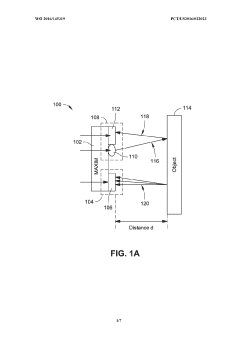
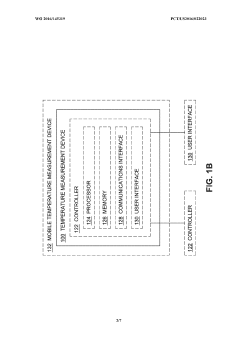
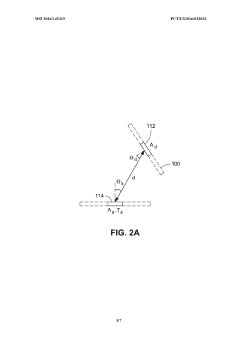
- A temperature measurement device equipped with a thermopile temperature sensor and a proximity sensor, where the proximity sensor detects the distance between the thermopile and the object, and a controller uses this information to correct the temperature measurement by accounting for the received radiation and distance, providing an accurate reading.

Heat imaging thermopile device and method
PatentActiveUS20160265977A1
Innovation
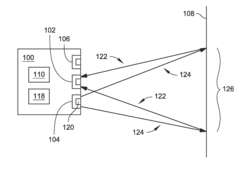
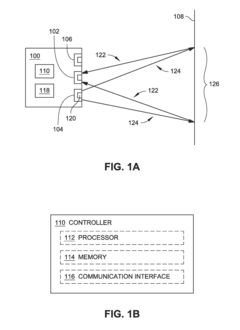
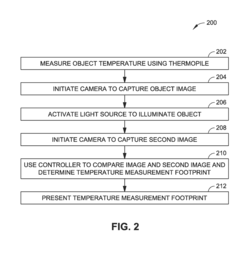
- A temperature measurement footprint device comprising a thermopile, a camera, and a light source, controlled by a processor, which captures images before and during illumination to determine and present a temperature measurement footprint, providing an indication of the area being measured.
Thermal Interface Materials and Their Impact
Thermal Interface Materials (TIMs) play a crucial role in optimizing thermopile positioning and maximizing their utilization efficiency. These specialized materials serve as conductive bridges between heat-generating components and heat dissipation systems, significantly impacting the overall thermal management performance. The selection of appropriate TIMs directly influences the effectiveness of thermopile arrays by ensuring efficient heat transfer across interfaces where air gaps would otherwise create thermal resistance.
High-performance TIMs typically incorporate materials with superior thermal conductivity properties, such as metal-based compounds, carbon-based materials, or ceramic-filled polymers. Metal-based TIMs, including indium, gallium, and their alloys, offer thermal conductivity values ranging from 20 to 86 W/m·K, making them particularly suitable for high-power density applications where thermopiles must operate at maximum efficiency.
Carbon-based TIMs, especially those utilizing graphene or carbon nanotubes, have emerged as promising alternatives due to their exceptional thermal conductivity exceeding 2000 W/m·K in ideal conditions. These materials can significantly enhance heat spreading across thermopile junctions, reducing thermal gradients and improving overall energy conversion efficiency.
The interface quality between thermopiles and adjacent surfaces critically affects performance metrics. Studies indicate that thermal contact resistance can account for up to 50% of the total thermal resistance in a typical electronic assembly. Properly applied TIMs can reduce this contact resistance by 80-95%, directly translating to improved thermopile output. The thickness of the TIM layer presents an important design consideration, with optimal thickness typically ranging between 25-100 μm depending on surface roughness and application requirements.
Environmental factors including temperature cycling, humidity, and mechanical stress can degrade TIM performance over time. Advanced TIMs incorporate phase-change materials or liquid metal composites that maintain consistent performance despite these challenges. These materials exhibit self-healing properties and resistance to pump-out effects that commonly plague conventional thermal greases.
Recent innovations in TIM technology focus on developing materials with anisotropic thermal conductivity, allowing engineers to direct heat flow in specific directions to optimize thermopile positioning. This directional heat management capability enables more precise thermal gradient control across thermopile arrays, potentially increasing power generation efficiency by 15-30% compared to systems using conventional isotropic TIMs.
The cost-performance ratio of TIMs represents another important consideration in thermopile system design. While premium TIMs may offer superior thermal performance, their implementation must be justified by corresponding improvements in system efficiency and reliability. Emerging manufacturing techniques, including 3D printing of custom TIM patterns, are creating new possibilities for optimizing the thermal interface specifically for thermopile applications.
High-performance TIMs typically incorporate materials with superior thermal conductivity properties, such as metal-based compounds, carbon-based materials, or ceramic-filled polymers. Metal-based TIMs, including indium, gallium, and their alloys, offer thermal conductivity values ranging from 20 to 86 W/m·K, making them particularly suitable for high-power density applications where thermopiles must operate at maximum efficiency.
Carbon-based TIMs, especially those utilizing graphene or carbon nanotubes, have emerged as promising alternatives due to their exceptional thermal conductivity exceeding 2000 W/m·K in ideal conditions. These materials can significantly enhance heat spreading across thermopile junctions, reducing thermal gradients and improving overall energy conversion efficiency.
The interface quality between thermopiles and adjacent surfaces critically affects performance metrics. Studies indicate that thermal contact resistance can account for up to 50% of the total thermal resistance in a typical electronic assembly. Properly applied TIMs can reduce this contact resistance by 80-95%, directly translating to improved thermopile output. The thickness of the TIM layer presents an important design consideration, with optimal thickness typically ranging between 25-100 μm depending on surface roughness and application requirements.
Environmental factors including temperature cycling, humidity, and mechanical stress can degrade TIM performance over time. Advanced TIMs incorporate phase-change materials or liquid metal composites that maintain consistent performance despite these challenges. These materials exhibit self-healing properties and resistance to pump-out effects that commonly plague conventional thermal greases.
Recent innovations in TIM technology focus on developing materials with anisotropic thermal conductivity, allowing engineers to direct heat flow in specific directions to optimize thermopile positioning. This directional heat management capability enables more precise thermal gradient control across thermopile arrays, potentially increasing power generation efficiency by 15-30% compared to systems using conventional isotropic TIMs.
The cost-performance ratio of TIMs represents another important consideration in thermopile system design. While premium TIMs may offer superior thermal performance, their implementation must be justified by corresponding improvements in system efficiency and reliability. Emerging manufacturing techniques, including 3D printing of custom TIM patterns, are creating new possibilities for optimizing the thermal interface specifically for thermopile applications.
Energy Efficiency and Sustainability Considerations
The optimization of thermopile positioning represents a significant opportunity for enhancing energy efficiency and sustainability across various applications. When thermopiles are strategically positioned to maximize thermal gradient capture, they can substantially reduce the need for conventional energy sources, thereby decreasing carbon emissions and environmental impact.
Energy recovery systems utilizing optimally positioned thermopiles demonstrate remarkable efficiency improvements, with some industrial implementations reporting energy savings of 15-25% compared to traditional systems. This efficiency gain translates directly into reduced fossil fuel consumption and lower greenhouse gas emissions, supporting global climate change mitigation efforts.
From a lifecycle perspective, thermopile-based energy harvesting systems offer compelling sustainability advantages. The materials used in modern thermopiles are increasingly selected for their reduced environmental footprint, with manufacturers moving away from rare earth elements toward more abundant and less environmentally damaging alternatives. Additionally, the extended operational lifespan of properly positioned thermopile arrays—often exceeding 15 years with minimal maintenance—enhances their sustainability profile.
The circular economy potential of thermopile systems deserves particular attention. When integrated into waste heat recovery frameworks, optimally positioned thermopiles create closed-loop energy systems where thermal energy that would otherwise dissipate as waste is captured and repurposed. This approach aligns perfectly with sustainable development principles by maximizing resource utilization efficiency.
Economic sustainability also improves through strategic thermopile positioning. The return on investment for optimized thermopile installations has decreased from 7-8 years to 3-5 years in recent implementations, making these systems increasingly viable for widespread adoption across various sectors including manufacturing, transportation, and building management.
Regulatory frameworks worldwide are increasingly recognizing the contribution of thermal energy harvesting to sustainability goals. Several countries have introduced incentives for implementing waste heat recovery technologies, including tax benefits and subsidies that specifically support thermopile-based solutions. These policy developments further enhance the economic case for optimal thermopile positioning.
Future sustainability improvements will likely emerge from integration with smart grid technologies and renewable energy systems. Thermopiles optimally positioned within hybrid energy networks can provide valuable load balancing capabilities, enhancing the stability and reliability of renewable energy sources while further reducing dependence on fossil fuels.
Energy recovery systems utilizing optimally positioned thermopiles demonstrate remarkable efficiency improvements, with some industrial implementations reporting energy savings of 15-25% compared to traditional systems. This efficiency gain translates directly into reduced fossil fuel consumption and lower greenhouse gas emissions, supporting global climate change mitigation efforts.
From a lifecycle perspective, thermopile-based energy harvesting systems offer compelling sustainability advantages. The materials used in modern thermopiles are increasingly selected for their reduced environmental footprint, with manufacturers moving away from rare earth elements toward more abundant and less environmentally damaging alternatives. Additionally, the extended operational lifespan of properly positioned thermopile arrays—often exceeding 15 years with minimal maintenance—enhances their sustainability profile.
The circular economy potential of thermopile systems deserves particular attention. When integrated into waste heat recovery frameworks, optimally positioned thermopiles create closed-loop energy systems where thermal energy that would otherwise dissipate as waste is captured and repurposed. This approach aligns perfectly with sustainable development principles by maximizing resource utilization efficiency.
Economic sustainability also improves through strategic thermopile positioning. The return on investment for optimized thermopile installations has decreased from 7-8 years to 3-5 years in recent implementations, making these systems increasingly viable for widespread adoption across various sectors including manufacturing, transportation, and building management.
Regulatory frameworks worldwide are increasingly recognizing the contribution of thermal energy harvesting to sustainability goals. Several countries have introduced incentives for implementing waste heat recovery technologies, including tax benefits and subsidies that specifically support thermopile-based solutions. These policy developments further enhance the economic case for optimal thermopile positioning.
Future sustainability improvements will likely emerge from integration with smart grid technologies and renewable energy systems. Thermopiles optimally positioned within hybrid energy networks can provide valuable load balancing capabilities, enhancing the stability and reliability of renewable energy sources while further reducing dependence on fossil fuels.
Unlock deeper insights with PatSnap Eureka Quick Research — get a full tech report to explore trends and direct your research. Try now!
Generate Your Research Report Instantly with AI Agent
Supercharge your innovation with PatSnap Eureka AI Agent Platform!