
Customizing Notch Filter for Targeted Noise Reduction
MAR 17, 20269 MIN READ
Generate Your Research Report Instantly with AI Agent
Patsnap Eureka helps you evaluate technical feasibility & market potential.
Notch Filter Technology Background and Objectives
Notch filters represent a specialized category of frequency-selective circuits designed to attenuate specific frequency components while preserving the integrity of signals across other frequency ranges. These filters, also known as band-stop or band-reject filters, have evolved from simple passive LC circuits in the early 20th century to sophisticated digital signal processing implementations capable of precise frequency targeting and adaptive response characteristics.
The fundamental principle underlying notch filter operation involves creating a sharp attenuation peak at a predetermined frequency, effectively "notching out" unwanted spectral components. Traditional implementations relied on analog components such as twin-T networks, bridged-T configurations, and Wien bridge circuits. However, the advent of digital signal processing has revolutionized notch filter design, enabling programmable frequency selection, variable bandwidth control, and real-time adaptation capabilities.
Contemporary notch filter applications span diverse technological domains, from audio engineering and telecommunications to biomedical signal processing and industrial automation. The increasing complexity of modern electronic environments has intensified the demand for customizable noise reduction solutions capable of targeting specific interference sources without compromising signal quality in adjacent frequency bands.
The evolution toward customizable notch filtering reflects the growing need for adaptive signal conditioning systems. Modern applications frequently encounter dynamic noise environments where interference frequencies may shift over time or vary across different operational conditions. Traditional fixed-frequency notch filters prove inadequate for such scenarios, necessitating the development of intelligent filtering systems capable of real-time frequency tracking and automatic parameter adjustment.
Current technological objectives focus on achieving several key performance metrics: enhanced frequency selectivity with minimal passband ripple, reduced group delay distortion, improved dynamic range, and faster adaptation speeds. Advanced implementations incorporate machine learning algorithms for predictive noise characterization and employ sophisticated control mechanisms for seamless filter parameter updates without introducing transient artifacts.
The integration of software-defined radio principles with notch filter design has opened new possibilities for multi-band operation and concurrent noise suppression across multiple frequency ranges. These developments align with the broader industry trend toward flexible, reconfigurable signal processing architectures that can adapt to evolving interference scenarios while maintaining optimal system performance.
The fundamental principle underlying notch filter operation involves creating a sharp attenuation peak at a predetermined frequency, effectively "notching out" unwanted spectral components. Traditional implementations relied on analog components such as twin-T networks, bridged-T configurations, and Wien bridge circuits. However, the advent of digital signal processing has revolutionized notch filter design, enabling programmable frequency selection, variable bandwidth control, and real-time adaptation capabilities.
Contemporary notch filter applications span diverse technological domains, from audio engineering and telecommunications to biomedical signal processing and industrial automation. The increasing complexity of modern electronic environments has intensified the demand for customizable noise reduction solutions capable of targeting specific interference sources without compromising signal quality in adjacent frequency bands.
The evolution toward customizable notch filtering reflects the growing need for adaptive signal conditioning systems. Modern applications frequently encounter dynamic noise environments where interference frequencies may shift over time or vary across different operational conditions. Traditional fixed-frequency notch filters prove inadequate for such scenarios, necessitating the development of intelligent filtering systems capable of real-time frequency tracking and automatic parameter adjustment.
Current technological objectives focus on achieving several key performance metrics: enhanced frequency selectivity with minimal passband ripple, reduced group delay distortion, improved dynamic range, and faster adaptation speeds. Advanced implementations incorporate machine learning algorithms for predictive noise characterization and employ sophisticated control mechanisms for seamless filter parameter updates without introducing transient artifacts.
The integration of software-defined radio principles with notch filter design has opened new possibilities for multi-band operation and concurrent noise suppression across multiple frequency ranges. These developments align with the broader industry trend toward flexible, reconfigurable signal processing architectures that can adapt to evolving interference scenarios while maintaining optimal system performance.
Market Demand for Customized Noise Reduction Solutions
The global market for customized noise reduction solutions is experiencing unprecedented growth driven by increasing awareness of noise pollution's impact on human health and productivity. Industries ranging from aerospace and automotive to consumer electronics and medical devices are actively seeking tailored filtering solutions that can address specific frequency ranges while preserving signal integrity. This demand stems from the recognition that traditional broadband noise reduction approaches often compromise desired signals along with unwanted noise.
Healthcare and medical device sectors represent a particularly lucrative market segment for customized notch filters. Medical imaging equipment, patient monitoring systems, and diagnostic devices require precise noise elimination at specific frequencies to ensure accurate readings and patient safety. The growing adoption of telemedicine and remote monitoring solutions has further amplified the need for sophisticated noise reduction technologies that can maintain signal quality across various transmission channels.
The consumer electronics industry continues to drive substantial demand for personalized audio experiences. Smart devices, wireless headphones, and home automation systems increasingly incorporate adaptive noise cancellation features that can be customized based on user preferences and environmental conditions. This trend reflects consumers' growing expectations for products that can intelligently adapt to their specific acoustic environments.
Industrial automation and manufacturing sectors present significant opportunities for targeted noise reduction solutions. Modern production facilities require precise control systems that must operate reliably in electromagnetically noisy environments. Customizable notch filters enable manufacturers to eliminate specific interference frequencies while maintaining the integrity of critical control signals, thereby improving operational efficiency and reducing downtime.
The telecommunications and data communication markets are experiencing robust demand for frequency-selective filtering solutions. As wireless communication systems become more complex and spectrum congestion increases, the ability to precisely target and eliminate specific interference sources becomes crucial for maintaining service quality and regulatory compliance.
Emerging applications in autonomous vehicles, Internet of Things devices, and renewable energy systems are creating new market opportunities. These applications often require highly specialized filtering solutions that can adapt to varying operational conditions and interference patterns, driving continued innovation in customizable noise reduction technologies.
Healthcare and medical device sectors represent a particularly lucrative market segment for customized notch filters. Medical imaging equipment, patient monitoring systems, and diagnostic devices require precise noise elimination at specific frequencies to ensure accurate readings and patient safety. The growing adoption of telemedicine and remote monitoring solutions has further amplified the need for sophisticated noise reduction technologies that can maintain signal quality across various transmission channels.
The consumer electronics industry continues to drive substantial demand for personalized audio experiences. Smart devices, wireless headphones, and home automation systems increasingly incorporate adaptive noise cancellation features that can be customized based on user preferences and environmental conditions. This trend reflects consumers' growing expectations for products that can intelligently adapt to their specific acoustic environments.
Industrial automation and manufacturing sectors present significant opportunities for targeted noise reduction solutions. Modern production facilities require precise control systems that must operate reliably in electromagnetically noisy environments. Customizable notch filters enable manufacturers to eliminate specific interference frequencies while maintaining the integrity of critical control signals, thereby improving operational efficiency and reducing downtime.
The telecommunications and data communication markets are experiencing robust demand for frequency-selective filtering solutions. As wireless communication systems become more complex and spectrum congestion increases, the ability to precisely target and eliminate specific interference sources becomes crucial for maintaining service quality and regulatory compliance.
Emerging applications in autonomous vehicles, Internet of Things devices, and renewable energy systems are creating new market opportunities. These applications often require highly specialized filtering solutions that can adapt to varying operational conditions and interference patterns, driving continued innovation in customizable noise reduction technologies.
Current State and Challenges of Notch Filter Design
Notch filter design has evolved significantly over the past decades, with traditional analog implementations giving way to sophisticated digital signal processing approaches. Contemporary notch filters employ various architectures including twin-T networks, bridged-T configurations, and active filter designs using operational amplifiers. Digital implementations leverage finite impulse response (FIR) and infinite impulse response (IIR) structures, offering enhanced precision and programmability compared to their analog counterparts.
The current landscape of notch filter technology spans multiple domains, from audio processing and biomedical signal conditioning to power electronics and telecommunications. Modern implementations increasingly rely on adaptive algorithms that can automatically adjust filter parameters based on real-time signal characteristics. Field-programmable gate arrays (FPGA) and digital signal processors (DSP) have become prevalent platforms for implementing complex notch filtering schemes.
Despite technological advances, several fundamental challenges persist in notch filter design. Achieving precise frequency selectivity while maintaining minimal impact on adjacent frequency components remains a critical concern. The trade-off between filter sharpness and stability presents ongoing difficulties, particularly in applications requiring extremely narrow notch widths. Group delay distortion around the notch frequency continues to affect signal integrity in sensitive applications.
Adaptive notch filtering faces computational complexity challenges, especially in real-time applications with stringent latency requirements. The convergence speed of adaptive algorithms often conflicts with stability requirements, creating design compromises that limit performance. Temperature variations and component aging in analog implementations introduce frequency drift issues that require continuous calibration or compensation mechanisms.
Customization for targeted noise reduction introduces additional complexity layers. Different noise characteristics demand distinct filter responses, yet achieving optimal performance across varying conditions remains challenging. The integration of machine learning approaches for intelligent filter adaptation shows promise but introduces new challenges related to training data requirements and computational overhead.
Manufacturing tolerances in analog components continue to limit the precision of traditional notch filter implementations. Digital alternatives, while offering superior accuracy, face quantization noise and finite word-length effects that can degrade performance in high-precision applications. The geographical distribution of advanced notch filter research concentrates primarily in North America, Europe, and East Asia, with significant contributions from academic institutions and semiconductor companies in these regions.
The current landscape of notch filter technology spans multiple domains, from audio processing and biomedical signal conditioning to power electronics and telecommunications. Modern implementations increasingly rely on adaptive algorithms that can automatically adjust filter parameters based on real-time signal characteristics. Field-programmable gate arrays (FPGA) and digital signal processors (DSP) have become prevalent platforms for implementing complex notch filtering schemes.
Despite technological advances, several fundamental challenges persist in notch filter design. Achieving precise frequency selectivity while maintaining minimal impact on adjacent frequency components remains a critical concern. The trade-off between filter sharpness and stability presents ongoing difficulties, particularly in applications requiring extremely narrow notch widths. Group delay distortion around the notch frequency continues to affect signal integrity in sensitive applications.
Adaptive notch filtering faces computational complexity challenges, especially in real-time applications with stringent latency requirements. The convergence speed of adaptive algorithms often conflicts with stability requirements, creating design compromises that limit performance. Temperature variations and component aging in analog implementations introduce frequency drift issues that require continuous calibration or compensation mechanisms.
Customization for targeted noise reduction introduces additional complexity layers. Different noise characteristics demand distinct filter responses, yet achieving optimal performance across varying conditions remains challenging. The integration of machine learning approaches for intelligent filter adaptation shows promise but introduces new challenges related to training data requirements and computational overhead.
Manufacturing tolerances in analog components continue to limit the precision of traditional notch filter implementations. Digital alternatives, while offering superior accuracy, face quantization noise and finite word-length effects that can degrade performance in high-precision applications. The geographical distribution of advanced notch filter research concentrates primarily in North America, Europe, and East Asia, with significant contributions from academic institutions and semiconductor companies in these regions.
Existing Customizable Notch Filter Solutions
01 Adaptive notch filter implementation
Adaptive notch filters dynamically adjust their center frequency and bandwidth to track and eliminate time-varying narrowband interference. These filters use algorithms to automatically detect the frequency of noise components and adapt their parameters in real-time, making them particularly effective for removing periodic noise or interference that may drift in frequency over time.- Adaptive notch filter implementation: Adaptive notch filters dynamically adjust their center frequency and bandwidth to track and eliminate time-varying narrowband interference. These filters use algorithms to automatically detect the frequency of noise components and adapt their parameters in real-time, making them particularly effective for removing periodic noise or interference that may drift in frequency over time.
- Digital signal processing based notch filtering: Digital notch filters utilize digital signal processing techniques to attenuate specific frequency components in the signal spectrum. These implementations often employ finite impulse response or infinite impulse response filter structures that can be precisely configured to target narrow frequency bands while preserving the integrity of the desired signal content across other frequencies.
- Multi-stage cascaded notch filter architecture: Multi-stage notch filter systems employ cascaded filter stages to achieve enhanced noise reduction performance. By combining multiple notch filters with different center frequencies or quality factors, these architectures can simultaneously eliminate multiple interference sources or achieve steeper attenuation characteristics than single-stage implementations.
- Notch filter with bandwidth control mechanism: Notch filters incorporating bandwidth control mechanisms allow for adjustable selectivity in frequency rejection. These designs enable users or automatic control systems to modify the width of the rejection band, balancing between narrow-band precision for minimal signal distortion and wider-band rejection for more robust noise elimination under varying conditions.
- Integrated notch filter in sensor signal conditioning: Notch filters integrated into sensor signal conditioning circuits provide front-end noise reduction for measurement and detection systems. These implementations are specifically designed to remove power line interference, electromagnetic interference, or other predictable noise sources before analog-to-digital conversion or further signal processing stages.
02 Digital signal processing based notch filtering
Digital notch filters utilize digital signal processing techniques to attenuate specific frequency components in the signal spectrum. These implementations often employ infinite impulse response or finite impulse response filter structures that can be precisely configured to target narrow frequency bands while preserving the integrity of the desired signal content across other frequencies.Expand Specific Solutions03 Multi-stage cascaded notch filter architecture
Cascaded notch filter systems employ multiple filtering stages in series to achieve enhanced noise reduction performance. This architecture allows for the simultaneous removal of multiple narrowband interference sources at different frequencies, with each stage targeting a specific noise component. The cascaded approach provides steeper attenuation characteristics and improved selectivity compared to single-stage implementations.Expand Specific Solutions04 Parametric notch filter with adjustable Q-factor
Parametric notch filters feature adjustable quality factor parameters that control the bandwidth and sharpness of the frequency rejection characteristic. These filters allow users or automatic control systems to fine-tune the notch width to match the specific characteristics of the interference, enabling precise noise suppression while minimizing impact on adjacent frequency components of the desired signal.Expand Specific Solutions05 Notch filter with feedback control mechanism
Feedback-controlled notch filtering systems incorporate monitoring and control loops that continuously assess the effectiveness of noise reduction and adjust filter parameters accordingly. These systems may analyze the output signal quality, detect residual interference, and modify filter characteristics to optimize performance under varying noise conditions, providing robust and consistent noise suppression across different operating scenarios.Expand Specific Solutions
Key Players in Signal Processing and Filter Industry
The customizing notch filter for targeted noise reduction technology represents a mature market segment within the broader signal processing industry, currently experiencing steady growth driven by increasing demand across consumer electronics, automotive, and medical device applications. The market demonstrates significant scale with established players like Samsung Electronics, Panasonic Holdings, and STMicroelectronics leading consumer applications, while specialized companies such as Cirrus Logic and Allegro MicroSystems focus on high-precision analog solutions. Technology maturity varies across applications, with companies like Siemens AG and Lockheed Martin advancing sophisticated implementations for industrial and aerospace uses, while emerging players like MediaTek drive innovation in mobile processing. The competitive landscape shows strong consolidation among major semiconductor manufacturers, complemented by specialized audio companies like Shure and Pioneer, alongside research institutions such as University of Electronic Science & Technology of China contributing to next-generation adaptive filtering algorithms and implementation methodologies.
Cirrus Logic, Inc.
Technical Solution: Cirrus Logic specializes in advanced digital signal processing solutions for audio applications, implementing sophisticated notch filter algorithms in their audio codecs and DSP chips. Their customizable notch filter technology utilizes adaptive algorithms that can automatically detect and suppress specific frequency components in real-time audio processing. The company's solutions feature programmable filter coefficients, allowing precise targeting of unwanted noise frequencies while preserving signal integrity. Their notch filters incorporate multiple cascaded stages with adjustable Q-factors and center frequencies, enabling effective removal of power line interference, mechanical vibrations, and other periodic noise sources in professional audio equipment and consumer electronics.
Strengths: Industry-leading audio DSP expertise, real-time adaptive filtering capabilities. Weaknesses: Primarily focused on audio applications, limited to specific frequency ranges.
STMicroelectronics International NV
Technical Solution: STMicroelectronics develops customizable notch filter solutions integrated into their microcontroller and sensor interface products. Their approach combines hardware-accelerated digital filtering with software-configurable parameters, enabling precise noise reduction in industrial and automotive applications. The company's notch filter implementations feature programmable center frequencies, bandwidth control, and multi-stage cascading capabilities. Their solutions are particularly effective for eliminating power supply noise, electromagnetic interference, and mechanical vibration artifacts in sensor data acquisition systems. STMicroelectronics' filters utilize optimized algorithms that maintain low computational overhead while providing high selectivity and minimal phase distortion.
Strengths: Hardware-software integration, low power consumption, automotive-grade reliability. Weaknesses: Limited to embedded applications, requires specialized development tools.
Core Innovations in Adaptive Notch Filter Design
Linear, low noise, high Q and widely tunable notch filter
PatentActiveUS10396748B2
Innovation
- A shunt N-path notch filter with tunable center frequency, using a series inductor and capacitor that can be bypassed for band-pass operation, and controlled by clock pulses to achieve linear, high quality factor filtering without the need for bulky off-chip filters.


Adaptive notch filter
PatentActiveUS9737265B2
Innovation
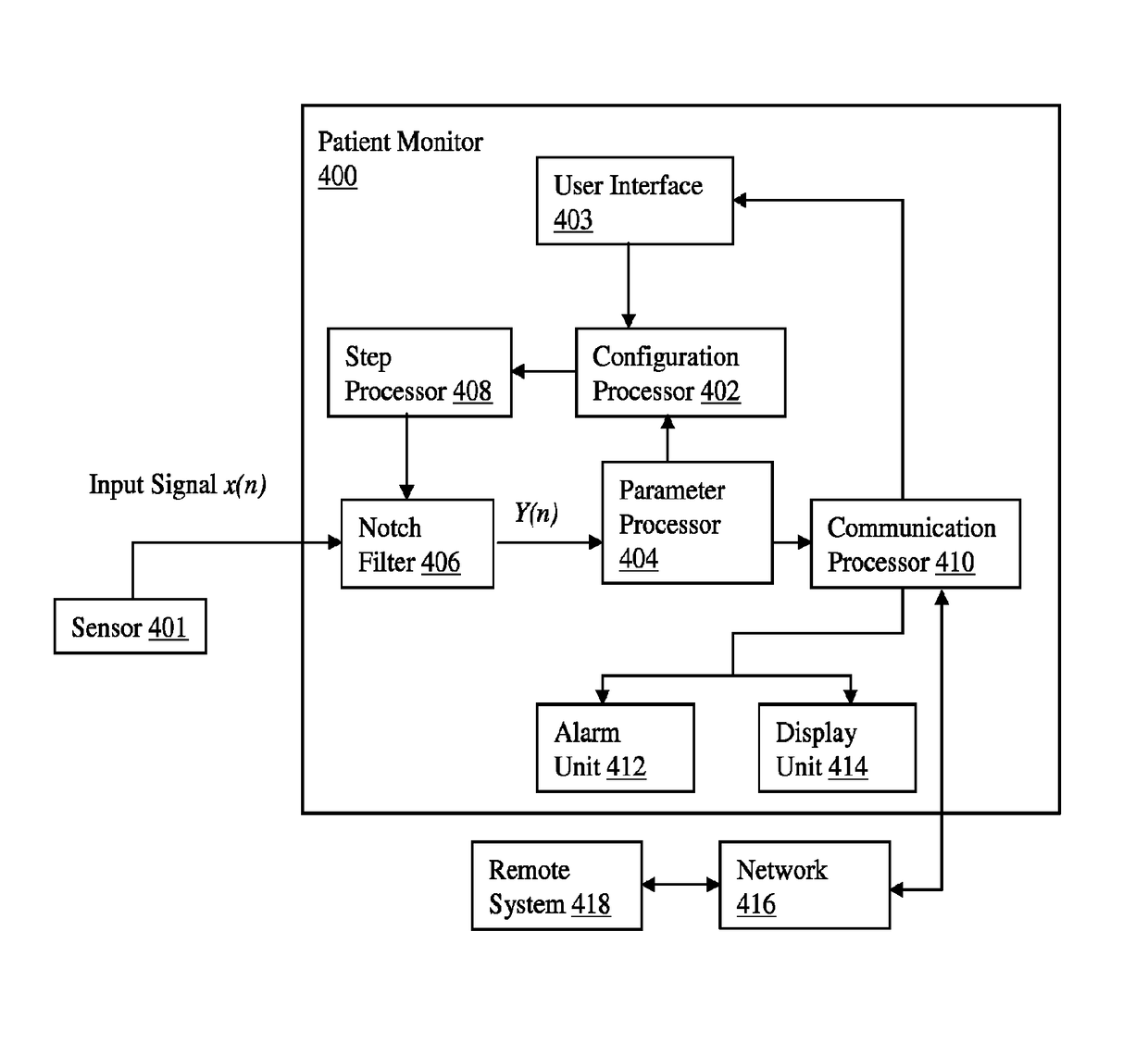
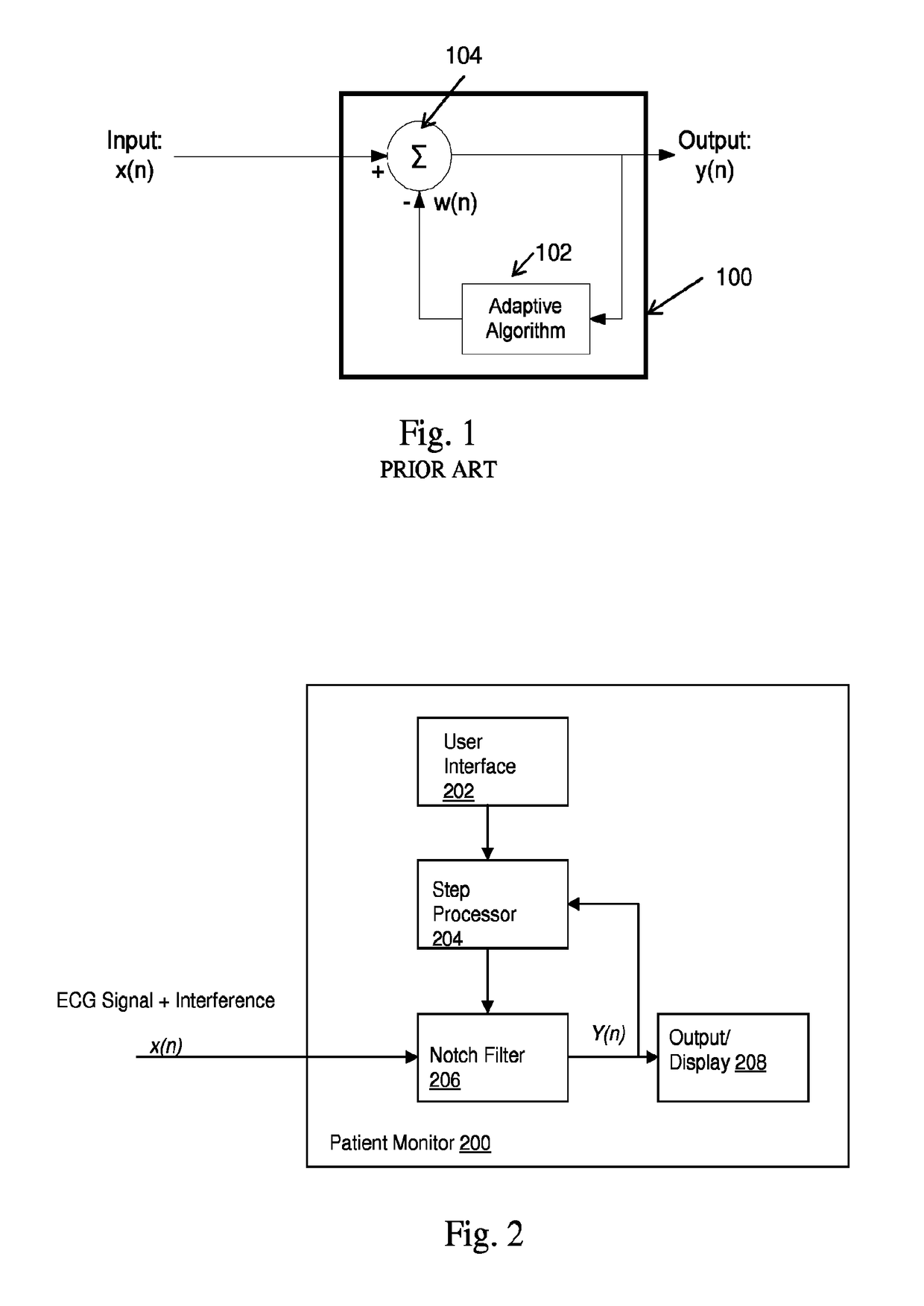
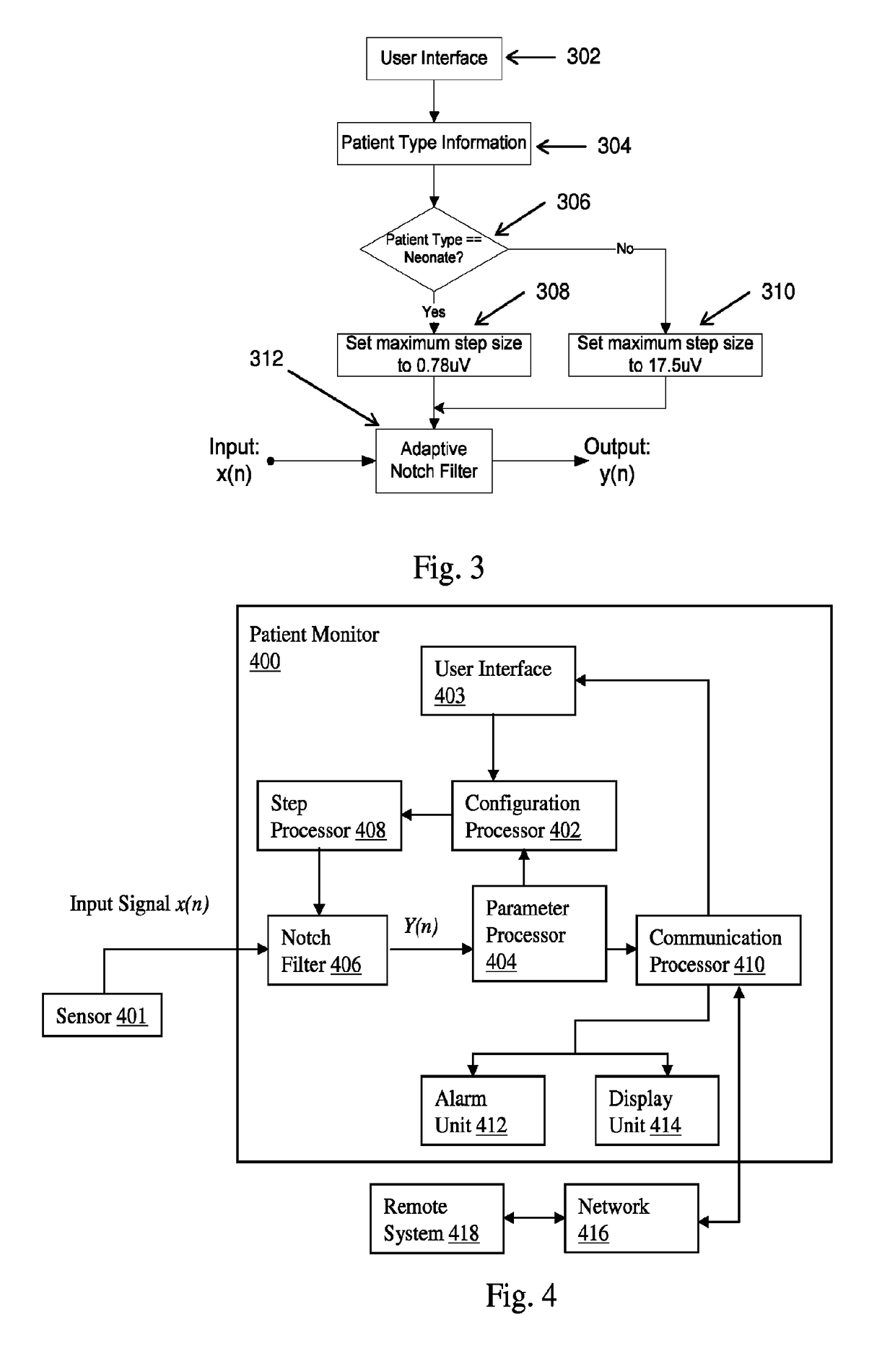
- An adaptive notch filter is implemented in patient monitoring devices that automatically estimates and removes interference signals by dynamically setting a filter parameter, specifically a maximum step size based on patient type, to minimize ringing artifacts and enhance signal convergence.

Real-time Implementation Challenges and Solutions
Real-time implementation of customized notch filters for targeted noise reduction presents several critical challenges that must be addressed to achieve effective performance in practical applications. The primary constraint lies in computational latency requirements, where processing delays must remain below acceptable thresholds to maintain system responsiveness. Traditional notch filter designs often struggle with this balance between filtering precision and processing speed.
Memory allocation and buffer management constitute another significant challenge in real-time environments. Customized notch filters require dynamic coefficient updates and adaptive frequency tracking, which demand efficient memory usage patterns. The system must maintain multiple filter states simultaneously while avoiding memory fragmentation that could lead to processing interruptions or performance degradation.
Adaptive frequency tracking represents a complex implementation challenge, particularly when dealing with time-varying noise characteristics. The filter must continuously monitor input signals, detect frequency shifts in target noise components, and adjust filter parameters accordingly without introducing audible artifacts or processing gaps. This requires sophisticated algorithms that can operate within strict timing constraints while maintaining filtering accuracy.
Hardware resource optimization becomes crucial when implementing customized notch filters on embedded systems or digital signal processors. The solution involves leveraging parallel processing architectures and optimized mathematical libraries to distribute computational load effectively. Fixed-point arithmetic implementations often replace floating-point calculations to reduce processing overhead while maintaining acceptable precision levels.
Modern solutions incorporate predictive algorithms that anticipate frequency changes based on historical patterns, enabling proactive filter adjustments rather than reactive responses. Additionally, multi-threaded architectures separate filter coefficient calculation from signal processing operations, allowing continuous adaptation without interrupting the main filtering pipeline. These approaches collectively address the fundamental challenges of real-time customized notch filter implementation while maintaining the precision required for effective targeted noise reduction.
Memory allocation and buffer management constitute another significant challenge in real-time environments. Customized notch filters require dynamic coefficient updates and adaptive frequency tracking, which demand efficient memory usage patterns. The system must maintain multiple filter states simultaneously while avoiding memory fragmentation that could lead to processing interruptions or performance degradation.
Adaptive frequency tracking represents a complex implementation challenge, particularly when dealing with time-varying noise characteristics. The filter must continuously monitor input signals, detect frequency shifts in target noise components, and adjust filter parameters accordingly without introducing audible artifacts or processing gaps. This requires sophisticated algorithms that can operate within strict timing constraints while maintaining filtering accuracy.
Hardware resource optimization becomes crucial when implementing customized notch filters on embedded systems or digital signal processors. The solution involves leveraging parallel processing architectures and optimized mathematical libraries to distribute computational load effectively. Fixed-point arithmetic implementations often replace floating-point calculations to reduce processing overhead while maintaining acceptable precision levels.
Modern solutions incorporate predictive algorithms that anticipate frequency changes based on historical patterns, enabling proactive filter adjustments rather than reactive responses. Additionally, multi-threaded architectures separate filter coefficient calculation from signal processing operations, allowing continuous adaptation without interrupting the main filtering pipeline. These approaches collectively address the fundamental challenges of real-time customized notch filter implementation while maintaining the precision required for effective targeted noise reduction.
Performance Metrics and Validation Standards
The establishment of comprehensive performance metrics for customized notch filters requires a multi-dimensional evaluation framework that addresses both frequency domain and time domain characteristics. Primary metrics include notch depth, which measures the attenuation level at the target frequency, typically expressed in decibels and requiring minimum 40dB suppression for effective noise reduction. The quality factor (Q-factor) determines the selectivity of the filter, with higher Q values providing narrower notch widths but potentially introducing stability concerns in adaptive implementations.
Frequency response accuracy serves as a critical validation parameter, encompassing center frequency precision, bandwidth control, and stopband rejection characteristics. Modern validation standards mandate frequency accuracy within ±0.1% of the target frequency across operational temperature ranges. Additionally, passband ripple specifications typically require less than 0.5dB variation to maintain signal integrity in adjacent frequency bands.
Temporal performance metrics focus on adaptation speed and convergence stability for real-time applications. Step response characteristics, including settling time and overshoot parameters, directly impact the filter's ability to track dynamic noise sources. Validation protocols typically specify convergence times under 100 milliseconds for audio applications and sub-microsecond response for high-frequency communication systems.
Signal-to-noise ratio improvement represents the ultimate performance indicator, measuring the filter's effectiveness in enhancing desired signal quality. Industry standards require minimum 20dB SNR improvement for consumer applications and up to 60dB for precision instrumentation. Complementary metrics include total harmonic distortion, phase linearity, and group delay variation across the operational bandwidth.
Validation methodologies encompass both simulation-based verification and hardware-in-the-loop testing protocols. Standardized test signals, including swept sine waves, white noise, and application-specific interference patterns, ensure comprehensive performance characterization. Environmental stress testing validates performance stability across temperature, humidity, and electromagnetic interference conditions, with acceptance criteria defined by relevant industry standards such as IEC 61000 series for electromagnetic compatibility.
Frequency response accuracy serves as a critical validation parameter, encompassing center frequency precision, bandwidth control, and stopband rejection characteristics. Modern validation standards mandate frequency accuracy within ±0.1% of the target frequency across operational temperature ranges. Additionally, passband ripple specifications typically require less than 0.5dB variation to maintain signal integrity in adjacent frequency bands.
Temporal performance metrics focus on adaptation speed and convergence stability for real-time applications. Step response characteristics, including settling time and overshoot parameters, directly impact the filter's ability to track dynamic noise sources. Validation protocols typically specify convergence times under 100 milliseconds for audio applications and sub-microsecond response for high-frequency communication systems.
Signal-to-noise ratio improvement represents the ultimate performance indicator, measuring the filter's effectiveness in enhancing desired signal quality. Industry standards require minimum 20dB SNR improvement for consumer applications and up to 60dB for precision instrumentation. Complementary metrics include total harmonic distortion, phase linearity, and group delay variation across the operational bandwidth.
Validation methodologies encompass both simulation-based verification and hardware-in-the-loop testing protocols. Standardized test signals, including swept sine waves, white noise, and application-specific interference patterns, ensure comprehensive performance characterization. Environmental stress testing validates performance stability across temperature, humidity, and electromagnetic interference conditions, with acceptance criteria defined by relevant industry standards such as IEC 61000 series for electromagnetic compatibility.
Unlock deeper insights with Patsnap Eureka Quick Research — get a full tech report to explore trends and direct your research. Try now!
Generate Your Research Report Instantly with AI Agent
Supercharge your innovation with Patsnap Eureka AI Agent Platform!