
Notch Filter vs. Chebyshev Filter: Attenuation Study
MAR 17, 20269 MIN READ
Generate Your Research Report Instantly with AI Agent
Patsnap Eureka helps you evaluate technical feasibility & market potential.
Notch and Chebyshev Filter Background and Objectives
Electronic filtering technology has undergone significant evolution since the early 20th century, with the development of specialized filter designs addressing diverse signal processing requirements. The emergence of notch filters and Chebyshev filters represents two distinct approaches to frequency domain manipulation, each serving critical roles in modern electronic systems.
Notch filters, also known as band-stop or band-reject filters, evolved from the fundamental need to eliminate specific unwanted frequencies while preserving the integrity of surrounding frequency components. These filters demonstrate exceptional precision in targeting narrow frequency bands, making them indispensable in applications requiring surgical frequency removal. The development trajectory of notch filters has been driven by increasing demands for interference suppression in communication systems and power line noise elimination.
Chebyshev filters emerged from mathematical foundations established by Pafnuty Chebyshev in the 19th century, later finding practical implementation in electronic circuits during the mid-20th century. These filters are characterized by their equiripple response in either the passband or stopband, offering superior roll-off characteristics compared to Butterworth filters. The evolution of Chebyshev filter design has been closely tied to advances in analog circuit design and digital signal processing algorithms.
The primary objective of comparing notch and Chebyshev filter attenuation characteristics centers on understanding their respective strengths in frequency domain suppression. This comparative analysis aims to establish performance benchmarks for attenuation depth, selectivity, and transition band characteristics. Such evaluation is crucial for determining optimal filter selection in applications ranging from audio processing to RF communication systems.
Current technological trends indicate increasing integration of both filter types in software-defined radio systems and digital signal processing platforms. The objective extends beyond simple performance comparison to encompass implementation complexity, computational requirements, and real-world application suitability. Understanding these fundamental differences enables engineers to make informed decisions when designing systems requiring specific attenuation profiles and frequency response characteristics.
Notch filters, also known as band-stop or band-reject filters, evolved from the fundamental need to eliminate specific unwanted frequencies while preserving the integrity of surrounding frequency components. These filters demonstrate exceptional precision in targeting narrow frequency bands, making them indispensable in applications requiring surgical frequency removal. The development trajectory of notch filters has been driven by increasing demands for interference suppression in communication systems and power line noise elimination.
Chebyshev filters emerged from mathematical foundations established by Pafnuty Chebyshev in the 19th century, later finding practical implementation in electronic circuits during the mid-20th century. These filters are characterized by their equiripple response in either the passband or stopband, offering superior roll-off characteristics compared to Butterworth filters. The evolution of Chebyshev filter design has been closely tied to advances in analog circuit design and digital signal processing algorithms.
The primary objective of comparing notch and Chebyshev filter attenuation characteristics centers on understanding their respective strengths in frequency domain suppression. This comparative analysis aims to establish performance benchmarks for attenuation depth, selectivity, and transition band characteristics. Such evaluation is crucial for determining optimal filter selection in applications ranging from audio processing to RF communication systems.
Current technological trends indicate increasing integration of both filter types in software-defined radio systems and digital signal processing platforms. The objective extends beyond simple performance comparison to encompass implementation complexity, computational requirements, and real-world application suitability. Understanding these fundamental differences enables engineers to make informed decisions when designing systems requiring specific attenuation profiles and frequency response characteristics.
Market Demand for Advanced Filter Attenuation Solutions
The telecommunications industry represents the largest market segment driving demand for advanced filter attenuation solutions, particularly in 5G infrastructure deployment and spectrum management applications. Mobile network operators require sophisticated filtering technologies to manage interference between adjacent frequency bands while maintaining signal integrity across increasingly crowded spectrum allocations. The transition from 4G to 5G networks has intensified requirements for filters capable of providing steep roll-off characteristics and precise notch filtering capabilities.
Aerospace and defense sectors constitute another significant market driver, where mission-critical applications demand exceptional filter performance under extreme environmental conditions. Military communication systems, radar applications, and satellite communications require filters with superior attenuation characteristics to ensure reliable operation in contested electromagnetic environments. The growing emphasis on electronic warfare capabilities has further amplified demand for adaptive filtering solutions.
Consumer electronics markets are experiencing substantial growth in filter technology adoption, driven by the proliferation of wireless devices and Internet of Things applications. Smartphones, tablets, and wearable devices increasingly require compact, high-performance filters to manage multiple wireless protocols operating simultaneously within confined spaces. The miniaturization trend in consumer electronics has created specific demands for filters that maintain excellent attenuation performance while occupying minimal board space.
Industrial automation and automotive sectors are emerging as significant growth areas for advanced filter solutions. The automotive industry's shift toward electric vehicles and autonomous driving systems has created new requirements for electromagnetic compatibility and signal processing applications. Industrial IoT implementations require robust filtering solutions to ensure reliable communication in electrically noisy manufacturing environments.
Medical device applications represent a specialized but growing market segment where filter performance directly impacts patient safety and diagnostic accuracy. Medical imaging systems, patient monitoring equipment, and implantable devices require filters with exceptional stability and predictable attenuation characteristics to ensure accurate signal processing and regulatory compliance.
The market demand is increasingly favoring solutions that offer configurable attenuation profiles, enabling system designers to optimize filter performance for specific applications without requiring custom hardware development. This trend reflects the industry's need for flexible, cost-effective solutions that can adapt to evolving technical requirements while maintaining manufacturing scalability.
Aerospace and defense sectors constitute another significant market driver, where mission-critical applications demand exceptional filter performance under extreme environmental conditions. Military communication systems, radar applications, and satellite communications require filters with superior attenuation characteristics to ensure reliable operation in contested electromagnetic environments. The growing emphasis on electronic warfare capabilities has further amplified demand for adaptive filtering solutions.
Consumer electronics markets are experiencing substantial growth in filter technology adoption, driven by the proliferation of wireless devices and Internet of Things applications. Smartphones, tablets, and wearable devices increasingly require compact, high-performance filters to manage multiple wireless protocols operating simultaneously within confined spaces. The miniaturization trend in consumer electronics has created specific demands for filters that maintain excellent attenuation performance while occupying minimal board space.
Industrial automation and automotive sectors are emerging as significant growth areas for advanced filter solutions. The automotive industry's shift toward electric vehicles and autonomous driving systems has created new requirements for electromagnetic compatibility and signal processing applications. Industrial IoT implementations require robust filtering solutions to ensure reliable communication in electrically noisy manufacturing environments.
Medical device applications represent a specialized but growing market segment where filter performance directly impacts patient safety and diagnostic accuracy. Medical imaging systems, patient monitoring equipment, and implantable devices require filters with exceptional stability and predictable attenuation characteristics to ensure accurate signal processing and regulatory compliance.
The market demand is increasingly favoring solutions that offer configurable attenuation profiles, enabling system designers to optimize filter performance for specific applications without requiring custom hardware development. This trend reflects the industry's need for flexible, cost-effective solutions that can adapt to evolving technical requirements while maintaining manufacturing scalability.
Current Filter Performance and Attenuation Challenges
Current filter technologies face significant performance limitations when addressing specific attenuation requirements in modern electronic systems. Traditional filter designs often struggle to achieve optimal balance between selectivity, passband ripple, and stopband attenuation characteristics. The increasing demand for precise frequency response control in applications ranging from telecommunications to audio processing has exposed critical gaps in existing filter performance capabilities.
Notch filters currently demonstrate excellent narrow-band rejection capabilities, typically achieving 40-60 dB attenuation at specific frequencies. However, their performance degrades rapidly outside the notch frequency, limiting their effectiveness in applications requiring broader stopband control. The sharp transition characteristics that make notch filters valuable also create challenges in maintaining stable performance across temperature variations and component tolerances.
Chebyshev filters present a different set of performance challenges despite their superior rolloff characteristics. While Type I Chebyshev filters achieve steeper transition bands compared to Butterworth designs, they introduce equiripple behavior in the passband that can compromise signal integrity. The passband ripple typically ranges from 0.1 dB to 3 dB, creating amplitude variations that may be unacceptable in precision applications.
The attenuation performance of Chebyshev filters in the stopband, while mathematically predictable, often falls short of practical requirements. Type II Chebyshev filters address passband ripple concerns but introduce complexity in the stopband response, making it difficult to achieve consistent attenuation levels across wide frequency ranges. The trade-off between ripple control and attenuation depth remains a fundamental limitation.
Manufacturing tolerances significantly impact both filter types' real-world performance. Component variations can shift notch frequencies by several percent, while Chebyshev filter characteristics become sensitive to precise component matching. These tolerance effects often result in 10-15% degradation from theoretical attenuation performance, particularly problematic in high-frequency applications where parasitic effects become dominant.
Temperature stability presents another critical challenge affecting attenuation consistency. Notch filters experience frequency drift that directly impacts their rejection effectiveness, while Chebyshev filters suffer from coefficient variations that alter their fundamental response characteristics. Current compensation techniques add complexity and cost while providing only partial solutions to these stability issues.
Notch filters currently demonstrate excellent narrow-band rejection capabilities, typically achieving 40-60 dB attenuation at specific frequencies. However, their performance degrades rapidly outside the notch frequency, limiting their effectiveness in applications requiring broader stopband control. The sharp transition characteristics that make notch filters valuable also create challenges in maintaining stable performance across temperature variations and component tolerances.
Chebyshev filters present a different set of performance challenges despite their superior rolloff characteristics. While Type I Chebyshev filters achieve steeper transition bands compared to Butterworth designs, they introduce equiripple behavior in the passband that can compromise signal integrity. The passband ripple typically ranges from 0.1 dB to 3 dB, creating amplitude variations that may be unacceptable in precision applications.
The attenuation performance of Chebyshev filters in the stopband, while mathematically predictable, often falls short of practical requirements. Type II Chebyshev filters address passband ripple concerns but introduce complexity in the stopband response, making it difficult to achieve consistent attenuation levels across wide frequency ranges. The trade-off between ripple control and attenuation depth remains a fundamental limitation.
Manufacturing tolerances significantly impact both filter types' real-world performance. Component variations can shift notch frequencies by several percent, while Chebyshev filter characteristics become sensitive to precise component matching. These tolerance effects often result in 10-15% degradation from theoretical attenuation performance, particularly problematic in high-frequency applications where parasitic effects become dominant.
Temperature stability presents another critical challenge affecting attenuation consistency. Notch filters experience frequency drift that directly impacts their rejection effectiveness, while Chebyshev filters suffer from coefficient variations that alter their fundamental response characteristics. Current compensation techniques add complexity and cost while providing only partial solutions to these stability issues.
Existing Attenuation Optimization Solutions
01 Notch filter design with specific attenuation characteristics
Notch filters are designed to provide high attenuation at specific frequencies while allowing other frequencies to pass through with minimal loss. These filters can be implemented using various circuit topologies including active and passive configurations. The design focuses on achieving sharp rejection characteristics at the notch frequency with controlled bandwidth and depth of attenuation. Advanced implementations may include tunable notch frequencies and adjustable Q-factors to optimize performance for different applications.- Notch filter design with specific attenuation characteristics: Notch filters are designed to provide high attenuation at specific frequencies while allowing other frequencies to pass through with minimal loss. These filters can be implemented using various circuit topologies including active and passive configurations. The design focuses on achieving sharp rejection characteristics at the notch frequency with controlled bandwidth and depth of attenuation. Advanced implementations may incorporate tunable elements to adjust the notch frequency dynamically.
- Chebyshev filter implementation for steep roll-off attenuation: Chebyshev filters are characterized by their equiripple response in the passband or stopband, providing steeper roll-off compared to other filter types. These filters are particularly useful in applications requiring sharp transition between passband and stopband with controlled ripple characteristics. The implementation can utilize various orders to achieve desired attenuation slopes, with higher orders providing more aggressive filtering characteristics.
- Combined notch and bandpass filtering for interference suppression: Integration of notch filtering with other filter types enables selective attenuation of unwanted frequency components while preserving desired signal bands. This approach is effective for eliminating specific interference frequencies in communication systems and signal processing applications. The combined architecture allows for flexible frequency response shaping with multiple attenuation poles and controlled passband characteristics.
- Adaptive filter attenuation control mechanisms: Adaptive filtering techniques enable dynamic adjustment of attenuation characteristics based on signal conditions or user requirements. These systems incorporate feedback mechanisms and control algorithms to optimize filter performance in real-time. The adaptive approach allows for automatic tuning of center frequencies, bandwidth, and attenuation depth to maintain optimal signal quality under varying operating conditions.
- Multi-stage cascaded filter architectures for enhanced attenuation: Cascading multiple filter stages achieves enhanced attenuation performance beyond what single-stage designs can provide. This architecture combines different filter types or multiple instances of the same filter topology to achieve very high stopband rejection and precise frequency selectivity. The multi-stage approach enables independent optimization of each stage for overall system performance while managing impedance matching and signal degradation between stages.
02 Chebyshev filter implementation for enhanced attenuation
Chebyshev filters provide steeper roll-off characteristics compared to other filter types by allowing controlled ripple in the passband or stopband. These filters are particularly effective in applications requiring high attenuation rates with minimal transition bandwidth. The implementation can utilize various orders of Chebyshev polynomials to achieve desired attenuation slopes and frequency response characteristics. Design considerations include balancing passband ripple against stopband attenuation performance.Expand Specific Solutions03 Cascaded filter configurations for improved attenuation performance
Multiple filter stages can be cascaded to achieve enhanced attenuation characteristics that exceed the performance of single-stage designs. This approach combines different filter types or multiple stages of the same filter type to create steeper transition bands and greater stopband rejection. The cascaded configuration allows for optimization of overall frequency response while managing component tolerances and practical implementation constraints. Such designs are particularly useful in applications requiring very high selectivity and attenuation.Expand Specific Solutions04 Digital filter implementation with programmable attenuation
Digital signal processing techniques enable the implementation of notch and Chebyshev filters with programmable attenuation characteristics. These implementations offer advantages including precise control over filter parameters, adaptive frequency response adjustment, and the ability to implement high-order filters without component matching issues. Digital filters can be realized using various architectures including finite impulse response and infinite impulse response structures, with coefficients calculated to achieve desired attenuation specifications.Expand Specific Solutions05 Integrated filter circuits with optimized attenuation characteristics
Integrated circuit implementations of notch and Chebyshev filters provide compact solutions with consistent attenuation performance. These designs incorporate on-chip components and active elements to realize complex filter functions in minimal space. Integration techniques allow for precise matching of circuit elements, temperature compensation, and reduced parasitic effects that can degrade attenuation performance. Modern implementations may include automatic tuning circuits to maintain optimal attenuation characteristics across process and environmental variations.Expand Specific Solutions
Key Players in Filter Design and Signal Processing
The notch filter versus Chebyshev filter attenuation study represents a mature segment within the broader analog signal processing industry, which has reached a stable development phase with established market dynamics. The global filter market, valued at approximately $20 billion, demonstrates steady growth driven by telecommunications, automotive, and consumer electronics applications. Technology maturity varies significantly among key players: established semiconductor giants like Murata Manufacturing, STMicroelectronics, and Cirrus Logic possess advanced filter design capabilities and manufacturing expertise, while aerospace leaders including Boeing, Lockheed Martin, and Naval Research Laboratory focus on specialized high-performance applications. Companies such as Siemens, DENSO, and Harman International leverage filter technologies for industrial and automotive integration, whereas research institutions like University of Sydney and Shandong University contribute to theoretical advancements and novel filter architectures.
Murata Manufacturing Co. Ltd.
Technical Solution: Murata develops advanced ceramic-based notch filters utilizing their proprietary multilayer ceramic capacitor (MLCC) technology for precise frequency rejection. Their notch filters achieve attenuation levels exceeding 40dB at target frequencies while maintaining minimal insertion loss in passband regions. The company's surface acoustic wave (SAW) and bulk acoustic wave (BAW) filter technologies enable sharp frequency selectivity with quality factors (Q) reaching over 1000. Their integrated filter solutions combine notch and bandpass characteristics for complex signal conditioning applications in RF and communication systems.
Strengths: Industry-leading ceramic filter technology with excellent temperature stability and miniaturization capabilities. Weaknesses: Higher manufacturing costs compared to traditional LC filters and limited customization for specific attenuation requirements.
Telefonaktiebolaget LM Ericsson
Technical Solution: Ericsson develops advanced filtering solutions for telecommunications infrastructure, implementing both notch and Chebyshev filter designs in their base station and network equipment. Their notch filter implementations achieve interference suppression exceeding 50dB for specific frequency bands while maintaining signal integrity across communication channels. The company's Chebyshev filter designs optimize the trade-off between passband ripple and stopband attenuation, achieving roll-off rates of 120dB/decade for spectrum management applications. Their filtering systems incorporate machine learning algorithms to predict and adapt to changing interference patterns in wireless networks.
Strengths: Robust performance in harsh electromagnetic environments with excellent scalability for network applications. Weaknesses: High complexity and cost for implementation, requiring specialized expertise for deployment and maintenance.
Core Patents in Notch and Chebyshev Filter Design
High q notch filter
PatentInactiveUS3795877A
Innovation
- A notch filter design utilizing switching means and capacitors in two sections with an isolation amplifier and resistances, where capacitors are connected in a recurring sequence to achieve high Q and stability, eliminating the need for inductors and ensuring operation over a wide temperature range.


Notch filter capable of partially suppressing/attenuating signal frequency components and associated filter circuit
PatentActiveUS10536126B2
Innovation
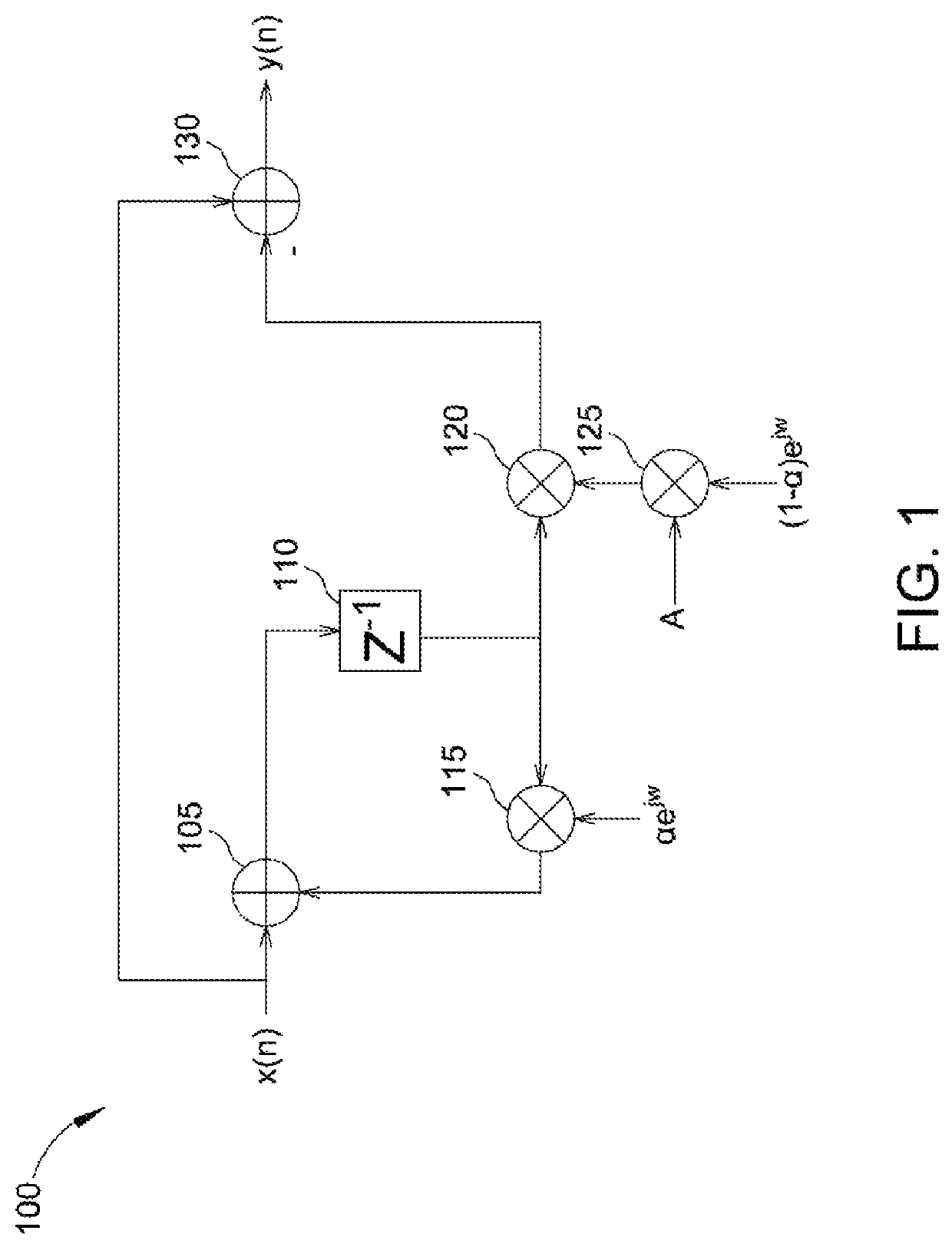
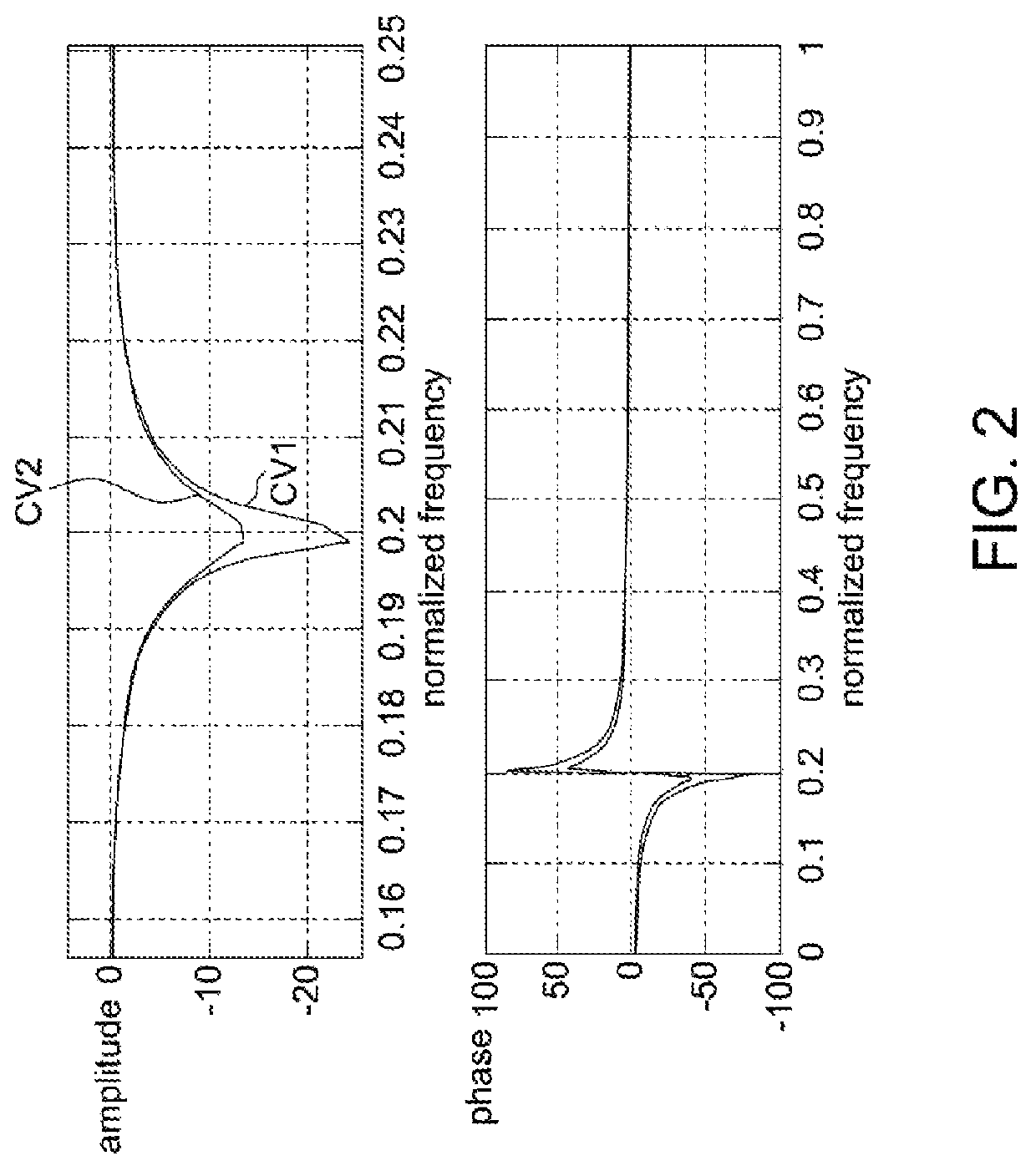
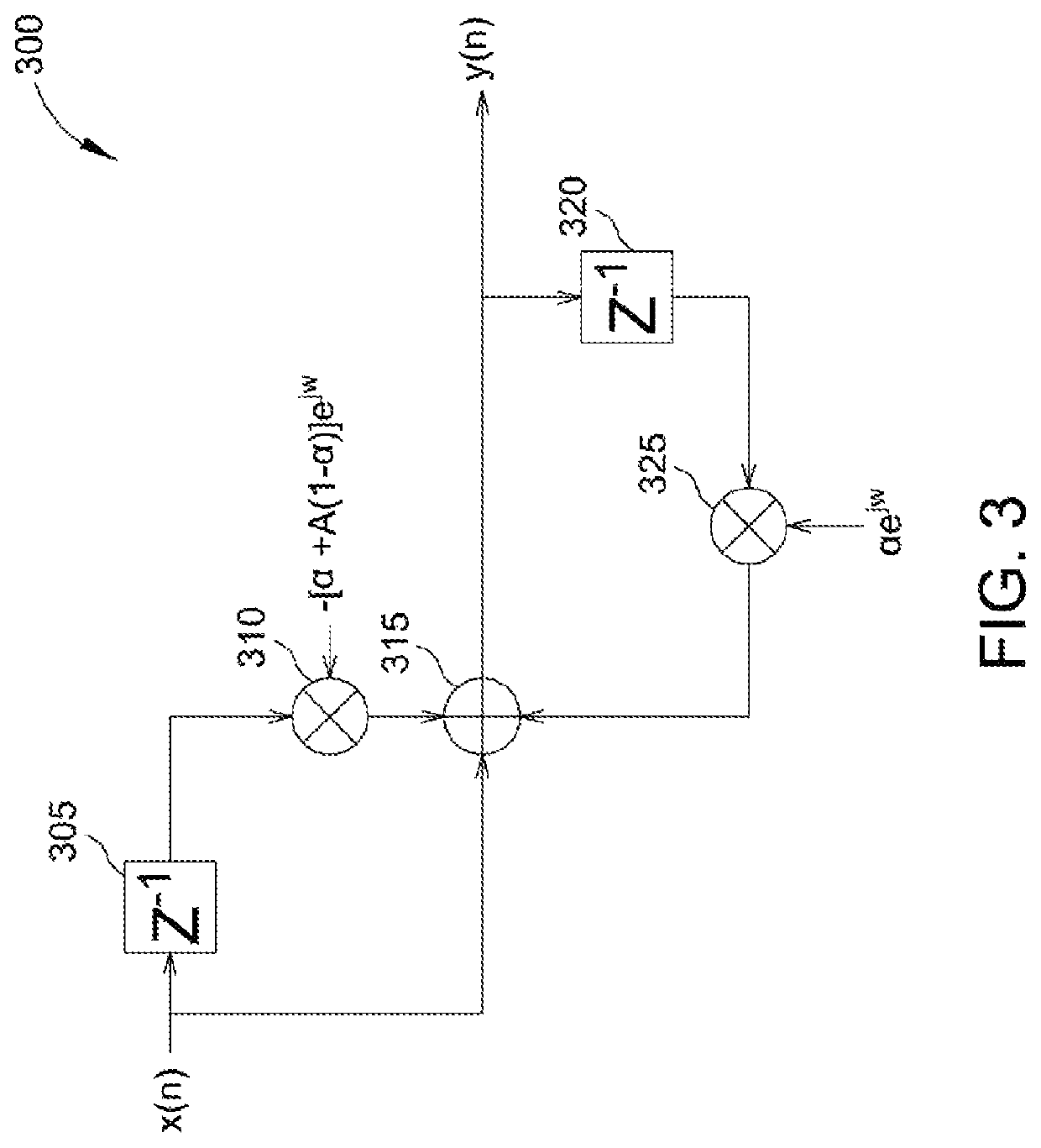
- A notch filter circuit structure that includes adders, multipliers, and delay circuits, allowing for adjustment of the attenuation at the center frequency through an adjustable parameter A, while maintaining the notch bandwidth unchanged, enabling partial suppression of signal frequencies without altering the notch bandwidth.

Standards and Compliance for Filter Performance
Filter performance standards and compliance requirements play a critical role in determining the suitability of Notch and Chebyshev filters for specific applications. International standards such as IEEE 802.11 for wireless communications, ITU-T recommendations for telecommunications, and IEC 61000 series for electromagnetic compatibility establish stringent attenuation specifications that directly impact filter selection decisions.
The IEEE 802.11 standard mandates specific out-of-band rejection requirements, typically demanding attenuation levels exceeding 40 dB for adjacent channel suppression. Chebyshev filters often excel in meeting these requirements due to their steep roll-off characteristics, while notch filters provide targeted compliance for specific interference frequencies. Telecommunications applications governed by ITU-T G.series recommendations require filters to maintain signal integrity while achieving prescribed attenuation levels across defined frequency bands.
Regulatory compliance frameworks vary significantly across different regions and applications. The Federal Communications Commission (FCC) Part 15 regulations in the United States specify spurious emission limits that influence filter attenuation requirements. European ETSI standards impose similar constraints with varying numerical thresholds. Medical device applications must adhere to IEC 60601 standards, which establish more stringent electromagnetic compatibility requirements affecting filter performance specifications.
Military and aerospace applications operate under MIL-STD-461 standards, demanding exceptional attenuation performance under extreme environmental conditions. These standards often favor Chebyshev implementations for broadband suppression while incorporating notch filters for specific threat frequency mitigation. The DO-160 standard for airborne equipment establishes additional compliance requirements that impact filter topology selection.
Measurement and verification protocols defined in standards such as IEC 61000-4-6 specify test methodologies for validating filter attenuation performance. These protocols establish standardized measurement conditions, impedance matching requirements, and acceptable measurement uncertainties. Compliance verification often requires third-party testing facilities accredited under ISO/IEC 17025 standards to ensure measurement traceability and reliability.
Emerging standards for 5G communications and Internet of Things applications are establishing new compliance frameworks that will influence future filter design requirements, potentially favoring adaptive filtering solutions that combine both notch and Chebyshev characteristics.
The IEEE 802.11 standard mandates specific out-of-band rejection requirements, typically demanding attenuation levels exceeding 40 dB for adjacent channel suppression. Chebyshev filters often excel in meeting these requirements due to their steep roll-off characteristics, while notch filters provide targeted compliance for specific interference frequencies. Telecommunications applications governed by ITU-T G.series recommendations require filters to maintain signal integrity while achieving prescribed attenuation levels across defined frequency bands.
Regulatory compliance frameworks vary significantly across different regions and applications. The Federal Communications Commission (FCC) Part 15 regulations in the United States specify spurious emission limits that influence filter attenuation requirements. European ETSI standards impose similar constraints with varying numerical thresholds. Medical device applications must adhere to IEC 60601 standards, which establish more stringent electromagnetic compatibility requirements affecting filter performance specifications.
Military and aerospace applications operate under MIL-STD-461 standards, demanding exceptional attenuation performance under extreme environmental conditions. These standards often favor Chebyshev implementations for broadband suppression while incorporating notch filters for specific threat frequency mitigation. The DO-160 standard for airborne equipment establishes additional compliance requirements that impact filter topology selection.
Measurement and verification protocols defined in standards such as IEC 61000-4-6 specify test methodologies for validating filter attenuation performance. These protocols establish standardized measurement conditions, impedance matching requirements, and acceptable measurement uncertainties. Compliance verification often requires third-party testing facilities accredited under ISO/IEC 17025 standards to ensure measurement traceability and reliability.
Emerging standards for 5G communications and Internet of Things applications are establishing new compliance frameworks that will influence future filter design requirements, potentially favoring adaptive filtering solutions that combine both notch and Chebyshev characteristics.
Cost-Performance Trade-offs in Filter Implementation
The implementation of Notch and Chebyshev filters presents distinct cost-performance considerations that significantly impact design decisions across various applications. Manufacturing costs for these filter types differ substantially due to their inherent complexity and component requirements. Notch filters, particularly when implemented as analog circuits, typically require fewer high-precision components and can achieve acceptable performance with standard tolerance resistors and capacitors. This translates to lower material costs and simplified manufacturing processes.
Chebyshev filters, conversely, demand higher precision components to maintain their characteristic ripple specifications and steep roll-off rates. The implementation complexity increases with filter order, requiring matched components and careful layout considerations to prevent parasitic effects. Digital implementations of Chebyshev filters necessitate more computational resources and higher-resolution arithmetic units, driving up silicon area and power consumption in integrated solutions.
Performance metrics reveal contrasting trade-offs between these architectures. Notch filters excel in applications requiring precise frequency rejection with minimal impact on adjacent frequencies, offering superior phase linearity and lower group delay variations. However, their narrow bandwidth characteristics limit versatility in broadband applications. Chebyshev filters provide excellent selectivity and compact transition bands, making them cost-effective for applications where sharp cutoff characteristics are paramount, despite introducing passband ripple.
Economic considerations extend beyond initial implementation costs to encompass long-term operational expenses. Notch filters typically exhibit better temperature stability and aging characteristics, reducing calibration requirements and maintenance costs over the product lifecycle. Chebyshev implementations may require periodic adjustment or compensation circuits to maintain specifications, particularly in harsh environmental conditions.
The scalability factor significantly influences cost-performance ratios in high-volume applications. While Chebyshev filters may incur higher per-unit costs in low-volume scenarios, their integration advantages in system-on-chip implementations can yield substantial cost reductions in mass production. Notch filters often require external components even in integrated solutions, limiting cost optimization opportunities in miniaturized applications.
Power consumption represents another critical trade-off dimension, particularly in battery-powered systems. Active notch filter implementations generally consume less power due to their simpler topologies, while high-order Chebyshev filters demand significant current for maintaining stability and performance specifications across temperature and process variations.
Chebyshev filters, conversely, demand higher precision components to maintain their characteristic ripple specifications and steep roll-off rates. The implementation complexity increases with filter order, requiring matched components and careful layout considerations to prevent parasitic effects. Digital implementations of Chebyshev filters necessitate more computational resources and higher-resolution arithmetic units, driving up silicon area and power consumption in integrated solutions.
Performance metrics reveal contrasting trade-offs between these architectures. Notch filters excel in applications requiring precise frequency rejection with minimal impact on adjacent frequencies, offering superior phase linearity and lower group delay variations. However, their narrow bandwidth characteristics limit versatility in broadband applications. Chebyshev filters provide excellent selectivity and compact transition bands, making them cost-effective for applications where sharp cutoff characteristics are paramount, despite introducing passband ripple.
Economic considerations extend beyond initial implementation costs to encompass long-term operational expenses. Notch filters typically exhibit better temperature stability and aging characteristics, reducing calibration requirements and maintenance costs over the product lifecycle. Chebyshev implementations may require periodic adjustment or compensation circuits to maintain specifications, particularly in harsh environmental conditions.
The scalability factor significantly influences cost-performance ratios in high-volume applications. While Chebyshev filters may incur higher per-unit costs in low-volume scenarios, their integration advantages in system-on-chip implementations can yield substantial cost reductions in mass production. Notch filters often require external components even in integrated solutions, limiting cost optimization opportunities in miniaturized applications.
Power consumption represents another critical trade-off dimension, particularly in battery-powered systems. Active notch filter implementations generally consume less power due to their simpler topologies, while high-order Chebyshev filters demand significant current for maintaining stability and performance specifications across temperature and process variations.
Unlock deeper insights with Patsnap Eureka Quick Research — get a full tech report to explore trends and direct your research. Try now!
Generate Your Research Report Instantly with AI Agent
Supercharge your innovation with Patsnap Eureka AI Agent Platform!